
Glossary entry
7 Layers to Protect Elderly Parents from Phone Scams
Last verified 2026-07-30
This is not financial or legal advice. Medicare/Medicaid and benefits rules vary by state and change over time — verify current rules with your state Medicaid office or Area Agency on Aging.
If you are trying to figure out how to protect elderly parents from phone scams before the next call comes in, start with layers, not one perfect warning. “Don’t answer unknown numbers” is fine until the caller ID says the bank, the doctor, Medicare, the police department, or your own phone number. A better plan gives your parent fewer scam calls to handle, fewer ways for a scammer to turn pressure into money, and a simple routine to follow when a call feels urgent.
This is a safety-literacy guide for families, not financial advice, legal advice, or a recommendation for any one app, bank, carrier, or device. The point is to help you sit down with a parent and put workable protections in place without making the conversation feel like a takeover.
The urgency is real. Americans age 60 and older lost an estimated $5 billion to scams in 2024, and phone scams had a median loss of $1,500 per person in FTC data cited by Regions Bank; those figures represent reported losses, so they should be read with the usual underreporting caveat for elder fraud.[1] The shape of the losses is also changing: from 2020 to 2024, FTC reports of older adults losing $10,000 or more to impersonation scams increased more than fourfold, while losses over $100,000 increased nearly sevenfold.[2]
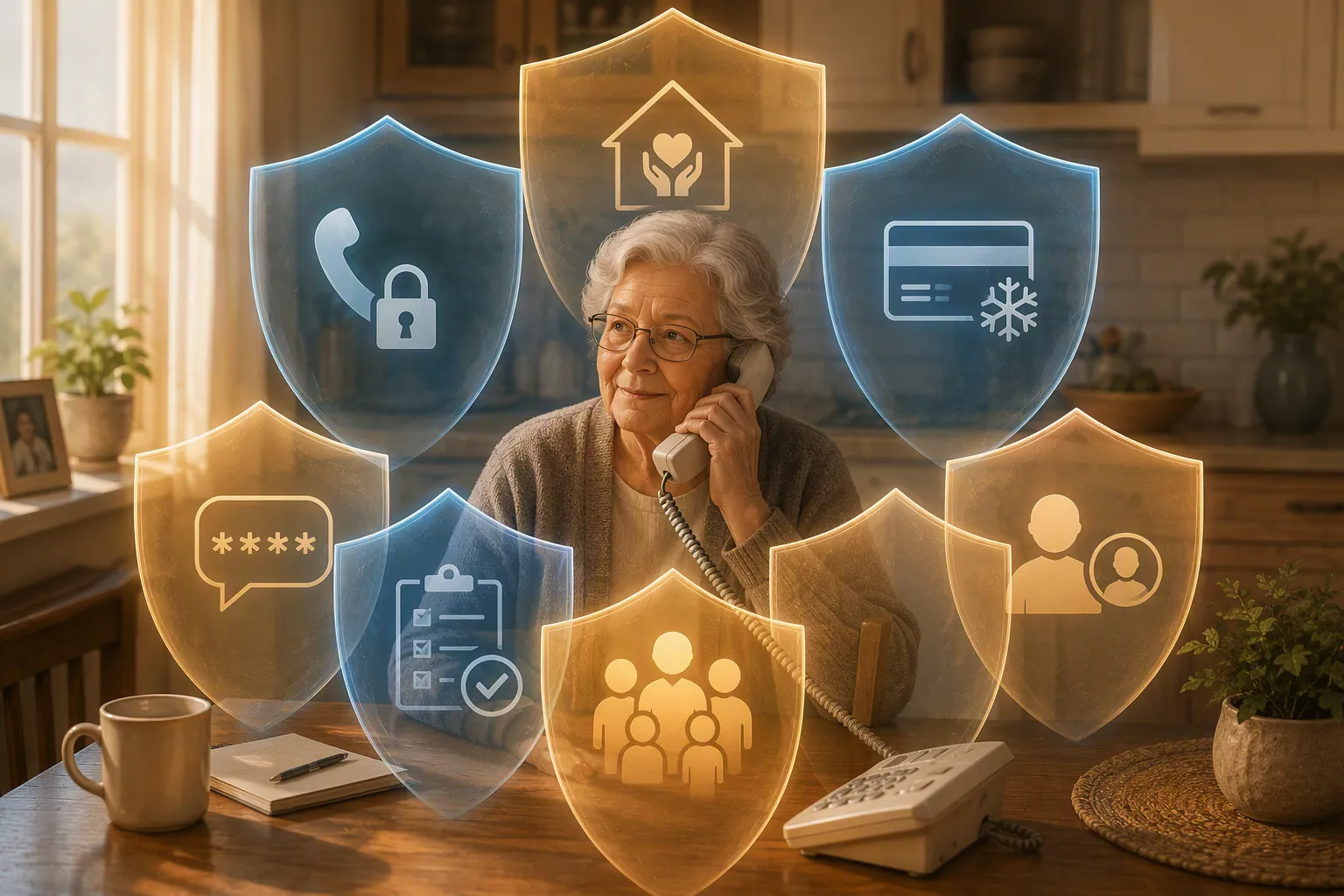
The seven layers, in the order I would set them up
You do not need to finish every layer in one sitting. In fact, trying to do that can turn a practical safety conversation into exactly the kind of “intervention” most parents resist. But it helps to see the whole system first.
| Layer | What it does | Why it is not enough by itself |
|---|---|---|
| 1. Reduce phone exposure | Cuts down the number of scam calls that reach your parent. | Important calls may still come through, and scammers can spoof numbers. |
| 2. Add device and carrier blocking | Uses carrier tools, phone settings, and apps to flag or block suspicious calls. | No tool catches every call, especially when caller ID is manipulated. |
| 3. Freeze credit | Makes it harder to open new credit accounts in your parent’s name. | It does not protect money already sitting in existing accounts. |
| 4. Turn on bank and investment-account alerts | Creates passive monitoring when money starts moving. | Someone has to receive, read, and be allowed to respond to the alerts. |
| 5. Choose and practice a family safe word | Gives your parent a quick test for family-emergency impersonation calls. | It only works if the parent remembers to use it under pressure. |
| 6. Use a verify-and-hang-up protocol | Turns a scary incoming call into a separate outgoing verification call. | It needs to be rehearsed in ordinary language before the crisis. |
| 7. Build trusted-contact and shared-awareness groundwork | Lets a family member notice trouble early without immediately taking control. | It depends on consent, trust, and regular maintenance. |
1. Reduce the number of scam calls your parent has to judge
The first goal is not to teach your parent to become a fraud analyst. It is to lower the number of moments when they are alone with a ringing phone and a stranger who sounds official.
Start with the basic phone environment. Make sure important contacts are saved clearly: adult children, doctors, pharmacy, bank, neighbors, building office, and any regular caregiver. If the phone allows favorite contacts or emergency contacts, set those up while your parent is watching. The practical benefit is small but real: when familiar names appear reliably, unfamiliar calls stand out more.
Then look at where scam calls are arriving. A parent may have a mobile phone, a landline, a tablet with calling features, and voicemail on all of them. If an old landline is mostly producing spam and no longer serving a medical, building-access, or family purpose, it deserves a calm review. If it needs to stay, ask the carrier what blocking or screening options exist for that line.
Be careful with any setting that silently sends unknown callers away. It may help, but it can also catch a new specialist’s office, a hospital desk, a repair technician, or a neighbor calling from a different phone. For some parents, the better first move is not “block every stranger.” It is “make the known people easy to recognize, and make suspicious calls easier to ignore.”
2. Add carrier and device blocking, without pretending it is a wall
The FCC maintains resources on carrier-provided call-blocking tools and robocall-blocking apps, and major carriers offer basic scam-blocking or scam-labeling tools, including AT&T ActiveArmor, T-Mobile Scam Shield, and Verizon Call Filter.[3][4] These are worth turning on. They are not magic.
- Check the mobile carrier account for free scam-blocking or spam-labeling features.
- Turn on the phone’s built-in spam, unknown-caller, or silence settings only after discussing what legitimate calls might be affected.
- Review voicemail greetings. A greeting does not need to reveal that an older adult lives alone or is slow to return calls.
- Remove unused calling apps or messaging apps that your parent does not recognize.
- Write down, in plain language, what the phone will now do when it suspects spam: label, silence, block, or send to voicemail.
If your parent uses an iPhone and has already been pressured into payments, app downloads, or suspicious account changes, device restrictions may be worth a deeper look. Our guide to setting up iOS Restricted Mode to stop senior payment scams walks through a more technical option. Use that kind of setting carefully: it can reduce risk, but it can also create frustration if your parent suddenly cannot do ordinary tasks.
3. Freeze credit with all three bureaus while your parent is present
A credit freeze is one of the rare protections that is free, concrete, and high-impact. Freezing credit with Equifax, Experian, and TransUnion does not affect existing credit scores or current accounts, and it helps prevent a scammer from opening new credit in your parent’s name.[4]
Do it with your parent, not around your parent, unless there is already a legal arrangement that says otherwise. The kitchen-table version is simple: open each bureau’s freeze page, have your parent verify identity, set up the freeze, and save the login or PIN information in a place your parent agrees to use. The freeze has to be placed separately at all three bureaus.
- Explain the purpose in one sentence: “This makes it harder for someone to open new credit in your name.”
- Gather what the bureaus may ask for: identifying information, contact information, and a way to verify identity.
- Visit Equifax, Experian, and TransUnion separately. Do not stop after one.
- Create or confirm the account login for each bureau.
- Record where the freeze information is stored. Avoid hiding it so well that no one can lift the freeze when your parent actually needs credit.
- Set a reminder to review the freeze information once a year or after any move, new phone number, or email change.
This layer has a clean boundary. It helps against new-account fraud. It does not stop a scammer from persuading your parent to send a wire, buy gift cards, move money into cryptocurrency, or disclose credentials for an existing bank account. That is why the next layer matters.
4. Put alerts on the accounts where money can actually leave
Bank and investment-account alerts are a quieter form of protection. They do not ask your parent to win an argument with a scammer. They create a second set of eyes when money moves.
J.P. Morgan and the FDIC both point families toward account alerts, trusted contacts, and shared awareness as practical ways to reduce elder financial risk.[5][6] For many families, the most useful alerts are not exotic: large withdrawals, debit-card purchases over a chosen threshold, new payees, wire transfers, address changes, password changes, and failed login attempts.
| Setup | What to decide with your parent | What it catches |
|---|---|---|
| Transaction alerts | A dollar threshold that is high enough to avoid noise and low enough to matter. | Unusual card purchases, withdrawals, or transfers. |
| Wire and transfer alerts | Who gets notified and how quickly they are expected to respond. | Large outbound movement before it disappears. |
| Login and password alerts | Whether alerts go to the parent only, the adult child, or both. | Account takeover attempts and suspicious access. |
| Statement sharing | Whether paper or digital statements can also be sent to a trusted family member. | Patterns that a single alert might miss. |
| Trusted contact | Who the institution may contact if it suspects exploitation or cannot reach the parent. | A path for concern without handing over full account control. |
Thresholds are personal. A parent who regularly pays a caregiver, landscaper, or medical bill may need a higher alert level than a parent whose monthly expenses are very stable. Some families start by testing alerts for transactions in the $100 to $500 range, then adjust after a month of seeing what creates noise and what creates useful signal.[5]
The permission piece matters. If an alert goes only to your parent, it may arrive while the scammer is still on the phone telling them to ignore messages. If it goes to you but you have no agreed role, you may notice trouble and still be unsure whether you are allowed to call the bank, call a sibling, or drive over. Decide that before the alert arrives.
5. Choose a family safe word, then practice it once
A safe word is not only for dramatic kidnapping plots. It is a plain family tool for impersonation calls: the caller claims to be a grandchild, adult child, lawyer, police officer, or hospital worker, and your parent needs one quick way to slow the moment down.
J.P. Morgan, AARP, and the FTC all endorse the idea of a unique word shared only among trusted family members as a practical defense against family-emergency impersonation scams, including calls where a voice may sound convincing.[5][7][8] The safest claim is not that a safe word defeats every voice-cloning scenario. It is that a safe word gives the family a pre-agreed test when emotion is being used as leverage.
- Do not use a pet’s name, a birth year, a street name, a favorite team, or anything visible on social media.
- Choose something memorable enough that your parent can retrieve it while upset.
- Limit who knows it. If every cousin, neighbor, and caregiver knows the word, it is no longer a check.
- Write down where it is stored if your parent wants a backup, but do not label it “safe word” in a place others can see.
- Practice once in a normal voice: “If someone says they are me and need money fast, ask for the word before you keep talking.”
That last step is the one people skip because it feels awkward. Skip it and the safe word may sit unused when the phone call comes. Practice makes it less strange. You are not testing your parent; you are rehearsing the family’s response.
6. Replace “just hang up” with a verify-and-hang-up routine
“Just hang up” is good advice given too late. A scammer’s first job is to make hanging up feel dangerous, rude, or irresponsible. Your parent needs a script that treats hanging up as part of verification, not as an act of defiance.
The FTC’s false-alarm scam example shows the problem clearly. Scammers impersonate the FTC or another authority, claim the older adult’s account is compromised or their identity is tied to crimes, and then direct them to empty accounts into Bitcoin ATMs.[2] The call creates its own fake emergency, fake authority, and fake solution.
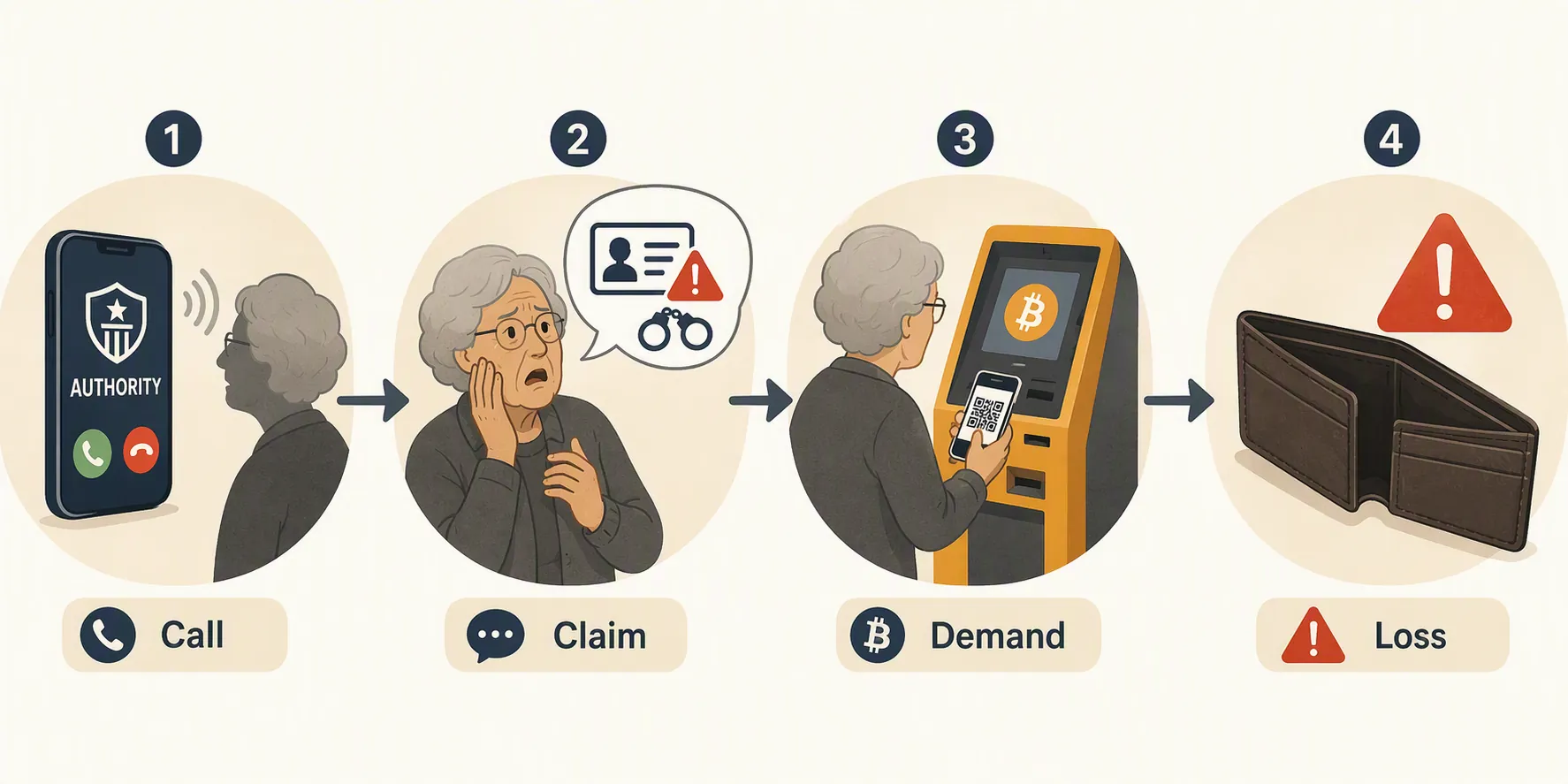
Give your parent language that does not require debate:
- “I do not move money on incoming calls.”
- “I am going to hang up and call the number on my card or statement.”
- “If this is my family, tell me the safe word.”
- “I do not keep financial conversations secret from my family.”
- “Send it in writing. I will review it later.”
Then make the routine specific. If the caller says they are from the bank, your parent hangs up and calls the number printed on the debit card, credit card, or bank statement. If the caller says they are from Medicare, a government agency, or law enforcement, your parent hangs up and calls a known public number or asks you to help verify. If the caller says a family member is in trouble, your parent asks for the safe word and separately calls that person or another family member.
The important part is the outgoing call. Do not call back the number the stranger provides. Do not press a button to be transferred. Do not trust the number that appeared on caller ID. The family rule is simple enough to tape near a landline: incoming money emergency equals hang up, then verify using a number we already trust.
7. Build the trusted-contact layer before anyone is embarrassed
This is the layer that keeps the other layers alive. It is also the one most likely to cause friction, because it sounds like the beginning of lost independence if you handle it badly.
Frame the request around backup, not supervision. “If a bank alert comes in and you are at lunch, who should be allowed to call you?” is a different conversation from “I need to watch your accounts.” So is “If someone scares you on the phone, let’s agree who you call next.” The goal is to create an agreed response path before fear, shame, or secrecy enters the room.
- Name one trusted contact for investment and bank relationships where that option is available.
- Decide whether account statements, low-balance alerts, transfer alerts, or security alerts can go to both the parent and an adult child.
- Write a short family rule for urgent money requests: no secrecy, no same-day transfers to new recipients, and no cryptocurrency, gift-card, or wire payments because of an incoming call.
- Choose a second backup person if the main adult child is unreachable.
- Agree on what happens after a near-miss: tell someone quickly, no scolding, then change the exposed password, card, account, or phone setting.
That “no scolding” line is not softness. It is prevention. Shame is useful to scammers because it keeps the next call private. If your parent thinks every mistake will become a family lecture, they may wait too long to tell you when money, passwords, or identity information are at risk.
If money has already been sent
Move quickly and keep the first hour practical. Call the bank, credit union, brokerage, card issuer, or payment service immediately. For some wire transfers, speed matters; funds may be more recoverable when reported within a narrow 24- to 48-hour window, but there is no guarantee.[6]
- Call the financial institution’s fraud department using a number from the card, statement, app, or official website.
- Ask whether the transaction can be stopped, recalled, frozen, disputed, or traced.
- Contact the National Elder Fraud Hotline at 833-FRAUD-11 for case-management help.
- Report the scam to the FTC at ReportFraud.ftc.gov and to the FBI’s Internet Crime Complaint Center if online or digital elements were involved.
- Change exposed passwords, replace compromised cards, and review recent account activity.
Be especially cautious about recovery promises. Cryptocurrency and gift-card payments are rarely recoverable, and a second scammer may pose as a recovery expert after the first loss.[2][8] The recovery path is still worth following, but it should run through the bank, official reporting channels, and trusted help — not a stranger who says they can get everything back for a fee.
When unusual money behavior may mean more than one scam
One missed payment or strange purchase does not diagnose anything. Still, financial changes can be an early signal that a parent needs more support. A 2020 Johns Hopkins study of 81,000 Medicare beneficiaries found that financial red flags — including credit score drops, missed payments, and unusual account activity — can appear up to six years before a dementia diagnosis, as cited by AARP and J.P. Morgan.[7][5]
Treat that information carefully. The point is not to turn every fraud alert into a medical conclusion. It is to notice patterns: repeated confusion about bills, sudden secrecy with money, new “friends” asking for help, unexplained withdrawals, or a parent who no longer remembers agreeing to a transaction. If those patterns are showing up alongside changes in driving, medication, falls, meals, or home safety, it may be time to read more about signals of declining capacity and decide what kind of support is proportionate.
What to do this week without turning your parent into an adversary
If your parent is cooperative, start with the three protections that are easiest to explain and hardest for scammers to argue with: freeze credit at all three bureaus, turn on bank alerts, and choose a safe word. If your parent is resistant, start smaller: save trusted phone numbers, turn on carrier spam labels, and agree on one sentence — “I do not move money on incoming calls.”
The relationship is not a soft extra. It is part of the security system. Call blocking helps until a spoofed call gets through. A credit freeze helps until the scam targets an existing account. A safe word helps only if it is remembered. Alerts help only if someone is watching and allowed to respond. The family needs overlapping barriers, habits, and permissions so there are more chances to interrupt the scam before it becomes a loss.
References
- Top 10 scams targeting seniors and how to avoid them, Regions Bank
- False alarm, real scam: how scammers are stealing older adults' life savings, FTC, August 2025
- Older Americans and Medicare Call Scams, FCC
- How to Stop Scammers From Calling an Elderly Parent, Experian
- Helping your elderly and vulnerable loved ones avoid the scammers, J.P. Morgan
- Scams Targeting Older Adults, FDIC, July 2025
- Protect Loved Ones With Cognitive Decline From Scams, AARP
- Scams Against Older Adults, FTC Consumer Advice
Browse more in the Glossary.