
Glossary entry
How Seniors Benefit from Reading to Shelter Pets
Last verified 2026-07-25
This is not financial or legal advice. Medicare/Medicaid and benefits rules vary by state and change over time — verify current rules with your state Medicaid office or Area Agency on Aging.
For an older adult who misses having an animal nearby, the usual advice can be too quick: get another dog, adopt a cat, let a pet keep you company. That may be a beautiful answer for some households. It can also be the wrong answer when knees are unreliable, money is tight, travel still matters, or no one has made a plan for the animal if the owner’s health changes.
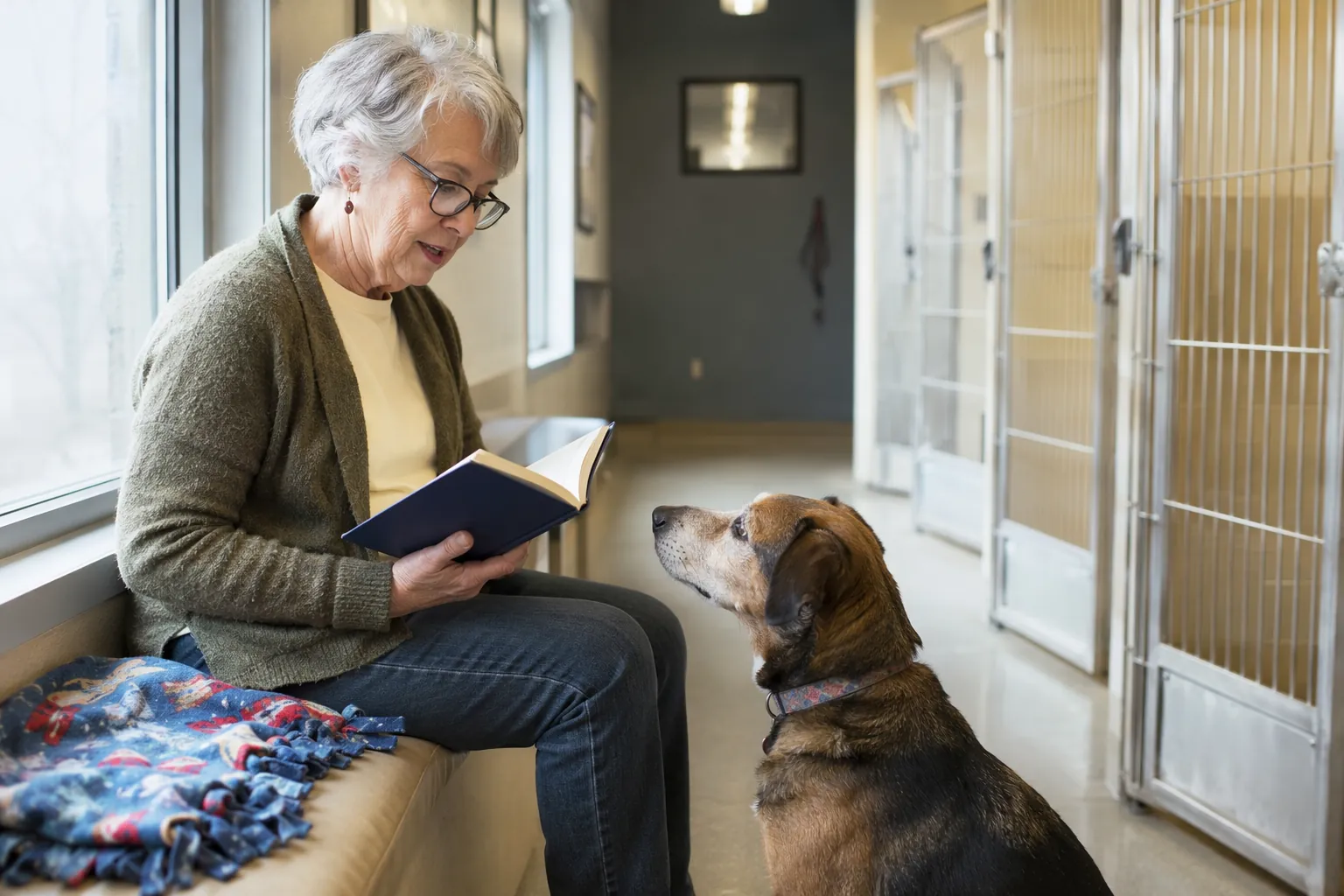
That is where the benefits of reading to shelter animals for seniors deserve a more careful look. The activity keeps the most practical part of animal companionship in view: a person shows up, sits safely, reads aloud, and gives a dog or cat calm human attention. It does not require buying food, lifting a carrier into the car, walking an excited dog on icy pavement, or taking on years of veterinary bills.
The appeal is real. In the 2025 University of Michigan National Poll on Healthy Aging, reported by American Humane, 83% of older pet owners said their pet gave them a sense of purpose, and 71% said their pet helped them enjoy life more.[1] Those numbers do not prove that a shelter reading program will do the same thing. They do show why many older adults are drawn to animals in the first place: animals make care visible and daily.
The burdens are real, too. A review on pets and older adults reported lifetime costs of more than $10,000 for a dog and more than $8,000 for a cat, based on 2014 estimates. The same review cites CDC surveillance data estimating 86,629 emergency-room-treated fall injuries each year associated with dogs and cats, with the highest rate among adults 75 and older at 70.6 per 100,000.[2] Those figures are not a reason to frighten people away from pets. They are a reason to stop pretending ownership is always the gentlest form of companionship.
What Shelter Reading Offers That Pet Ownership Cannot
Reading to shelter animals is not simply a substitute pet. It is a different arrangement. The shelter remains responsible for feeding, veterinary care, housing, temperament screening, and adoption work. The volunteer contributes presence, voice, patience, and routine. For a senior who wants contact without ownership, that difference matters.
The basic format is plain enough to be useful: a volunteer reads near a kennel, cat room, or designated shelter space while an animal hears a calm human voice without being handled, chased, or asked to perform. Some animals come closer. Some rest. Some simply get used to a person being nearby without anything unpleasant happening.
Structured programs already exist. The ASPCA describes a Storytelling Program that has involved 561 volunteers and more than 10,000 hours of reading since 2014, and it notes that the program welcomes volunteers of all ages.[3] Rescue Village, which launched its reading program in 2017, uses reading as one form of enrichment for shelter animals and gives volunteers guidance on how to participate safely and consistently.[4]
Those examples should not be inflated into proof that every shelter can run the same program tomorrow. A good shelter still has to decide which animals are suitable, where readers sit, how sessions are scheduled, who supervises new volunteers, what training is required, and whether older adults can get there safely. The program is simple at the chair-and-book level. It is not automatic at the operations level.
The Evidence Is Promising, But It Comes From Three Separate Places
No peer-reviewed study in the available research directly tests seniors reading to shelter animals as its own intervention. That is the first honest sentence any useful answer needs. The case rests on nearby evidence: animal contact can support older-adult wellbeing, volunteering can support life satisfaction and self-rated health, and calm voice exposure may help shelter animals behave in ways that make kennel life less stressful.
Animal contact can support mood, loneliness, and purpose
Pet ownership data is the closest everyday comparison, but it has to be handled carefully. The Michigan poll’s purpose and enjoyment findings come from older adults who own pets, not from people who visit shelter animals.[1] Ownership includes touch, routine, companionship at home, and responsibility across the whole day. A reading program offers a narrower slice: scheduled contact with an animal in a public or supervised setting.
Animal-assisted therapy research also supports the idea that animals can affect loneliness. In a study of 45 nursing home residents using the UCLA Loneliness Scale, animal-assisted therapy three times a week reduced loneliness compared with a control group.[2] That study was not about shelter reading, and it took place in a nursing home rather than a volunteer setting. Still, it helps explain why gentle, repeated animal contact may matter for older adults who feel socially thinly connected.
Volunteering adds something companionship alone does not
The volunteer part is not decoration. It changes the meaning of the activity. A senior is not only receiving comfort from an animal; the senior is doing something useful for a shelter, for staff, and for an animal that has limited control over its day.
In an international comparison published in Frontiers in Psychology, volunteering was associated with a 5.2 percentage-point improvement in life satisfaction and a 6.2 percentage-point improvement in self-reported health among adults ages 61 to 80.[5] That does not mean a weekly shelter reading visit will produce those exact gains for one person. It does mean that volunteering is not just “keeping busy.” For many older adults, being needed in a manageable way is part of wellbeing.
This is especially important for seniors who are tired of being offered activities that feel like entertainment with a sign-up sheet. Reading to shelter animals has a task built into it. The reader does not have to be athletic, talkative, or able to stand for long periods. The contribution is quiet, but it is still a contribution.
Shelter animals may benefit from calm human voice exposure
The animal side matters because pets should not be used as wellness equipment. If a program is worth supporting, it should help the animals or at least avoid making shelter life harder for them.
A report discussing research in Applied Animal Behaviour Science notes that dogs exposed to audiobooks spent more time resting and less time standing vigilantly.[6] That is a modest but meaningful kind of shelter benefit. Resting dogs are not magically “cured” of stress, but lower vigilance can make the kennel environment calmer for the animal and easier for people to observe.
The same report describes the Humane Society of Missouri’s reading program as reducing average shelter stay from 14 days to 6 days.[6] That figure is compelling, but it should be read as a reported program outcome, not a universal promise. Adoption speed depends on many things: animal age, health, breed or type, local demand, shelter capacity, photography, descriptions, fees, and adopter screening. Reading may help some animals appear calmer and more approachable, but it is one part of a larger adoption system.
How This Compares With Getting a Pet or Doing Ordinary Volunteering
| Option | What the senior receives | What the senior takes on | Best fit |
|---|---|---|---|
| Owning a pet | Daily companionship, routine, affection, and responsibility | Costs, feeding, cleaning, walking or lifting, veterinary decisions, and long-term care planning | Seniors with stable health, finances, housing, and backup care |
| General volunteering | Purpose, social contact, schedule, and community usefulness | Transportation, training, time commitment, and sometimes physical or social demands | Seniors who want a role but do not especially need animal contact |
| Reading to shelter animals | Animal contact, quiet service, routine, and visible usefulness without ownership | Transportation, shelter rules, training, scheduling, and comfort around animals | Seniors who want a low-impact, structured animal-related role |
The strongest comparison is not between shelter reading and an idealized pet. It is between shelter reading and the real choices many older adults face: no animal contact at all, pet ownership that may become unsafe or unaffordable, or volunteer roles that require more stamina than they have.
A reading program can also be easier to stop or adjust than ownership. If a senior has surgery, changes medication, gives up driving, or moves, the shelter can pause the volunteer schedule. That is not a small advantage. Good intentions toward animals become a problem when nobody plans for changing health.
Who Is Most Likely to Benefit
This activity fits best when the senior wants a routine that is gentle but not meaningless. The person should be comfortable reading aloud, able to follow shelter instructions, and willing to let the animal set the pace. Some visits may be quiet. A cat may not come forward. A dog may settle without looking especially grateful. That is still useful work.
- Seniors who miss animals but cannot safely or affordably own one may find shelter reading a lower-commitment way to stay connected.
- Older adults who prefer quieter volunteer roles may appreciate that reading does not require constant conversation or physical labor.
- People who do better with a weekly appointment than an open-ended social invitation may benefit from the structure.
- Senior-living activity directors may consider it when transportation, supervision, and shelter partnership details can be handled reliably.
It is not the right activity for everyone. Allergies, fear of dogs or cats, immune concerns, severe mobility limitations, transportation barriers, scent sensitivity, hearing issues in a loud kennel, or medical conditions that make shelter environments difficult all deserve respect. A person who dreads the visit will not be helped by calling it therapeutic.
Questions to Ask Before Signing Up
A sensible program starts with the shelter’s rules, not with a romantic picture of a person and a puppy. Before a senior commits, someone should ask how the program actually works.
- Does the shelter already have a reading or enrichment program, and are adults or seniors welcome?
- Where do readers sit, and can the senior use a chair, walker, cane, or other support safely?
- Which animals are included, and who decides whether a dog or cat is calm enough for reading sessions?
- What training, background checks, vaccination rules, or orientation sessions are required?
- How long are visits, how often are they scheduled, and what happens if the senior needs to cancel?
- Is transportation realistic in bad weather, after dark, or during periods when the senior is not driving?
For adult children, the most useful help may be practical rather than persuasive: call the shelter, check the parking, ask about seating, attend the first orientation, or arrange transportation. The goal is not to push a parent into one more worthy obligation. The goal is to make participation doable.
A Grounded Answer
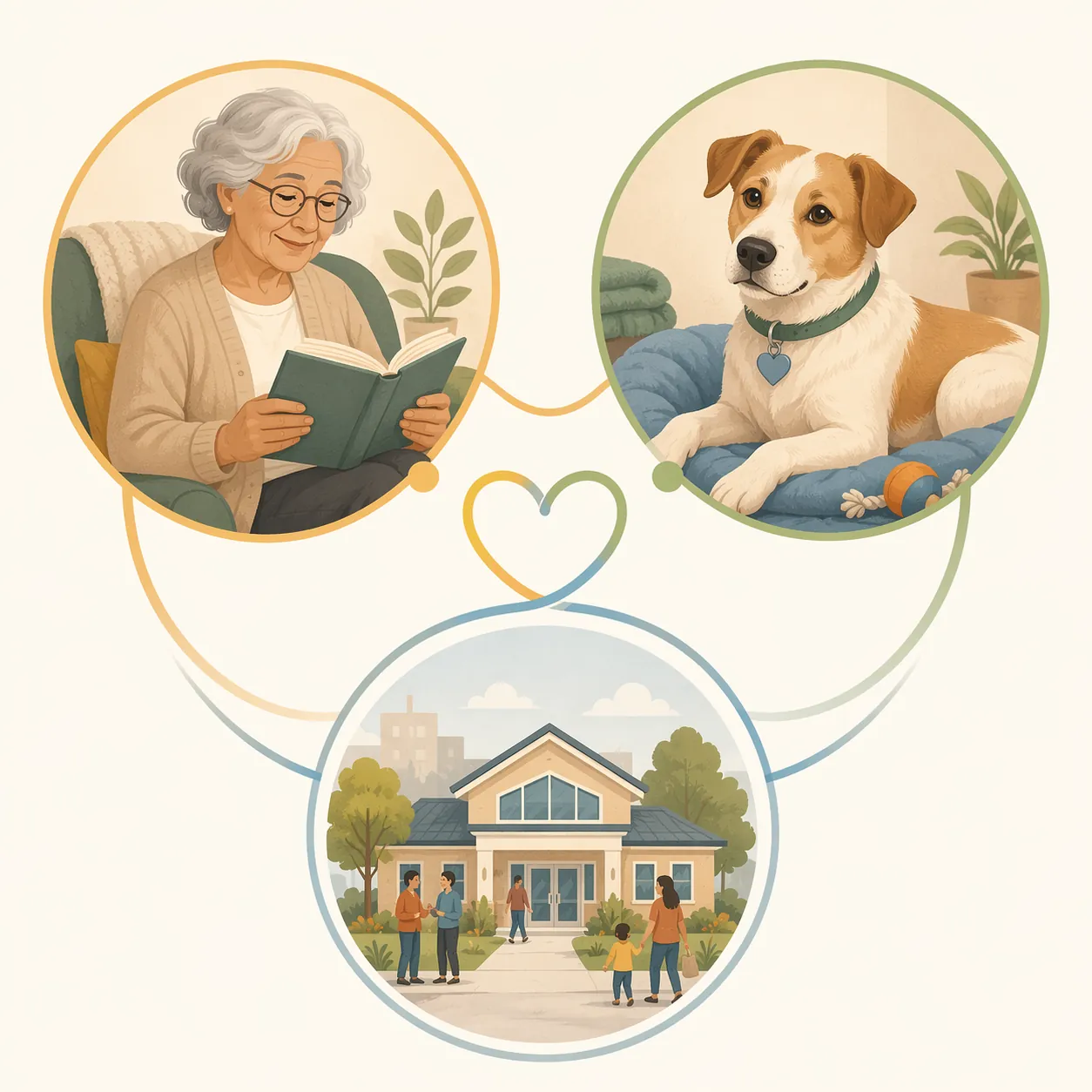
Reading to shelter pets has not been proven as a senior-specific clinical intervention. It should not be sold that way. The better case is quieter and stronger: it combines three things that already have evidence behind them in related settings—animal contact, volunteering, and shelter enrichment—while avoiding some of the cost, fall risk, and long-term responsibility of pet ownership.
When the arrangement is well run, the senior gets structure, purpose, gentle social contact, and time with animals. The animal gets calm human presence and practice being near people without pressure. The shelter gets another form of volunteer care that may make daily life better for animals waiting to be adopted. That is enough reason to consider it, without pretending the evidence says more than it does.
References
- Pets and Seniors, American Humane.
- The Benefit of Pets and Animal-Assisted Therapy to the Health of Older Individuals, Current Gerontology and Geriatrics Research, 2014.
- Read a Book to Benefit Yourself and a Furry Friend, ASPCA.
- Volunteers Provide Animal Enrichment, Rescue Village.
- Volunteering and Health in Older Adults: An International Comparison, Frontiers in Psychology, 2019.
- Reading to Shelter Pets Can Lower Stress, Improve Adoption Chances, Fear Free Happy Homes.
Browse more in the Glossary.