
Product term
What to do if you bought recalled eye drops for elderly parents
Last verified 2026-07-30
If you bought recalled eye drops for an elderly parent, the safest first move is not to study the whole recall notice while the bottle stays in use. Stop the drops now, set the bottle aside where your parent will not accidentally use it, and then verify the exact product by NDC and lot number. Do not wait for symptoms before checking the recall.
That may feel like overreacting, especially if the bottle is half-used and your parent says their eyes feel “the same as usual.” It is not. The 2023 Pseudomonas aeruginosa eye drop outbreak is the reason caregivers should treat “one more drop” as a real decision: CDC data cited by UC Davis Health connected that outbreak with 80 infections, 14 cases of vision loss, and 4 deaths.[1] That history does not mean the 2026 recalled bottles have caused the same harm. As of July 30, 2026, the UC Davis Health and FDA reporting cited here had not reported adverse events for the covered 2026 recalls.[1][2][3] It means the safety sequence matters before anyone tries to be practical and finish the bottle.
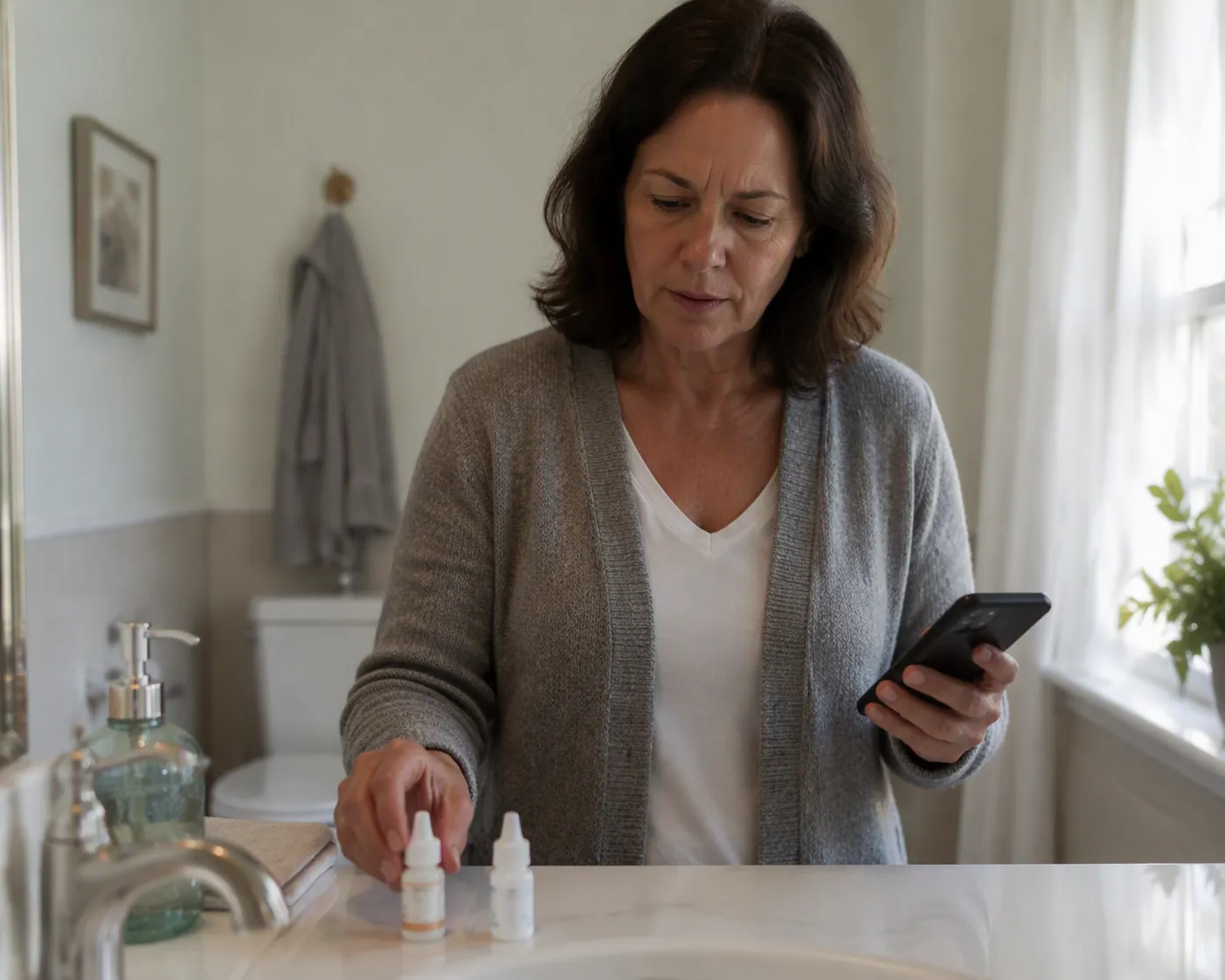
The next five minutes
Start with the bottle in your hand, not the brand list on the internet. Recalled eye drops can sit in a medicine cabinet beside older, safe bottles from the same household. A parent may also have prescription steroid drops from surgery, lubricating drops for dry eye, and “cooling” drops that all look similar when the print is tiny.
| Step | What to do |
|---|---|
| 1 | Stop using the suspected drops immediately. Do not give another dose while you are checking. |
| 2 | Move the bottle away from the sink, nightstand, purse, walker basket, and any other place your parent might reach automatically. |
| 3 | Photograph the front label, back label, bottom, carton, and any crimped or curved label area. |
| 4 | Enlarge the photo and verify the NDC and lot code against FDA notices, the manufacturer or retailer notice, or a current eye drop recall database. |
| 5 | Watch the parent for RSVP symptoms: Redness, Sudden vision change, and Pain. |
| 6 | Return or dispose of the recalled product as directed, replace it safely, and report any adverse effect to FDA MedWatch. |
If your parent uses a prescription eye drop after cataract surgery or another eye procedure, add one more immediate step: call the prescribing eye doctor’s office. Do not substitute an over-the-counter lubricating or redness-relief drop for a prescribed steroid drop.
Do not trust the big brand name alone
The part of a recall that fails older adults is usually physical: the NDC is small, the lot code may be wrapped around a curved bottle, and the expiration date can look like every other number on the label. If your parent has low vision, cataracts, macular degeneration, tremor, arthritis, or just bad bathroom lighting, asking them to “check the bottle” is not a plan.
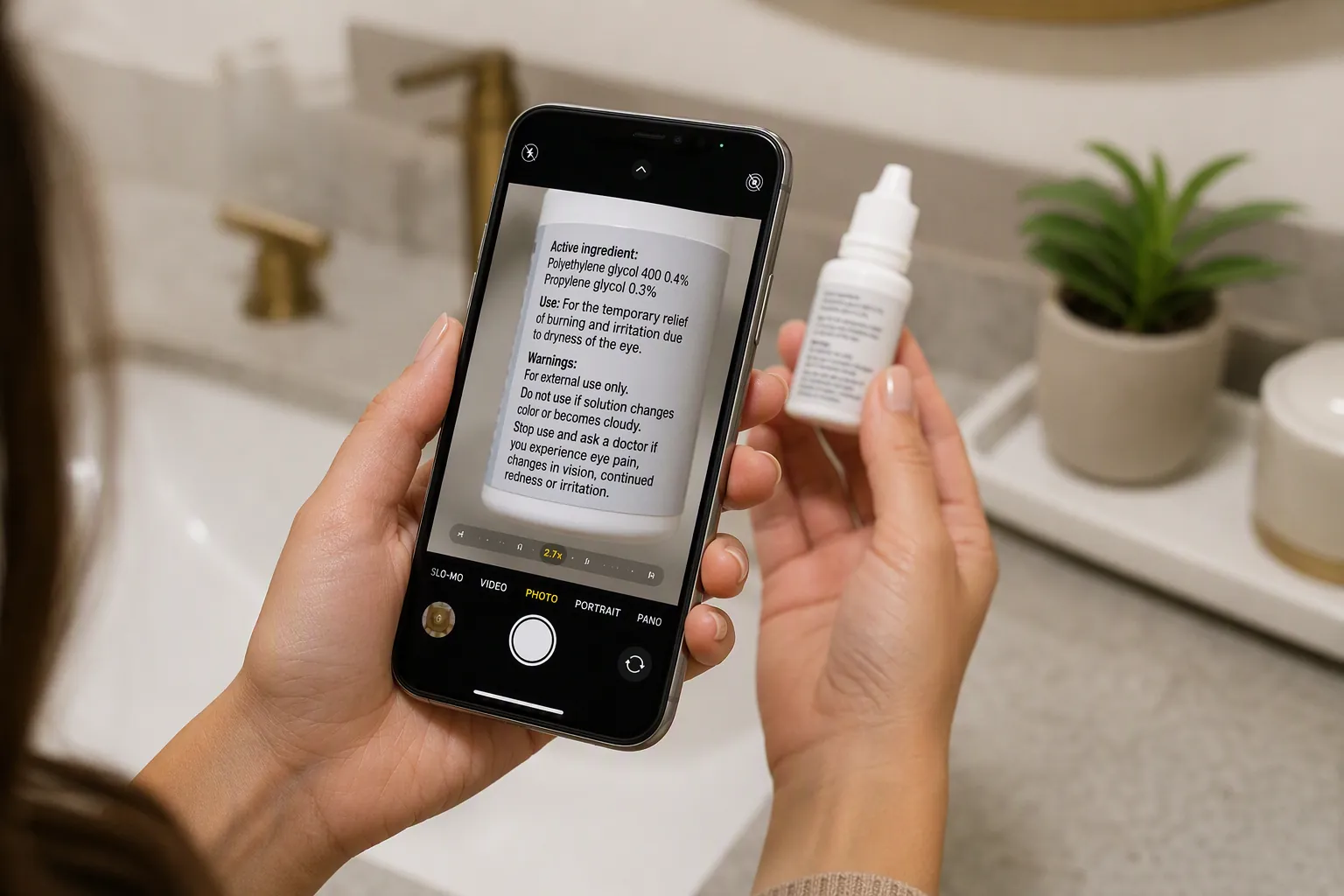
Use your phone as the magnifier. Put the bottle on a towel so it does not roll. Take several photos instead of trying to read the label live. Then pinch to zoom on the photo and look for three things: the product name, the NDC, and the lot or batch code. If the carton is still available, photograph that too; the carton often gives you a cleaner read than the bottle.
Then compare the NDC and lot code, not just the front-facing brand name. Brand names can be incomplete clues because recalls may involve only certain lots, certain manufacturers, or products sold under several labels. If you cannot confidently read the code, treat the bottle as unresolved: keep it out of use and call the pharmacy, retailer, manufacturer number on the notice, or the eye doctor’s office for help confirming it.
A simple bottle-sorting method
- Put confirmed recalled bottles in a sealed bag labeled “Do not use — recalled.”
- Put bottles that still need verification in a separate bag labeled “Do not use — checking.”
- Leave verified safe, current-use drops in a clearly different spot.
- If your parent resists throwing anything away, do not argue over disposal first. Remove access first, then handle the refund or replacement.
This separation matters because many older adults use drops by habit. The bottle may be on the bathroom counter, in the recliner side table, or beside the bed. A recalled drop that is “waiting to be checked” can still become tonight’s dose if it stays in its usual place.
Which 2026 eye drop recalls should caregivers know about?
Use this as a map of the 2026 recall landscape, not as your only checklist. The bottle still has to be verified by NDC and lot code.
- K.C. Pharmaceuticals over-the-counter eye drops: UC Davis Health reported in April 2026 that FDA flagged more than 3 million bottles across 28 brand names.[1]
- Lupin prednisolone acetate ophthalmic suspension 1%: UC Davis Health reported in July 2026 that 2.53 million bottles of this prescription corticosteroid eye drop were recalled.[2]
- Rohto Mentholatum cooling eye drops: UC Davis Health reported in July 2026 that 12 million units were recalled.[2]
- Excelvision-manufactured products: FDA warned consumers not to purchase or use certain drops from several major brands, and the Dry Eye Foundation’s recall database lists products including GenTeal, Systane Night Gel, Optase, Ivizia, and Oasis Tears PF among the Excelvision-manufactured products to check.[3][4]
The Lupin prednisolone acetate recall deserves special attention in older parents because prednisolone acetate is the kind of corticosteroid drop a senior may be using after cataract surgery or another eye procedure. If that bottle is in the house, do not let the problem turn into either of the two bad options: continuing a recalled medication or independently stopping a post-surgical medication without instructions. Stop use of the recalled bottle, keep it for identification, and call the prescribing eye doctor for a replacement plan.
Use RSVP to decide how urgently your parent needs care
After exposure to recalled eye drops, symptom monitoring should be caregiver-led. Many seniors already live with dry eye, blurry vision, crusting, light sensitivity, or irritation. They may describe a new problem as “my usual eyes,” “old age,” or “just allergies.” Some older adults also do not mount dramatic inflammatory responses, so a serious problem may not arrive with the kind of obvious complaint a family expects.
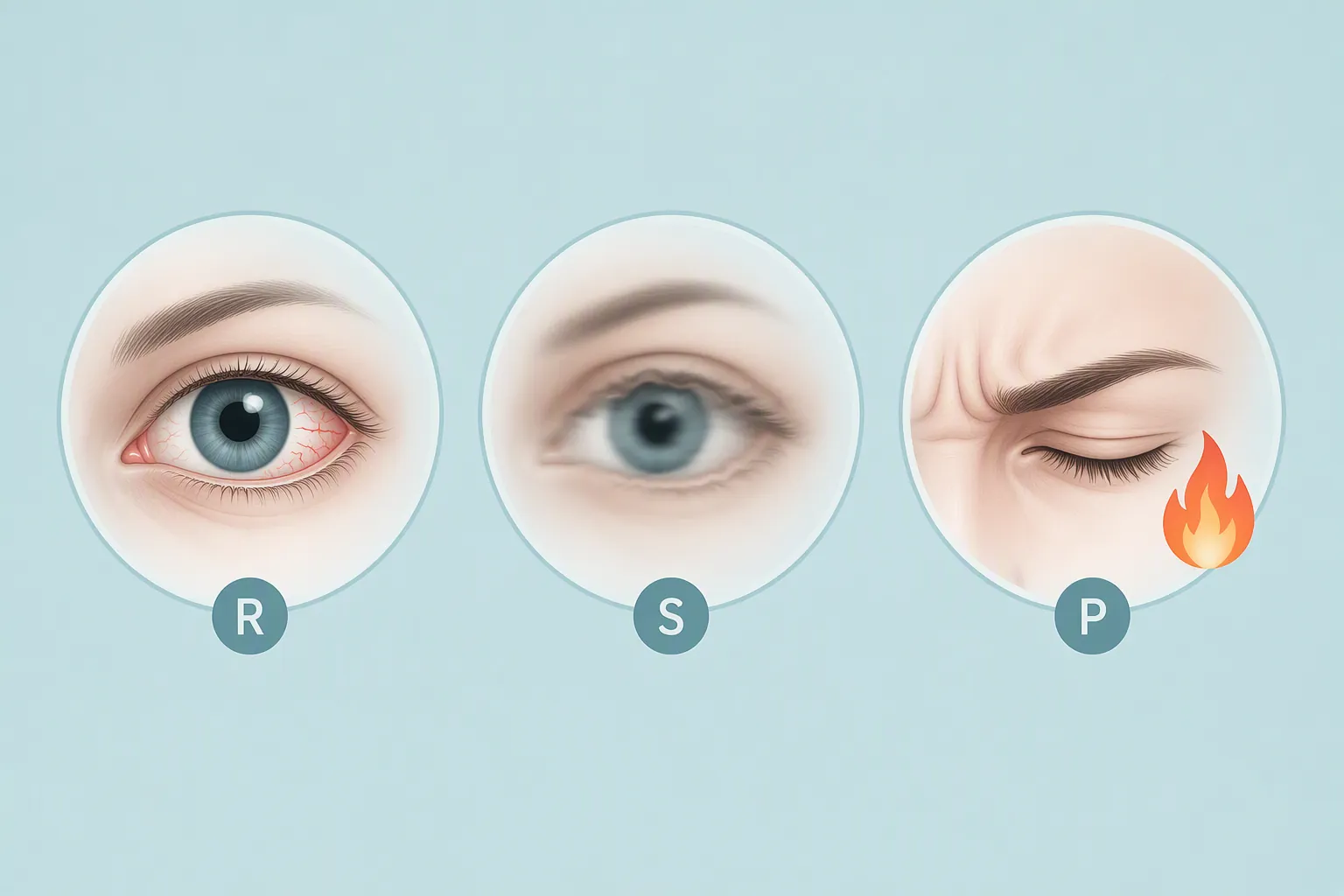
UT Southwestern frames urgent eye symptoms with RSVP: Redness, Sudden vision change, and Pain.[5] For a caregiver, that is not just a memory trick. It is a way to watch the parent in front of you without needing them to use perfect medical language.
| RSVP sign | Caregiver-sized way to check |
|---|---|
| Redness | Look at both eyes in good light. Is one eye newly red, or is redness worse than the parent’s usual dry-eye pattern? |
| Sudden vision change | Ask the parent to read the clock, TV caption, medication label, or a familiar sign. Compare it with what they could do earlier today or yesterday. |
| Pain | Listen for words like aching, pressure, scratchy, sore, burning, or “I just can’t open it.” Older adults may not use the word pain. |
If the parent has RSVP symptoms after using a recalled product — especially sudden vision change or eye pain — seek emergency care at a facility with 24/7 on-call ophthalmology, following UT Southwestern’s emergency-care protocol.[5] This is not the moment to wait for a routine appointment several days away.
If symptoms are mild but new, call the eye doctor the same day, particularly if the parent recently had cataract surgery, is using prescription steroid drops, or cannot describe symptoms clearly. Bring or photograph the bottle, the NDC, the lot code, and the timing of the last dose. The doctor’s office can do more with “Lupin prednisolone acetate 1%, lot code in photo, last used last night” than with “some recalled drops.”
Refunds are secondary, but do not skip them
Once the bottle is out of use and symptoms are handled, deal with the return. CVS, Target, Walgreens, Walmart, and Rite Aid have been identified in FDA-related guidance and amaEyes recall information as retailers that accept recalled products without a receipt.[3][6] Policies can still vary at the counter, so bring the bottle, the carton if you have it, and a screenshot or printed recall notice showing the affected product.
Do not pour the drops down the sink before you have the identifying information. A recalled bottle is evidence for the recall check, the refund, and any later MedWatch report if your parent develops symptoms.
Replace the drops without buying the same risk pattern
For nonprescription dry-eye care, preservative-free single-use vials are the safer default replacement to discuss with the eye doctor or pharmacist. UC Davis Health quoted ophthalmologist Dr. Jeffrey Ma recommending preservative-free artificial tears, and UT Southwestern cited research finding a 24% contamination rate in multi-use bottles after 1 week.[1][5]
Single-use vials also solve a very ordinary caregiving problem: they reduce the chance that one old bottle sits open for weeks in a bathroom, touches eyelashes, travels in a purse, and then goes back into use. They are not magic; hands still need to be clean, and a vial should not become a “multi-use” bottle just because some liquid remains. But they remove one of the small household failure points that recalls make hard to ignore.
For prescription drops, especially post-surgery steroid drops such as prednisolone acetate, replacement is not a shopping decision. Call the prescribing clinician or pharmacy and ask for a nonrecalled replacement, dosing instructions if a dose was missed, and whether the parent needs an exam.
Report symptoms to FDA MedWatch
If your parent had redness, sudden vision changes, pain, infection symptoms, or any other suspected adverse effect after using a recalled eye drop, report it to FDA MedWatch. You do not need a healthcare provider to file the report. FDA MedWatch accepts reports by phone at 1-800-FDA-0178 or online.[3]
Before you start the report, gather the product name, NDC, lot code, expiration date, where it was bought, when it was first and last used, what symptoms occurred, and what medical care was needed. If you do not have every detail, report what you do have. A partial report is still more useful than silence.
Fit this into the rest of your parent’s medication safety routine
Eye drops are easy to underestimate because they are small, familiar, and often bought without much ceremony. For an older parent, they belong in the same safety routine as pill bottles, inhalers, glucose supplies, and post-surgery instructions. If you are already rebuilding that system, use CareWise Guide’s medication management guide for older adults as the broader checklist.
This is also not separate from fall prevention. A parent with irritated eyes, blurred vision, eye pain, or an untreated infection may move differently through the bathroom, hallway, and stairs. The recall task ends when the unsafe bottle is out of use, symptoms have been triaged, a safe replacement is in place, and any adverse effect has been reported.
References
- Eye drop recall 2026: FDA flags over 3 million bottles; Eye doctors explain what you should know — UC Davis Health, 2026/04
- 2.5 million bottles of prescription eye drops recalled — UC Davis Health, 2026/07
- FDA warns consumers not to purchase or use certain eye drops from several major brands — FDA, 2026/07
- Are your eye drops safe? — OTC Eye Drop Warnings & Recalls — eyedropsafety.org
- What patients need to know about the 2023 eye drop recall — UT Southwestern
- Current Eye Drop Recalls Information — amaEyes
Browse more in the Glossary.