
Clinical term
How to Relieve Statin Muscle Pain in Older Adults
Last verified 2026-07-29
If an older adult starts a statin and then notices aching thighs, sore calves, weak hips, or a new hesitation getting up from a chair, the safest first move is not to stop the pill on their own. Call the prescribing clinician and describe exactly what changed: where the pain is, when it started, whether walking or balance changed, and what other medications or supplements were added recently. Most statin-related muscle pain can be sorted out and managed without giving up heart protection.
This article is educational and is not a substitute for medical advice. Do not stop, skip, split, restart, or change the dose of a prescription statin unless the prescribing clinician tells you to. That caution matters even more for older adults with several prescriptions, low muscle mass, kidney or thyroid problems, or a history of heart attack, stroke, diabetes, or vascular disease.

Why statin muscle pain is confusing
The confusing part is that muscle symptoms are both common and often hard to pin directly on the statin. Observational reports have found that as many as 25% to 30% of people taking statins report muscle symptoms, while blinded randomized trials suggest that only about 5% of muscle symptoms are directly attributable to the drug itself; expectation and worry about side effects can also intensify symptoms, a pattern often called the nocebo effect.[1][2]
That does not mean the pain is imaginary. It means the clinician has to sort carefully. In the PROSPER trial of pravastatin in 5,804 adults ages 70 to 82, myopathy was not increased compared with placebo, yet real-world studies still report much higher symptom rates.[3] Those findings can sit side by side because trials and everyday clinics do not see the same mix of people, medications, expectations, frailty, and competing causes of leg pain.
For the person who is limping across the kitchen, the practical question is narrower: can the pain be reduced while keeping cholesterol treatment in place if it is still needed? Often, yes. Cleveland Clinic notes that more than 90% of patients with muscle symptoms can eventually tolerate a statin long term after dose adjustment, switching, or other optimization, though that is encouragement rather than a promise for every patient.[4]
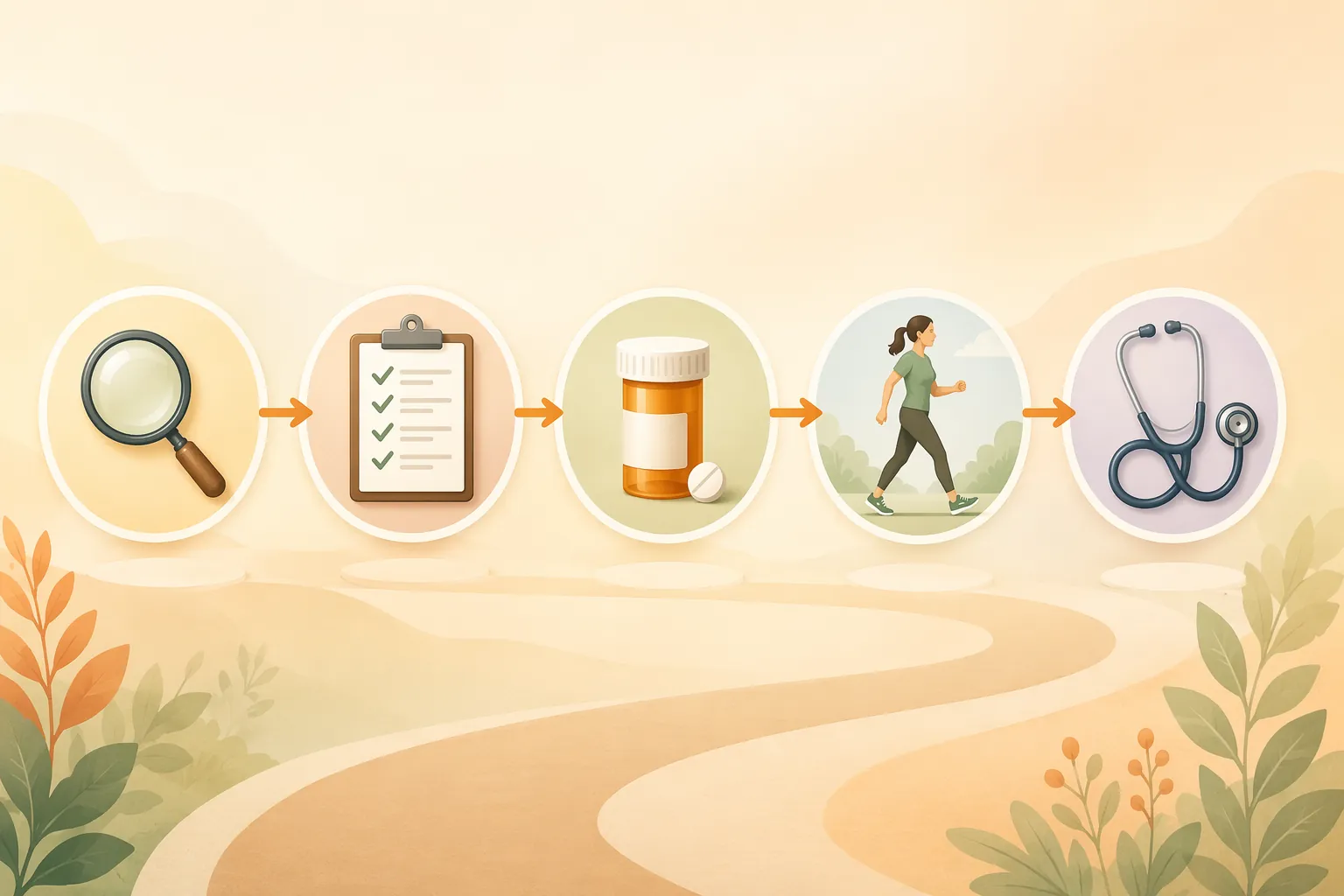
A doctor-guided path to relief
A good statin muscle pain visit is not just a quick yes-or-no judgment. It is a medication review, symptom history, risk-factor check, and shared decision about how much cardiovascular protection is needed and how much the current symptoms are interfering with daily movement.
| Step | What the clinician is trying to learn or change |
|---|---|
| Describe the symptom pattern | Whether the pain fits a statin pattern, another muscle problem, arthritis, nerve pain, or deconditioning |
| Check modifiable risk factors | Whether thyroid disease, vitamin D deficiency, low muscle mass, age-related vulnerability, or drug interactions are increasing risk |
| Review the medication plan | Whether the statin type, dose, timing, or combination with other drugs can be changed safely |
| Preserve safe movement | Whether walking and strength can be maintained without pushing through severe symptoms |
| Escalate when needed | Whether symptoms suggest serious muscle injury, sudden functional decline, or fall danger |
Start by making the pain specific
Before the appointment or phone call, write down the statin name and dose, the date symptoms began, where the pain sits, and whether it is symmetrical. Statin muscle symptoms often show up as aching, soreness, cramping, or weakness in large muscle groups such as the thighs, hips, shoulders, or upper arms, but those same areas can hurt for many other reasons in later life.
The most useful details are functional. Can the person rise from a low chair without pushing off? Are stairs slower? Is the morning walk shorter? Has sleep changed because the legs ache at night? Has a cane come out of the closet after months of not needing it? Those changes help the clinician judge urgency, and they help separate mild nuisance pain from a problem that is already affecting safety.
Look for fixable reasons the muscles are vulnerable
Older adults are not all at the same risk. Reviews of statin-associated muscle problems identify higher-risk situations including age over 80, female sex, low muscle mass, hypothyroidism, vitamin D deficiency, and polypharmacy.[3] Some of these cannot be changed. Some can.
That is why the clinician may order lab work, review kidney and liver function, check thyroid status, or look for vitamin D deficiency when the history fits. The point is not to chase every possible test; it is to avoid blaming the statin too quickly when another treatable condition is making the muscles ache.
The medication list deserves the same attention. Bring prescription drugs, over-the-counter medicines, and supplements, or bring a clear written list. In older adults, the problem is often not one medicine in isolation but the stack: dose changes, new antibiotics or antifungals, heart medications, grapefruit products, or supplements that the prescriber does not know about.
Ask what can be changed before giving up the statin
If the clinician agrees the statin is a likely contributor, the next step is usually not permanent discontinuation. Common supervised options include lowering the dose, holding and rechallenging under instruction, trying a different statin, using less frequent dosing in selected patients, or considering a non-statin medication when statins remain intolerable.
The type of statin can matter. Rosuvastatin and pravastatin are hydrophilic statins, meaning they are less likely to enter muscle tissue than more lipophilic statins such as atorvastatin or simvastatin; reviews describe fewer muscle symptoms with hydrophilic options in some patients.[5] This does not make one statin universally best, but it gives the prescriber a reasonable switch to consider when muscle symptoms are limiting daily life.
Some clinicians use slow titration for people who previously could not tolerate a statin. The American College of Cardiology’s Statin Intolerance Tool describes starting rosuvastatin at 2.5 mg once or twice weekly in selected patients, with about 70% of previously intolerant patients eventually resuming daily therapy.[6] That kind of plan belongs in a clinician’s hands because it has to match the person’s cardiovascular risk, cholesterol goals, other medications, and symptom history.
It is also fair to ask what level of statin intensity is necessary. A person who takes a statin after a heart attack may have a different risk-benefit balance than someone taking one for primary prevention. The answer may still be to continue treatment, but the conversation should be individualized rather than reduced to “tough it out” or “stop it.”
What the older adult can safely support at home
Home care does not replace medication adjustment, but it can keep the situation from snowballing. Pain often leads people to move less. Moving less can bring stiffness, weaker legs, poorer balance confidence, and a higher chance that the next trip to the bathroom becomes risky.
Moderate activity is usually the safer goal than bed rest. Harvard Health notes that regular exercise may help protect against statin-induced muscle damage, while stopping exercise can worsen symptoms.[1] That does not mean pushing through sharp pain or severe weakness. It means keeping gentle, tolerable movement in the day while the prescriber is sorting out the medication plan.
- Keep walks shorter but regular if walking is still steady and the clinician has not advised rest.
- Use a cane, walker, railing, or caregiver arm temporarily if thigh or hip soreness changes confidence.
- Avoid new strenuous workouts until the medication question is clearer.
- Track whether pain improves, worsens, or moves after dose changes made by the clinician.
- Report weakness separately from soreness; weakness affects safety more directly.
Hydration, sleep, and enough protein in the diet are ordinary measures, not statin-specific cures, but they support muscle recovery. If appetite has dropped or weight has been falling, that belongs in the same conversation as the muscle pain. Low muscle reserve gives older adults less margin when any medication side effect interferes with walking.
Be careful with supplement promises
Coenzyme Q10 and vitamin D often come up when people search for how to relieve statin muscle pain in elderly adults. The evidence is cautious. Harvard Health notes that small trials have not substantiated clear positive effects for CoQ10 or vitamin D as routine treatment for statin muscle symptoms.[1] Vitamin D replacement may be appropriate if deficiency is documented, but taking it without checking the reason for the pain can delay the more useful work: medication review, risk-factor correction, and dose or statin adjustment.
Supplements can also interact with medications or add pill burden. If an older adult wants to try one, bring the bottle to the clinician or pharmacist first. “Natural” does not mean harmless, especially when the person already takes several prescriptions.

When muscle pain becomes a fall-risk issue
Muscle pain matters because it hurts. In older adults, it also matters because it can change how a person moves through the house. A sore thigh can shorten stride. Weak hips can make chair transfers uncertain. Fear of pain can lead someone to rush, grab furniture, or avoid walking until strength slips further.
The fall-risk evidence should be read carefully. A 2024 analysis using NHANES and UK Biobank data found statin use associated with 1.27 times higher odds of self-reported falls in the NHANES cross-sectional analysis, and a Mendelian randomization estimate found genetically predicted statin use associated with 21% higher odds of falls.[7] The same study had limits: the genetic analysis drew from predominantly European-ancestry datasets, and the NHANES association was strongest in adults ages 40 to 65 rather than in the oldest adults.[7]
So the right conclusion is not that every older adult on a statin is likely to fall. The right conclusion is that a new gait change deserves attention. If pain has already changed walking, balance, transfers, or stair use, treat the home as part of the care plan while the medication is being reviewed.
That may mean clearing throw rugs, improving night lighting, using shoes with backs instead of slippers, keeping a phone within reach, and making sure the route from bed to bathroom is not crowded. Caregivers who want the wider medication-safety view can also use A Caregiver's Guide to Medications That Increase Fall Risk in Older Adults to think beyond statins and look at the full prescription list.
When to call promptly, and when to seek urgent care
Call the prescribing clinician promptly if muscle aches persist, interfere with sleep, limit walking, or return after a statin dose change. Call sooner if the person is older than 80, has low muscle mass, recently added another medication, or has thyroid or kidney concerns. These are the situations where small changes can have larger consequences.
Seek urgent medical attention for severe weakness, dark or cola-colored urine, sudden inability to rise from a chair, a rapid decline in walking, a fall, or muscle pain that comes with feeling very ill. Those symptoms can signal a more serious muscle injury or an immediate safety problem and should not wait for a routine appointment.
For the more common situation—aching legs, uncertain cause, and worry about heart protection—the next step is still straightforward: keep taking the statin as prescribed unless told otherwise, contact the clinician, bring a complete medication list, and describe the pain in terms of daily function. Relief usually comes from careful adjustment, not from guessing alone.
References
- Managing statin muscle pain — Harvard Health
- Statin side effects: Weigh the benefits and risks — Mayo Clinic
- Myopathy in older people receiving statin therapy — PMC / British Journal of Clinical Pharmacology
- Is My Statin To Blame for Muscle Pain? — Cleveland Clinic
- Treatment Options for Statin-Associated Muscle Symptoms — PMC / Deutsches Ärzteblatt International
- ACC Statin Intolerance Tool — American College of Cardiology
- Statin use and fall risk in adults — Frontiers in Pharmacology
Browse more in the Glossary.