
Glossary entry
Retirement Planning Checklist for Seniors 2025/2026
Most retirement planning checklists ask the familiar questions first: when to claim Social Security, how much to withdraw, which Medicare option to choose, and whether the portfolio can last. Those questions matter. But they are not the whole plan if the retirement you are planning is supposed to happen mostly at home.
For 2025/2026, a useful retirement planning checklist for seniors has to put five things in the same folder: income, health coverage, home safety, legal authority, and daily life. The dates and dollar limits in this article should be verified before you act, because Medicare, tax, and contribution rules can change. The structure is educational, not personal financial, legal, tax, or medical advice.
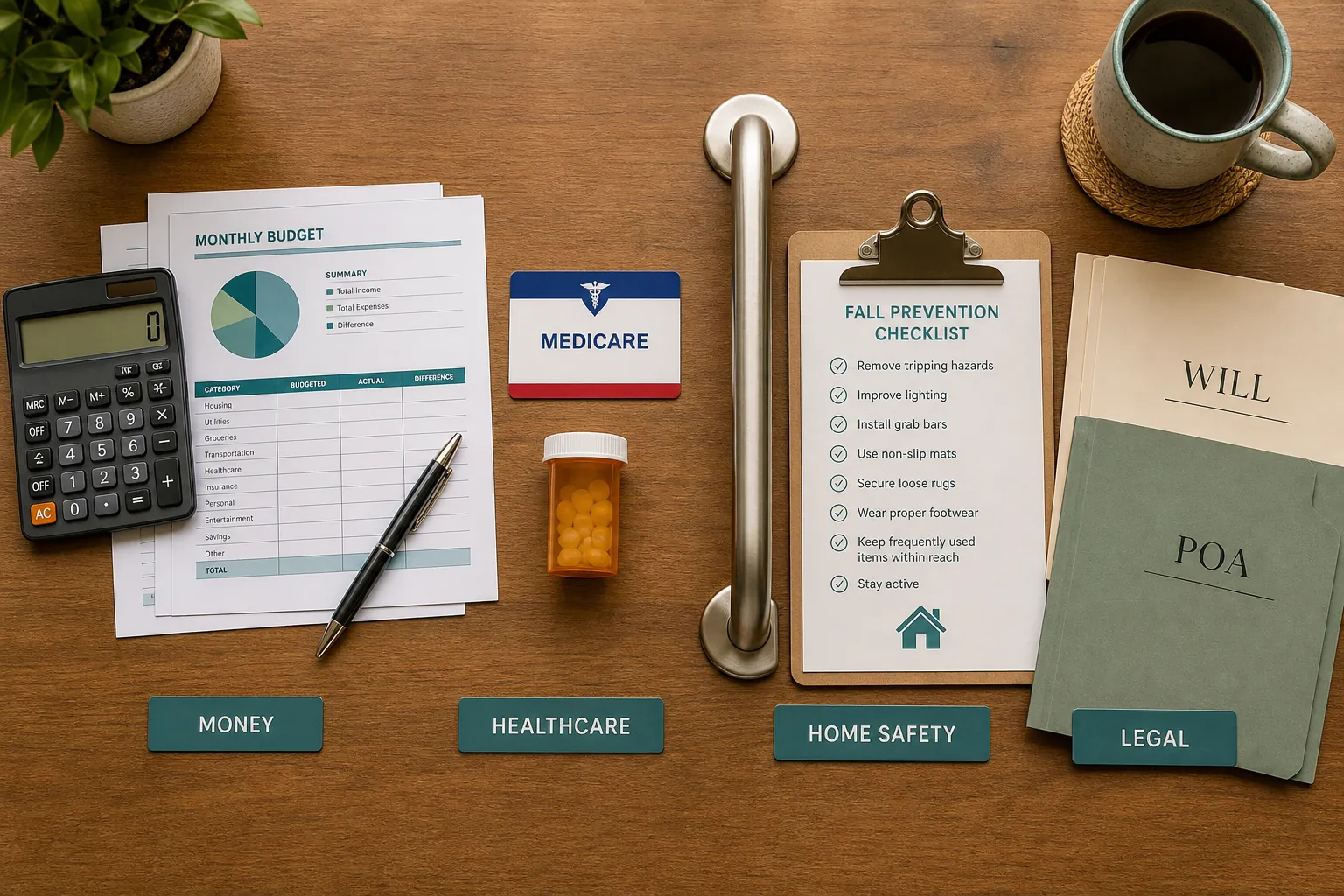
The Complete Printable Retirement Checklist
Start with the whole map. Some items depend on age, work status, or enrollment windows; others can be handled this month. The point is not to finish everything at once. The point is to see what is missing before a missed deadline, a fall, or a paperwork gap turns into a family scramble.
| Domain | Checklist items |
|---|---|
| Finances and income | Estimate retirement income; review Social Security claiming age; list pensions, annuities, savings, and part-time income; check 2026 catch-up contribution limits; plan withdrawals; understand RMD timing; reduce high-interest debt; update beneficiaries. |
| Healthcare and insurance | Confirm Medicare enrollment window; decide how employer coverage affects Part B timing; compare Original Medicare, Medigap, Part D, and Medicare Advantage; price prescriptions; estimate out-of-pocket healthcare costs; consider long-term care funding; keep insurance cards and login access organized. |
| Home safety and aging in place | Walk the home as if it is part of the retirement plan; check bathroom transfer points, stairs, lighting, entryways, flooring, rugs, seating height, and emergency access; prioritize fall prevention; decide whether modifications, home care, downsizing, or a move should be explored. |
| Legal and estate documents | Review or create a will; consider whether a trust is appropriate; name financial power of attorney; name healthcare power of attorney; complete advance directives; update beneficiary designations; store documents where the right person can find them. |
| Lifestyle and purpose | Plan weekly structure; protect social connection; discuss transportation; decide whether part-time work, volunteering, caregiving, travel, classes, or faith/community routines belong in the first retirement year. |
One useful way to work through the list is by urgency. Anything with a penalty or limited enrollment window comes first. Anything that affects safety at home comes earlier than most people think. The rest can be scheduled, reviewed, and revised.
Money Decisions That Can Be Hard to Undo
Retirement income planning does not need to become a hobby, but it does need to be specific enough that someone else could understand it in an emergency. Write down expected income sources, where they arrive, when they start, whether taxes are withheld, and who can access the account information if help is needed.
- Estimate fixed income: Social Security, pensions, annuities, rental income, and any predictable part-time work.
- Estimate flexible income: IRA withdrawals, 401(k) withdrawals, taxable investments, savings, and home-equity decisions if they are being considered.
- Match income against basic expenses: housing, food, utilities, transportation, insurance, healthcare, debt payments, taxes, and home maintenance.
- Separate wants from obligations: travel can usually wait; property taxes, prescriptions, and insurance premiums cannot.
- Keep a simple account inventory: institution name, account type, beneficiary, login location, and whether a trusted person knows the account exists.
Social Security claiming deserves more care than a quick break-even guess. The Social Security Administration reports that 43% of beneficiaries age 65 and older rely on Social Security for at least half of their income, which means a claiming decision can affect the household budget for years, not just the first retirement month.[1]
Before claiming, confirm full retirement age, estimated monthly benefits at different claiming ages, survivor benefit implications for a spouse, and how continued work could affect benefits before full retirement age. If Social Security will cover groceries, utilities, or housing rather than extras, that decision belongs near the top of the checklist.
For people still saving in 2026, verify these catch-up contribution limits before acting: up to $32,500 for 401(k) participants age 50 and older, up to $35,750 for ages 60 through 63, and $8,600 for IRA savers age 50 and older. They are worth checking with the IRS or plan administrator while there is still earned income to use.
Required minimum distributions also need a calendar reminder. For 2025/2026 planning, RMDs generally begin at age 73, and a missed withdrawal can carry a 25% penalty. That is the kind of rule that should not live only in someone’s memory.
- Ask which account should be used first for withdrawals, and whether the answer changes after Social Security or RMDs begin.
- Review high-interest debt before retirement income drops.
- Check whether mortgage payoff, refinancing, or staying with the current payment is realistic under retirement cash flow.
- Update beneficiaries on retirement accounts, life insurance, bank accounts, and transfer-on-death accounts.
- Decide who will help with bill management if illness, hospitalization, or cognitive changes make the routine harder.
Healthcare Timing Is Not a Loose End
Healthcare planning is where a retirement checklist has to become calendar-based. Medicare is not just a card that arrives around age 65. Enrollment choices, employer coverage, prescription needs, and supplemental coverage can create deadlines that are easy to miss if retirement timing changes.
The Medicare initial enrollment period is a seven-month window around the 65th birthday. Current Medicare rules also include a Part B late enrollment penalty of 10% for each full 12-month period a person could have had Part B but did not sign up. Some people can delay Part B because they have qualifying employer coverage, but that should be confirmed directly rather than assumed.
- Mark the seven-month Medicare initial enrollment window before the 65th birthday arrives.
- If still working, ask the employer benefits office whether current coverage allows a Part B delay without penalty.
- Compare Original Medicare plus Medigap and Part D against Medicare Advantage using current doctors, hospitals, prescriptions, travel habits, and prior authorization concerns.
- Check the Medigap guaranteed-issue window, generally six months starting when enrolled in Part B at age 65 or older.
- Put the final enrollment confirmations, plan cards, and prescription formulary notes in one place.
Medigap deserves special attention because timing affects choice. During the guaranteed-issue window, a person generally has stronger access protections than they may have later. That does not mean Medigap is always better than Medicare Advantage, or that every household should choose the same path. It means the comparison should happen while the door is open.
Healthcare cost estimates are uncomfortable, but they help prevent magical thinking. Fidelity’s 2025 Retiree Health Care Cost Estimate says a 65-year-old individual may need $172,500 after tax to cover healthcare expenses in retirement, and that estimate excludes long-term care.[2]
That number is not a bill that arrives on the first day of retirement. It is a planning signal. It should prompt a household to ask how premiums, deductibles, dental care, vision care, hearing care, prescriptions, and out-of-pocket costs will be paid when paychecks stop.
Long-term care is the harder uncertainty. Fidelity’s estimate excludes it, and that exclusion matters. Medicare generally should not be treated as a full long-term custodial care plan. Long-term care insurance may help some households, but premiums, underwriting, benefits, inflation protection, and purchase age can change the value sharply. Others may need to plan around savings, family caregiving, Medicaid eligibility rules, paid home care, or a move.
For readers trying to understand what may or may not pay for care at home, CareWise Guide’s 2026 senior home healthcare payment guide is the next place to go. If the issue is not payment yet but organizing help, medications, meals, transportation, and supervision, use the aging-in-place home care plan as a practical companion.
The Home Has to Be in the Retirement Plan
Many older adults want to stay where they are. The National Institute on Aging describes aging in place as growing older at home, and it frames the goal around support, safety, activities of daily living, healthcare, money, and social connection.[3] That is a wider plan than simply saying, “I’m not moving.”
AARP and NCOA have reported that 93% of adults 55 and older want to age in place. That preference explains why home safety belongs beside Medicare and income planning. If the plan is to stay home, then the hallway, bathroom, stairs, lighting, flooring, and entry points are not background scenery. They are part of the infrastructure.

The CDC’s STEADI materials identify falls as a major older-adult health risk and provide a framework for screening fall risk, reviewing medications, checking vision, encouraging strength and balance activity, and making the home safer.[4] CDC data also show that 1 in 4 older adults falls each year and that falls are the leading cause of fatal injury among older adults. That is not a reason to panic. It is a reason to put fall prevention in the same planning folder as insurance cards and beneficiary forms.
Start Where a Fall Is Most Likely to Change Everything
The bathroom usually deserves the first look because it combines water, hard surfaces, transfers, and privacy. A person may be steady in the kitchen and still be at risk stepping over a tub wall, turning on wet tile, or reaching for a towel bar that was never meant to hold body weight.
- Check whether grab bars are installed at the toilet and shower or tub transfer points.
- Replace loose bath mats with non-slip surfaces.
- Consider a shower chair, handheld showerhead, or walk-in shower if balance, fatigue, or pain is already changing bathing habits.
- Improve nighttime lighting between bedroom and bathroom.
- Ask whether the door, layout, or threshold would work if a walker were needed temporarily after surgery or illness.
The next layer is the travel path: bedroom to bathroom, living room to kitchen, entry to car, laundry to stairs. Look for loose rugs, cords, narrow turns, uneven thresholds, poor lighting, unstable furniture, and clutter that is harmless on a good day but dangerous on a tired one.
Stairs need a separate decision. Two sturdy handrails, contrast marking, lighting, and repaired treads may be enough for now. If stairs are already being avoided, the plan may need to include moving the bedroom, adding a stair lift, modifying the entry, or seriously comparing the cost and disruption of staying versus moving.
Do Not Wait Until the First Fall to Price the Work
Home modification does not have to mean a full renovation. Some of the most useful changes are small: a brighter bulb, a removed rug, a firmer chair, a grab bar placed into blocking, a rail by the entry step. Other changes are expensive and need bids, permits, or a family decision. Mixing those two categories together is one reason people postpone all of it.
If the list feels too big, use CareWise Guide’s aging-in-place priority checklist to sort modifications by cost and fall risk. For a full walkthrough, use the room-by-room home safety assessment. If the question is whether to modify the current home or move, compare the tradeoffs in choosing home modifications over downsizing.
There can be grief in this part of the checklist. A grab bar can feel like an admission. A first-floor bedroom can feel like giving up the house as it used to be. Downsizing can feel practical and still hurt. The checklist should leave room for that, but it should not let discomfort postpone decisions that protect independence.
Legal Documents That Prevent Family Confusion
Legal planning is not only about what happens after death. It is also about who can pay bills, talk to insurers, make healthcare decisions, or sell property if the person who usually handles everything is suddenly unable to do it.
- Will: names who receives property and who is responsible for administering the estate.
- Trust, if appropriate: may help with privacy, probate, incapacity planning, or property management, depending on state law and household complexity.
- Financial power of attorney: allows a trusted person to handle financial matters under the terms of the document.
- Healthcare power of attorney or healthcare proxy: names who can make medical decisions if the person cannot.
- Advance directive or living will: records preferences about medical treatment and end-of-life care.
- Beneficiary review: confirms that retirement accounts, insurance policies, bank accounts, and investment accounts still name the right people.
The beneficiary review is easy to underestimate because it looks like clerical work. It is not. Beneficiary forms can control where major assets go, and they may not match an old will, divorce, remarriage, estrangement, birth, death, or changed caregiving relationship. A document that was reasonable ten years ago can be wrong today.
Professional review matters when there is a blended family, disabled beneficiary, minor grandchild, business, out-of-state property, Medicaid planning concern, tax issue, or family conflict. A checklist can identify the missing document. It cannot replace state-specific legal advice.
The Small Folder That Saves Time Later
A retirement plan is easier to use when the right person can find it. Keep one physical folder or clearly labeled digital folder with the essentials, and tell the chosen helper where it is. Do not put passwords in an unsafe place, but do make access planning realistic.
- Social Security login location and benefit estimate.
- Medicare, Medigap, Medicare Advantage, Part D, employer retiree coverage, dental, vision, and long-term care insurance documents.
- Medication list, doctors, pharmacies, allergies, and emergency contacts.
- Account inventory with banks, retirement plans, pensions, life insurance, and investment accounts.
- Will, powers of attorney, advance directive, trust documents if any, and funeral or burial preferences if documented.
- Home safety notes, contractor bids, modification priorities, and any care plan being developed.
Lifestyle Planning Comes After the Supports Are Visible
Travel, hobbies, classes, volunteering, and grandparent time are real parts of retirement. They are just easier to enjoy when the income plan, insurance plan, home plan, and authority documents are not quietly unfinished.
The first year of retirement often needs more structure than people expect. Work supplies a calendar, social contact, identity, movement, and small obligations. Retirement removes some burdens, but it can also remove the default rhythm.
- Choose a weekly rhythm before the first month feels empty.
- Protect transportation options, especially if driving becomes limited.
- Name the people who will notice if routines change.
- Plan movement, strength, and balance activity in a way that fits health status and clinician guidance.
- Discuss caregiving expectations with adult children before help is urgently needed.
Purpose does not have to be grand. It can be a Tuesday volunteer shift, a walking group, regular childcare, a church committee, a class, a garden, or part-time consulting. The practical question is whether the retirement week has enough connection and enough reason to get out of the chair.
One-Page Retirement Planning Checklist for Seniors 2025/2026
| Area | Print-and-check actions |
|---|---|
| Social Security | Review benefit estimates; compare claiming ages; check spouse or survivor implications; decide whether work earnings affect timing. |
| Retirement income | List all income sources; estimate monthly spending; plan withdrawals; review taxes; reduce high-interest debt; update beneficiaries. |
| Savings rules | Verify current catch-up contribution limits; use remaining earned-income years intentionally; calendar RMD start date and withdrawal responsibility. |
| Medicare | Mark the seven-month initial enrollment window; confirm employer coverage rules; avoid Part B penalty surprises; compare Original Medicare, Medigap, Part D, and Medicare Advantage. |
| Healthcare costs | Estimate premiums and out-of-pocket costs; review prescriptions; plan for dental, vision, and hearing; decide how long-term care risk will be addressed. |
| Home safety | Check bathroom, bedroom-to-bath path, stairs, entry, lighting, rugs, cords, flooring, seating, and emergency access; prioritize fall prevention. |
| Aging in place | Decide whether the current home can support likely needs; price urgent modifications; compare staying, modifying, adding help, downsizing, or moving. |
| Legal documents | Review will, trust if appropriate, financial POA, healthcare POA, advance directive, beneficiaries, and document storage. |
| Family access | Tell the chosen helper where key documents are; organize account inventory, insurance cards, medication list, contacts, and care preferences. |
| Daily life | Plan weekly structure, transportation, social connection, movement, purpose, and caregiving expectations. |
A complete retirement checklist is not finished when the accounts look organized. It is finished only when the money, the healthcare coverage, the home, the body, and the paperwork have all been brought into the same plan.
References
- Social Security: What Every Woman Should Know, Social Security Administration.
- How to plan for rising health care costs, Fidelity, March 2026.
- Aging in Place: Growing Older at Home, National Institute on Aging.
- STEADI - Older Adult Fall Prevention, Centers for Disease Control and Prevention.
Browse more in the Glossary.