
Clinical term
How RFK Jr's Peptide Push Affects Senior Health
Last verified 2026-07-27
Last verified: Q3 2026, using sources available through July 27, 2026 UTC. The July 23 Pharmacy Compounding Advisory Committee vote is documented; full final outcomes for the July 24 peptide votes should be rechecked before anyone treats this as settled FDA policy.
On July 23, 2026, an FDA advisory panel voted 8–6–1 to recommend allowing compounding pharmacies to make four unapproved peptides: BPC-157, KPV, MOTS-c, and TB-500.[1] That vote was a win for Robert F. Kennedy Jr.'s push to loosen peptide restrictions, but it was not the same thing as FDA approval, a finding that the products work, or a safety clearance for older adults.
For a caregiver, the plain-English translation is this: access may become easier, but the burden of proof has not disappeared. A clinic may be able to talk more openly about a compounded peptide. A patient may find it easier to buy one. But the questions that matter at the kitchen table remain the same: What exactly is in the vial, who made it, what dose is being used, what human evidence supports it, and has anyone checked it against the older adult's full medication list?
What Peptides Are, and Why the Word Can Mislead
Peptides are short chains of amino acids. The body uses them as signaling molecules, and medicine uses some of them very seriously. Insulin is a peptide-based therapy with a long clinical history. GLP-1 drugs are peptide medicines used for diabetes. Teriparatide is used for osteoporosis, and calcitonin is another FDA-approved peptide medicine discussed in aging-related therapeutic literature.[2]
That is the first distinction to keep straight: “peptide” does not automatically mean fringe. It also does not automatically mean proven. The policy fight in 2026 is mostly about unapproved peptides promoted for recovery, inflammation, injury repair, longevity, body composition, or anti-aging effects. Those claims are not interchangeable with the evidence behind FDA-approved peptide drugs.
| Type of peptide product | What it means for a family decision |
|---|---|
| FDA-approved peptide medicine | Has an approved use, labeling, manufacturing standards, dosing information, and a clearer coverage path depending on the indication. |
| Compounded peptide | Made by a compounding pharmacy for a patient; may become easier to access if FDA policy changes, but it is not FDA-approved for safety or effectiveness. |
| Gray-market or online peptide | May be sold through clinics, wellness channels, or suppliers outside normal prescription safeguards; contents and purity may be uncertain. |
That middle category is where much of the current confusion lives. Compounding can be legitimate when it solves a specific medication problem, such as a needed formulation that is not commercially available. But a compounded version of an unapproved peptide is not the same as an approved drug. It does not arrive with the same trial package, labeling, manufacturing review, or Medicare coverage expectation.
What RFK Jr.'s Peptide Push Actually Changed
The immediate policy event was narrow. The Pharmacy Compounding Advisory Committee recommended allowing compounding of BPC-157, KPV, MOTS-c, and TB-500 by an 8–6–1 vote on July 23, 2026.[1] NPR also reported that the FDA panel backed easier access to peptides that day.[3] Additional peptides, including Semax, Epitalon, and Emideltide, were scheduled for review on July 24, but the full confirmed outcomes for those votes were not available in the sources checked by July 27.[3]
The committee's recommendation is advisory. FDA advisory panels can influence agency action, but they do not write the final rule by themselves. The FDA can follow the recommendation, narrow it, delay action, or go another direction. That matters because the public often hears “FDA panel backs access” and translates it into “the FDA says this is safe.” Those are different statements.
Before the vote, FDA scientists had reviewed the seven peptides on the agenda and concluded there was insufficient evidence for all of them.[4] That is not a small footnote. It means the access debate was happening in the absence of the kind of human safety and effectiveness evidence families are used to seeing for prescription medicines.
There was also concern about the makeup of the restructured advisory panel because some members reportedly owned or worked at peptide-marketing clinics.[1] That context is worth knowing, but the larger issue for seniors is simpler: even a clean committee vote would not substitute for human trial evidence, known dosing, interaction data, contamination controls, and a payment pathway.
Why Older Adults Face a Different Risk Stack
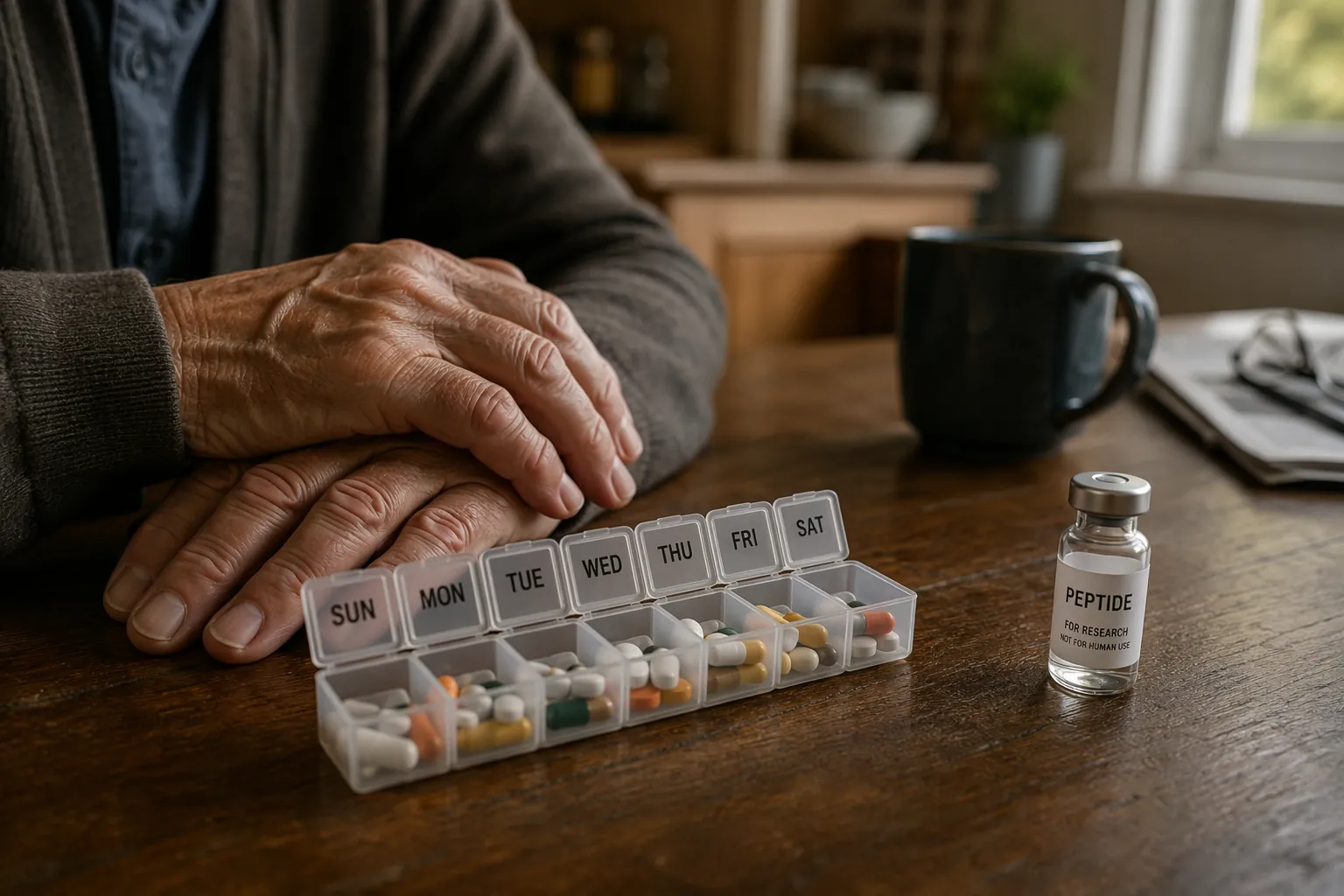
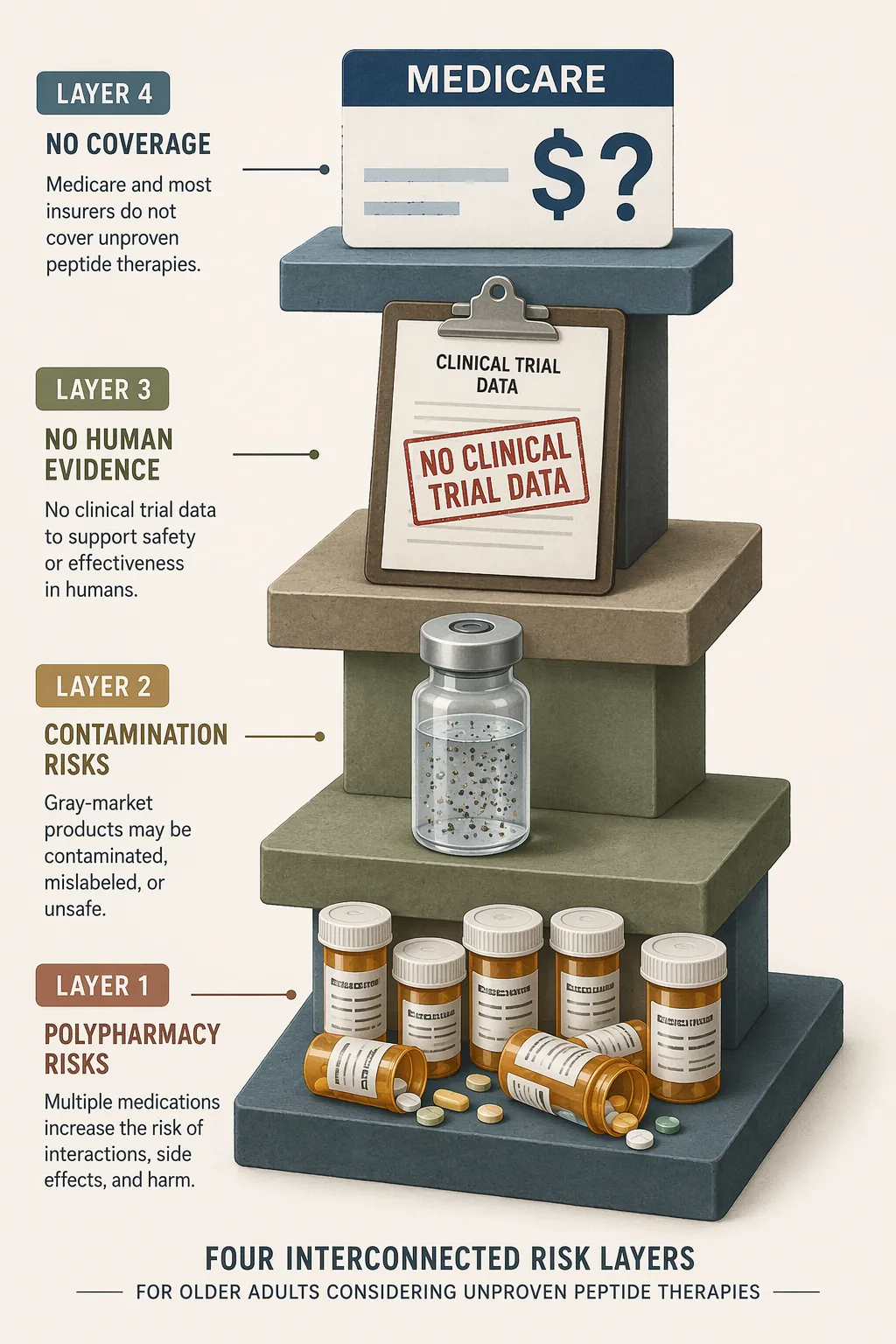
A healthy 35-year-old experimenting with a recovery product is not the same risk picture as a 78-year-old taking blood pressure medicine, a statin, an anticoagulant, a diabetes drug, a sleep aid, and something for arthritis. About 60% of adults 65 and older take five or more medications, a level of polypharmacy that makes interaction questions more than theoretical.[5]
That medication list is the first document a caregiver should put on the table before discussing any compounded anti-aging or recovery peptide. The issue is not only whether the peptide itself causes a known side effect. It is whether it changes appetite, inflammation, sleep, blood sugar, immune signaling, blood pressure, wound healing, or hormone pathways in a person whose prescriptions are already balancing those systems.
For older adults with a cancer history, suspicious lesions, unexplained weight loss, or growth-related medical concerns, the uncertainty becomes more uncomfortable. Some peptide marketing leans on tissue repair, growth hormone, or regeneration language. That does not prove a cancer risk in any individual patient, but it does mean the prescribing clinician should know the full history before an injection is accepted.
The route of administration matters too. A pill, a nasal spray, and an injection do not carry the same practical risks. An injection adds sterility, storage, dosing, and technique questions. If a product is being handed over at a wellness event, mixed by a clinic, mailed from an online source, or used without the primary doctor's knowledge, the caregiver has less ability to trace what happened if the older adult gets sick.
A Bad Outcome Is Not Just a Chart Entry
In 2025, two women were hospitalized after receiving peptide injections at an anti-aging conference; one required a ventilator.[6] That incident does not prove that every peptide injection will cause severe harm. It does show what “unproven” can look like outside a journal abstract: emergency care, frightened family members, missing information about what was injected, and medical teams trying to catch up after the fact.
For a senior, the aftermath can be harder to absorb. A younger person may recover from a bad reaction and return to baseline. An older adult can lose strength during a hospitalization, miss regular medications, become delirious, fall behind on bills, or need more help at home after discharge. That is why the access question cannot be separated from the cleanup question.
The Evidence Gap Is Especially Stark for BPC-157
BPC-157 is often marketed for healing, pain, tendon injury, gut repair, and recovery. The senior-care problem is that the human evidence has not caught up to the sales language. A 2025 systematic review cited by AARP found that 35 of 36 BPC-157 studies were preclinical animal studies, with only one small uncontrolled human study involving 12 knee-pain patients.[7]
Animal studies can be useful early signals. They are not the same as proving safety and benefit in an older person with kidney disease, diabetes, atrial fibrillation, osteoporosis, or a history of cancer. A small uncontrolled human study also cannot answer whether a peptide prevents falls, restores independence, reduces hospitalizations, or safely combines with common senior prescriptions.
That distinction matters because older adults are often sold outcomes, not mechanisms. Less pain. Faster recovery. More energy. Better mobility. Those are meaningful hopes, and families should not be mocked for caring about them. But if the actual evidence is mostly animal data, the honest label is early and uncertain, not established therapy.
Other peptide examples raise different questions. CJC-1295, for instance, had a published human trial showing a two- to tenfold increase in growth hormone sustained for more than six days; a Phase 2 trial was discontinued after a participant death that was deemed unrelated.[8] That does not mean CJC-1295 is the same as the four peptides in the July 23 vote. It shows why hormone-related effects deserve careful medical review rather than wellness shorthand.
Source and Purity Are Not Small Details
Once a product moves through gray-market channels, the question is no longer just whether the ingredient works. It is whether the vial contains what the label says it contains. FDA testing described by Ars Technica found heavy metals, including arsenic at up to 10 times toxicity limits and lead, and found purity ranging from 5% to 75% of the label claim in tested products.[9]
That purity range should stop a family conversation cold. If a product contains far less active ingredient than claimed, the user may assume it “didn't work” and escalate use. If it contains contaminants, the older adult bears the medical risk. If it contains a different amount from month to month, neither the patient nor the doctor can reliably connect dose to response.
A compounded pharmacy is not the same as a random online supplier, but compounding still does not turn an unapproved peptide into an FDA-approved drug. Families should ask who compounded it, whether the pharmacy is licensed, whether the prescription came from a clinician who examined the patient, and whether the product is being promoted for an unapproved use with little human evidence.
The Medicare and Cash-Pay Problem
The peptide policy debate can sound like a science story, but for many seniors it becomes a bill. Medicare does not cover non-FDA-approved peptides or compounded peptides, and FDA-approved GLP-1 drugs are covered for diabetes rather than for weight loss alone.[10] Compounded peptide therapy is commonly described in the $200 to $600 per month out-of-pocket range, though actual costs vary by pharmacy, region, and peptide type.[6][10]
That money often comes out of the same household budget that pays for Part D premiums, copays, dental work, hearing aids, transportation, and groceries. A product can be easier to access and still be unaffordable. It can be legal to sell and still not be covered. It can be popular online and still leave the family holding the bill if it fails.
Coverage also affects safety in a quiet way. When a therapy is outside Medicare and paid in cash, it may be delivered outside the usual medical record. The primary care doctor may not know about it. The cardiologist may not know about it. The pharmacist checking interactions may never see it. That is how a purchase meant to improve independence can become another untracked variable.
Questions to Ask Before a Parent Uses a Compounded Peptide
A family does not need to become a regulatory expert before saying yes or no. It does need clear answers to ordinary safety and benefits questions. If the clinic cannot answer them plainly, that is useful information.
- Is this peptide FDA-approved for the exact use being promised, or is it compounded and unapproved?
- Has the prescribing clinician reviewed every medication, supplement, injection, and over-the-counter product the older adult uses?
- Is there human clinical evidence for this benefit in older adults, not just animal research, testimonials, or recovery claims from younger patients?
- Who made the product, is the pharmacy licensed, and how would the family verify sterility, storage, and dosing instructions?
- What side effects or warning signs should trigger a call to the doctor, urgent care, or emergency services?
- What is the monthly cash cost, what happens if it continues for six months, and what medical costs could follow if there is a bad reaction?
One more question belongs near the top: does the older adult's regular doctor know? Not every primary care clinician will be familiar with every peptide on the market. Still, the doctor or pharmacist is better positioned than a wellness seller to look at kidney function, liver disease, cancer history, anticoagulants, diabetes drugs, immune conditions, and the medication list as a whole.
What the Policy Shift Does Not Prove
For senior health, RFK Jr.'s peptide policy push is mainly an access and confusion issue, not a new proof-of-benefit issue. The July 2026 advisory vote may make certain compounded peptides easier to obtain, depending on final FDA action. It does not prove that BPC-157 heals an older adult's tendon injury, that TB-500 prevents falls, that MOTS-c improves longevity, or that KPV reduces inflammation safely in someone taking multiple prescriptions.
It also does not create Medicare coverage. It does not solve gray-market contamination. It does not replace missing human trials. It does not tell a daughter whether her father with heart disease should add an injection after seeing an online ad. It does not tell a widow on a fixed income whether a $200 to $600 monthly expense is likely to buy function, hope, or disappointment.
Older adults who are considering compounded anti-aging or recovery peptides should treat them as unproven therapies requiring clinician review, especially when five or more medications are already in use. Before a family spends hundreds of dollars a month or accepts an injection from a clinic or online source, the basic facts should be visible: approval status, medication review, supplier legitimacy, route of administration, cash cost, and human evidence for the promised benefit in older adults.
References
- In win for RFK Jr., FDA advisory panel narrowly votes to allow compounding of unapproved peptides, STAT News, July 23, 2026.
- Therapeutic peptides in gerontology: mechanisms and applications for healthy aging, Frontiers in Aging, 2026.
- FDA panel backs easier access to peptides, NPR, July 23, 2026.
- FDA scientists flag concerns with peptides as RFK Jr. tries to ease access, NPR, June 30, 2026.
- Older Adult Medication Safety, Centers for Disease Control and Prevention.
- RFK Jr. wants to make it easier to get peptides. FDA scientists disagree., NBC News.
- Are Peptides Safe? What Older Adults Need to Know, AARP, April 2026.
- RFK Jr. Says FDA Will Lift Ban on Peptides, MedPage Today, February 2026.
- RFK Jr. wants Americans to use peptides that were banned over safety risks, Ars Technica, March 2026.
- Medicare and Insurance Coverage for Peptide Therapy in 2026, PeptideLaws.com, 2026.
Browse more in the Glossary.