
Product term
How the Robot Vacuum Ban Affects Elderly Users
Last verified 2026-07-31
As of July 31, 2026, the short answer is this: your mother’s current robot vacuum will not stop working because of the July 28 FCC action, and a model that was already authorized before the ban can still be sold through normal retail channels. The new restriction is aimed at future, not-yet-authorized foreign-made robot vacuums and similar advanced robotic devices, not at machines already sitting in people’s kitchens, hallways, and living rooms.[1][2]
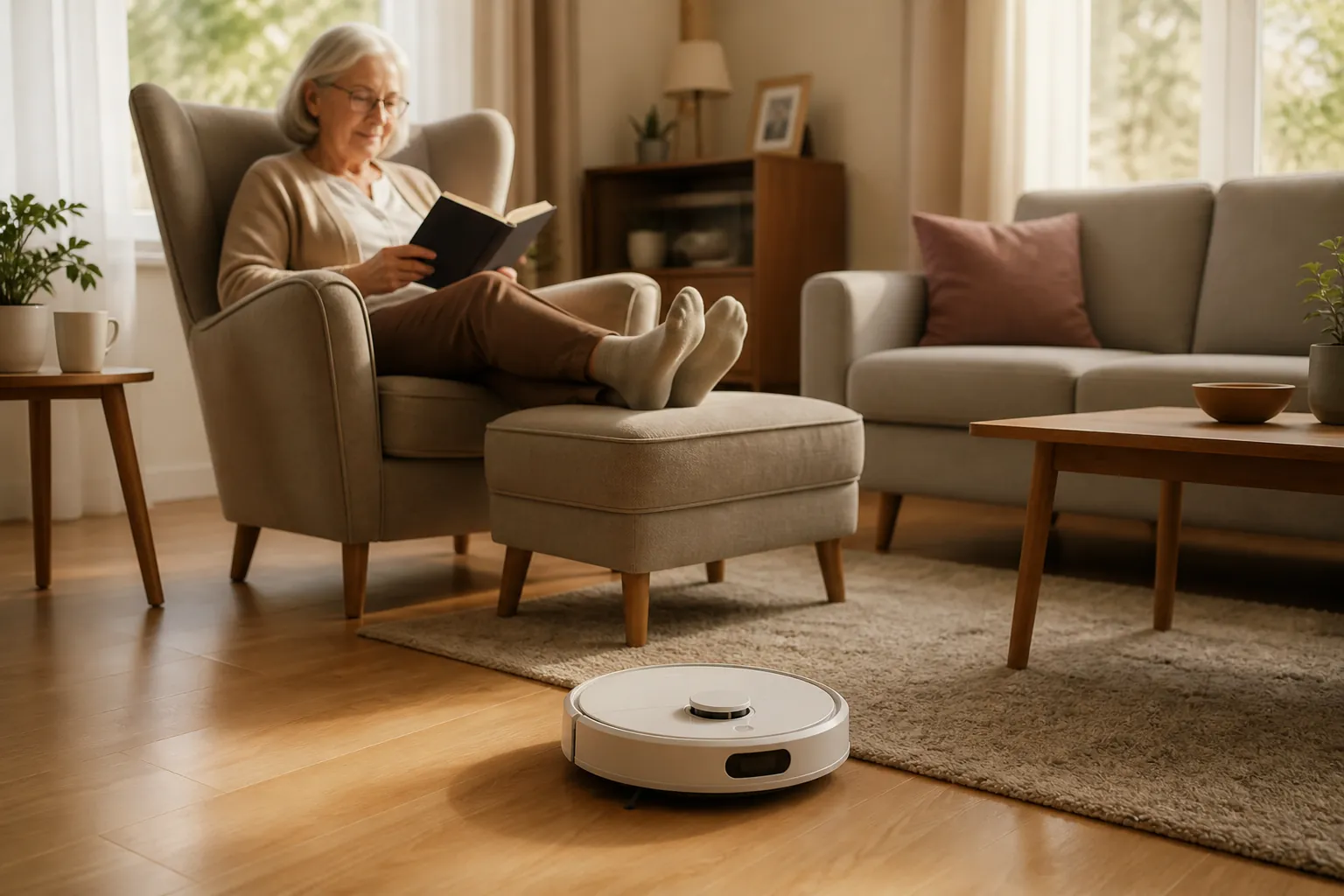
That distinction matters if the robot vacuum is not a novelty in the house. For an older adult who uses one because dragging out a corded upright feels unsteady, or because bending under the dining table is getting harder, the first question is not whether the robot is “banned.” It is whether Tuesday morning’s cleaning routine still happens. For current owners, it does.
What changes, and what does not
The practical way to read the ban is to separate three things: a device already in the home, a model that already has FCC authorization, and a future new model that has not yet been authorized.
| Situation | What the July 2026 ban means |
|---|---|
| A robot vacuum already in a senior’s home | It can keep operating. The ban does not remotely disable it or make normal use illegal. |
| An already-authorized model still in retail stock | It can still be sold through existing channels, although stock and pricing may change. |
| A new foreign-made model that has not received FCC authorization | It cannot enter the U.S. market unless a Department of Defense waiver applies. |
| Software or security updates for already-authorized equipment | They remain permitted for devices already authorized or already in use. |
The FCC’s July 28 update covers “advanced robotic devices” that are mobile, weigh more than 4.4 pounds, use autonomous navigation, include sensors, and have wireless connectivity. Robot vacuums fit that description, so new covered models from restricted foreign sources are blocked from new authorization unless they receive a Department of Defense waiver.[1]
That sounds sweeping because the category is broad. But the household effect is narrower. A vacuum that already received authorization is not suddenly contraband. A robot vacuum already paired to a parent’s phone app is not supposed to lose permission to connect. Software and security updates for already-authorized equipment are still allowed, which is important because an aging-in-place tool should not become less safe simply because it can no longer be patched.[1][2]
The uncertain part is not whether existing vacuums keep working. The uncertain part is how quickly retailers sell through already-authorized inventory, how manufacturers respond, and whether any future models receive waivers. The ban was only announced three days before this article’s date, so stock levels, waiver requests, and manufacturer plans are still moving targets.[1]
Why caregivers still have a real access problem
The harder case is the caregiver who was about to buy one. That person is now shopping in a narrowing window. The ban does not erase existing inventory, but it does cut off the normal pipeline for new covered foreign-made models that have not yet been authorized. In a category where Chinese manufacturers held roughly 70% of the global robot vacuum market in 2025, that is not a small supply-side footnote.[3][4]
The familiar-brand workaround is also less simple than it used to be. iRobot, the company behind Roomba, filed for Chapter 11 bankruptcy and was acquired by Chinese manufacturer Picea in January 2026.[5] For families who assumed they could avoid the issue by choosing the best-known U.S. robot vacuum brand, that acquisition changes the practical answer. Current and already-authorized Roomba models may still be available, but new models from that foreign-owned production pipeline can fall within the same restriction if they are not already authorized.
There is a U.S.-made option, but it is not priced like the robot vacuums many families were considering for a parent. Matic has been reported at about $1,245, while comparable foreign-made robot vacuums commonly sat in the $200 to $700 range before the ban.[3][4] For a senior on a fixed income, that difference can decide whether the tool is realistic at all.
That is why the impact on elderly users is not that their current machines shut down. It is that affordable replacement choices may become scarcer, and first-time buyers may have fewer low-cost options if they wait until authorized retail stock thins out.
The fall-prevention issue is modest, but not trivial
A robot vacuum is not a complete fall-prevention program. It will not fix poor lighting, loose rugs, medication side effects, weak balance, or a bathroom without grab bars. There is also no dedicated evidence in the provided research showing that robot vacuums, by themselves, reduce falls among older adults.
But it is still reasonable to care about this chore. The CDC’s STEADI home safety checklist tells older adults to remove things they can trip over, including cords, and the National Institute on Aging’s home safety guidance points to clutter, poor floor conditions, and risky household setup as fall hazards.[6][7] A robot vacuum can reduce some repeated risk moments: pulling a cord across a walkway, bending to reach under furniture, carrying or dragging heavier equipment, and letting debris accumulate because vacuuming feels like too much.
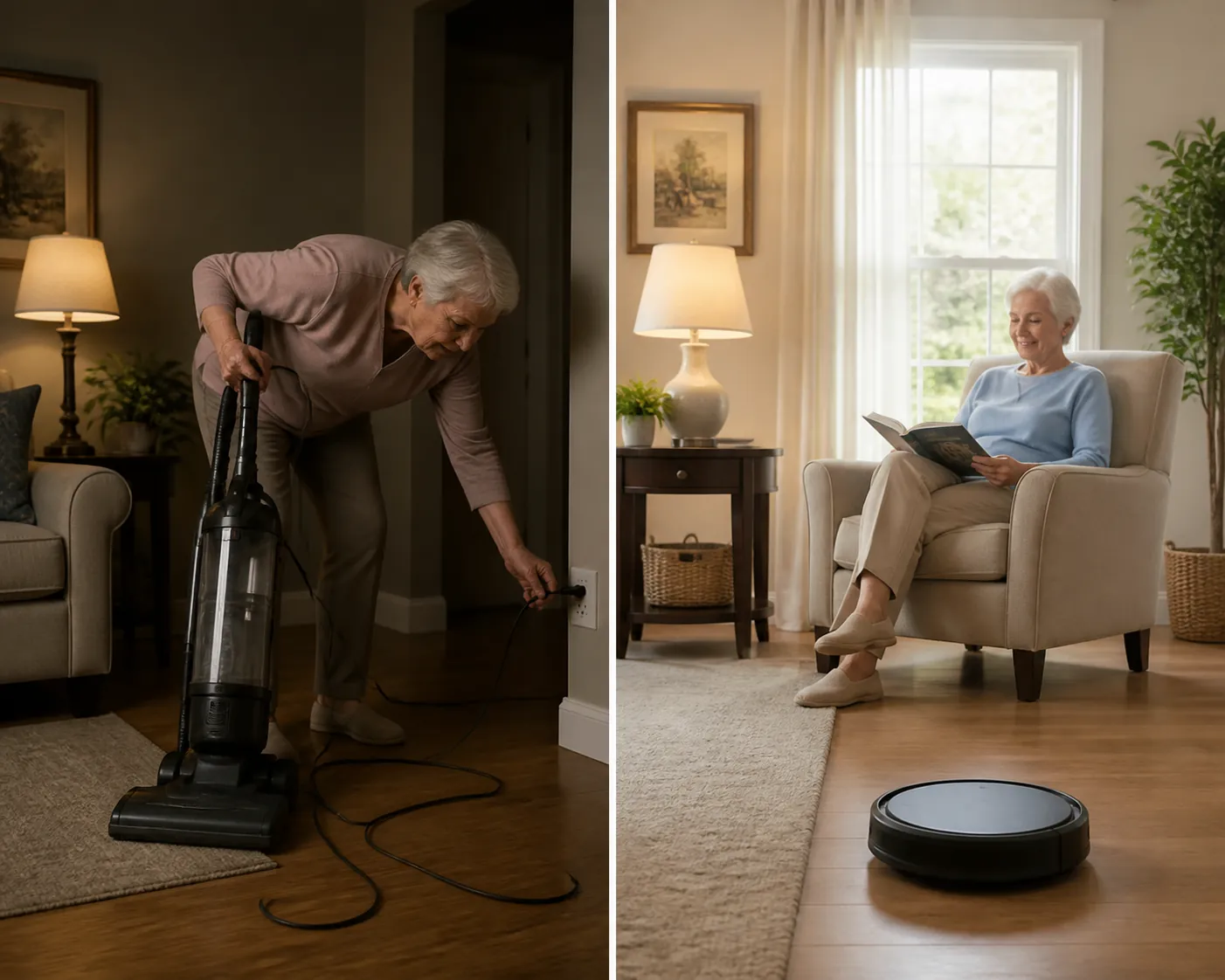
Those moments matter because falls are common and consequential. More than one in four adults age 65 and older falls each year, and falls are the leading cause of injury-related death among older adults.[8] A routine chore that happens every week, sometimes every day, deserves attention if it repeatedly puts a parent in an awkward bend, a twisted reach, or a hallway with a cord stretched across it.
The right claim is narrow: a robot vacuum can remove or reduce certain cleaning-related hazards in some homes. It does not make the home safe on its own. A parent still needs clear walkways, safe transitions between rooms, good lighting, stable furniture, and a realistic plan for stairs, bathrooms, laundry, and entryways. For that broader work, a room-by-room aging-in-place safety checklist and a home-modification cost plan are better tools than any single appliance.
What to do if your parent already has one
Do not unplug a working robot vacuum because of a headline. If it is already helping your parent avoid a corded vacuum, keep it in service unless it creates a different problem, such as blocking a walkway, tangling in rugs, getting stuck under furniture, or requiring app steps your parent cannot manage.
The maintenance work is ordinary but important. Check that the dock sits against a wall and not in a walking path. Make sure charging cords are tucked away. Replace consumable parts before performance drops so the parent does not go back to the upright vacuum “just this once.” If the model maps rooms through an app, confirm that someone besides the older adult can troubleshoot it. A device that prevents bending only helps if the parent is not bending over it twice a week to rescue it.
Also think about replacement timing. If the battery is already weak, the brushes are hard to find, or the model regularly fails, this is a reasonable moment to look for compatible parts or an already-authorized replacement. That is different from panic-buying. It is simply not waiting until the machine dies and the low-cost shelf is emptier.
What to do if you were about to buy one
If a robot vacuum was already part of your fall-prevention plan for a parent, check authorized retail stock soon. That means looking at models already available through established retailers rather than waiting for the next product generation. The point is not to chase features. It is to avoid losing access to the mid-priced machines that made this kind of help plausible for many families.
Still, do not buy the first box you see. Match the device to the home. A small apartment with hard floors and few thresholds is a different job from a house with thick rugs, chair legs, pet bowls, and a parent who gets frustrated by phone apps. If Wi-Fi setup will fall entirely on you, assume you will also be the person who handles map resets, part replacements, and troubleshooting. That is fine if you live nearby or can manage it remotely; it is a problem if the parent will be left with a beeping machine they cannot fix.
Budget also belongs in the decision. A $200 to $700 robot vacuum may be a reasonable home-safety expense if it keeps a parent from hauling out a heavier corded vacuum. A four-figure alternative may compete with grab bars, stair rail repairs, better lighting, medication reviews, or paid help with cleaning. For many households, the safest spending order will not be obvious until the whole home is considered.
For now, purchasing specifics are likely to change quickly as retailers clarify inventory and manufacturers respond to the waiver process. If you need a model-by-model answer, use current availability guides rather than old “best robot vacuum” lists that were written before the July 28 ban.
The practical caregiver answer
Keep and maintain an existing robot vacuum if it is working safely. If you were already considering one for an older parent, check already-authorized retail stock soon rather than waiting for the market to sort itself out. Do not panic-buy without looking at the parent’s floors, thresholds, rugs, Wi-Fi comfort, maintenance needs, and budget. And do not let the robot vacuum stand in for the larger fall-prevention work: cords still need to be secured, clutter still needs to be removed, lighting still needs to be checked, and the rooms where falls are most likely to hurt someone still deserve a room-by-room safety review.
References
- Covered List, Federal Communications Commission
- The FCC’s robot vacuum ban doesn’t mean your Roomba will stop working, Engadget
- FCC ban on Chinese robot vacuums: What it means for Roomba and other smart home devices, Mashable
- What the FCC robot vacuum ban means for consumers, USA Today
- Roomba maker iRobot files for bankruptcy, to be acquired by China's Picea, Reuters, January 22, 2026
- Check for Safety: A Home Fall Prevention Checklist for Older Adults, Centers for Disease Control and Prevention
- Fall-Proofing Your Home, National Institute on Aging
- Facts About Falls, Centers for Disease Control and Prevention
Browse more in the Glossary.