
Product term
What the FCC Roomba Ban Means for Seniors
Last verified 2026-07-31
Last verified: July 31, 2026.
If you already own a Roomba or another robot vacuum, the practical answer is simple: it should keep working. The July 28, 2026 FCC action does not shut off robot vacuums already in homes, and it does not make previously approved models illegal to use or sell. The FCC’s FAQ says the restriction applies to covered equipment that has not already been authorized, while previously authorized equipment is treated differently.[1]
There is one especially important date for ordinary households: security and software updates for previously authorized equipment are allowed through at least January 1, 2029 under an FCC waiver.[2] That matters because a robot vacuum is most useful when it keeps receiving the fixes that make it safer and less troublesome to own.
Quick Answers for Seniors and Caregivers
| Question | Plain answer |
|---|---|
| Will my current Roomba stop working? | No. The FCC action does not turn off robot vacuums already in use. |
| Can I still buy a robot vacuum? | Yes, if the model was already FCC-authorized. Previously authorized models can still be sold. |
| Will it still get updates? | Security and software updates are allowed through at least January 1, 2029 for previously authorized equipment. |
| Are all future robot vacuums banned? | No. The issue is future models that are covered and not yet authorized. Brand-specific outcomes may depend on FCC decisions not yet published. |
| Should I unplug mine because of spying concerns? | Not automatically. Use updates, review privacy settings, and consider offline operation where supported. |
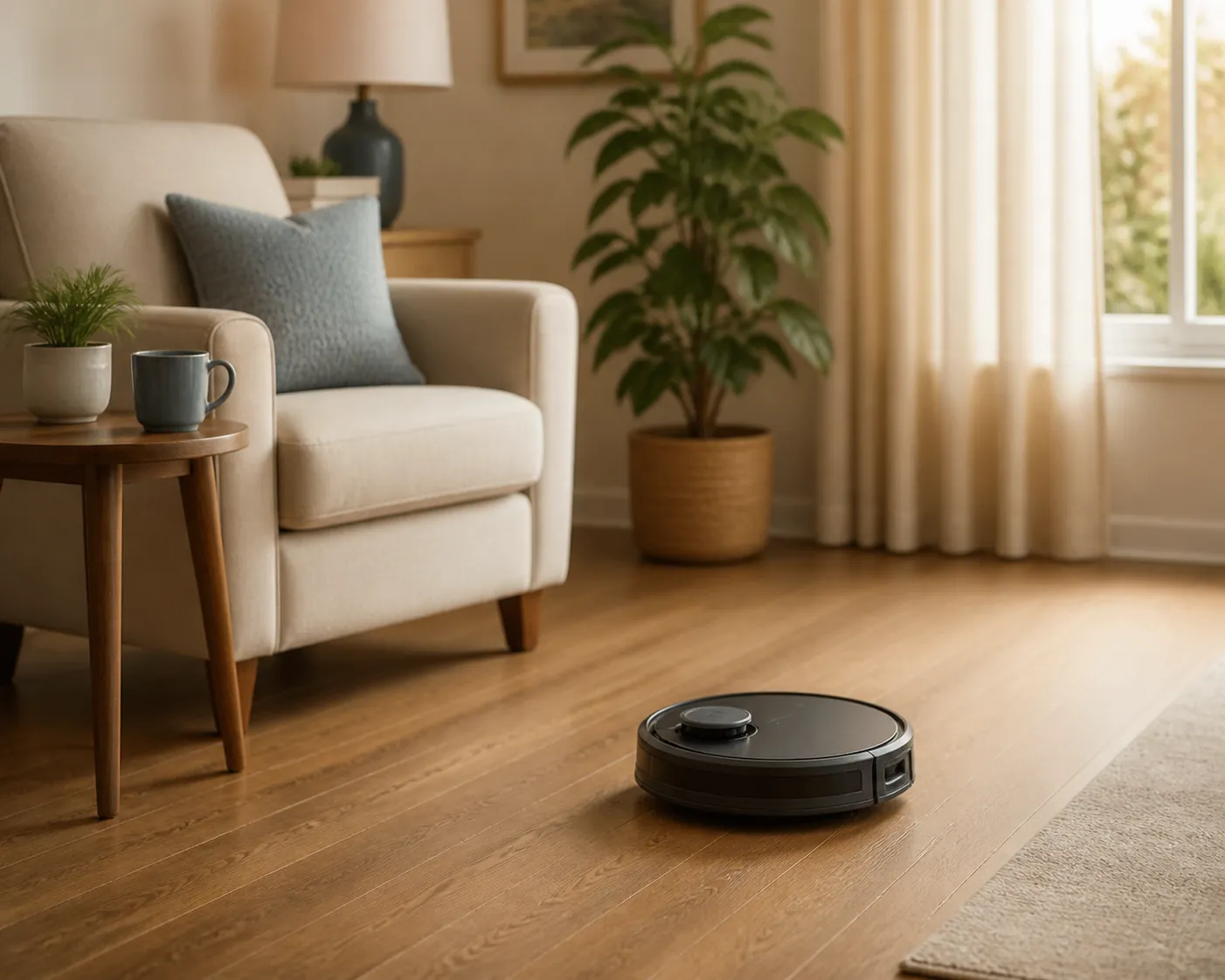
That is the useful starting point: do not drag the old upright vacuum back out of the closet tonight because of a headline. If the little vacuum has been keeping pet hair, crumbs, and dust from building up without leaving a cord across the room, it can keep doing that.
What the FCC Actually Did on July 28
On July 28, 2026, the FCC added foreign-produced advanced robotic devices to its Covered List. Reporting on the decision, including confirmation from an FCC spokesperson, says the category includes robot vacuums and robot lawn mowers.[3] The FCC’s own determination is broader than one household product: it is about communications equipment and services judged to pose national security concerns under the Covered List process.[4]
For a buyer standing in a store aisle or comparing models online, the key phrase is “previously authorized.” Robot vacuums use radios such as Wi-Fi or Bluetooth, so models generally need FCC equipment authorization before they are sold in the United States. If a model already had that authorization before the FCC action, the current guidance leaves room for it to remain on sale and to keep receiving permitted updates.[1][2]
The uncertain part is the next wave of models. New foreign-produced advanced robotic devices that have not yet been FCC-authorized face the new restriction, and future outcomes may depend on case-by-case waivers or additional FCC guidance.[1] Because this decision is only three days old, it is too early to treat any brand’s entire future product line as settled.
Can You Still Buy a Roomba or Robot Vacuum?
Yes, if you are buying a model that was already FCC-authorized. The practical buying window has not slammed shut. What has changed is the comfort level around waiting for the next model, the next sale season, or a redesigned version that may not yet have authorization.
For Roomba specifically, the safest factual statement is narrower than many headlines. Existing FCC-authorized Roomba models remain the clearer ground. iRobot’s Chapter 11 bankruptcy in December 2025 and acquisition by Chinese manufacturer Picea Robotics make future product-pipeline claims harder to state cleanly, but they do not mean a Roomba already in your home suddenly stops sweeping the kitchen.
If a senior already planned to buy a robot vacuum, this is a reasonable moment to choose a currently available, already approved model rather than waiting for an uncertain future release. That is not panic buying. It is simply the kind of practical timing that avoids one more unresolved issue later.
- Favor models already on sale from major retailers rather than unreleased or preorder-only devices.
- Check that the manufacturer still provides software and security updates.
- Prefer simple controls: a physical clean button, voice assistant support if already used at home, and an app that a caregiver can help set up once.
- Look for return windows long enough to test whether the vacuum actually handles the home’s thresholds, rugs, pet bowls, and chair legs.
Why This Matters for Fall Prevention
A robot vacuum is not a medical device, and the available evidence does not show that it has been independently proven to prevent falls. Its value is more ordinary than that. It can remove a few jobs that become risky with age: bending to plug in a cord, pulling a canister through a hallway, lifting a vacuum over a threshold, or stooping every day to empty a dustbin.
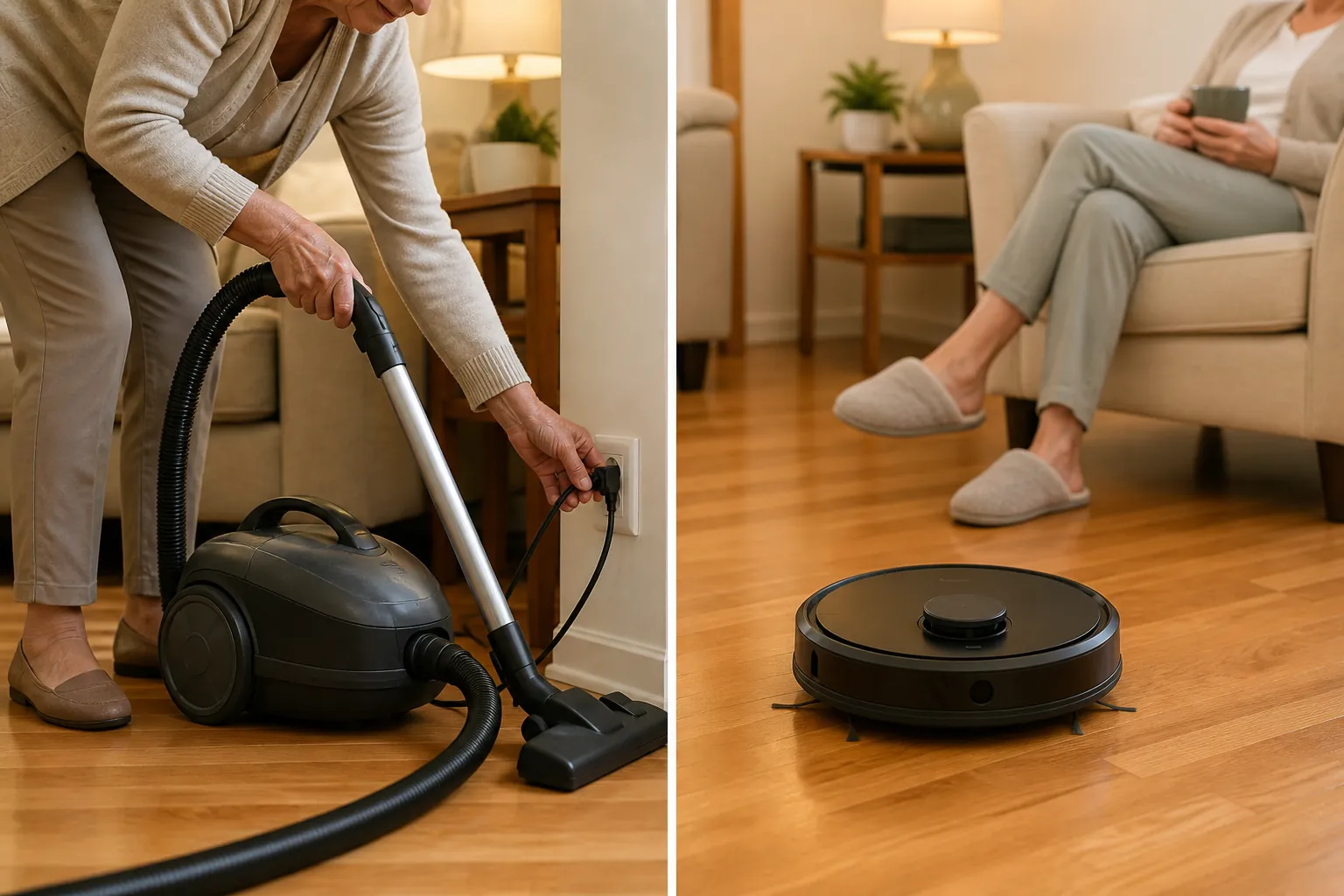
Manufacturer and user-facing materials describe robot vacuums as helpful for older adults because they reduce manual vacuuming, bending, and daily dustbin handling, especially when paired with self-emptying docks.[5][6] Those are product-benefit claims, not fall-prevention trial results. Still, anyone who has watched an older adult manage a heavy vacuum cord around an end table understands why the difference is not cosmetic.
The strongest senior-friendly features are the ones that remove a physical task or a point of confusion. A self-emptying base reduces trips to the trash can and repeated bending. Obstacle detection helps avoid socks, cords, and small objects that can stop the machine in an inconvenient place. A predictable schedule means the floor gets cleaned before crumbs and grit build up. Voice control can help if the app is too small, too fussy, or simply one app too many.
The home still has to be set up sensibly. A robot vacuum can get caught on loose fringe, push lightweight objects, or stop in a walkway if it runs into trouble. Before relying on one, do a slow walk-through: lift cords off the floor, remove loose throw rugs that already slide, keep charging docks out of narrow paths, and make sure the vacuum does not create a new obstacle near the bathroom, bedroom, or favorite chair.
For a broader safety plan, robot cleaning belongs beside ordinary home modifications, not in place of them. Better lighting, grab bars, stable rugs, clear walking paths, and heat-related fall precautions still matter. Readers building a larger plan can use guides on prioritizing aging-in-place modifications and fall prevention during heat waves as companion steps.
What About Privacy and Spying?
Privacy concerns are real enough to take seriously, but they should not be translated into “every robot vacuum is spying on every home.” The FCC determination does not identify a confirmed active exploitation campaign against deployed household robots. It places a class of foreign-produced advanced robotic devices on the Covered List because of national security concerns, which is different from saying your living-room vacuum has been personally compromised.[4]
There have been documented incidents and research findings around connected robots. Publicly reported examples include hacked Ecovacs Deebot X2 speakers in 2024, a Spanish researcher accessing more than 7,000 DJI robot cameras via MQTT in 2026, and CVEs affecting robot platforms, including UniPwn CVE-2025-35027 and CVE-2025-2894. Those examples show why updates and security design matter; they do not prove that ordinary senior households are seeing widespread active attacks.
Roomba owners have a few practical options. iRobot says its robots can operate without Wi-Fi, although connected features require an account and network connection; it also describes encryption and data-sharing choices, including opt-out controls.[7] Mozilla’s “Privacy Not Included” guide rated iRobot Roombas “pretty good” on privacy, while still encouraging consumers to understand what data is collected and how it is used.[8]
The most sensitive Roomba privacy story in recent years involved images captured from development versions of robot vacuums and later obtained by MIT Technology Review; that reporting was about training-data and contractor-review practices, not a finding that normal consumer Roombas were all secretly publishing home footage.[9] The distinction matters because seniors and caregivers need useful precautions, not fear that makes a helpful tool unusable.
- Keep the robot vacuum updated while updates remain available.
- Use a strong home Wi-Fi password and avoid sharing the robot account password widely.
- Review app settings for mapping, data sharing, voice assistants, and camera-based features if the model has them.
- Consider offline operation for basic cleaning if the model supports it and connected features are not needed.
- Use manufacturer opt-outs where available, especially if a caregiver set up the account on behalf of a parent.
What to Do This Week
If a robot vacuum is already part of the household routine, keep using it. Make sure it is charging properly, update the app or firmware if prompted, and check that it is not stopping in a walkway where someone could trip over it later.
If you were already thinking about buying one for a parent or spouse, focus less on the phrase “ban” and more on choosing a model that is available now, easy to maintain, and genuinely suited to the home. A self-emptying dock may be worth more than a flashy feature if bending is the daily problem. Simple scheduling may matter more than advanced mapping if the person using it will not open the app often.
If you are not sure whether a robot vacuum will help, borrow one, buy from a retailer with a return window, or test it in the rooms that matter most: the bedroom path, the kitchen, the hallway, and the main chair-to-bathroom route. The right question is not whether the robot is impressive. It is whether tomorrow morning’s floor is cleaner, clearer, and easier to move through.
The situation may change as the FCC publishes more guidance and manufacturers respond. For now, the practical judgment is steady: keep the device you have, keep it updated, consider buying soon if it already fits a fall-prevention plan, and treat floor-cleaning technology as one useful piece of a safer home rather than the whole plan.
References
- Covered List FAQs: Robots and Inverters, FCC
- FCC Waiver DA-26-789A1, FCC
- FCC Ban on Foreign-Made Robots Includes Robot Vacuums, PCMag
- FCC Determination DOC-423682A1, FCC, July 28, 2026
- Self-Empty Robot Gift for Elderly, Ecovacs
- What Impact Robotic Vacuums Have on Seniors and People with Disabilities, Srhythm
- Privacy and Data Sharing, iRobot Support
- iRobot Roombas, Mozilla Foundation
- Roomba testers feel misled after intimate images ended up on Facebook, MIT Technology Review
Browse more in the Glossary.