
Glossary entry
How to Plan Holiday Activities Seniors Can Safely Enjoy
The best holiday activities for seniors with family are usually not the fanciest ones. They are the ones an older adult can actually join without being parked in a recliner as the room happens around them. A cookie table with the right chair, a tree-decorating job that does not require reaching, or a short drive to see lights can feel more like togetherness than an elaborate outing that leaves everyone watching for the next stumble.
That planning matters because falls are common: the CDC reports that about 1 in 4 older adults falls each year.[1] Holiday homes also add their own temporary hazards, including rearranged furniture, cords across walking paths, displaced lamps, icy walkways, and crowded rooms, according to Age Safe America.[2] The useful part is that many risks are not mysterious. Age Safe America states that up to 80% of falls are preventable with simple home safety measures, which is exactly the kind of holiday preparation families can do before guests arrive.[2]
Start With What They Can Safely Tolerate
Before choosing activities, look at the day from the older adult's point of view. Can they sit upright comfortably for half an hour? Do they use a walker or cane? Can they stand long enough to hang ornaments, or would that turn into gripping the nearest table edge? Do crowds or noise make them confused, tired, or anxious? None of this needs to become a family medical exam. It is simply the difference between planning participation and hoping participation happens.
A practical holiday plan should account for three things: mobility, stamina, and cognitive load. Mobility tells you whether the activity should be seated, supported standing, or an outing. Stamina tells you how long the activity should last. Cognitive load tells you whether the setting should be quiet and familiar or whether a busy concert, crowded church service, or late-night gathering will ask too much.
For many families, the safest rhythm is shorter than tradition suggests. Heisinger Bluffs recommends 20- to 30-minute activity sessions with rest breaks for seniors with limited mobility.[3] That does not make the holiday smaller. It keeps the enjoyable part from sliding into fatigue, which is often when the careful walking, steady transfers, and good judgment start to fray.
| Ability level | Better-fit holiday activities | Safety setup that matters most |
|---|---|---|
| Limited mobility, walker use, or easy fatigue | Cookie decorating, ornament crafting, card writing, board games, photo albums | Firm chair with arms, clear path to table, supplies within reach, 20-30 minute sessions |
| Can stand briefly with support nearby | Low tree decorating, setting a small centerpiece, choosing ornaments, car-based light viewing | Stable chair with armrests, no reaching, cords taped to baseboards, non-slip footwear |
| Moderate mobility and enough stamina for a short trip | Holiday concerts with accessible seating, daytime light tours, brief family visits | Accessible parking and seating checked ahead, less crowded timing, planned restroom access |
Seated Activities: For Limited Mobility, Walker Users, and Tired Days
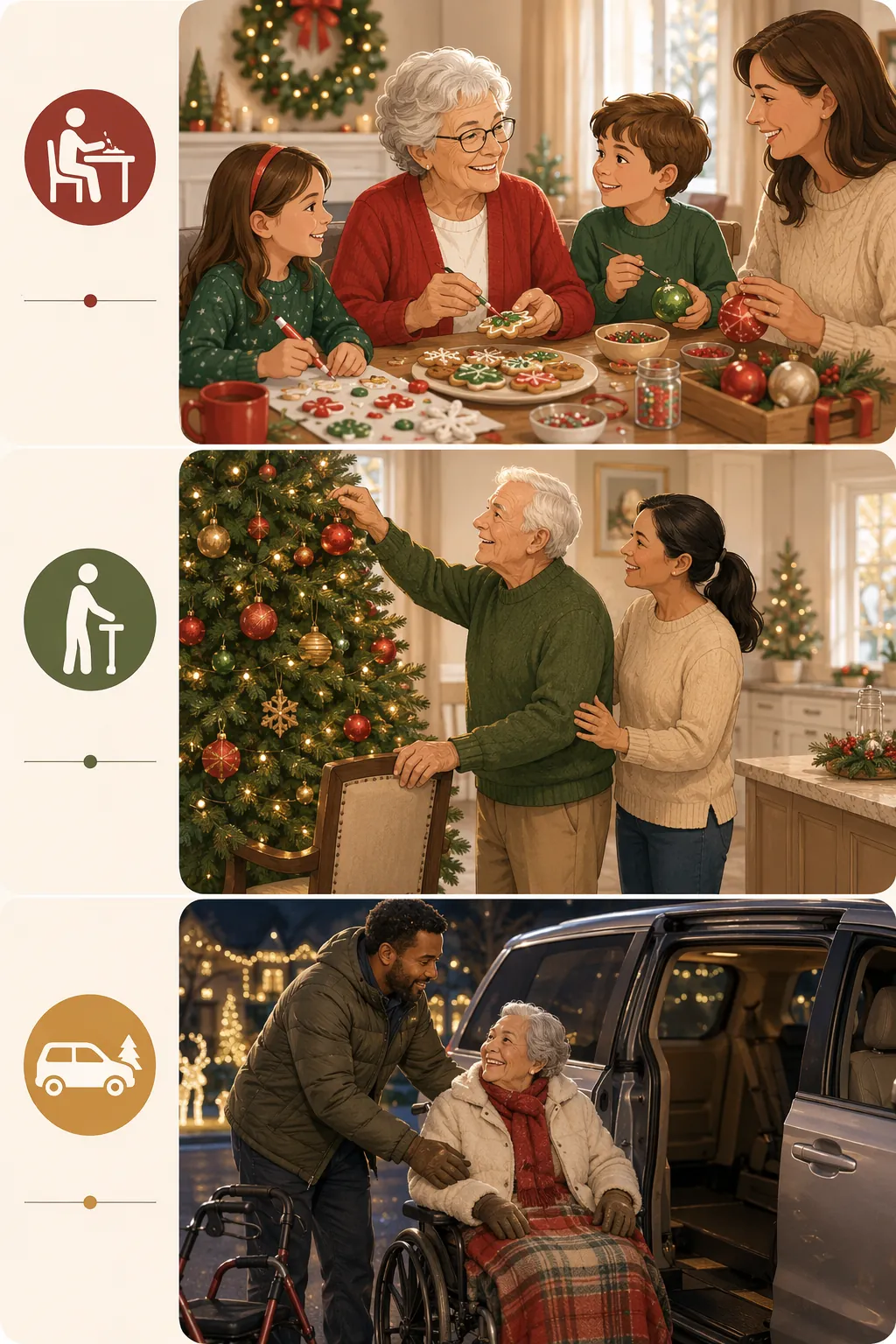
Seated activities are not the consolation prize. Done well, they are often the most inclusive part of the holiday because children, adults, and older relatives can all work at the same level. A Place for Mom includes cookie decorating, ornament making, card writing, games, and looking through photos among meaningful holiday activities for older loved ones.[4] The difference between "sweet idea" and "actually workable" is usually the setup.
Cookie Decorating
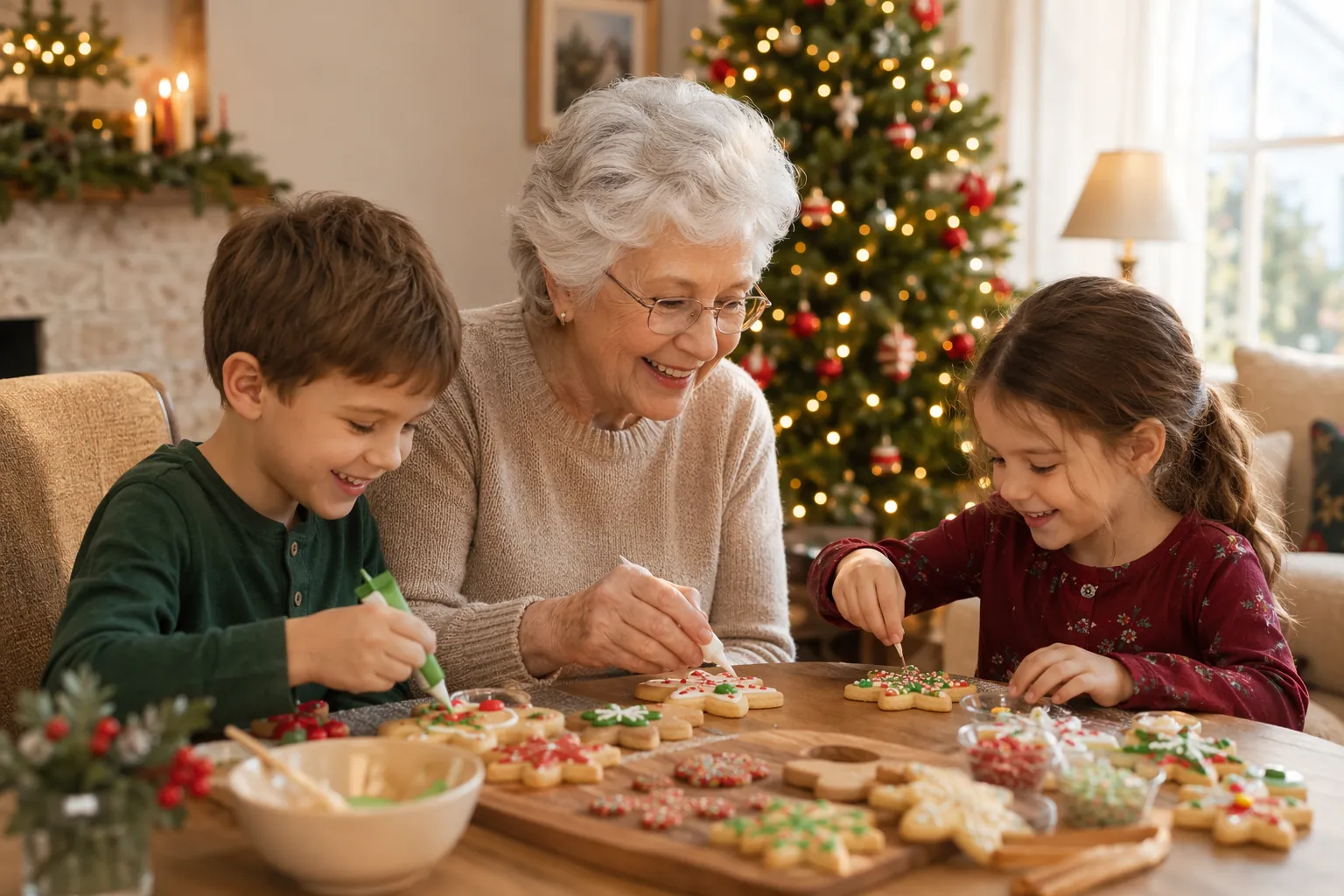
Cookie decorating works well for seniors who can sit comfortably and use their hands, even if standing at the kitchen counter is no longer safe. Put the senior at a real table, not on the edge of the action. The chair should be firm, stable, and ideally have arms so sitting down and standing up do not require grabbing the tablecloth or a nearby child.
Set out only what they need: a small plate of cookies, a few icing colors, sprinkles in containers that are easy to open, napkins, and water. Keep the mixing bowls, hot trays, oven doors, and traffic of the kitchen somewhere else. If young children are helping, give them a separate sprinkle zone instead of letting everyone reach over the same chair.
- Use a chair with armrests rather than a folding chair.
- Clear the walking route from the living room, bathroom, and kitchen to the table.
- Keep bags, toy bins, and gift boxes out from underfoot.
- Plan a natural stopping point after about 20-30 minutes.
Ornament Crafts and Card Writing
Ornament crafting and card writing are good choices when fine motor skills are still comfortable but walking around the house is not. Choose materials that do not roll away, drip, or require scissors if dexterity is limited. Foam stickers, wide markers, pre-cut ribbon, adhesive labels, and large-print address lists are kinder than tiny hooks and glitter that falls on the floor and waits for someone with a walker.
Card writing can also carry more meaning than it looks like. It gives an older relative a role that is not decorative: choosing who receives a note, adding a sentence, signing their name, or telling a grandchild what to write. If memory changes make a long address list frustrating, narrow the task. Three cards written with patience are better than a stack that turns the table into a test.
Games and Photo Albums
Board games and photo albums fit seniors who enjoy conversation but may tire from constant movement. Pick games with large pieces, simple turns, and low pressure. If hearing is difficult, seat the senior away from the loudest part of the room and make sure one person is close enough to repeat turns without making a performance of it.
Photo albums are especially useful when the family wants conversation without putting the older adult on the spot. Instead of asking, "Do you remember this?" try, "Tell us about this house," or "Who made this pie?" That leaves room for memory without turning a warm activity into a quiz.
Supported Standing Activities: For Seniors Who Can Stand Briefly
Some seniors still want to decorate, stir, arrange, and inspect. They may not want to be assigned to the couch while everyone else handles the visible parts of the holiday. Supported standing activities work when standing is brief, the task is at waist or chest height, and a stable seat is close enough that sitting down does not require a search party.
Tree Decorating Without Reaching or Climbing
Tree decorating can be adapted without making it feel fake. Give the older adult the lower, easy-to-reach ornaments or the job of choosing which ornaments go on next. If they want to place a few themselves, keep the tree area clear and limit the work to branches that do not require bending, twisting, stepping backward, or reaching overhead.
The tree itself changes the room. Furniture gets shifted, lamps move, cords appear, and familiar routes can disappear under decor. Age Safe America specifically identifies rearranged furniture and new cords across pathways as holiday fall risks.[2] Tape cords to baseboards, avoid extension cords across walking routes, and put the sturdy chair with arms near the tree before anyone starts handing out ornaments.
Small Decorating Jobs That Still Count
A senior does not need to handle the whole tree to participate. They can arrange a tabletop nativity scene, choose ribbon colors, sort ornaments by family member, place unbreakable decorations in a basket, or help set a centerpiece while seated. These jobs are safer when the supplies come to them rather than asking them to circulate through a crowded room.
Footwear matters here. Socks on polished floors, floppy slippers, and long robe hems can turn a cheerful five-minute task into the most dangerous part of the evening. Ask about shoes early, not after someone has already crossed the room three times in slippery socks.
Car-Based Light Viewing
Light viewing from the car can be a good middle option for someone who likes holiday outings but cannot safely walk through a crowded display. The activity is not the drive alone; it is the transfer into the car, the cold walkway, the seat belt, the need for a bathroom, and the transfer back into the house afterward. Those parts deserve as much planning as the route.
Choose a short route, go before the most crowded time if possible, and decide in advance whether anyone is getting out of the car. If the answer is no, say so kindly before leaving. If the answer is maybe, bring the mobility aid, check the ground surface, and skip stops where people will be stepping over curbs, snow piles, or extension cords.
Gentle Outings: For Seniors With Moderate Mobility and a Clear Exit Plan
Holiday concerts, church programs, daytime light tours, and brief visits can be wonderful for a senior who still has moderate mobility. They can also become too much very quickly if the family treats "accessible" as a vague hope instead of a checked detail.
Call or check ahead for accessible parking, wheelchair access, elevator availability, aisle seating, restroom location, and whether the venue has a drop-off area near the entrance. For an older adult who uses a walker, the difference between a close entrance and a long walk through a crowded parking lot is not a small inconvenience. It may decide whether the outing is possible at all.
- Choose daytime events when lighting is better and fatigue is lower.
- Avoid the busiest arrival and departure times when crowds compress pathways.
- Pick seats near an exit or aisle if bathroom trips are likely.
- Keep the outing short enough that leaving early does not feel like failure.
- Bring the usual mobility aid even if the senior says they may not need it.
This is also where emotional inclusion matters. The National Council on Aging notes the Surgeon General's finding that loneliness is associated with mortality risk comparable to smoking 15 cigarettes a day.[5] That does not mean every older adult needs a packed holiday calendar. It means that being meaningfully included is not a decorative extra, and safety planning should make connection possible rather than quietly narrowing the senior's world.
Match the Activity to Cognition, Not Just Walking Ability
Mobility is visible, so families tend to plan around it first. Cognitive stamina is easier to miss. A senior may walk well enough to attend a gathering but struggle with a noisy room, several conversations at once, unfamiliar furniture placement, or being asked to make repeated choices.
For mild memory changes, keep activities familiar and concrete: sorting ornaments, signing cards, looking at photos, tasting cookies, folding napkins, or listening to familiar music. For confusion that worsens later in the day, move the main shared activity earlier. For a senior who becomes anxious in crowds, choose a smaller group or a quieter room where family members rotate in rather than expecting the older adult to manage the whole party at once.
The goal is not to remove every challenge. It is to avoid setting up an activity where the senior spends the whole time compensating: trying to hear, trying to remember, trying not to trip, trying to look cheerful while watching everyone else move too fast.
Room-by-Room Holiday Safety Setup
Once the activity is chosen, the house has to support it. Holiday safety is not a separate lecture after the fun has been planned. It is the quiet work that lets the fun happen without the older adult navigating a new obstacle course in a familiar home.
Living Room
The living room is where holiday charm most often steals the walking route. The tree goes where the side table used to be. A lamp moves to make room for presents. A power strip appears behind a chair. Someone pulls an ottoman into the middle of the room because it looks cozy.
- Tape tree and decoration cords to baseboards, never across a walking path.
- Keep pathways about 36 inches wide so a walker can pass without side-stepping.
- Use firm chairs with armrests for anyone who has trouble standing from soft seating.
- Move gift bags, pet beds, toys, and low decor out of the main route.
- Check that the lamp you moved did not leave a dim corner on the route to the bathroom.
Bathroom
The bathroom is not festive, which is why it gets forgotten. It should not be. Age Safe America states that bathrooms account for more than 80% of serious household falls among older adults, and it cautions that grab bars should be anchored to wall studs rather than suction-cup mounted.[2]
If an older guest will be in the house for several hours or overnight, the bathroom path needs to be treated as part of the gathering. A non-slip bath mat, an uncluttered floor, a raised toilet seat if needed, and a properly installed grab bar are not overpreparing. They are the difference between a normal bathroom trip and a preventable emergency.
Night walking deserves special attention. Age Safe America reports that 60% of falls occur at night while walking to the bathroom and describes a $10 nightlight as a potentially life-saving fix.[2] Put one in the bedroom, hallway, and bathroom before bedtime, not after someone has already tried to find the switch in the dark.
Front Entry
The front entry is the first transfer point: car to walkway, walkway to step, step to threshold, threshold to a room full of people saying hello. Age Safe America says more than 40% of outdoor falls happen within 3 feet of the front door and points to a motion-sensor light and non-slip mat as low-cost fixes.[2]
- Use a flat, non-slip welcome mat that will not bunch under a walker or cane.
- Add a motion-sensor light, especially if guests may leave after dark.
- Salt or sand icy walkways before guests arrive, not as they are stepping out of the car.
- Clear decorations, planters, and extension cords away from the door swing and threshold.
- Have one person help with the entry instead of creating a crowd at the doorway.
Kitchen
The kitchen gets busy fast, and busy kitchens are not kind to walkers, canes, or slower reaction times. If the senior wants to help, bring a seated job to the table: trimming green beans, reading a recipe aloud, choosing serving dishes, folding napkins, or decorating cooled cookies. Standing near the stove while people carry hot pans behind them is not the only way to contribute.
- Use non-slip mats at the sink and stove if the senior will stand there.
- Store heavy dishes and frequently used items at waist height.
- Keep the walking path clear of step stools, grocery bags, pet bowls, and open dishwasher doors.
- Make sure the fire extinguisher location is visible and not blocked by holiday storage.
Guest Bedroom
If the senior is staying overnight, the guest bedroom should be set up before the house is tired and full of coats. The bed should be high enough to stand from without a deep push, but not so high that feet cannot reach the floor. A firm mattress is usually easier for transfers than a soft, sinking one.
- Place a nightlight on the path from bed to bathroom.
- Put a phone, water, glasses, tissues, and medications within easy reach.
- Clear suitcases, extra blankets, and decorative pillows from the floor.
- Leave space beside the bed for a walker or cane.
- Show the bathroom route in daylight before the first nighttime trip.
A Simple Planning Cue Before the Gathering
Before the holiday, choose one activity from the right ability tier, set a time limit that respects fatigue, and walk the route the senior will use: entry, chair, table, bathroom, and bedroom if needed. Look for the things that changed because of the holiday: the cord, the moved lamp, the poinsettia stand, the extra chair, the icy step, the gift bag in the hallway.
A good holiday plan is not the most elaborate one. It is the one where the older adult has a real part to play, enough rest to enjoy it, and a house that has been adjusted for the predictable hazards before everyone gathers.
References
- Older Adult Falls Data — CDC
- How to Prevent Falls During the Holidays: Room-by-Room Safety Checklist — Age Safe America
- Planning Holiday Activities for Seniors with Limited Mobility — HBRHC / Heisinger Bluffs
- 35+ Meaningful Holiday Activities for Elderly Loved Ones — A Place for Mom
- Combat Loneliness in Older Adults During the Holidays — NCOA
Browse more in the Glossary.