
Glossary entry
How Is the 2027 Social Security COLA Calculated?
Last verified 2026-07-29
This is not financial or legal advice. Medicare/Medicaid and benefits rules vary by state and change over time — verify current rules with your state Medicaid office or Area Agency on Aging.
The 2027 Social Security COLA is not a number the Social Security Administration can finish calculating yet. The rule is fixed, but two of the three months that matter are still missing. For 2027, SSA will compare the average CPI-W for July, August, and September 2026 with the average CPI-W for July, August, and September 2025, then round the percentage increase to the nearest one-tenth of 1%.[1]
That is the part to keep separate from the headlines. A 3.6%, 3.7%, or 3.8% figure in July 2026 is an estimate, not the official 2027 COLA. The official rate waits for the September 2026 CPI-W reading, which is expected in mid-October 2026. Once that number is released, SSA can complete the calculation and announce the final COLA.[1]

What Is Known Now, and What Is Still Missing
The known part is the formula. Social Security COLAs are tied to the Consumer Price Index for Urban Wage Earners and Clerical Workers, usually shortened to CPI-W. SSA does not choose a general inflation estimate, average a full year of prices, or use the inflation number most often quoted in the news. It uses the CPI-W average for the third quarter: July, August, and September.[1]
For the 2027 COLA, July 2026 CPI-W data is available, but August and September 2026 data are still pending. That means the calculation has started to take shape, but it cannot be completed. A projection can be useful for planning rent, prescriptions, groceries, or a household budget, but it should still be treated as a placeholder until the last required month is in.
| Question | Status in July 2026 |
|---|---|
| Which inflation index is used? | CPI-W, the Consumer Price Index for Urban Wage Earners and Clerical Workers |
| Which months matter for the 2027 COLA? | July, August, and September 2026 compared with July, August, and September 2025 |
| Is the official 2027 COLA known yet? | No. August and September 2026 CPI-W data are still pending |
| When should the official rate be known? | After September 2026 CPI-W data is released in mid-October 2026 |
| Are current 3.6% to 3.8% figures official? | No. They are July 2026 projections |
The 2027 COLA Formula, Step by Step
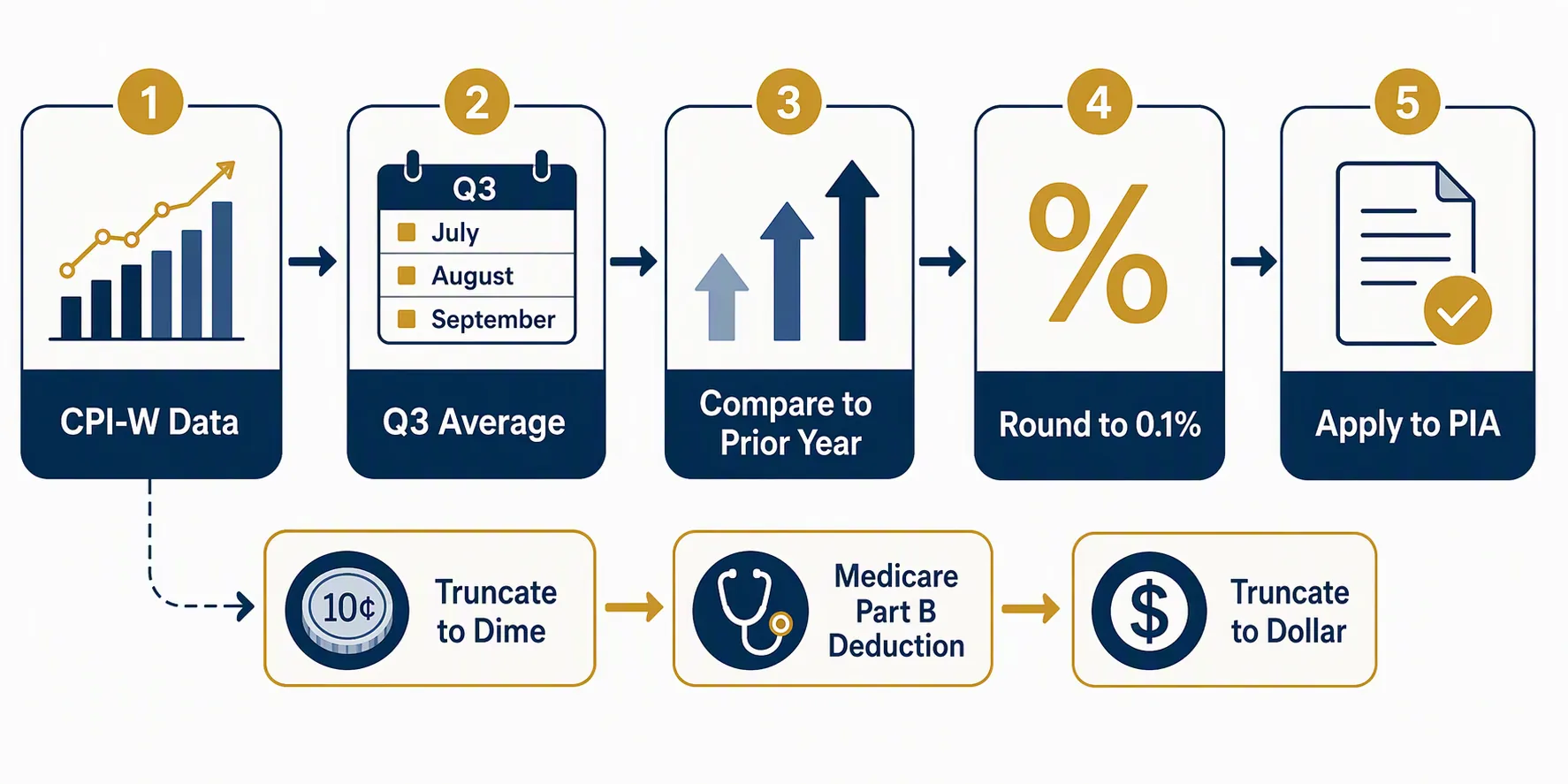
The calculation is easier to follow if the word “average” is taken literally. SSA does not look only at September. It takes the CPI-W for July, August, and September of the current measuring year, adds those three index values together, and divides by three. That gives the third-quarter average for 2026.
Then SSA compares that 2026 third-quarter average with the third-quarter average from 2025. If the 2026 average is higher, the percentage increase becomes the starting point for the COLA. SSA then rounds that increase to the nearest one-tenth of 1%.[1]
- Take the CPI-W readings for July, August, and September 2026.
- Average those three readings.
- Compare that average with the CPI-W average for July, August, and September 2025.
- Calculate the percentage increase.
- Round the result to the nearest 0.1%.
If the third-quarter CPI-W average does not rise from one measuring year to the next, there is no COLA. That rule matters because it explains why the formula has a floor at zero rather than producing a benefit cut. Current inflation conditions make a no-COLA outcome unlikely for 2027, but the feature belongs to the formula and is worth knowing.[1]
Why July, August, and September Carry So Much Weight
The third quarter matters because the law uses that specific window for the annual comparison. It may feel odd if a household’s biggest price pressures happen in winter, or if grocery and prescription costs move differently from the index. But for the COLA calculation, the question is narrower: did the CPI-W average for July through September 2026 rise above the CPI-W average for July through September 2025?
This is also why estimates shift during the year. A projection made before all three third-quarter months are known has to rely on partial data and assumptions about the missing months. Once each new CPI-W release arrives, the estimate can move up or down. That movement does not mean the formula changed. It means the unfinished inputs changed.
The clean dividing line is September. July alone is not enough. July plus August is still not enough. The September 2026 CPI-W release completes the three-month set, and that is when SSA can replace projections with the official 2027 COLA.[1]
Where the 3.6% to 3.8% Estimates Fit
As of July 2026, the public estimates clustered in a narrow range. AARP reported an early 2027 COLA estimate of 3.6%.[2] The Senior Citizens League’s COLA Watch placed its estimate at 3.8%.[3] CNBC reported that independent Social Security and Medicare policy analyst Mary Johnson projected 3.7%, while also noting that the estimate had been revised downward as inflation readings cooled earlier in 2026.[4]
Those are not three official answers. They are three attempts to anticipate the same official calculation before the required data set is complete. For a household budget, that range can help with cautious planning. For a benefits notice, bank deposit, or Medicare deduction calculation, it is too early. SSA’s mid-October announcement is the number that replaces the estimates.[1]
The Headline COLA Is Not the Same as the Deposited Increase
Once SSA has the COLA percentage, it still has to apply that percentage to each person’s benefit. This is the point where a neat headline number begins to turn into a less tidy monthly payment. The COLA is applied first to the person’s Primary Insurance Amount, or PIA. After the COLA is applied, the result is truncated to the next lower dime.[5]
For beneficiaries who have Medicare Part B premiums deducted from their Social Security payment, that premium comes out after the benefit amount is adjusted. Then the final monthly benefit payable is truncated to the next lower dollar.[5]
- SSA applies the COLA percentage to the Primary Insurance Amount.
- The adjusted PIA is truncated to the next lower dime.
- Any Medicare Part B premium deduction is subtracted, if it applies.
- The remaining monthly benefit is truncated to the next lower dollar.
That is why two people who hear the same COLA percentage may not see the same dollar increase in their deposits. Their starting benefit amounts may differ. One may have Medicare Part B deducted and another may not. Rounding and truncation can shave off small amounts that are invisible in a percentage headline but very visible when someone is checking a bank deposit.
A Simple Hypothetical Example
Suppose, hypothetically, a person’s benefit calculation starts with a PIA and the official COLA is later applied to it. SSA would not simply multiply the current deposited amount by the COLA and call that the new payment. It would apply the COLA to the PIA, truncate the adjusted PIA to the next lower dime, subtract Medicare Part B if the person has that premium withheld, and then truncate the final amount to the next lower dollar.[5]
That example is deliberately general because the exact result depends on the person’s own benefit record and deductions. The useful lesson is the sequence. The COLA percentage starts the calculation; it does not by itself tell a person what will land in the bank.
Medicare Part B Can Change the Net Increase
Medicare is the other reason a COLA headline can feel larger than the increase a person actually sees. Many Social Security beneficiaries have Medicare Part B premiums deducted directly from their monthly Social Security payments. If the Part B premium rises for 2027, part of the gross COLA increase may be absorbed before the payment is deposited.
The 2026 Medicare Trustees Report estimate discussed in current planning materials puts the 2027 Part B premium at about $209.50 per month, up from $202.90 in 2026, but that is not the final 2027 premium. Beneficiaries should wait for the official Medicare premium announcement before treating any Part B figure as final.
This is not a small technical footnote for someone living on a fixed income. A gross Social Security increase and a net payment increase are different things. The gross increase answers what the COLA did to the benefit calculation. The net increase answers what is left after applicable deductions.
Recent COLAs Show Why People Pay Attention
Recent COLAs have not felt routine. SSA’s COLA history shows increases of 5.9% for 2022, 8.7% for 2023, 3.2% for 2024, 2.5% for 2025, and 2.8% for 2026.[6] Those numbers help explain why beneficiaries and caregivers are watching the 2027 estimate closely. A few tenths of a percentage point can matter when the same check is expected to cover housing, food, utilities, health care, and transportation.
Still, history does not calculate the next COLA. The 2027 rate will come from the 2026 third-quarter CPI-W average compared with the 2025 third-quarter CPI-W average. Past COLAs provide context, not a shortcut.
What to Watch Between Now and the Official Announcement
Between now and mid-October 2026, the practical watchpoint is not every inflation headline. It is the CPI-W readings for the months that count. July 2026 is already part of the picture. August and September 2026 still have to be released before the official COLA can be calculated.
- Use July 2026 estimates as planning placeholders, not final benefit amounts.
- Expect estimates to move when additional CPI-W data is released.
- Look for SSA’s official COLA announcement after September 2026 CPI-W data is released in mid-October 2026.
- Remember that Medicare Part B deductions can reduce the net increase in a monthly payment.
- Use your own SSA notice and official Medicare premium information for your final numbers.
The official 2027 Social Security COLA will be known only after the September 2026 CPI-W release completes the third-quarter data. Until then, the responsible way to use the 3.6% to 3.8% range is as a planning aid, not a promise. This article is informational benefits-literacy guidance, not financial advice; each beneficiary’s final amount depends on SSA’s official COLA, the person’s benefit record, applicable deductions, and the official Medicare premium announcements.
References
Browse more in the Glossary.