
Glossary entry
The 2027 Social Security COLA Increase Is Smaller Than It Looks
Last verified 2026-07-28
This is not financial or legal advice. Medicare/Medicaid and benefits rules vary by state and change over time — verify current rules with your state Medicaid office or Area Agency on Aging.
For a retiree trying to estimate the 2027 Social Security COLA increase, the headline number is only the first half of the arithmetic. Current projections point to a gross Social Security COLA of about 3.6% to 3.8%, but Medicare Part B is expected to take a piece of that before the payment reaches the bank account. On a $2,000 monthly Social Security benefit, that leaves an estimated net increase of about $65 to $70 a month after the standard Part B premium deduction.
That is still a raise. It is just not the same raise people see when they multiply their benefit by the COLA percentage and stop there.

The Spendable-Dollar Estimate
AARP has put the 2027 COLA estimate at 3.6%.[1] The Senior Citizens League and the Committee for a Responsible Federal Budget have been around 3.8%, with CRFB also giving a wider possible range of 3% to 4.5%.[2] That wider range is not a reason to treat every number as equally likely; it is a reminder that the final COLA is not known yet.
The official figure depends on the September CPI-W data scheduled for release on October 14, 2026, followed by the Social Security Administration’s COLA announcement.[2] Until then, every 2027 COLA number is a projection, even when it comes from a careful source.
The Medicare side is also still an estimate. The standard Part B premium is projected to rise from $202.90 in 2026 to about $209.50 in 2027, an increase of $6.60 a month, based on the Medicare Trustees projection cited in July 2026 reporting.[3] The final 2027 Part B premium is expected in November 2026.[3]
| If monthly Social Security benefit is $2,000 | Gross COLA increase | Projected standard Part B increase | Estimated net monthly increase |
|---|---|---|---|
| 3.6% COLA estimate | $72.00 | $6.60 | $65.40 |
| 3.8% COLA estimate | $76.00 | $6.60 | $69.40 |
This is the calculation many retirees care about most: the COLA is applied to the Social Security benefit, but the higher Part B premium is commonly deducted from the monthly Social Security payment. So the person with a $2,000 benefit does not simply get to keep the whole $72 or $76. The projected standard Medicare increase reduces the amount that actually arrives by $6.60.
For a household with one Social Security check, the difference between the 3.6% and 3.8% estimates is about $4 a month on a $2,000 benefit. For a household with two checks, or for someone with a higher benefit, the dollar difference changes. The percentage is the same; the checkbook result is not.
Why 2026 Made Retirees Wary
The caution around 2027 is not just habit. In 2026, the Social Security COLA was 2.8%, while the standard Medicare Part B premium rose 9.7%, from $185 to $202.90.[4] That $17.90 monthly premium increase came out of checks before many retirees had a chance to feel much of the COLA.[4]
Someone with a smaller benefit felt that more sharply than someone with a larger one. A premium increase is a flat dollar amount for people paying the standard Part B premium, while the COLA is a percentage of the Social Security benefit. That means a retiree with a modest check can see a larger share of the raise swallowed by Medicare.
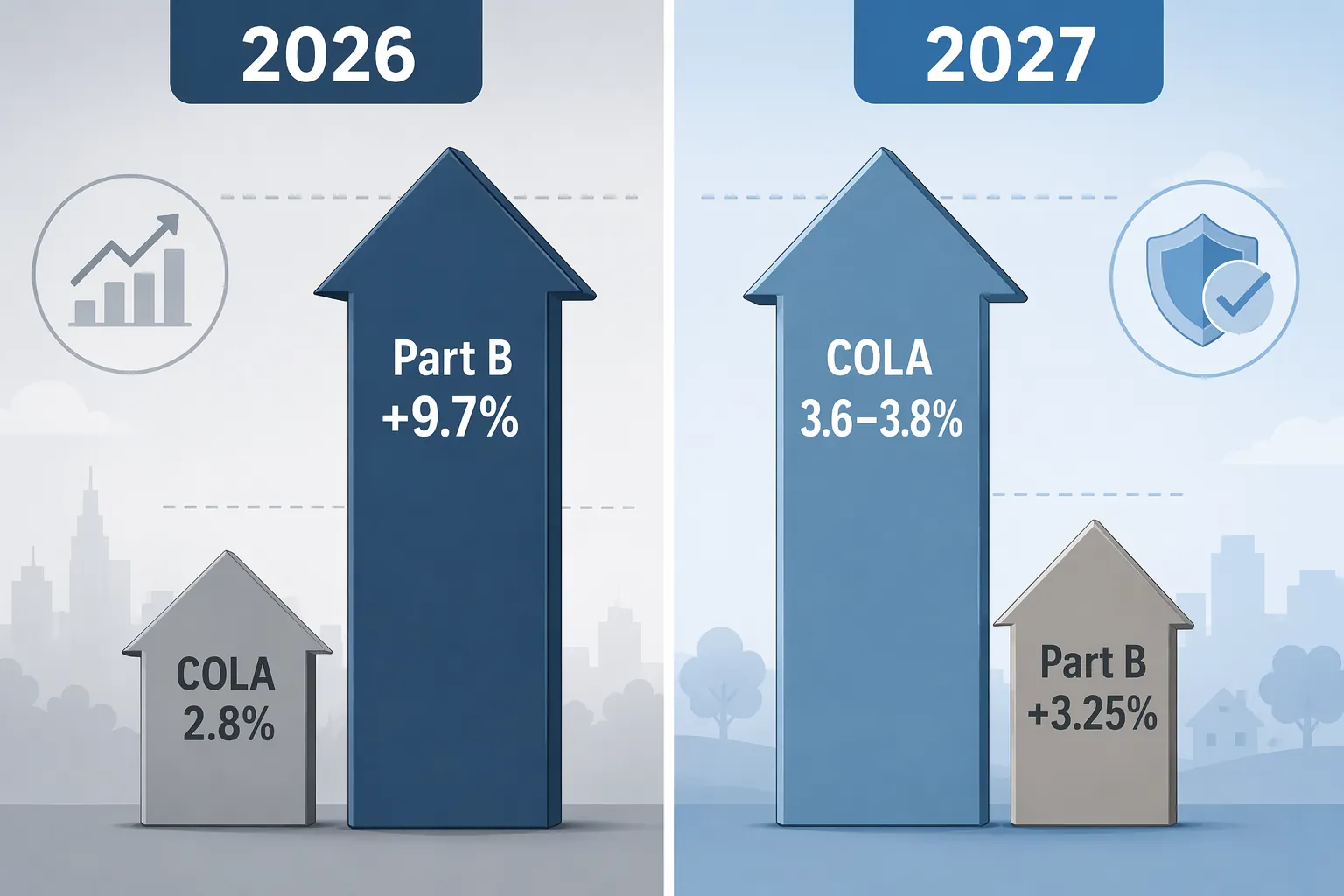
That is why the 2027 projection deserves a little credit, even after the Medicare deduction. If the current estimates hold, COLA growth would exceed Medicare premium growth for the first time since 2023.[3] It does not make the raise large, but it changes the direction of the squeeze.
The Part B Deduction Is the First Adjustment, Not the Only One
The $65 to $70 estimate is useful because it shows the standard case plainly. It is not a promise for every retiree.
- People with benefits below $2,000 would see a smaller gross COLA in dollars, so the same $6.60 projected Part B increase would take a bigger share of the raise.
- People with benefits above $2,000 would see a larger gross COLA in dollars, though Medicare and tax details may still reduce the amount they feel.
- People who pay IRMAA, the Income-Related Monthly Adjustment Amount, do not fit the standard Part B example because their Medicare premiums are higher.
- People who have Medicare premiums handled differently should use their own benefit notice or my Social Security account rather than this standard deduction example.
For a quick kitchen-table estimate, use the same order: multiply your current monthly benefit by the projected COLA, then subtract the projected increase in your Medicare Part B premium. If you pay the standard premium, the current projected subtraction is $6.60. If you pay more because of IRMAA, the subtraction will need your own Medicare figure.
Why the Raise Can Still Feel Thin
The COLA is meant to help benefits keep up with inflation, but retirees do not spend from a national average basket. The Senior Citizens League has estimated that Social Security benefits have lost about 13.7% of purchasing power since 2010.[5] One reason it points to is the gap between the CPI-W, which is used for the COLA, and CPI-E, an experimental index that gives more weight to older Americans’ spending patterns. In TSCL’s comparison, healthcare is weighted at 6.9% in CPI-W and 11.3% in CPI-E.[5]
That does not mean the 2027 COLA estimate is wrong. It means a correct COLA can still feel short when the bills on the table are prescriptions, premiums, repairs, insurance, and groceries. A percentage can be accurate and still not stretch far.
What to Check Before Treating the Number as Final
There are two official steps left. First, the September CPI-W release on October 14, 2026 should allow the Social Security Administration to announce the final 2027 COLA.[2] Second, the final Medicare Part B premium is expected in November 2026.[3] The most useful personal number will come after both are known.
Once the notices arrive, compare three lines: your 2026 gross benefit, your 2027 gross benefit, and your 2027 Medicare deduction. The difference between the old net deposit and the new net deposit is the raise you can actually budget.
Retirees who use the extra amount for health or home-safety costs may also want to review what Medicare fall prevention services cover and whether local or state programs offer property tax relief for seniors that can support home safety improvements. A $65 or $70 monthly increase will not remodel a house, but it can help pay for practical fixes when paired with other benefits.
This article is informational only and is not financial, tax, legal, or Medicare advice. For your own 2027 amount, use the official SSA notice, your my Social Security account, and your Medicare premium information after the final figures are released.
References
- COLA 2027 Increase Estimate, AARP.
- Social Security 2027 COLA inflation retirees, CBS News.
- What a Bigger 2027 COLA Could Mean for Your Medicare Premiums, The Motley Fool, July 23, 2026.
- 2026 Social Security COLA vs. Medicare Part B premium increase, CNBC Select.
- COLA Watch, The Senior Citizens League.
Browse more in the Glossary.