
Glossary entry
Will taxes eat part of your 2027 Social Security COLA?
Last verified 2026-08-05
This is not financial or legal advice. Medicare/Medicaid and benefits rules vary by state and change over time — verify current rules with your state Medicaid office or Area Agency on Aging.
Last verified: August 5, 2026. This article is for general benefits-literacy purposes and is not tax, legal, or financial advice. Check IRS, SSA, and current 2026/2027 guidance before making withholding or estimated-payment decisions.
Your January 2027 Social Security check may be bigger. That does not mean every new dollar is automatically tax-free.
The federal tax problem starts with a line that has not moved with inflation: Social Security benefits can become taxable once your “provisional income” crosses $25,000 for many single filers or $32,000 for married couples filing jointly. The IRS calculation is adjusted gross income, plus tax-exempt interest, plus one-half of your Social Security benefits.[1]

That is why the practical answer to “2027 Social Security COLA increase: what seniors should expect” is not just a percentage. If your other income already puts you close to the tax line, the COLA can be the marginal amount that moves part of your benefit into taxable territory.
The 2027 COLA is still an estimate until the official announcement on October 14, 2026. AARP has projected a 3.6% increase, about $75 a month on an average retiree benefit of roughly $2,084.[2] CNBC Select, citing The Senior Citizens League, reported a 3.8% projection, which would raise a $2,026 benefit to about $2,103, or roughly $77 a month.[3] For the announcement calendar, see our guide to the 2027 Social Security COLA announcement date; for the inflation formula itself, see our separate 2027 COLA formula explainer.
The fixed tax thresholds matter more than the headline COLA
The phrase “up to 85% taxable” is easy to misunderstand. It does not mean the government takes 85% of your Social Security check. It means that, depending on your provisional income, up to 85% of your annual Social Security benefits may be included in taxable income. Your actual tax depends on the rest of your return.
The first test is whether your provisional income crosses the base amount for your filing status. IRS Publication 915 gives the key thresholds this way:[1]
| Filing status | First threshold where benefits may become taxable | Band where up to 50% of benefits may be taxable | Above this point, up to 85% may be taxable |
|---|---|---|---|
| Single, head of household, qualifying surviving spouse | $25,000 | $25,000 to $34,000 | More than $34,000 |
| Married filing jointly | $32,000 | $32,000 to $44,000 | More than $44,000 |
| Married filing separately and lived apart from spouse for all of the tax year | $25,000 | $25,000 to $34,000 | More than $34,000 |
| Married filing separately and lived with spouse at any time during the tax year | $0 | Special rule applies | Up to 85% may be taxable |
Those dollar lines are the trap for people living close to them. A cost-of-living adjustment raises the benefit. The threshold stays put.
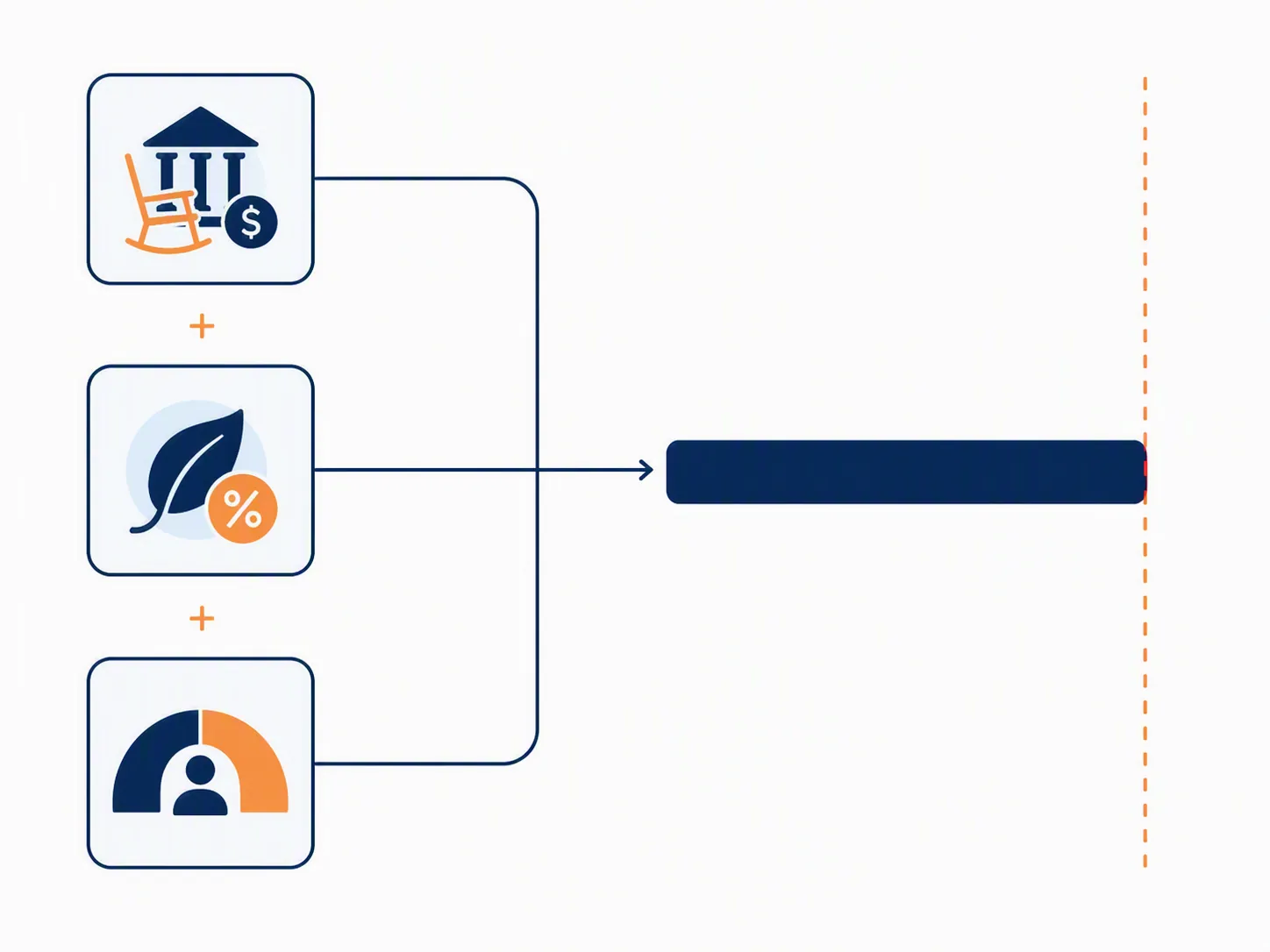
A copy-the-math example: when the COLA is the dollar that crosses the line
Here is a simplified example, not a tax return. It is meant to show the trigger mechanism.
Say a single retiree has $12,500 of other income for the year from a small IRA withdrawal, part-time work, pension income, or tax-exempt interest. Say the retiree’s 2026 Social Security benefit is $2,084 a month, matching the average benefit figure used in AARP’s 2027 COLA estimate.[2]
| Step | Calculation | Result |
|---|---|---|
| Annual Social Security before the 2027 COLA | $2,084 × 12 | $25,008 |
| Half of annual Social Security before the COLA | $25,008 ÷ 2 | $12,504 |
| Provisional income before the COLA | $12,500 other income + $12,504 half of benefits | $25,004 |
In that version, the retiree is already just above the $25,000 single-filer base amount. If another retiree had slightly less other income, the pre-COLA calculation could sit just below the line. The point is not that every average-benefit retiree owes tax. The point is that the margin can be very small.
Now add AARP’s estimated 3.6% COLA. The monthly benefit would rise by about $75, from roughly $2,084 to roughly $2,159.[2]
| Step | Calculation | Result |
|---|---|---|
| Estimated annual Social Security after a 3.6% COLA | $2,159 × 12 | $25,908 |
| Half of estimated annual Social Security after the COLA | $25,908 ÷ 2 | $12,954 |
| Provisional income with the same $12,500 of other income | $12,500 + $12,954 | $25,454 |
The retiree did not take a larger IRA withdrawal in this example. The part-time work did not change. The tax-exempt interest did not change. The COLA alone increased the “half of benefits” part of the provisional-income formula by about $450 for the year. For someone who started a few hundred dollars below the $25,000 line, that can be enough to turn a clean-looking raise into a tax question.
Using the 3.8% projection cited by CNBC Select would produce a similar result, with about a $77 monthly increase in the example reported there.[3] The exact 2027 number will change when the official COLA is announced, but the household test will be the same: add your other income, add tax-exempt interest, add half of your benefits, and compare the result with the threshold for your filing status.
What to check before the January 2027 payment arrives
The least pleasant time to discover this rule is April, with Form SSA-1099 in one hand and a tax bill in the other. Before January 2027, gather the papers that show what actually happened last year, then make a rough 2027 estimate.

- Look at last year’s Form SSA-1099 for total benefits paid and any federal tax already withheld. The federal income tax withheld from Social Security benefits appears in box 6 of Form SSA-1099.[1]
- Check last year’s tax return for adjusted gross income and whether any Social Security benefits were taxable.
- Estimate 2027 Social Security benefits using the projected COLA range for now, then replace the estimate after the official October 14, 2026 announcement.
- Add likely 2027 pension payments, IRA or 401(k) withdrawals, part-time earnings, taxable interest, dividends, and tax-exempt interest.
- Apply the provisional-income formula: adjusted gross income plus tax-exempt interest plus one-half of Social Security benefits.[1]
This is not a full tax projection. It is a warning light. If the estimate lands near $25,000 for a single filer or $32,000 for a married couple filing jointly, it is time to decide whether to withhold federal tax from benefits or make estimated payments.
Voluntary withholding is the cleanest fix for many households
Social Security does not automatically withhold federal income tax from benefits unless you ask for it. IRS Form W-4V lets you choose withholding of 7%, 10%, 12%, or 22% from each monthly Social Security payment.[4]
SSA says you can request, change, or stop federal tax withholding through your my Social Security account, by phone at 1-800-772-1213, or by submitting the paper Form W-4V.[5] Because withholding is a percentage of the monthly payment, the withheld dollars rise automatically when the January 2027 COLA raises the check.
The choice is not whether to “give up” part of the COLA. The choice is whether to send some federal tax throughout the year or risk owing it later. For someone who has been surprised once, steady withholding may be easier to live with than a spring tax bill.
If withholding is not a good fit, IRS estimated payments using Form 1040-ES are another route. Retirees who want help can also look for free Tax Counseling for the Elderly or Volunteer Income Tax Assistance services, especially if a spouse has died, work income changed, or retirement-account withdrawals are starting for the first time.
What the 2025 tax law did not change
The One Big Beautiful Bill Act did not repeal federal taxation of Social Security benefits. Kiplinger reports that the law created a Senior Bonus Deduction of $6,000, or $12,000 for married couples filing jointly, but that deduction phases out once adjusted gross income exceeds $75,000 for single filers or $150,000 for joint filers.[6]
That matters because some retirees have heard “no tax on Social Security” and stopped there. The federal benefit-tax rules still exist. Higher-income retirees can still have up to 85% of benefits included in taxable income, and near-threshold retirees still need to run the provisional-income calculation.
Keep state taxes and Medicare separate from this calculation
This article is about federal income tax on Social Security benefits. State tax treatment varies, so do not assume the federal answer is the whole answer on a state return.
Medicare Part B premiums are a different offset. They can reduce the net amount that lands in a Social Security recipient’s bank account, but they are not part of the provisional-income formula. For that separate issue, see our guide to the 2027 Social Security COLA net benefit after Medicare.
The practical expectation for 2027
The 2027 COLA may still help with groceries, utilities, prescriptions, repairs, or safer equipment at home. If you are trying to decide what the raise can realistically cover, our home-safety COLA guide looks at that household side of the increase.
For taxes, the expectation should be plainer: if you are near the fixed $25,000 or $32,000 provisional-income threshold, treat the 2027 COLA as a number to run through the formula before the January check arrives. A bigger benefit is welcome. A preventable April surprise is not.
References
- Social Security and Equivalent Railroad Retirement Benefits, IRS, 2025.
- Social Security COLA Preview: Will 2027 Benefits Go Up?, AARP.
- How Much Will the Social Security 2027 COLA Be?, CNBC Select.
- About Form W-4V, Voluntary Withholding Request, IRS.
- Request to withhold taxes, Social Security Administration.
- Taxes on Social Security Benefits: 6 Things to Know for 2026, Kiplinger.
Browse more in the Glossary.