
Clinical term
Which SPMS treatment options matter for seniors?
Last verified 2026-07-31

The short answer: SPMS treatment has two layers
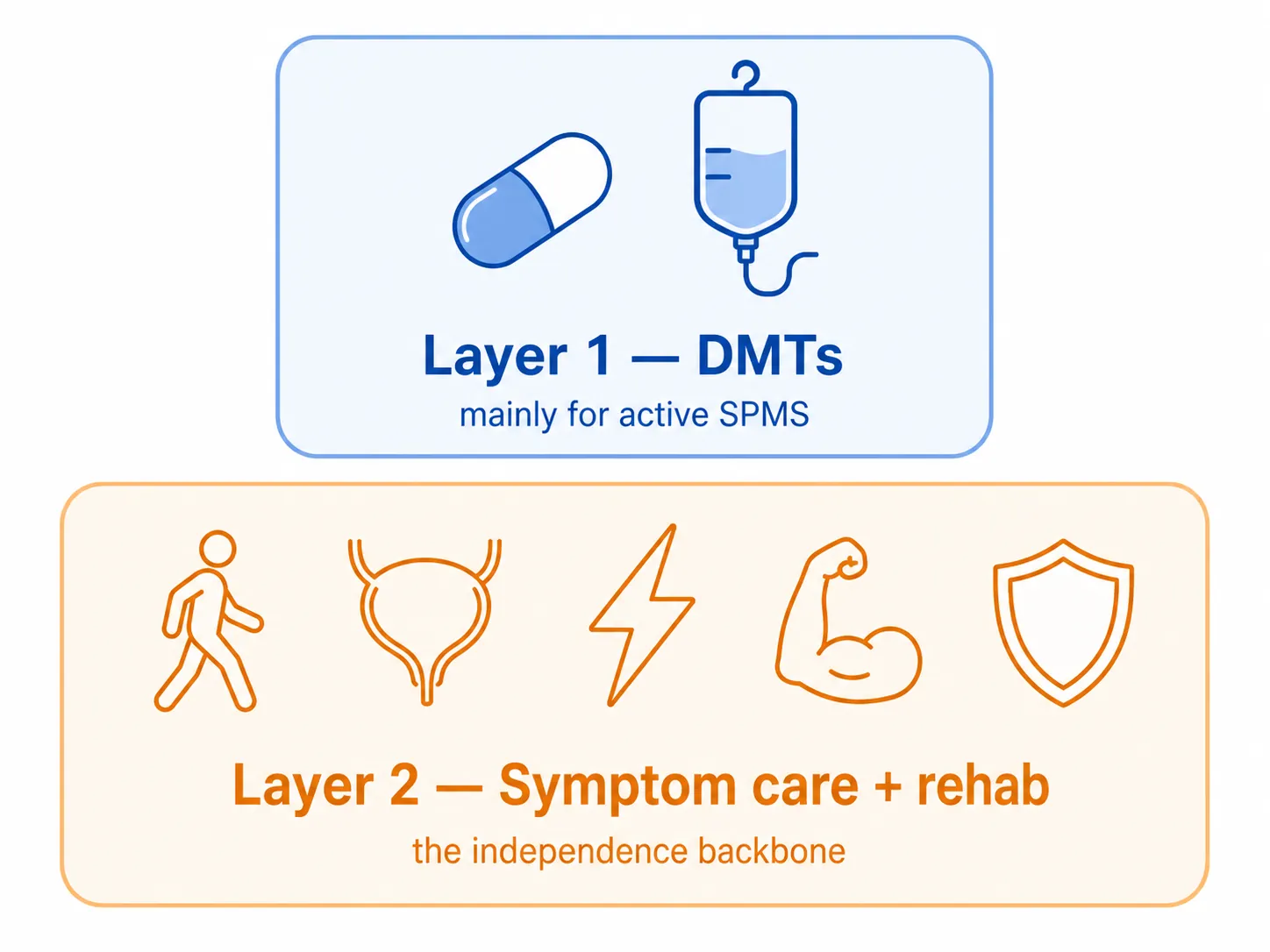
For someone searching for secondary progressive MS treatment options for seniors, the first useful answer is not a list of drug names. It is a map. One layer is disease-modifying therapy, or DMT, which is mainly relevant when SPMS is still “active,” meaning there are relapses or new inflammatory changes on MRI. The other layer is symptom management and rehabilitation: walking support, physical and occupational therapy, bladder care, fatigue planning, spasticity treatment, medication review, speech or swallowing help when needed, and fall-risk reduction.
Those two layers answer different worries. DMTs are meant to reduce inflammatory disease activity and, in selected patients, may slow future disability progression. They do not bring back walking endurance, fix bladder urgency, remove fatigue, or make a risky bathroom safer. The daily independence work happens in the second layer, and for many older adults with SPMS, that layer is not secondary at all.
Use this article as appointment preparation, not medical advice. SPMS treatment decisions should be made with a neurologist who can review the person’s MRI history, relapse history, age, other diagnoses, infection risk, heart history, cognition, kidney and liver function, and current medications.
The hinge question: is the SPMS active?
SPMS usually means the disease has shifted from a relapsing-remitting pattern into a more gradual worsening of disability. But SPMS can still be active or non-active. Active SPMS means there are relapses, new MRI lesions, or other signs of continuing inflammatory activity. Non-active SPMS means the person is worsening without clear relapses or new inflammatory MRI activity, at least during the period being assessed.[1][2]
That distinction matters because DMTs are aimed at inflammatory activity. If an older adult has active SPMS, the neurologist may reasonably discuss whether a DMT could reduce relapses or slow some future progression. If the SPMS is non-active, the drug conversation often changes: the possible benefit may be smaller or more uncertain, while age-related risks may carry more weight.
A family can ask this very plainly at the visit: “Are we seeing active SPMS, or progression without activity?” If the answer is not clear, ask what evidence is being used: recent relapses, MRI changes, exam changes, walking tests, or symptom history.
What DMTs can reasonably be expected to do
A DMT decision in SPMS is not the same as choosing a medication for pain or bladder urgency. The goal is usually longer-term: fewer relapses, less new inflammatory MRI activity, and possibly slower disability progression. That kind of benefit can be meaningful, but it is not the same as symptom relief next week.
Siponimod, sold as Mayzent, is the most concrete SPMS example because it was studied in a large SPMS trial and received FDA approval on March 26, 2019 for relapsing forms of MS, including active SPMS. The company’s FDA approval announcement described it as the first oral drug specifically approved for active SPMS.[3]
The main EXPAND trial enrolled 1,651 people with SPMS. The mean age was 48, and about half of participants needed a walking aid. In the overall trial population, siponimod was associated with a 21% reduction in the risk of 3-month confirmed disability progression compared with placebo. In people with recent relapse activity, the reported reduction was 33%.[3][4]
Those numbers are worth discussing with a neurologist, especially if the older adult still has relapses or new MRI activity. They are not a promise that a person in their late 60s, 70s, or 80s will get the same benefit. The trial’s average participant was not a true senior, and that matters when families are trying to judge benefit against infection risk, heart concerns, falls, cognition, other medications, and general frailty.
The senior evidence gap belongs in the main conversation
Older adults have not been well represented in pivotal MS drug trials. Reviews of MS treatment evidence note that many trials excluded people above roughly the mid-40s to mid-50s age range, leaving much less direct evidence for people over 65.[5][6]
One meta-analysis pooling data from more than 28,000 trial participants predicted that DMT efficacy on disability progression declined with age and was no longer present beyond about age 53. That is a statistical model prediction, not a rule that treatment becomes useless on a birthday. But it is a serious caution against applying trial results from younger adults too casually to a senior with SPMS.[5]
This is why the DMT question for a senior should be framed as “What evidence applies to this person?” rather than “Which SPMS drug is strongest?” A 67-year-old with recent relapses and new MRI lesions is in a different discussion from a 78-year-old whose last relapse was many years ago and whose main problems are falls, urinary urgency, fatigue, and worsening gait.
Other DMTs may come up because some current MS medications are labeled for relapsing forms of MS that include active SPMS. The exact list and labeling should be checked at the time of prescribing, because approvals and safety language change. For an older adult, the practical question is not only whether a drug is allowed by label, but whether the person’s current disease activity and health risks make the expected benefit worth the burden.
Mitoxantrone may appear in older discussions of progressive MS treatment, but it is now largely historical and rarely used because of serious toxicity concerns, including cardiotoxicity and leukemia risk.[6]
The treatment layer that protects daily independence
Symptom management and rehabilitation are sometimes presented as what remains after the drug conversation. That understates their importance. For progressive MS, these are active treatments aimed at preserving mobility, safety, communication, energy, continence, and life at home. The Multiple Sclerosis Association of America describes treatment of progression as including rehabilitation, symptom management, wellness approaches, and care-team coordination, because DMTs do not restore lost function.[7]
| Problem threatening independence | Treatment conversations that often matter |
|---|---|
| Walking decline, stiffness, weakness, or imbalance | Physical therapy, gait assessment, strength and balance work, stretching, spasticity treatment, walking aids, home safety changes |
| Trouble with bathing, dressing, cooking, transfers, or household tasks | Occupational therapy, energy conservation, adaptive equipment, bathroom setup, safer routines |
| Bladder urgency, nighttime bathroom trips, or incontinence | Bladder evaluation, timed voiding, fluid timing, pelvic-floor strategies when appropriate, medication review, cognition-sensitive prescribing |
| Fatigue | Sleep review, medication review, pacing, cooling strategies, exercise planning, treatment of contributing problems |
| Speech, swallowing, or cognitive communication changes | Speech-language pathology evaluation, swallowing strategies, communication supports, caregiver training |
| Falls or fear of falling | Fall-risk assessment, PT, medication review, vision and footwear checks, transfer training, bathroom and hallway safety |
A physical therapist can look at gait, balance, endurance, leg strength, spasticity, transfers, and the way a person actually moves through the home. The goal is not only exercise. It is deciding whether the person needs a cane, rollator, ankle-foot orthosis, scooter evaluation, stair strategy, or caregiver training before a fall or near-fall forces the decision.
An occupational therapist can turn vague worries into specific changes: where a grab bar belongs, whether a shower chair is safer than standing, how to reduce trips between rooms, whether fatigue is worse because the morning routine is too demanding, and whether cooking or medication management now needs a different setup.

Bladder treatment should include a cognition check
Bladder urgency is not a minor symptom when it determines whether someone rushes to the bathroom at night, avoids leaving home, or falls while hurrying. Treatment may include behavioral strategies, bladder evaluation, pelvic-floor work when appropriate, and medications. In seniors, the medication review deserves extra care because anticholinergic bladder medications can worsen cognition.[6]
That does not mean every bladder medication is wrong. It means the neurologist, primary-care clinician, urologist, pharmacist, patient, and caregiver should look at the whole medication list and ask whether memory, confusion, constipation, dry mouth, dizziness, or falls have worsened since a drug was started or increased.
Falls are a treatment issue, not a side note
Falls are common in MS. Cleveland Clinic reports that 50% to 70% of people with MS fall within a six-month period, and it identifies contributors such as balance problems, weakness, bladder urgency, and sedating medications.[8]
For a senior with SPMS, a fall can change the whole care plan: hospitalization, loss of confidence, less walking, more dependence with bathing, or pressure on an adult child to provide more help. A fall-risk plan may include PT, assistive-device training, bathroom changes, better lighting, footwear review, medication changes, and a plan for nighttime toileting.
How to prepare for the neurologist visit
The most useful visit preparation is concrete. Bring dates of recent relapses or sudden worsening, MRI reports if available, a current medication list including over-the-counter sleep aids and bladder medicines, a short fall history, and the symptoms that are shrinking daily life the most.
- Is the SPMS active or non-active right now, and what evidence shows that?
- If a DMT is being considered, what trial evidence applies to someone this age?
- What is the realistic goal: fewer relapses, fewer MRI lesions, slower progression, or something else?
- What risks are higher because of age, infections, heart issues, cognition, mobility, or other medications?
- If no DMT is recommended, what is the plan for monitoring disease activity?
- Which symptoms are most threatening independence right now: walking, falls, bladder urgency, fatigue, spasticity, pain, cognition, swallowing, or mood?
- Should PT, OT, speech-language pathology, urology, pharmacy review, or a home-safety evaluation be added?
- Which medications on the current list could be worsening fatigue, dizziness, cognition, constipation, bladder symptoms, or fall risk?
For seniors with SPMS, the right plan is usually individualized and two-layered: a careful DMT discussion when there is active disease, and a serious rehabilitation and symptom-care plan aimed at preserving function, safety, and life at home.
References
- Secondary Progressive MS (SPMS) — Cleveland Clinic.
- Secondary progressive MS — MS Society UK.
- Novartis receives FDA approval for Mayzent® (siponimod), the first oral drug to treat secondary progressive MS with active disease — Novartis, March 26, 2019.
- Siponimod versus placebo in secondary progressive multiple sclerosis (EXPAND): a double-blind, randomised, phase 3 study — Lancet, 2018.
- Impact of aging on treatment considerations for multiple sclerosis patients — Frontiers in Neurology, 2023.
- Management of multiple sclerosis in older adults: review of current evidence and future perspectives — Journal of Neurology, 2024.
- Understanding Progression in MS, Part II: Treating Progression — Multiple Sclerosis Association of America.
- MS Approaches: Falls — Cleveland Clinic.
Browse more in the Glossary.