
Clinical term
How to recognize caregiver burnout when your spouse has cancer
Last verified 2026-07-27
You can love your spouse and still feel emptied out by the work of cancer caregiving. You can be competent with the medication list, the infusion schedule, the insurance calls, and the nausea plan, then find yourself snapping over something small or sitting in the car unable to go back inside. The question is not whether that makes you a bad partner. The question is whether this is expected strain, caregiver burnout, depression, or a crisis that needs help today.
The best available spouse-specific research is hard to read, but it matters because it gives permission to stop minimizing what is happening. Reporting on a 2024 JAMA Oncology study from Danish national patient databases, the American Cancer Society notes that spouses of people with cancer had a 1.28 times higher risk of attempting suicide and a 1.47 times higher risk of dying by suicide, with risk highest in the first year after diagnosis.[1] The Virginia Breast Cancer Foundation discusses the same findings as evidence that spouses need direct support, not just sympathy from the edge of the treatment plan.[2]
That does not mean every exhausted spouse is suicidal, and the Danish data may not transfer perfectly to the U.S. healthcare system. It does mean spouse caregiving has documented health risks. Waiting until you collapse is not the standard of loyalty.
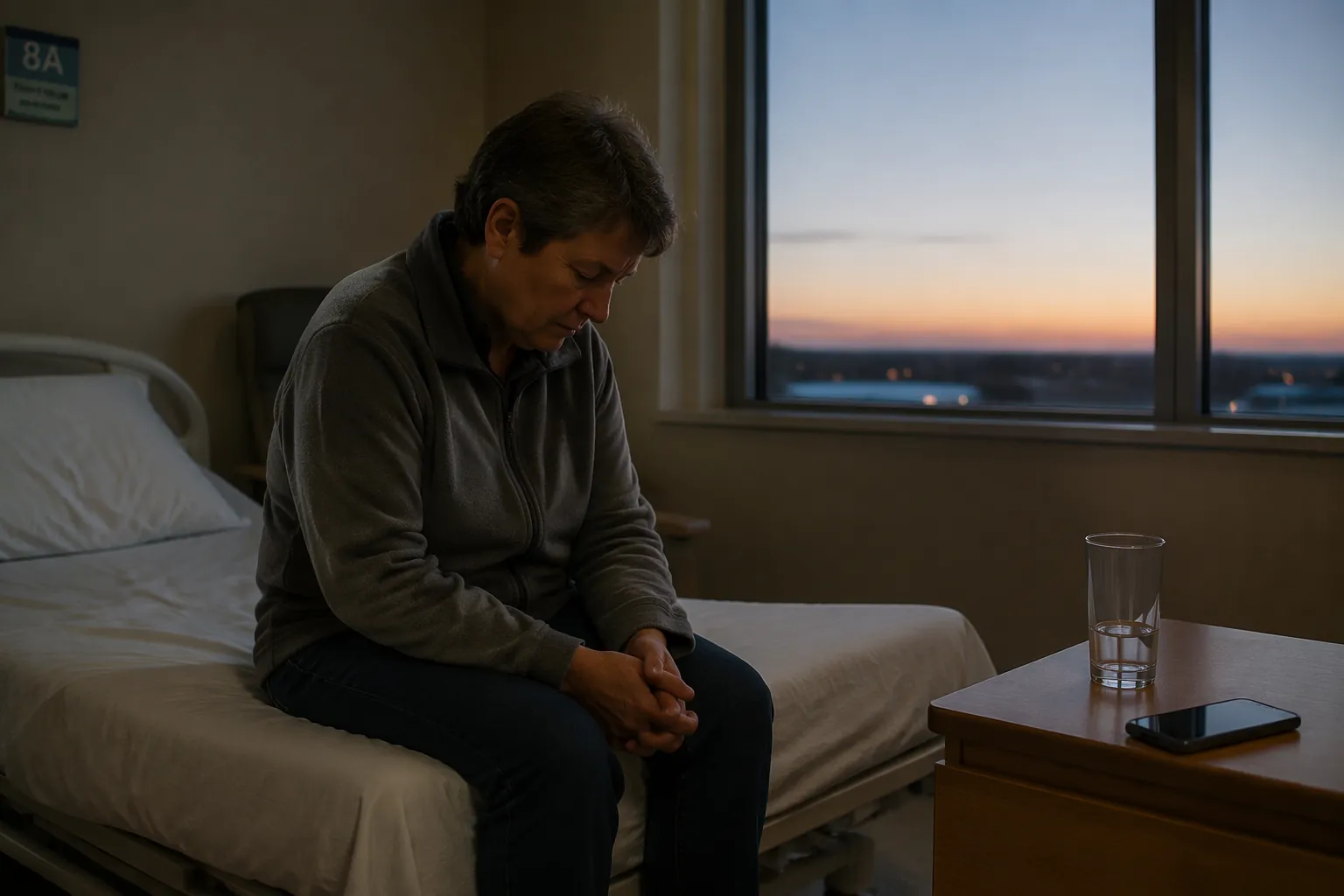
Cancer caregivers also show high levels of distress across studies. The National Cancer Institute’s PDQ summary reports a pooled prevalence of depressive symptoms of 42% among cancer caregivers across 35 studies including 11,396 caregivers, and elevated anxiety in 29%.[3] NCI also cautions that depressive symptoms are not the same as a formal diagnosis of major depression. That distinction is important: the number is a warning light, not a label.
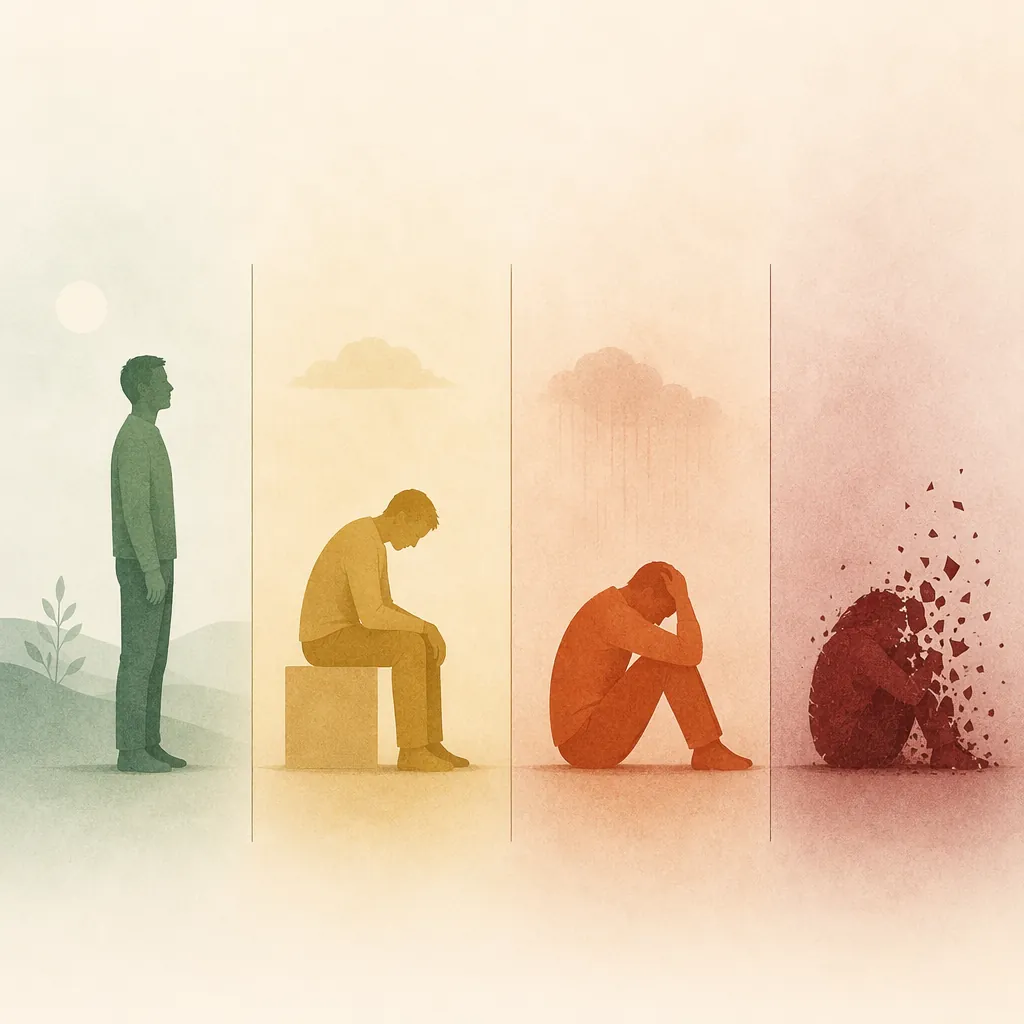
Is this normal strain, burnout, depression, or crisis?
Normal strain has a shape you can usually trace to the week you are living through: scan results, a new side effect, a hospital admission, a frightening bill, a night without sleep. You may cry more easily, feel tense, forget something, or need time alone. When the pressure eases, even briefly, some part of you can still recover.
Burnout is more like running a household, a treatment plan, and an emotional weather system with no off switch. Rest stops restoring you. You may feel irritable, numb, resentful, trapped, or strangely detached from the person you are caring for. Burnout often shows up first in behavior: skipping meals, losing sleep, forgetting your own appointments, avoiding calls, or feeling angry at anyone who tells you to “take care of yourself” without offering to take a shift.
Depression deserves a firmer boundary. If for about two weeks or more you have persistent low mood, loss of interest, hopelessness, major sleep or appetite changes, trouble functioning, or thoughts that others would be better off without you, it is time to involve a mental health professional or your medical team. In cancer caregiving, depression can be easy to disguise as devotion because there is always another task to do.
Crisis is different from both burnout and depression. If you might harm yourself, feel unable to stay safe, are making plans to die, or are afraid you could hurt someone else, use emergency help now: call 911, go to the nearest emergency department, or call or text 988 in the U.S. and ask for immediate crisis support. Do not wait for the next oncology appointment.
What are the signs of caregiver burnout when your spouse has cancer?
CancerCare’s caregiver burnout guidance names ten signs that are useful because they sound like real life, not a wellness poster. They include withdrawal from friends and family, loss of interest in activities, feeling blue or hopeless, changes in appetite or weight, sleep changes, getting sick more often, emotional and physical exhaustion, irritability, loss of patience with the person receiving care, and thoughts of hurting yourself or the person you are caring for.[4]
| What you notice | What it may mean | What to do next |
|---|---|---|
| You are tired after a treatment week but recover somewhat after sleep, help, or a quieter day. | Normal caregiving strain. | Add practical support before the next hard week; do not wait until the pattern worsens. |
| You feel emotionally flat, resentful, constantly rushed, or unable to rest even when your spouse is stable. | Possible burnout. | Ask the oncology team for an oncology social worker referral and start planning respite or task relief. |
| Low mood, hopelessness, loss of interest, or impaired functioning persists for about two weeks or more. | Possible depression. | Contact a mental health professional, primary care clinician, oncology social worker, or CancerCare counselor. |
| You have thoughts of suicide, self-harm, or harming someone else, or you cannot trust yourself to stay safe. | Crisis. | Call 988, call 911, go to an emergency department, or use local emergency services now. |
A spouse often delays help because the patient is the one with cancer. That instinct is understandable, but it is not harmless. NCI’s PDQ summary reports that in a survey of 689 patient-caregiver dyads, higher caregiver depression was associated with patients rating the quality of care they received as lower.[3] Getting help for your depression or burnout is not a detour away from your spouse’s care. It is one way of protecting the care.
How do I support my spouse with cancer when I am already burning out?
The first support move is not to become more patient by force. It is to reduce the number of unsolved problems you are carrying alone.
NCI’s PDQ summary reports that 64% of cancer caregivers had at least one significant unmet need, and caregivers with 5 to 10 unmet needs were at highest risk for negative outcomes.[3] That is a practical clue. Burnout often worsens when needs stack up: transportation, medication confusion, work leave, childcare, bills, symptom monitoring, sleep, meals, family updates, and fear that has nowhere to go.
Start by naming the three problems that are costing you the most right now. Not the three problems you “should” fix. The three that are making daily life unsafe or unmanageable. For many spouses, those are sleep loss, symptom uncertainty, and no backup person. For others, it is money, anger, or isolation. If you need a broader map of patterns before choosing a next step, the general guide to caregiver burnout patterns and warning signs can help you sort the overload without making this cancer-specific situation feel generic.
What actually helps spouse cancer caregivers?
The strongest evidence in this area does not point to one magic intervention. It points to structured support that teaches coping, problem-solving, communication, and symptom-management skills. NCI summarizes a meta-analysis of 29 randomized controlled trials finding that psychoeducational and skill-building interventions improved caregiver coping, burden, and self-efficacy, with small-to-moderate effects.[3]
Problem-solving therapy and the COPE model
Problem-solving therapy is useful when your distress is attached to a pile of concrete problems: uncontrolled symptoms, confusing discharge instructions, family members who will not commit, bills you avoid opening, or a patient who refuses help you cannot safely provide alone.
The COPE model, named in NCI’s PDQ summary, gives caregivers a structured way to handle caregiving problems by building creativity, optimism, planning, and expert information into the response.[3] In plain terms, it helps you move from “I cannot do this” to “What is the exact problem, what are the options, who has the missing information, and what is the next testable step?”
A spouse might ask for this kind of help by saying: “I am overwhelmed by managing symptoms and decisions at home. Is there a social worker, nurse navigator, psychologist, or caregiver program that can help me use problem-solving therapy or a COPE-style approach?” That is a precise request. It gives the oncology team something to route.
FOCUS and other psychoeducational skill-building programs
Programs like FOCUS are built for the patient-caregiver pair, not only the patient. NCI identifies FOCUS as a psychoeducational intervention used with cancer dyads, addressing family involvement, outlook, coping effectiveness, uncertainty reduction, and symptom management.[3] This can be especially helpful when the marriage has become a clinic schedule with two exhausted people inside it.
This kind of program fits when the problem is not only task overload but communication strain: the patient does not want to talk about fear, you are afraid to mention your own, or every conversation turns into logistics. Ask the cancer center whether it offers caregiver education, couples-based counseling, psycho-oncology, palliative care support, or dyadic programs for patients and spouses.
Web-based support such as CHESS
Web-based support can help when appointments, geography, infection precautions, work, or exhaustion make in-person support unrealistic. NCI names CHESS as a computer-based system used to provide information, communication, and support for cancer caregivers.[3] It is not the same as having a person take over a night shift, but it can reduce the feeling that every question starts from zero.
Ask the oncology social worker, nurse navigator, or hospital library whether the cancer center offers caregiver portals, moderated online support, symptom-management education, or referral to reputable web-based programs. If you search on your own, favor cancer-center, nonprofit, or medically reviewed resources over anonymous forums when you are making treatment-adjacent decisions.
Oncology social work
The oncology social worker is often the most practical first call because they sit at the intersection of emotional distress, insurance problems, transportation, financial assistance, family meetings, advance care planning, lodging, work leave, support groups, and crisis referral. NCI’s caregiver support resources direct caregivers toward help with emotional support, practical needs, and communication with the healthcare team.[5]
If you do not know who the social worker is, say this at the next call or portal message: “I am the spouse caregiver. I am not coping well and need a referral to oncology social work for caregiver support, respite planning, and counseling options.” You do not have to prove you are in enough pain. The request itself is enough.
CancerCare counseling and support groups
CancerCare offers caregiver burnout guidance and describes access to free professional oncology social work services, including counseling and support groups.[4] This is a strong option if your cancer center has limited caregiver services, if you need something remote, or if you need to speak with someone who will not require you to first explain why a spouse can be both devoted and depleted.
Support groups are not for everyone, and no spouse should be pressured to perform gratitude in a room full of strangers. But a well-run group can do one thing friends sometimes cannot: normalize the ugly middle without asking you to tidy it up. Look for groups specifically for cancer caregivers, spouses, or the relevant cancer type when possible.
Where does respite fit?
Respite is not a reward for being cheerful. It is a safety intervention when one person has become the default system for everything. It can mean a relative sitting with your spouse during treatment recovery, a paid aide covering bathing or meals, adult day services when appropriate, volunteer transportation, a neighbor handling pharmacy pickup, or a hospice or palliative care team helping plan relief when illness is advanced.
The right respite depends on the symptom cluster. If your main problem is sleep loss, a daytime visitor may not help as much as overnight coverage. If your problem is decision fatigue, a ride to treatment may matter less than a nurse call that clarifies when to worry. The guide to matching burnout symptoms to respite options can help sort those differences, and preparing for a first respite care experience can make the first handoff feel less like abandonment.
If cost is the barrier, ask the oncology social worker about local grants, disease-specific foundations, transportation assistance, employer leave, Medicaid waivers where applicable, veterans’ benefits if relevant, and faith or community volunteer programs. If your household may qualify for Medicare-related caregiver support, the guide to accessing Medicare’s GUIDE respite benefit may be worth checking, depending on eligibility.
What if I feel numb instead of loving?
Emotional numbness frightens spouses because it feels like evidence against love. In caregiving, numbness can also be a nervous system trying to keep functioning when tenderness would make the next task impossible. It may show up while you are flushing a drain, arguing with insurance, watching your spouse vomit, or listening to another person say “stay positive.”
Numbness becomes more concerning when it persists, spreads into everything, comes with hopelessness, or makes you feel unsafe. That is when it belongs in a conversation with a counselor, physician, oncology social worker, or crisis line. You do not need to wait until you can describe it elegantly.
If the deepest problem is that you are doing this alone, the piece on solo spousal caregiving may fit better than another generic self-care list. Isolation changes the load.
Can self-care help, or is that too small for this?
Self-care can help when it means food, sleep, movement, medical care, emotional support, and protected time away from responsibility. It becomes insulting when it is offered as a substitute for help. The American Cancer Society’s caregiver self-care guidance emphasizes basics such as getting support, keeping up with your own healthcare, resting, eating well, and accepting help.[6] Those basics are not glamorous; they are maintenance for a body under chronic stress.
The useful question is not “Am I doing self-care?” It is “Am I in prevention or recovery?” Prevention might mean keeping one weekly walk, one therapy appointment, and one backup driver on the calendar. Recovery from burnout may require removing duties, adding respite, treating depression, or changing the care plan. The caregiver self-care checklist for prevention or recovery can help you separate light maintenance from actual repair.
What should I say when I ask for help?
Most spouses wait too long because they are trying to find the right words. Use plain ones. The oncology team does not need a polished story; they need an accurate signal.
- “I am the spouse caregiver, and I am showing signs of burnout. Who is the oncology social worker for this clinic?”
- “I am not sleeping, I am irritable, and I am worried about how long I can keep doing this. I need caregiver support, not only patient education.”
- “Can you refer me to counseling, a caregiver support group, or a psycho-oncology program?”
- “We need help with transportation, respite, insurance, or financial assistance. Can social work screen us for resources?”
- “I have had thoughts of not wanting to be alive,” or “I am afraid I cannot stay safe.” Say this directly and seek urgent help.
If your spouse is also your elderly parent’s co-caregiver, or if cancer care overlaps with aging-parent duties, the evidence-based guide to the mental health toll of caring for an elderly parent may help with that second layer. If you are an adult child caring for a parent with cancer rather than a spouse, start with how to care for an elderly parent with cancer instead.
How do I keep track without carrying it all in my head?
A spouse caregiver’s mind becomes a storage unit for appointment times, side effects, medication changes, questions for the oncologist, pharmacy delays, lab values, visitors, bills, and the patient’s fears. Externalizing that information is not a productivity trick. It reduces the cognitive load that makes burnout worse.
Use whatever system you will actually touch: a paper binder, shared phone note, calendar app, or printed checklist. The free printable caregiver checklist binder can help if the immediate need is to get medications, appointments, questions, and contacts out of your head and into one place.
When is the threshold for professional help?
Call for professional help when symptoms are persistent, worsening, or unsafe. Persistent means they keep going for about two weeks or more, especially low mood, hopelessness, loss of interest, sleep or appetite disruption, inability to function, or emotional numbness that does not lift. Worsening means the old coping methods no longer touch it. Unsafe means suicidal thoughts, self-harm risk, fear of harming someone else, or feeling unable to get through the next few hours safely.
For persistent or worsening symptoms, contact the oncology team, oncology social worker, primary care clinician, therapist, psychiatrist, CancerCare, or another qualified mental health professional. For unsafe symptoms, use emergency or crisis support now. If you are in the U.S., call or text 988, call 911, or go to the nearest emergency department.
Medical note: This article is educational and is not a diagnosis, treatment plan, or substitute for professional medical or mental health care. A licensed oncology social worker or mental health clinician with cancer-caregiver experience can help you decide what level of support is appropriate.
References
- How to Cope When Your Spouse or Partner Has Cancer — American Cancer Society.
- The Hidden Struggles: Why Spouses of Cancer Patients May Need Support — Virginia Breast Cancer Foundation.
- Informal Caregivers in Cancer (PDQ®) – Health Professional Version — National Cancer Institute.
- Advice for Caregivers: Handling Burnout — CancerCare.
- Support for Caregivers of Cancer Patients — National Cancer Institute.
- Taking Care of Yourself When You're a Cancer Caregiver — American Cancer Society.
Browse more in the Glossary.