
Glossary entry
How to Stress Test Your Retirement Plan for Healthcare and Housing Costs
Last verified 2026-07-26
This is not financial or legal advice. Medicare/Medicaid and benefits rules vary by state and change over time — verify current rules with your state Medicaid office or Area Agency on Aging.
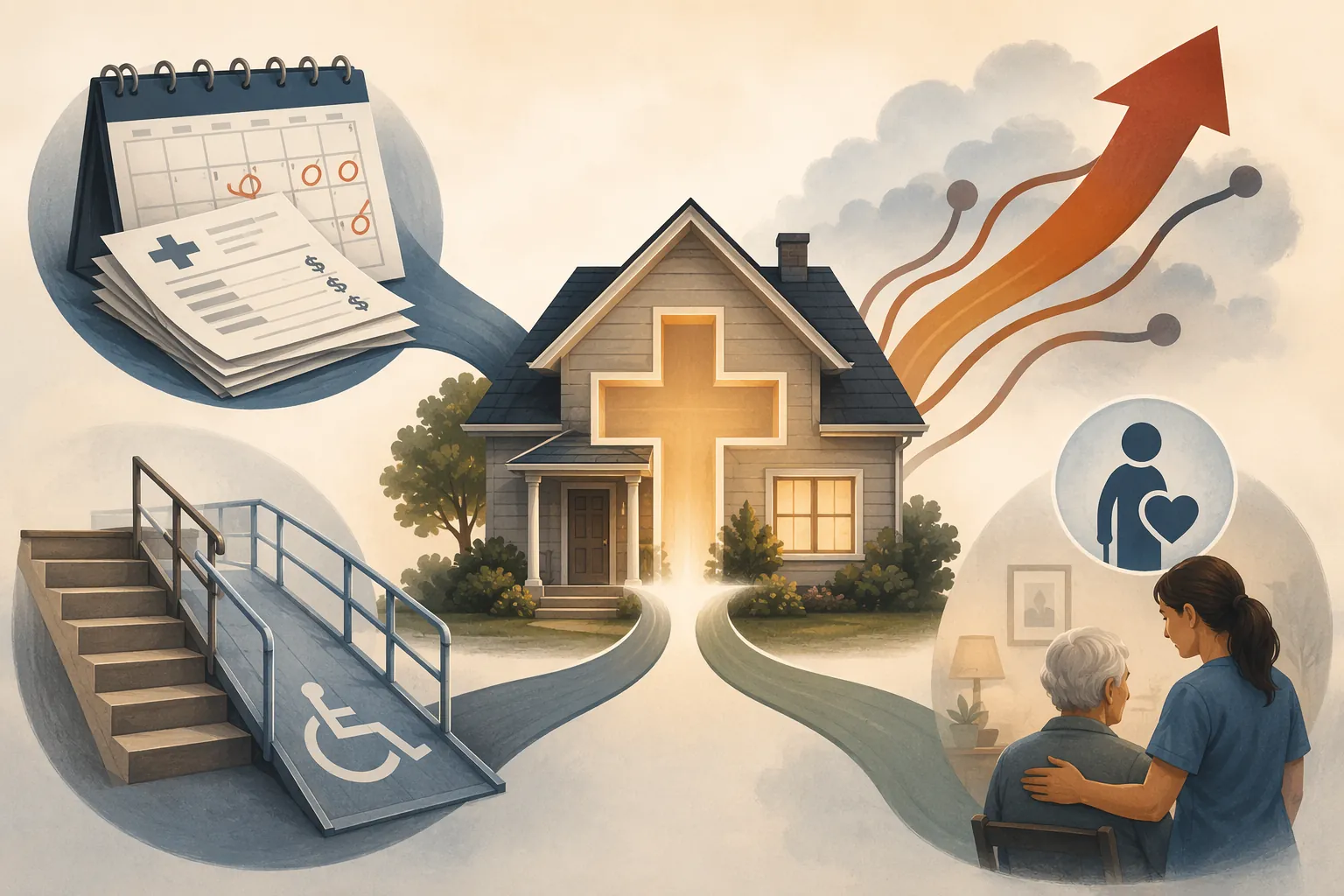
A retirement plan can look solid when healthcare and housing are tested in separate columns. Then one health event puts both columns under pressure in the same year. A fall can mean Medicare deductibles and copays, new prescriptions, a bathroom that no longer feels safe, a ramp or stair solution, paid help for bathing or meals, and a family decision about whether the house still works.
That is the point of a combined retirement stress test for seniors' healthcare and housing costs: not to scare yourself with the biggest possible number, but to see whether the plan survives when medical costs, home costs, and care costs rise together.
This is educational planning methodology, not personalized financial, legal, tax, insurance, or medical advice. The 2026 Medicare figures and care-cost inputs used here are planning inputs that should be verified near publication or before any real decision.
Start With the Collision, Not the Average
The neat version of retirement planning asks one question at a time: What if healthcare inflation runs hot? What if property taxes rise? What if long-term care is needed? The messier version asks what happens when one event triggers all three.
For 2026, Medicare Part B is reported at $202.90 per month, with a Part B deductible of $283 and a Part A inpatient hospital deductible of $1,736 per benefit period.[1] Those numbers do not include every out-of-pocket exposure a retiree may face, and they do not pay for a safer shower, a widened doorway, or recurring home care.
Fidelity’s 2025 retiree healthcare benchmark estimates that a single 65-year-old may need $172,500, after tax, to cover healthcare expenses in retirement, assuming original Medicare and no employer-provided retiree coverage.[2] It is useful as a benchmark. It is not a personal answer, and it should not be treated as if everyone needs the same number.
The housing and care side can move just as fast. CareScout’s 2025 Cost of Care data shows a national median home care rate of $35 per hour, which becomes $54,600 per year at 30 hours per week. The same source lists assisted living at $6,200 per month, or $74,400 per year, and a private nursing home room at $129,575 per year.[3]
Home modifications add a different kind of pressure because they often arrive as lumpy, urgent expenses. ElderLife Financial describes low-cost aging-in-place updates such as grab bars and lever handles in the $25 to $500 range, mid-range projects such as walk-in showers, stair lifts, and ramps in the $1,000 to $10,000 range, and larger structural changes such as bathroom widening, a first-floor bedroom, or an elevator in the $10,000 to $50,000-plus range.[4] AARP also emphasizes that aging in place can carry meaningful home-update, maintenance, and care costs, even when the house is already owned.[5]
Gather the Baseline Inputs Before You Build Scenarios
The baseline is not the stress test. It is the sheet you need before the stress test means anything. If the baseline is too vague, the scenarios become theater: impressive-looking percentages attached to guesses.
| Input | What to Put in the Model | Why It Matters |
|---|---|---|
| Medicare and supplemental coverage | Premiums, deductibles, expected prescription costs, dental/vision/hearing assumptions, and IRMAA exposure if income may be high enough | Medicare reduces risk, but it does not remove healthcare spending from the retirement budget |
| Current housing costs | Property taxes, homeowners insurance, HOA fees, utilities, repairs, maintenance, mortgage or rent if any | Owning the home outright does not make the house free |
| Home safety gap | Known hazards: stairs, bathroom access, narrow halls, poor lighting, entry steps, laundry location | A medical event often turns a tolerable inconvenience into an urgent expense |
| Care labor assumption | Hours per week of paid help, hourly rate, and whether family caregiving is assumed | The number of hours matters more than the comforting phrase “a little help” |
| Facility alternative | Local assisted living and nursing home costs, not just national medians | The facility scenario may be expensive, but it can be safer or more realistic for some households |
Housing inputs deserve more respect than they usually get. CareScout, using 2024 Census data, reported that 12.5 million senior households were cost-burdened, meaning they spent at least 30% of income on housing. Its analysis also noted that property taxes were up about 25% since 2020, homeowners insurance was up 40.4%, and housing costs for mortgage-free seniors were up 35% since 2019.[6]
For home-modification inputs, do not average everything into one vague reserve line. Put likely projects into tiers. A grab-bar-and-lighting year is not the same as a bathroom rebuild year. If the house has stairs to the only bedroom, that is not a footnote; it is a scenario driver. For more detailed project ranges, use a room-by-room guide such as Home Modification Costs for Aging in Place: A Room-by-Room Budget Guide before choosing your numbers.
Run Three Combined Scenarios
The combined stress test works best when it compares three futures side by side. They do not need to be perfect predictions. They need to be different enough to expose whether the plan depends on everything going politely.
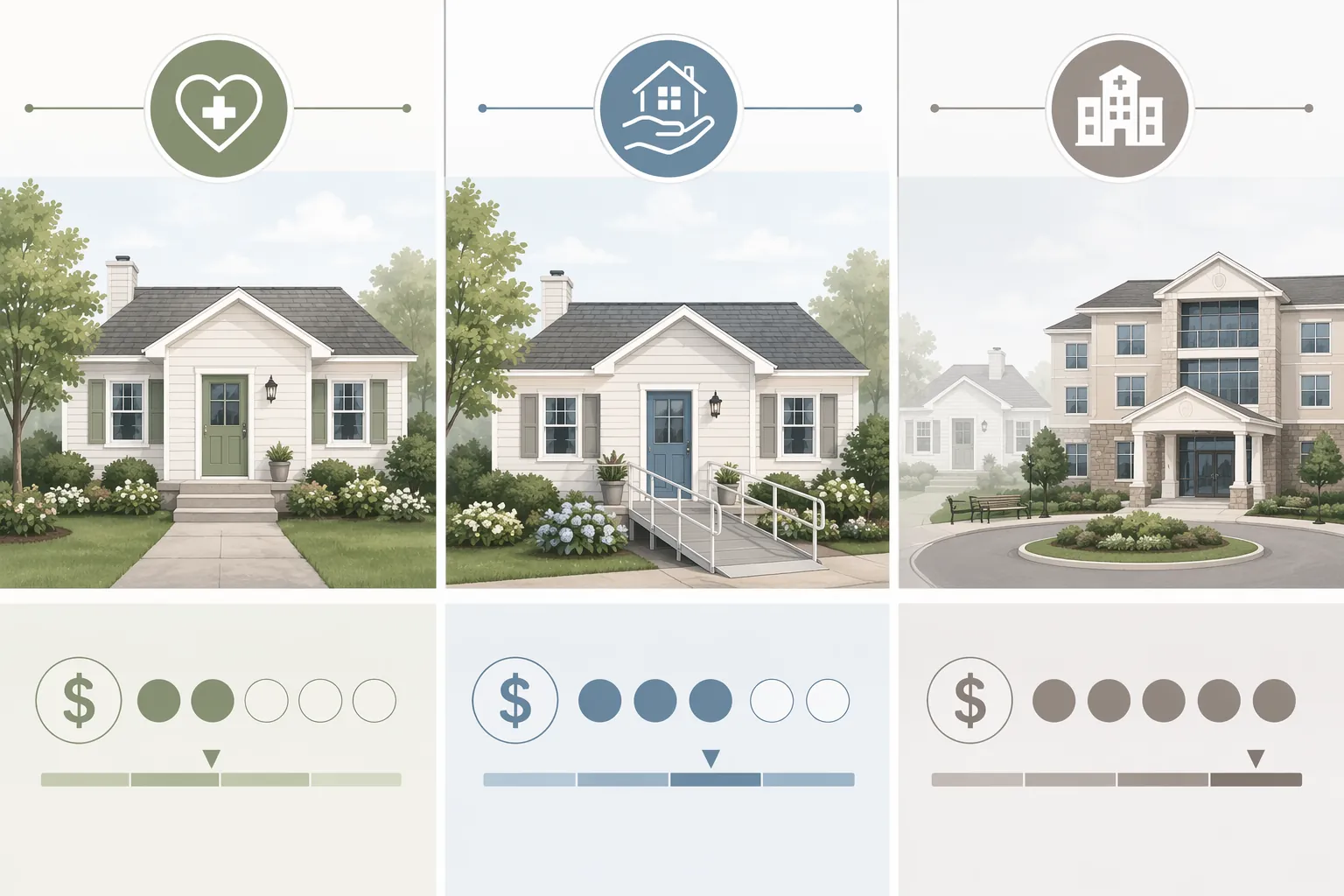
| Scenario | Core Question | Costs to Combine |
|---|---|---|
| Healthy aging in place | What if the person remains mostly independent but the home still gets older? | Medicare premiums and deductibles, prescriptions, routine care, property taxes, insurance, maintenance, preventive modifications |
| Moderate care needs at home | What if a health change creates recurring help at home but not a facility move? | Higher medical out-of-pocket costs, home modifications, paid care hours, transportation, higher maintenance pressure |
| Facility transition | What if the home is no longer the safe or workable setting? | Medical costs, move costs, assisted living or nursing home costs, possible ongoing home expenses during sale or transition |
Scenario A: Healthy Aging in Place
This is the scenario many households silently assume, but it should not be modeled as “no problem.” Healthy aging in place still has Medicare premiums, prescription costs, dental and vision gaps, property taxes, insurance, utilities, maintenance, and the cost of making the home safer before a crisis forces the issue.
In the spreadsheet, keep normal retirement spending separate from healthcare and housing lines. Then add a preventive modification reserve, even if it is modest. The point is not to remodel the whole house in advance. The point is to admit that a house built for younger knees may not be a free asset in later life.
- Use current 2026 Medicare premiums and deductibles as starting inputs, then update them annually.
- Add a prescription and out-of-pocket healthcare line that is separate from premiums.
- Inflate property taxes, insurance, utilities, and maintenance separately from general spending.
- Add a preventive home-safety budget for entryways, bathrooms, lighting, flooring, and stair risks.
- Do not assume family labor is free unless the family member has agreed and the plan accounts for backup care.
This scenario is where an aging-in-place plan can look emotionally right and financially reasonable. It is also where small omissions accumulate. A paid-off house still sends tax bills. A newer roof eventually becomes an older roof. A shower that is technically usable may not be safe after balance changes. For broader trade-offs between home-based aging and residential care, see The Hidden Costs of Aging in Place in 2026.
Scenario B: Moderate Care Needs at Home
This is the scenario most likely to be underestimated because it does not have a clean label. It is not “independent.” It is not “assisted living.” It is the in-between year, or years, when the person is still at home but the home now requires money and people to make it work.
A moderate-care-at-home scenario might include higher doctor visits, prescriptions, therapy copays, a walker or other equipment, transportation help, a bathroom project, and paid aides several days a week. The care line is the one to make uncomfortably specific. At CareScout’s national median of $35 per hour, 30 hours a week is $54,600 per year before considering whether rates are higher locally or whether weekend coverage costs more.[3]
This is also where the house can become a care expense. A ramp may be a housing cost on paper, but it exists because of a health change. A stair lift may sit under “home modification,” but the reason it matters is that the bedroom and bathroom are upstairs. If the model separates those costs too neatly, the year of the incident looks calmer than it is.
| Moderate-Care Input | How to Model It | Common Underestimate |
|---|---|---|
| Paid home care | Test several weekly-hour levels, not one fixed assumption | Starting with a few hours and never testing what happens if needs rise |
| Home modifications | Add one-time tiers: low-cost, mid-range, and structural | Treating a bathroom or stair problem as optional decor |
| Medical out-of-pocket costs | Raise premiums, deductibles, prescriptions, therapy, and equipment assumptions where relevant | Assuming Medicare makes the health event financially neutral |
| Family caregiving | Assign a backup paid-care cost even if family expects to help | Counting on adult children without pricing illness, travel, work, or burnout |
| Housing maintenance | Keep taxes, insurance, utilities, repairs, and accessibility upkeep in the model | Letting the care budget crowd out the house budget until something breaks |
The moderate scenario deserves more than one version. Test a lighter version, such as limited weekly help plus low-cost modifications. Then test a heavier version with 30 hours of weekly care and a mid-range or structural project. If the plan only fails when you use the harshest possible assumptions, that is one kind of conversation. If it fails when the assumptions are merely plausible, that is a different one.
Long-term care data supports taking this middle ground seriously. AARP’s Public Policy Institute has reported that families pay about one-third of long-term services and supports costs out of pocket.[7] Amplify Life, summarizing federal long-term care statistics, notes that about 70% of people turning 65 will need some long-term care services, with women averaging 3.6 years and men averaging 2.5 years of need.[8] Those figures do not say every household will face the same costs. They do say that pretending the need is rare is not much of a plan.
Scenario C: Facility Transition
A facility transition should not be written into the plan as failure. For some families, it is the safer and more sustainable answer. The financial mistake is different: assuming the household can avoid modeling it because everyone prefers home.
Use national medians only as a starting point. CareScout lists assisted living at $74,400 per year and a private nursing home room at $129,575 per year, but the same data shows wide variation by state and market.[3] A plan built on a national median may be too optimistic in a high-cost area and too pessimistic somewhere else.
The transition year matters. A move may overlap with medical costs, deposits, moving expenses, home repairs before sale, storage, legal work, or several months of carrying the old home. If the house will be sold to fund care, the model should show the timing gap instead of pretending the equity turns into spendable cash on the same day the decision is made.
- Test assisted living and nursing home costs separately; they are not interchangeable.
- Model at least one transition year with overlapping home and care costs.
- Use local facility rates when possible, especially if the retiree lives in a high-cost state.
- Show whether home equity is available immediately, delayed, or intentionally preserved.
- Keep healthcare costs in the model; facility fees do not eliminate medical spending.
Inflate Healthcare and Housing Separately
General inflation is too blunt for this job. Healthcare, home insurance, property taxes, paid care, and facility costs do not move in lockstep. Pine Grove Financial Group describes stress-testing approaches that layer healthcare inflation in the 5% to 7% range and housing inflation in the 4% to 5% range.[9] Those are planning assumptions, not official rules, but they are more useful than pretending every cost line follows the same retirement inflation rate.
For each scenario, separate inflation rates by cost type:
- Medical premiums, deductibles, prescriptions, and out-of-pocket healthcare
- Property taxes, homeowners insurance, HOA fees, utilities, and maintenance
- Paid home care hourly rates
- Assisted living or nursing home charges
- One-time modification or transition costs
The one-time costs do not need an annual inflation rate if they occur immediately in the scenario year. But if the event is modeled ten years from now, the cost should be grown forward. A $10,000 bathroom assumption today is not the same as a $10,000 bathroom assumption after a decade of labor and material changes.
Read the Result as a Planning Signal
You can run the scenarios through a year-by-year cash-flow projection, a Monte Carlo simulation, or both. The cash-flow view shows when the pressure hits. The Monte Carlo view shows how often the plan survives across many market-return paths. They answer different questions, and a careful plan usually needs both.
Pine Grove Financial Group describes common Monte Carlo interpretation bands in which 90% or higher is strong, 75% to 89% is workable, and below 75% signals that changes should be considered.[9] These are industry-style planning signals, not an official rule. A household with fragile health, no nearby family, or high housing exposure may want a larger cushion than the percentage alone suggests.
| Result | How to Read It | What to Discuss Next |
|---|---|---|
| 90% or higher across all three scenarios | The plan appears resilient under the tested assumptions | Confirm assumptions, update annually, and review estate, tax, and care documents |
| 75% to 89% in one or more scenarios | The plan may work, but the weak scenario deserves attention | Test spending changes, timing changes, insurance options, home-equity strategy, and care alternatives |
| Below 75% in the moderate-care or facility scenario | The plan is vulnerable to combined healthcare and housing pressure | Bring the scenario to a financial planner and, where relevant, a tax/legal advisor or care manager |
| Cash-flow failure during transition years | The issue may be timing, not only lifetime wealth | Model liquidity, home-sale timing, bridge resources, and who can authorize decisions |
The result should not be reduced to one success rate. Look at which scenario breaks first. A plan that fails only in the nursing home case needs a different conversation from a plan that fails when 20 to 30 hours of home care are added. The first may point toward long-term care insurance review, Medicaid planning questions, or home-equity strategy. The second may mean the aging-in-place plan is underfunded even before a facility is considered.
If the Plan Falls Short, Change a Lever You Can Actually Control
A weak stress-test result is not useful unless it points to decisions. Some levers are financial. Some are housing decisions. Some are family agreements that need to be made while everyone can still think clearly.
- Reduce baseline spending before care begins, so the plan has more room for a shock.
- Delay retirement or part-time work assumptions if the household is still pre-retirement.
- Revisit Social Security claiming, pension elections, and withdrawal sequencing with a qualified planner.
- Price long-term care insurance or hybrid coverage if health, age, and premiums make that review realistic.
- Identify whether home equity, downsizing, a reverse mortgage, or sale timing belongs in the plan.
- Fund the most important safety modifications before a fall turns them into an emergency project.
When home modifications are the weak spot, look at funding before assuming everything must come from savings. Grants, loans, tax treatment, insurance limits, and local programs vary, so the right next step is to compare options rather than bury the cost in a credit card balance. A deeper starting point is How to Pay for Aging in Place Home Modifications.
When the weak spot is the house itself, the question is not only whether the retiree loves the home. It is whether the home can absorb care hours, mobility changes, maintenance, taxes, insurance, and a possible transition without exhausting the plan. For families reacting after a fall, a practical room-by-room priority review such as Aging in Place Remodel: A Room-by-Room Priority Guide for Families After a Fall can help separate urgent safety work from projects that can wait.
What to Bring to an Advisor Meeting
Do not bring only the final number. Bring the assumptions. The assumptions are where the real conversation happens.
- The three scenario sheets: healthy aging in place, moderate care at home, and facility transition
- Current Medicare premium, deductible, drug, and supplemental coverage assumptions
- Local home care, assisted living, and nursing home rates
- A home-safety list with likely modification tiers and timing
- The Monte Carlo result and the cash-flow year where the plan is weakest
- Questions about taxes, legal authority, insurance, home equity, and care decision-making
Ask the planner to show what changes if care starts earlier than expected, lasts longer than expected, or overlaps with a bad market period. Ask the tax or legal advisor what happens if home equity must be used, if Medicaid planning becomes relevant, or if decision-making authority is unclear. Ask a care professional whether the home setup matches the level of care being assumed.
A retirement plan is more credible once healthcare and housing have been tested as one connected risk. The cleaner separate tests may feel better, but the combined test is closer to the year a family may actually have to live through.
References
- How Higher Medicare Costs Will Affect Older Adults in 2026, ElderLawAnswers
- Plan for rising health care costs, Fidelity
- Cost of Care, CareScout
- How Much Do Home Modifications Cost for Aging in Place?, ElderLife Financial
- The Costs of Aging in Place, AARP
- Rising Housing Costs, CareScout
- Long-Term Care Affordability Report, AARP Public Policy Institute
- Long-Term Care Statistics, Amplify Life
- How to Stress Test Your Retirement Plan Before the Next Market Downturn, Pine Grove Financial Group
Browse more in the Glossary.