
Glossary entry
Does Student Loan Debt Disappear at Retirement?
Last verified 2026-07-26
This is not financial or legal advice. Medicare/Medicaid and benefits rules vary by state and change over time — verify current rules with your state Medicaid office or Area Agency on Aging.
Last verified: July 26, 2026. This article is general benefits-literacy information for families sorting through student loan notices in retirement. It is not financial or legal advice, and student loan rules may change through legislation, court decisions, or agency guidance.
No, student loan debt does not disappear at retirement or at age 65. If the loan is a federal student loan, retirement by itself does not cancel it, and ignoring the letters can make the situation worse. If the loan falls into default, the federal government can take part of a borrower’s Social Security benefit through an automatic offset. At the same time, many older adults struggling with student loan debt in retirement may be able to lower the required federal loan payment to $0 through the right income-driven repayment plan and keep making progress toward eventual forgiveness.[1]

The first job is not to feel ashamed or to solve the whole loan system at once. The first job is to find out whether the loan is federal or private, whether it is current or in default, and whether a Social Security check is already at risk.
Can Social Security Be Garnished for Student Loans?
Yes, for defaulted federal student loans. The government can offset up to 15% of a borrower’s Social Security benefit. The protected amount is only $750 per month, a floor that has not been updated since 1996 and was $400 below the 2024 poverty line, according to the Consumer Financial Protection Bureau.[2]
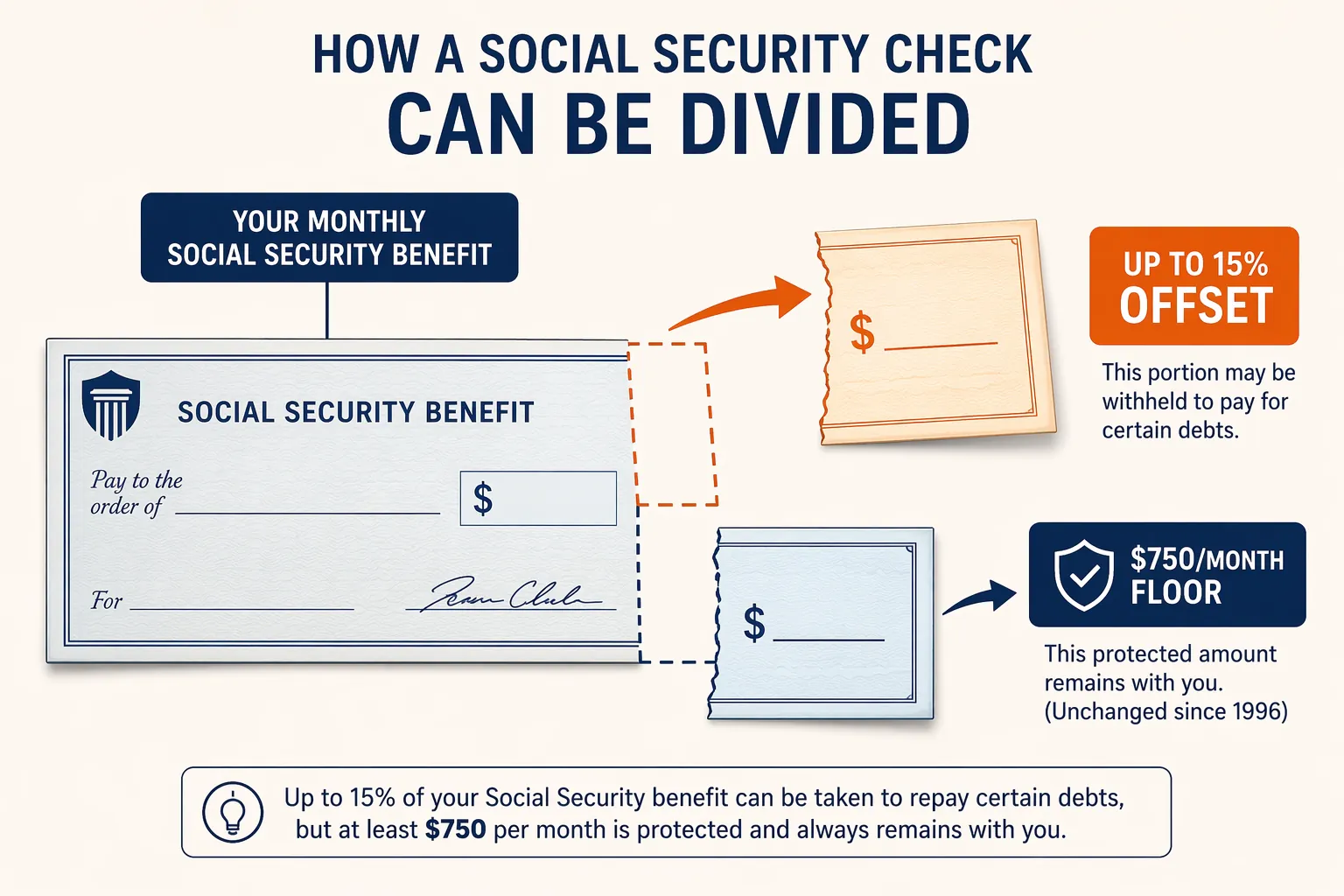
That $750 floor is the part that should make families stop and open the envelope. It does not leave room for rent, groceries, prescriptions, transportation, utilities, and the small emergencies that come with age. A borrower may still technically receive a Social Security payment, but the offset can remove money that was already spoken for.
The CFPB reported that 192,300 Social Security beneficiaries experienced offsets in 2019, a 3,000% increase since 2001. It also estimated that 452,000 borrowers age 62 and older with defaulted loans faced resumed collections. Those figures are somewhat lagged and do not perfectly describe Q3 2026 collections, but they are still the clearest recent warning about what default can do to a retirement check.[2]
The offset also may not reduce the debt in the way a family expects. The CFPB found that three out of four dollars collected through Social Security offset went to interest and fees rather than principal. It also found that 82% of affected beneficiaries likely qualified for a hardship exemption, but fewer than 10% applied.[2]
That is the narrow place where a paperwork step can protect a household. If an older borrower receives a notice about default, collections, Treasury offset, or Social Security withholding, it is not a letter to put in a pile for later. It is a letter to read, copy, date, and act on before the next benefit payment is reduced.
What Should a Retired Borrower Do First?
Start with the loan status, not with a long debate about whether the debt should exist. The next safe action depends on which lane the borrower is in.
| What you find | Why it matters | Next action |
|---|---|---|
| Current federal loan | The borrower may be able to prevent default and lower the payment. | Ask the servicer about IBR or ICR eligibility. |
| Defaulted federal loan | Social Security offset may become the immediate risk. | Ask about getting out of default and about hardship protections before offset begins. |
| Parent PLUS loan | The June 30, 2026 consolidation deadline changed the available repayment paths. | Check whether the loan was consolidated by the deadline. |
| Private student loan | Federal income-driven repayment and federal offset rules usually do not apply in the same way. | Read the promissory note and contact the lender or a qualified adviser. |
| Death or total and permanent disability situation | Federal loans may have discharge options. | Ask the servicer about death discharge or Total and Permanent Disability discharge. |
For a federal loan that is still current, the main goal is to avoid default. For a federal loan already in default, the main goal is to stop or prevent collection from reaching Social Security. Those are different calls, different forms, and often different departments.
How to tell whether the loan is federal or private
Federal student loans are handled through federal student aid systems and federal loan servicers. Private student loans come from banks, credit unions, state-affiliated lenders, schools, or other private lenders. A retired borrower may have both. Do not assume that one servicer statement tells the whole story.
- Look for words such as Direct Loan, FFEL, Perkins, Parent PLUS, Direct Consolidation Loan, Department of Education, or Federal Student Aid.
- Check whether the notice says the loan is delinquent, in default, transferred to collections, or subject to Treasury offset.
- Separate student loan mail from medical bills, tax notices, benefit letters, and ordinary account statements.
- Keep the envelope and the notice date, especially if a deadline is listed.
If an adult child is helping, it is worth making one simple folder: current servicer, loan type, balance, status, repayment plan, last notice, and any collection or offset warning. That folder can save hours when a servicer asks a question that sounds simple but is not.
Can Retirees Really Have a $0 Student Loan Payment?
Some can. Retirees whose only income is nontaxable Social Security may qualify for a $0 monthly payment under an available income-driven repayment plan, such as Income-Based Repayment or Income-Contingent Repayment, and those $0 payments can still count toward the 20- or 25-year forgiveness timeline.[1][3]
That last part matters. A $0 income-driven payment is not the same as ignoring the loan. The borrower is enrolled in a repayment plan, the required payment for that year is calculated as zero, and the borrower must keep up with recertification rules. If the borrower simply stops paying without being on the right plan, the loan can become delinquent and then default.
Be careful with older advice that tells retirees to use the SAVE plan. The SAVE plan was vacated by a federal court in March 2026. As of this last verification date, the income-driven options to focus on are IBR and ICR, with PAYE available only in limited situations.[3]
What income counts for a $0 payment?
Income-driven repayment calculations are tied to income information, usually taxable income. That is why a retired borrower living only on nontaxable Social Security may receive a very different payment calculation from a retired borrower with wages, pension income, taxable retirement account withdrawals, rental income, or other taxable income.
This is also why student loan paperwork sometimes belongs in the same household conversation as tax paperwork. A borrower’s loan payment, Social Security benefit, and retirement account withdrawals can collide on the kitchen table even when each one arrives in a separate envelope.
What If the Federal Loan Is Already in Default?
A defaulted federal loan is the danger zone because it can move from confusing paperwork to automatic collection. The borrower should ask the loan holder or collection contact what options are available to get out of default and whether a hardship exemption or other protection is available before Social Security is offset.
The CFPB’s hardship finding is the one to keep in mind: most affected beneficiaries likely qualified, but fewer than 10% applied.[2] That does not mean every borrower will qualify. It does mean families should not assume that a notice is final just because it looks official and frightening.
- Call the contact listed on the default or offset notice and write down the date, time, representative name, and any case number.
- Ask whether the account is already certified for Treasury offset or only at risk of offset.
- Ask what is required to request a hardship exemption, pause, review, rehabilitation, consolidation, or other default-resolution option.
- Do not promise a payment the borrower cannot afford just to end the call.
- If a caregiver is calling, ask what authorization form is needed so the servicer can speak with that caregiver.
The practical goal is to move the account out of the collection lane and into a repayment or protection lane before the benefit check is touched. Once money is being withheld, the household has less room to fix the problem.
What Changed for Parent PLUS Borrowers After June 30, 2026?
Parent PLUS borrowers need a separate look because the deadline has just passed. Borrowers who consolidated Parent PLUS loans into a Direct Consolidation Loan by June 30, 2026 may still have access to ICR, including the possibility of a $0 payment in retirement and 25-year forgiveness. Borrowers who missed that deadline have, under the sources available as of July 26, 2026, lost access to income-driven repayment, Public Service Loan Forgiveness, and other forgiveness paths for those Parent PLUS loans, leaving Standard, Extended, or Graduated repayment plans as the remaining repayment options.[1][4]
That is a harsh branch in the road, especially for parents who borrowed for a child and then reached retirement with less income than expected. It is also exactly why families should not give or accept a vague answer like “it’s a parent loan.” The question is whether it was consolidated by June 30, 2026, and what repayment plan it is in now.
Missing the Parent PLUS consolidation deadline does not erase every possible discharge. Death discharge and Total and Permanent Disability discharge are separate issues. But for ordinary repayment and forgiveness, the missed deadline can change the answer in a way that a retired borrower cannot fix by simply asking for an income-driven plan later.[1]
How Many Older Adults Have Student Loan Debt?
The scale matters mostly because it tells a worried borrower they are not the only person opening these letters in retirement. Bankrate reported that 3.6 million Americans age 60 and older held federal student loan debt, up 65% since 2017.[5] CNBC, citing Fidelity data, reported that 9.5 million Americans over age 50 carried roughly $452 billion in student loan debt as of Q1 2026.[6]
Student debt can also show up as thinner retirement savings. CNBC reported that employees over age 50 with student debt had average retirement balances 30% lower than those without it, $153,000 compared with $221,000, based on Fidelity data.[6]
Those numbers do not mean student loans caused every dollar of the retirement gap. They do mean the loan bill is arriving in households that may already have less cushion than their neighbors.
Are Student Loans Forgiven When the Borrower Dies?
Federal student loans are discharged when the borrower dies. Private student loans vary by lender and contract, so families should not assume the same rule applies to every loan.[5]
For a federal Parent PLUS loan, the borrower is the parent, not the child. That distinction matters when families are sorting responsibility, estate paperwork, and discharge requests. If the parent borrower dies, the federal Parent PLUS loan can be discharged under the federal death discharge rule.[5]
What If the Borrower Is Disabled?
Federal Total and Permanent Disability discharge may be available when a borrower meets the program’s disability standard, and this possibility is separate from whether a Parent PLUS borrower met the June 30, 2026 consolidation deadline.[1]
This is not a box to check casually. Families should ask the servicer what documentation is required and should keep copies of every submission. If the borrower is already receiving disability-related federal benefits, that paperwork may be relevant, but the discharge process still has its own rules.
Do Private Student Loans Work the Same Way?
No. Private student loans do not automatically follow federal income-driven repayment, federal forgiveness, federal death discharge, or federal Social Security offset rules. A private lender may offer hardship options, settlement options, cosigner release, death discharge, or none of those in the same way. The answer depends on the contract and lender policy.
Private loans can still be serious. They may involve collection calls, credit damage, lawsuits, or cosigner problems. But the $0 IBR or ICR path discussed here is a federal-loan path, not a promise a private lender has to match.
A Short Decision Check Before the Next Benefit Payment
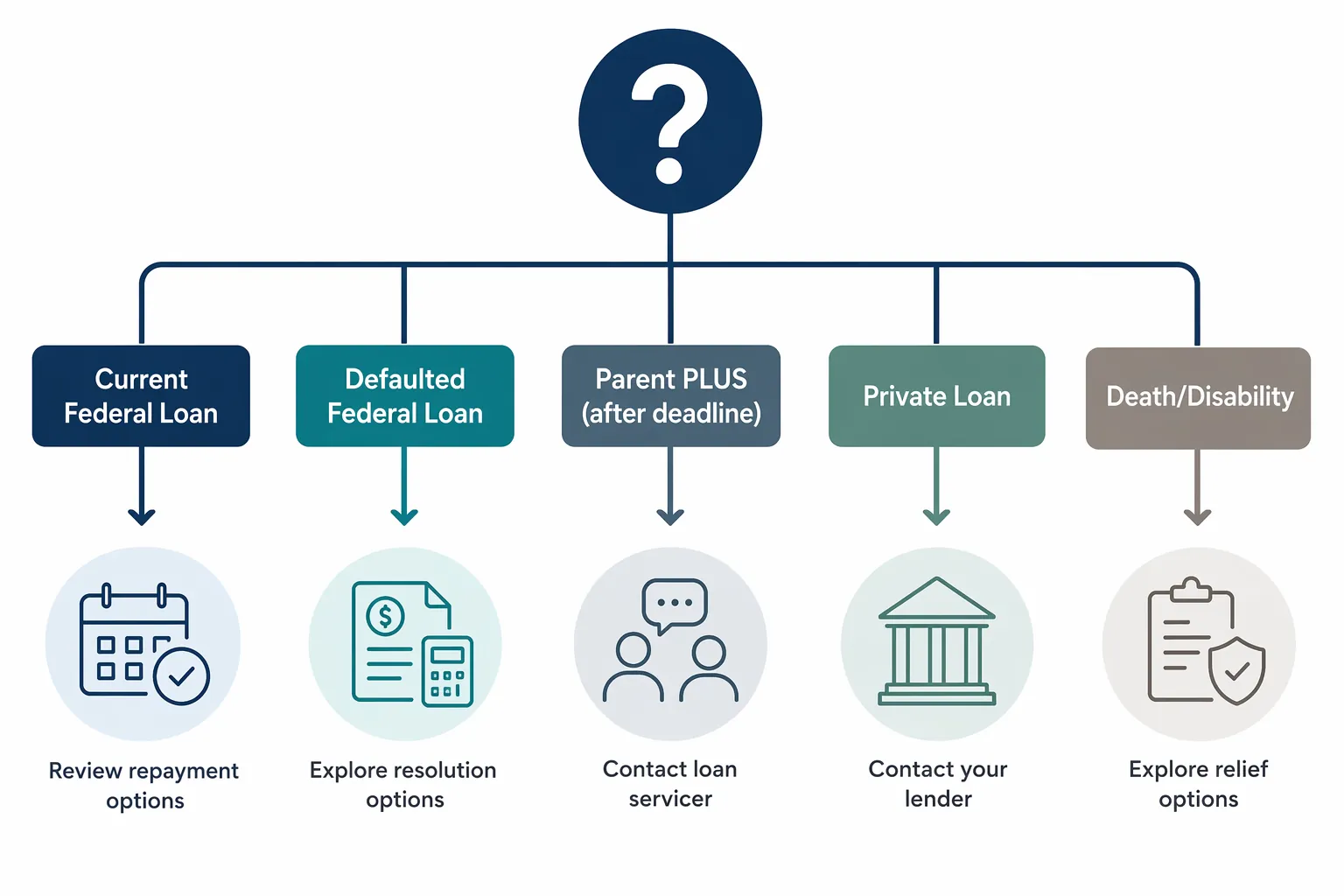
If the borrower has a current federal loan, ask about IBR or ICR and whether the payment can be calculated at $0 based on current taxable income. Keep recertification dates visible.
If the borrower has a defaulted federal loan, treat any collection or offset notice as urgent. Ask how to get out of default and whether a hardship exemption or other protection can stop or reduce Social Security offset.
If the borrower has Parent PLUS loans, check whether they were consolidated into a Direct Consolidation Loan by June 30, 2026. That one date may decide whether ICR remains available.
If the loan is private, read the contract and ask the lender what hardship, discharge, or settlement options exist. Do not assume federal protections apply.
If the situation involves death or Total and Permanent Disability, ask about federal discharge before anyone makes payments out of fear or confusion.
The debt does not vanish at retirement. But in many federal-loan households, the worst outcome is not simply owing the money. It is doing nothing until the Social Security check is already being offset.
References
- Student Loan Forgiveness for Elderly Borrowers, Tate Esq., updated July 2, 2026
- Issue spotlight: Social Security offsets and defaulted student loans, Consumer Financial Protection Bureau, January 2025
- Managing student loan debt in retirement, Empower
- How to manage Parent PLUS student loans near retirement, Kiplinger
- Seniors carrying student loan debt in retirement, Bankrate
- Student loan debt is hurting retirement savings, CNBC, February 2026
Browse more in the Glossary.