
Glossary entry
Student Loan Repayment Options for Seniors 2025–2026
Last verified 2026-07-26
This is not financial or legal advice. Medicare/Medicaid and benefits rules vary by state and change over time — verify current rules with your state Medicaid office or Area Agency on Aging.
No, federal student loans are not automatically forgiven at 65. There is no age-based student loan forgiveness program that wipes out a balance because a borrower reaches retirement age, starts Medicare, or begins collecting Social Security. Current as of July 26, 2026, the better question is not whether age erases the debt, but which repayment, discharge, or hardship protection fits the borrower’s actual loan type, income, and default status. [1]
That distinction matters because many older borrowers are not dealing with a small bookkeeping problem. The National Consumer Law Center reports that 3.5 million older Americans hold more than $125 billion in student loan debt. [2] The Consumer Financial Protection Bureau warned in January 2025 that about 452,000 borrowers age 62 and older with defaulted federal student loans were at risk of forced collections, including Social Security offset, as collections resumed. [3]

The practical paths now fall into a few buckets: Income-Based Repayment for many existing federal borrowers, the new Repayment Assistance Plan for loans under the post-July-2026 system, a much narrower Parent PLUS route because a key consolidation deadline has closed, and protections such as Total and Permanent Disability discharge or hardship suspension when collection would take money needed for basics.
Start with loan status, not age
A retiree with federal loans in good standing is in a different position from someone whose loans are in default. A Parent PLUS borrower is in a different position from a borrower who took loans for their own schooling. A borrower whose only income is non-taxable Social Security may have a very different payment calculation from someone still doing paid consulting work, taking retirement-account withdrawals, or filing jointly with a spouse.
Before choosing any plan, confirm three things through the federal loan servicer or StudentAid.gov: whether the loans are federal or private, whether they are current or in default, and whether any loan is a Parent PLUS loan. Private student loans do not follow the same federal repayment-plan rules, and federal default is the condition that can trigger Treasury collection tools such as Social Security offset.
| If this describes the borrower | The path to check first | Why it matters in 2025–2026 |
|---|---|---|
| Retired, loans current, very low taxable income | Income-Based Repayment | IBR may produce a $0 monthly payment when income counted for the plan is low enough. |
| Loans first entering the new post-July-2026 system | Repayment Assistance Plan | RAP is part of the new repayment structure, with different payment and interest features. |
| Parent PLUS borrower | Consolidation history and ICR eligibility | The July 1, 2026 consolidation deadline has closed, so access depends heavily on what happened before that date. |
| Defaulted loans and Social Security at risk | Hardship suspension, rehabilitation, consolidation, or other default-resolution help | Offset can happen, but caps and hardship protections may limit or stop it. |
| Severe long-term disability | Total and Permanent Disability discharge | TPD discharge is not age-based and can apply regardless of loan type if the borrower qualifies. |
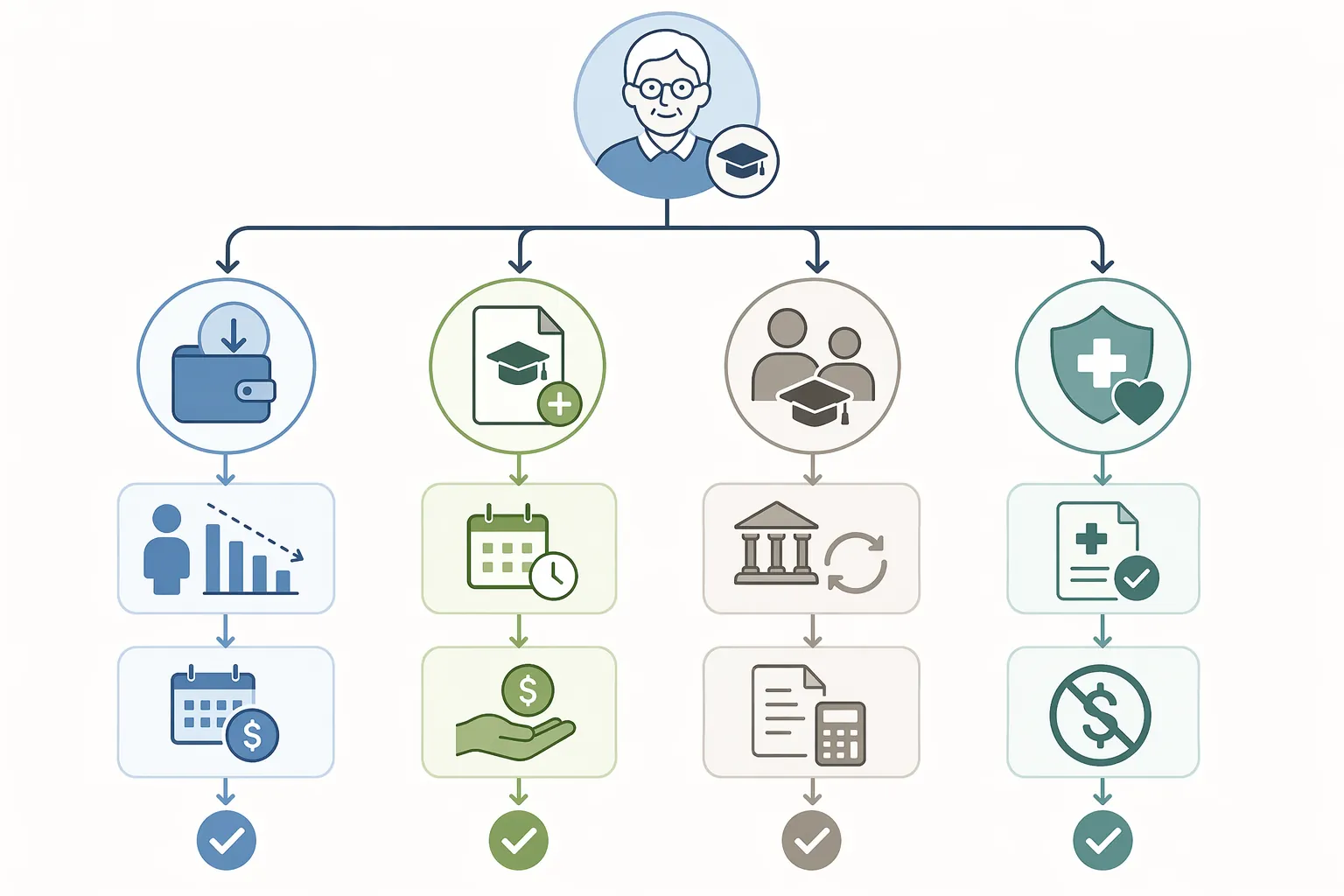
IBR is still the clearest route to a $0 payment for many retirees
For a senior borrower with federal loans in good standing and little or no taxable income, Income-Based Repayment deserves the first careful look. Under income-driven repayment, the payment is tied to income rather than the loan balance. That is why two people with the same balance can have very different bills in retirement.
For some retirees whose only income is non-taxable Social Security, the calculated payment under an income-driven plan can be $0. That does not mean the loan vanished. It means the required monthly payment is set at zero while the borrower remains properly enrolled and recertifies as required. Student Loan Borrower Assistance describes income-driven repayment plans as plans that set payments based on income and family size, with forgiveness after the applicable repayment period. [4]
The timing is important. The 2025 law and 2026 repayment changes did not leave every old plan untouched. TICAS explains that the One Big Beautiful Bill Act, signed July 4, 2025, reshaped the repayment system, eliminated SAVE after litigation, created the new RAP structure, and set July 1, 2028 as the phase-out date for ICR and PAYE. [5] IBR remains especially important during this transition because it is the most concrete income-driven path many existing borrowers can still use before the 2028 deadline.
A borrower already in retirement should not assume the servicer will automatically place them into the lowest-payment plan. The borrower, or the adult child helping them, needs to ask which income-driven plans are available for that loan type, what income documentation is being used, whether a spouse’s income is counted, and when recertification is due. A $0 payment is still a required-payment amount; missing paperwork can turn a manageable account into a problem.
The forgiveness tail matters, even when the payment is zero
IBR can lead to forgiveness after 20 or 25 years, depending on the borrower’s circumstances and applicable plan terms. [4] That long horizon may sound almost beside the point for someone already in their late 60s or 70s, but it still matters because staying in a qualifying plan can prevent delinquency and default while keeping the monthly bill tied to income.
There is also a tax caveat that older borrowers should not skip. Under current law after 2025, forgiven student loan amounts may be treated as taxable income, although an insolvency exclusion may be available. That is not a reason to avoid a low payment when groceries and prescriptions are the immediate issue. It is a reason to keep tax records and ask a qualified tax professional before assuming forgiveness will have no later consequences.
RAP matters, but it is not a magic senior-relief program
The new Repayment Assistance Plan is part of the post-2026 federal repayment landscape. It is especially relevant for borrowers whose loans fall under the new system after July 2026. RAP has features that can help prevent balances from growing in the same discouraging way borrowers have seen under older repayment arrangements, including interest-subsidy and principal-paydown features described in the July 2026 repayment-plan analysis. [5]
But RAP should not be described as if it solves every senior borrower’s problem. A retired borrower with older federal loans, Parent PLUS history, or an already defaulted account may first need to resolve eligibility, consolidation history, or default status. The fact that a new plan exists does not mean a servicer has already moved the borrower into the best available option, and it does not mean a borrower facing Social Security offset can ignore collection notices.
For an older adult still borrowing for their own education after July 2026, RAP may be the main repayment framework to understand before the first bill arrives. For an older adult carrying loans from years ago, the first question is more basic: whether IBR is available, whether the loan is current, and whether a past consolidation opened or closed other doors.
Parent PLUS borrowers need a separate check
Parent PLUS loans are where many families get surprised. These are federal loans, but they have not always had the same income-driven repayment access as loans a student borrowed for their own education. For older parents, that can mean a loan taken to help a child now sits beside a mortgage, medical bills, or a Social Security check.
The July 1, 2026 deadline is now closed. Under the post-2025 changes summarized by TICAS, Parent PLUS borrowers had a hard deadline to consolidate into a route that could preserve access to income-driven repayment; after that deadline, borrowers who missed it permanently lost IDR access for those Parent PLUS loans. [5] Parent PLUS borrowers who did consolidate before July 1, 2026 may still need to act before July 1, 2028 if they are trying to use ICR while that plan remains available. [5]
This is not a scolding point. It is a paperwork point with real consequences. Many Parent PLUS borrowers were not wealthy families casually borrowing extra money. NCLC and New America reported that one-quarter of Parent PLUS borrowers had an Expected Family Contribution of $0. [6] If that describes the household, a missed deadline can feel especially unfair, but the next step is still to confirm the consolidation record rather than guess.
- If the Parent PLUS loan was consolidated before July 1, 2026, ask the servicer which repayment plans remain available and whether ICR action is needed before July 1, 2028.
- If the Parent PLUS loan was not consolidated by July 1, 2026, do not assume a late consolidation will restore IDR access; ask for the current federal rule in writing.
- If the account is already in default, ask about default-resolution options and hardship protections before Social Security offset begins or continues.
- If the borrower may qualify for disability discharge, check TPD separately because it is not limited to non-Parent loans.
Social Security offset is real, but it has limits
A borrower in default can face forced collection. For older borrowers, the frightening word is often garnishment, but the federal student-loan process usually appears as a Treasury offset against federal payments, including Social Security retirement or disability benefits. The CFPB reported that 37% of the 1.3 million Social Security beneficiaries with student loans rely on Social Security for 90% or more of their income. [3]
The basic federal offset limits are important. Social Security benefits can be offset up to 15%, and a protected floor of $750 per month must be left. Supplemental Security Income is protected from student-loan garnishment. [7] That $750 floor has not been adjusted since 1996, and the CFPB noted that it sits $400 below the 2024 federal poverty line. [3]
Those limits do not make offset harmless. A person living on a tight monthly check may have already assigned every dollar to rent, utilities, food, medicine, and transportation. The CFPB reported that half of Social Security beneficiaries with defaulted student loans skipped a doctor’s visit or did not fill a prescription because of cost. [3] That is the part of the rule that does not show up when someone only says, “They can take 15%.”
There is a hardship protection many affected borrowers appear not to be using. According to CFPB’s discussion of GAO data, 82% of Social Security beneficiaries with defaulted loans likely qualify for a full hardship suspension, but fewer than 10% apply. [3] For a borrower already receiving offset notices, asking about hardship suspension is not begging for a favor. It is asking the government to apply a protection that exists for people whose basic living costs are at risk.
The longer trend explains why this fear has spread through retirement households. Between 2001 and 2019, the number of Social Security beneficiaries facing offsets grew from about 6,200 to 192,300, a roughly 3,000% increase. [3] In 2019, approximately 75% of the $429.7 million collected through Social Security offsets went to interest and fees rather than principal. [3]
If an offset notice arrives
Do not ignore the letter, even if it is upsetting or hard to understand. The immediate task is to identify the collection agency or federal contact listed, confirm that the loan is actually in default, and ask what deadline applies to request review, hardship suspension, rehabilitation, consolidation, or another available resolution. If the borrower receives SSI, that should be stated clearly because SSI is protected. [7]
If an adult child is helping, make a one-page folder: loan servicer, collection contact, Social Security benefit amount, SSI status if any, rent or housing cost, utilities, medical costs, prescription costs, and food costs. The hardship request is easier to complete when the household can show what the offset would actually displace.
TPD discharge is not about age; it is about disability
Total and Permanent Disability discharge can cancel eligible federal student loans when the borrower meets the disability standard. It is available regardless of age or loan type, including for borrowers whose difficulty repaying is connected to a serious long-term disability rather than ordinary retirement income limits.
This path should be checked separately from IBR, RAP, Parent PLUS rules, and offset hardship. A borrower can be too disabled to work, too overwhelmed to keep up with mail, and still not know that TPD exists. Families helping with benefits paperwork should look for federal TPD guidance, required documentation, and any monitoring or tax consequences that apply at the time of application.
Do not treat disability discharge as a last resort only after years of unaffordable payments. If disability is the reason the borrower cannot earn enough to repay, it belongs near the front of the review.
What changed from 2025 into 2026
Anyone looking for 2025 guidance now has to read the rules across two years. The One Big Beautiful Bill Act was signed July 4, 2025, and the new repayment structure took shape in 2026. SAVE is no longer a current option after being vacated by federal court in March 2026, and borrowers who were relying on that path need to confirm where they are being moved. [5]
The large practical changes are these: RAP becomes central for loans in the new system after July 2026; ICR and PAYE are scheduled to terminate July 1, 2028; IBR remains a key income-driven path for many existing borrowers before that transition date; and the Parent PLUS consolidation deadline of July 1, 2026 has already passed. [5]
For someone already retired, this means old advice may be stale even if it was correct when written. A 2024 article telling a Parent PLUS borrower to consolidate for ICR may describe a door that is now closed. A 2025 explanation of SAVE may describe a plan that no longer operates as a current repayment option. A generic warning that Social Security can be garnished may leave out SSI protection, the 15% cap, the $750 floor, and hardship suspension.
Sorting yourself into the next action
The useful next step depends less on the borrower’s age than on the account’s status. A 67-year-old with current Direct Loans and only non-taxable Social Security should ask about IBR and whether the payment calculation could be $0. A 72-year-old with a default notice should ask first about offset, hardship suspension, and default resolution. A Parent PLUS borrower should pull the consolidation history before assuming any income-driven plan remains available.
- Loans current and income very low: check IBR eligibility, payment calculation, recertification date, and the July 1, 2028 transition timeline.
- Loans under the new post-July-2026 system: ask how RAP applies and whether its payment, interest, and principal features fit the borrower’s income.
- Parent PLUS loans: confirm whether consolidation occurred before July 1, 2026 and whether any ICR access must be used before July 1, 2028.
- Defaulted loans with Social Security at risk: ask immediately about hardship suspension, SSI protection, offset limits, and default-resolution options.
- Serious long-term disability: review Total and Permanent Disability discharge before focusing only on monthly repayment.
Seniors do not receive automatic age-based forgiveness, and the 2025–2026 changes removed some routes while preserving or creating others. The safest way through is to verify the loan type, status, and income facts first, then match the borrower to the plan or protection that actually exists now. This article is educational information, not personalized financial, tax, or legal advice. Federal guidance should be checked directly through StudentAid.gov or a qualified professional because student loan policy is still moving, and state rules for Medicaid or other means-tested benefits can vary.
References
- Student Loan Forgiveness for Elderly Borrowers, Tate Law, updated July 2026.
- 3.5 Million Older Americans Have Over $125 Billion in Student Loans, National Consumer Law Center.
- Issue Spotlight: Social Security Offsets and Defaulted Student Loans, Consumer Financial Protection Bureau, January 2025.
- Payment Plans, Student Loan Borrower Assistance.
- Upcoming Changes to Income-Driven Repayment Plans, The Institute for College Access & Success, July 2026.
- The Growing Impact of Student Loan Debt on Older Adults, National Consumer Law Center and New America Foundation, 2024.
- Can SSI Be Garnished for Student Loans?, Tate Law.
Browse more in the Glossary.