
Clinical term
How to Support Your Aging Parent During Cancer Treatment
Last verified 2026-07-27
The practical answer is to start before the crisis evening. Put the work into four buckets: medical coordination, home safety adaptation, daily care logistics, and caregiver self-preservation. Cancer centers can guide treatment; families still have to make the house, calendar, medication handoffs, and night routine safer.
That matters because treatment changes the home quietly. The same hallway, bathroom, recliner, and bedroom can become harder to manage when fatigue, pain medicine, nausea, dehydration, poor sleep, appetite loss, or sedation enter the routine. An older parent may still look independent in the morning and be unsteady by 9:40 p.m.
| Domain | What to Set Up First |
|---|---|
| Medical coordination | Treatment calendar, current medication list, symptom notes, and clear instructions on whom to call |
| Home safety adaptation | Bathroom, bedroom, hallway, stairs, lighting, footwear, mobility aids, and fall-risk triggers |
| Daily care logistics | Rides, meals, hydration, pharmacy pickup, appointment notes, and family task assignments |
| Caregiver self-preservation | Coverage schedule, backup helpers, work boundaries, emotional support, and overload warning signs |
Start With Medical Coordination, But Do Not Try to Become the Oncology Team
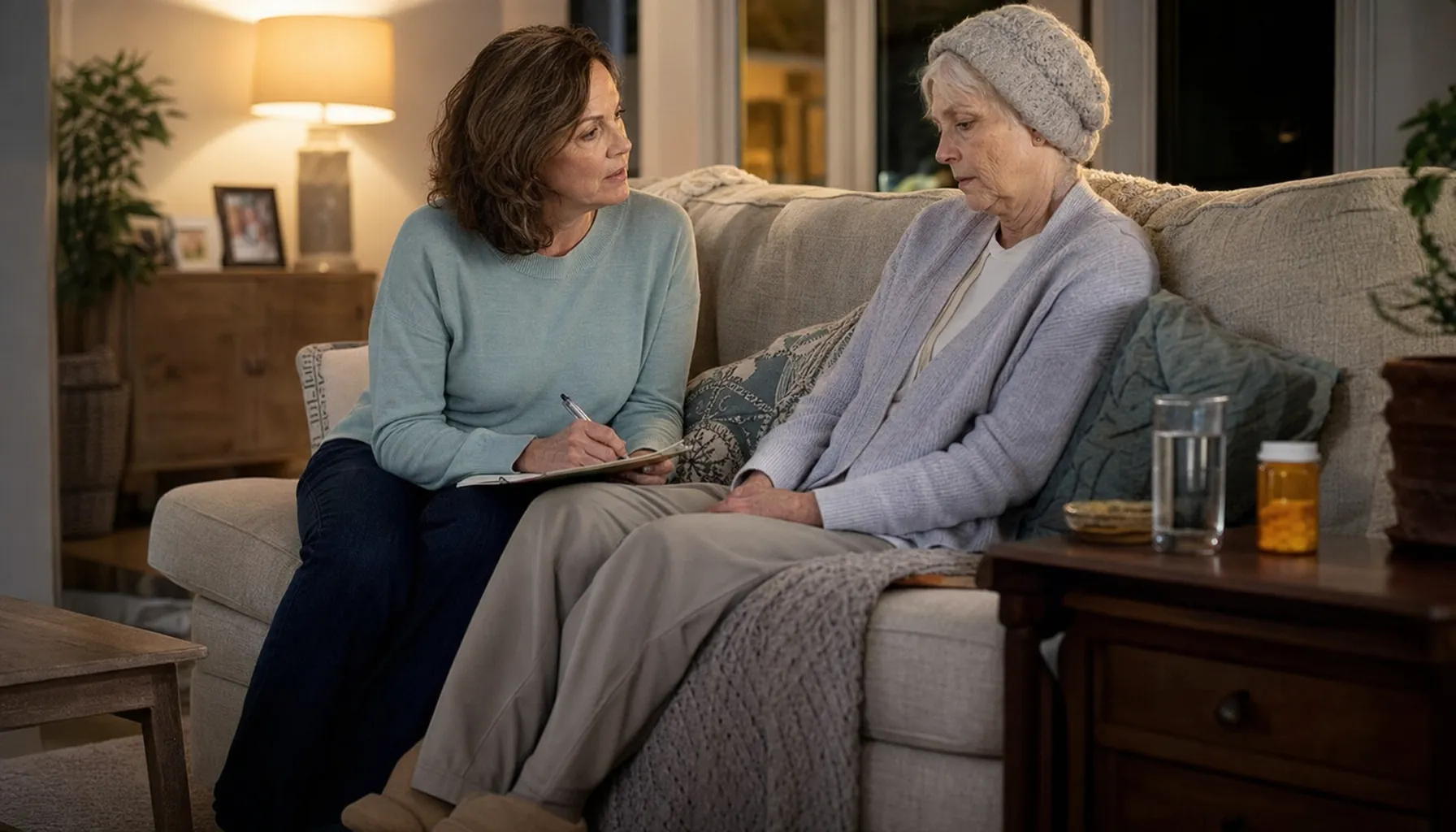
The first job is not to master cancer medicine. It is to make sure the right information follows your parent from the oncology office to the kitchen table, the pharmacy counter, and the urgent late-night phone call. The National Cancer Institute encourages caregivers to learn what help is needed, keep communication open, and use the care team as a source of guidance rather than guessing alone.[1] The American Cancer Society’s caregiver materials make the same point in practical terms: caregivers often help with appointments, medicines, symptoms, transportation, meals, and communication.[2]
For the first week, the medical coordination system can be simple:
- Keep one treatment calendar with appointments, lab visits, scans, infusion days, expected high-fatigue days, and follow-up calls.
- Maintain one medication list that includes prescriptions, over-the-counter drugs, supplements, as-needed medicines, recent changes, and who changed them.
- Track symptoms in plain language: appetite, hydration, bowel changes, dizziness, confusion, pain, sleep, fever, falls, near-falls, and new weakness.
- Ask the oncology team who to call for fever, uncontrolled pain, vomiting, dehydration, confusion, missed medication, a fall, or a possible medication reaction.
- Bring appointment notes home in writing so the person who drives Tuesday is not relying on what the person who attended Monday remembers.
MD Anderson’s advice for adult children caring for a parent with cancer emphasizes attending appointments when possible, helping the parent remember information, and respecting the parent’s preferences rather than taking over automatically.[3] Fox Chase Cancer Center similarly advises families to clarify what the parent wants, organize information, and accept that needs may change as treatment unfolds.[4] That is the right balance: be organized enough to prevent mistakes, but not so forceful that your parent feels managed instead of supported.
Treat Fall Prevention as a Cancer-Care Task
Home safety should not wait until after the first fall. Older adults with cancer have been reported to have a 15% to 20% greater fall risk than older adults without cancer.[5] A 2022 meta-analysis of 1,237 hospitalized cancer patients identified 11 fall risk factors; among them were opiates, benzodiazepines, and chemotherapy, with reported odds ratios of 1.72, 2.17, and 1.71 respectively.[5] That study is hospital-based, so it does not map perfectly onto every parent receiving outpatient treatment at home. It still points directly to the household moments families need to take seriously: sedation, pain control, treatment fatigue, nighttime toileting, and medication changes.
The most dangerous assumption is that the house is safe because it has always been safe. A parent who could cross the bedroom in the dark last month may now be weaker after an infusion, dizzy after standing, constipated from pain medication, rushing to the bathroom, or too embarrassed to ask for help. Fall prevention is not about wrapping the house in caution tape. It is about removing predictable traps before pride, fatigue, and urgency collide.
Do the First Home Check at Night, Not at Noon
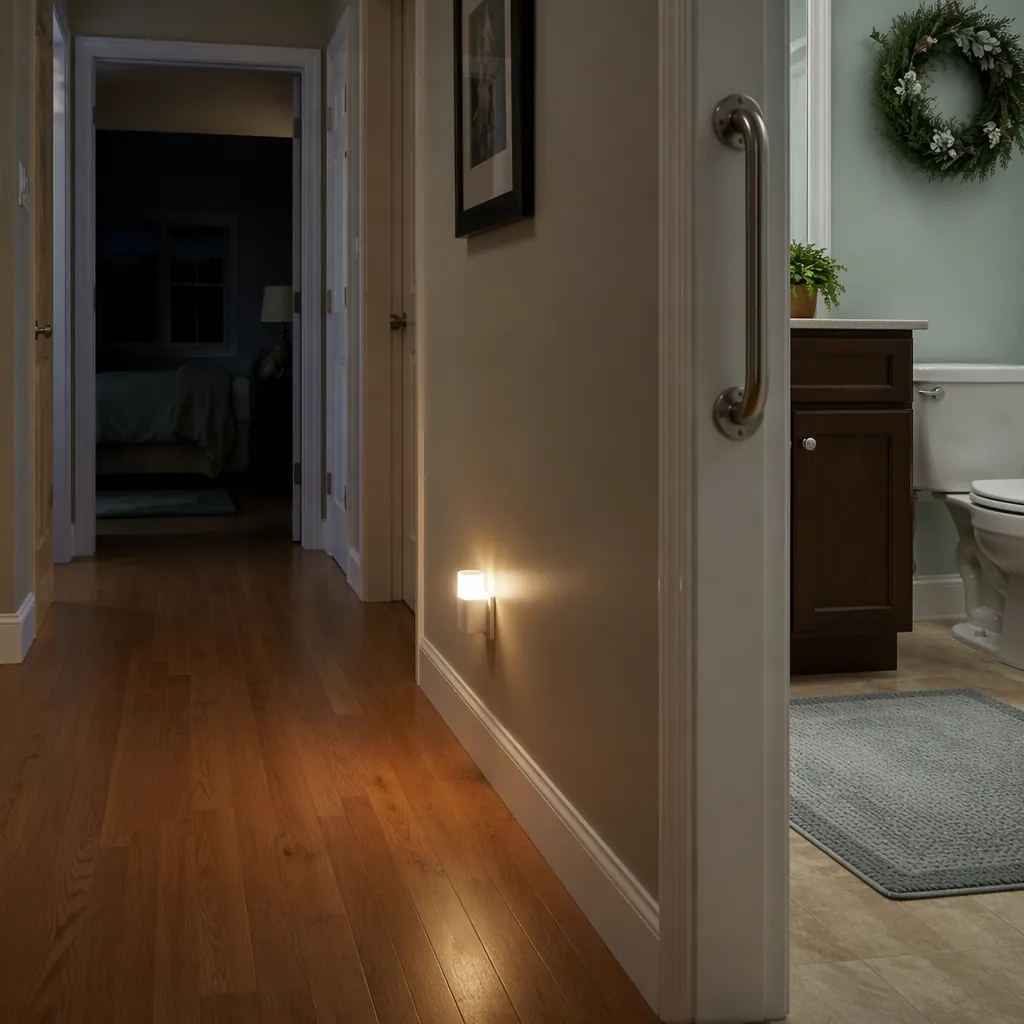
Walk the route your parent takes from bed to bathroom after dark. Turn on only the lights they would actually use. Notice whether a robe brushes against furniture, whether slippers slide, whether the hallway has shadows, whether the bathroom rug curls, whether the toilet is too low, whether the bed is hard to rise from, and whether there is a stable place to hold at each transition.
- Add nightlights from bed to bathroom, including the bathroom entrance.
- Remove loose rugs, cords, stacked laundry, low stools, and decorative objects from walking paths.
- Use non-slip mats only if they lie flat and do not create a tripping edge.
- Place water, phone, tissues, glasses, nausea supplies, and pain instructions within easy reach so your parent is not wandering half-awake.
- Check that slippers and shoes have backs, grip, and a fit that still works if the parent has swelling or weakness.
- Ask whether a raised toilet seat, shower chair, hand-held shower, or properly installed grab bars would reduce risky reaching.
Bathroom help deserves special care because it is where dignity and fall risk often meet. If your parent resists assistance, offer choices instead of issuing instructions: a nightlight instead of the overhead light, a shower chair for treatment weeks only, a call button or phone on the nightstand, or a rule that someone waits outside the bathroom after a sedating medication. The goal is not to win an argument. The goal is to make the safer option feel less humiliating.
Connect Medication Changes to the Walking Plan
Every medication change should trigger a safety check, especially when pain medicine, anti-anxiety medication, sleep medication, nausea medication, steroids, or new chemotherapy side effects are involved. Families often update the pillbox and forget to update the walking plan. If a new medicine can cause drowsiness, dizziness, confusion, diarrhea, constipation, urgency, or dehydration, the parent may need extra supervision during the first doses, bathroom trips, and nighttime hours.
This is also where the medication list matters. A current list makes it easier for the oncology team, primary care clinician, pharmacist, or urgent-care clinician to spot combinations that may worsen unsteadiness. It also prevents the family from relying on memory when everyone is tired and someone asks, “Did she already take the evening pain pill?”
Escalate When Falls or Near-Falls Repeat
A near-fall counts. So does grabbing a towel bar, sitting down suddenly in the hallway, abandoning a shower because of weakness, or admitting, “I almost went down.” One isolated stumble may lead to a quick fix. Repeated events call for a broader decision: whether the home needs more equipment, whether someone should stay overnight, whether physical therapy or occupational therapy should be requested, or whether the current level of care is no longer enough.
If falls become recurrent, use a decision framework such as When Falls Signal the Need for 24/7 Home Care rather than treating each incident as a separate scare. For fatigue and sleep-related unsteadiness, the guidance in How Permanent DST Affects Seniors’ Sleep and Fall Risk can help families think through light, sleep disruption, and nighttime movement. For hydration and medication-related risk, especially during hot weather or poor intake, open the heat wave fall risk guide. If the home itself is becoming the problem, compare temporary fixes with longer-term choices in home modifications vs. downsizing.
Make Daily Logistics Visible Before They Become Emergencies
Most families do not collapse because no one cares. They collapse because the work stays vague. “Let me know what you need” sounds kind, but it does not drive to radiation on Tuesday, pick up anti-nausea medicine before the pharmacy closes, or sit with a parent who is afraid to shower.
Put the recurring tasks on a shared calendar and assign names, not intentions:
- Transportation: who drives, who stays, who can handle a long wait, and who is backup if treatment runs late.
- Appointment notes: who writes down medication changes, symptom instructions, next steps, and warning signs.
- Meals: who brings food your parent can actually tolerate, not just what is comforting to the cook.
- Hydration: who checks fluid intake, swallowing problems, vomiting, diarrhea, or signs that drinking has dropped off.
- Pharmacy: who picks up prescriptions, checks refill timing, and confirms new directions.
- Household basics: trash, laundry, pet care, mail, bills, groceries, and clean bedding.
- Safety coverage: who is present after sedating medications, after infusion days, during showers, or overnight if needed.
The calendar should include the parent’s preferences. Some parents want one adult child at every visit. Others want privacy at appointments but help afterward. Some will accept a meal train before they will accept bathing help. Respect matters, but so does clarity. If a task affects medication, hydration, mobility, or symptom reporting, it cannot live in a group text as a hopeful suggestion.
It also helps to build one household checklist for predictable disruptions. A cancer-treatment week can become more hazardous during a storm, outage, extreme heat, or pharmacy delay. The Power Outage Fall Prevention Checklist is a useful model: think through lighting, charged phones, clear paths, medication access, hydration, and backup help before the house is dark or the caregiver is already stretched.
Protect the Caregiver Because the Care System Depends on Them
Caregiver self-preservation is not a reward for being noble. It is part of the safety plan. NCI’s PDQ summary on informal caregivers describes family caregivers as a central part of cancer care and notes that caregiving can involve substantial time, physical effort, emotional strain, and care coordination.[6] In cancer-caregiver data cited in the research literature, caregivers averaged 32.9 hours per week, and one-third provided 41 or more hours per week.[6] That is not “helping out.” That is a second job, often layered on top of paid work, parenting, marriage, and one’s own health.
Among caregivers of older adults with cancer, 75% reported some burden and 15% reported high burden in Cancer and Aging Research Group findings.[7] In a Cancer journal study, 64% of older adults with cancer had at least one unmet social support need.[8] A 2022 systematic review and meta-analysis reported a 42% pooled prevalence of depressive symptoms among cancer caregivers.[9] These numbers should end the fantasy that one responsible adult child can quietly absorb everything if they are organized enough.
Redistribute work when any of these signs appear:
- One person is doing rides, medication calls, night monitoring, housework, and family updates.
- The caregiver is sleeping poorly, missing work repeatedly, skipping their own medical care, or becoming short-tempered from exhaustion.
- Medication updates are being missed because too many people are texting separate instructions.
- A parent’s fall risk is increasing because no one is available at the risky times of day.
- Siblings or relatives keep offering general concern but do not own a recurring task.
The fix is not another family update from the person already drowning. Assign durable jobs. One person handles Tuesday transportation. One person owns pharmacy refills. One person checks hydration and meals after infusion days. One person updates the medication list after appointments. One person is backup overnight on high-risk days. If someone lives far away, they can still manage bills, insurance calls, grocery delivery, appointment scheduling, or the family calendar.
The parent should not disappear inside the system either. Ask what help feels acceptable, what feels intrusive, who they want in appointments, and where they want privacy preserved. Then be honest about non-negotiables: unsafe showering, repeated near-falls, missed medications, dehydration, confusion, or unmanaged pain require more support than preference alone can settle.
A First-Week Operating System
If treatment has just started, do not wait to see how hard it gets. Build the first version now:
- Create one treatment calendar and one medication list.
- Ask the oncology team who to call for fever, falls, dehydration, confusion, uncontrolled symptoms, and medication questions.
- Walk the bedroom-to-bathroom route at night and fix lighting, clutter, rugs, footwear, and unstable handholds.
- Review every medication change for dizziness, sedation, urgency, dehydration, confusion, or weakness.
- Assign recurring tasks by name: rides, notes, meals, hydration, pharmacy, household chores, and high-risk safety coverage.
- Set a rule that repeated falls, near-falls, missed medications, or caregiver exhaustion trigger a family redistribution of work, not just another worried conversation.
Supporting an aging parent through cancer treatment is not only about showing up at the infusion center. It is about noticing what treatment does to the ordinary parts of home life, then making those ordinary parts safer, clearer, and less dependent on one exhausted person remembering everything.
References
- Support for Caregivers of Cancer Patients, National Cancer Institute
- Caregiver Resource Guide, American Cancer Society
- Caring for a parent with cancer? Follow this advice, MD Anderson Cancer Center
- Caring for a Parent with Cancer, Fox Chase Cancer Center
- Risk factors for falls in hospitalized patients with cancer: A systematic review and meta-analysis, PMC, 2022
- Informal Caregivers in Cancer: Roles and Challenges (PDQ®)–Health Professional Version, National Cancer Institute
- Caregiver burden in older adults with cancer, Cancer and Aging Research Group
- Unmet social support needs among older adults with cancer, Cancer, 2019
- Prevalence of depressive symptoms among cancer caregivers: A systematic review and meta-analysis, Psycho-Oncology, 2022
Browse more in the Glossary.