
Clinical term
What Men Over 50 Need to Know About Testosterone Screening
Last verified 2026-07-25
Last verified: July 25, 2026. This article is for general education and is not a diagnosis, treatment plan, or substitute for a clinician who knows your health history.
If you are over 50, testosterone screening does not belong on the annual lab list just because another birthday passed. The better question is narrower: are there symptoms or medical conditions that make low testosterone a reasonable possibility, and would the result change what you and your clinician do next?
Major medical guidelines do not recommend routine testosterone screening for all older men. The Endocrine Society recommends diagnosing hypogonadism only in men with symptoms and signs plus consistently low testosterone levels; the American Urological Association says the diagnosis requires symptoms or signs associated with testosterone deficiency and low total testosterone; and the ACP/AAFP guidance on age-related low testosterone focuses treatment decisions on men with sexual dysfunction rather than broad testing of older men without a clear clinical reason.[1][2][3]

What testosterone screening actually tests
Testosterone screening usually starts with a blood test for total testosterone, which measures testosterone circulating in the blood. Sometimes a clinician also orders free testosterone, which estimates the portion not tightly bound to proteins and more available to tissues. Free testosterone can matter when total testosterone does not fit the symptoms or when binding-protein changes are suspected, but it is not usually the first number families need to chase.
The test is simple. The interpretation is not. Testosterone varies by time of day, illness, medication use, sleep, weight changes, and lab method. That is why a single low result should usually be treated as a lead to follow, not as a diagnosis by itself.
Who should consider testing
The most useful starting point is not age. It is a pattern: symptoms that fit low testosterone, a medical condition linked with testosterone deficiency, or both. A man who feels well, has no sexual symptoms, no unexplained loss of strength or body hair, and no relevant medical condition usually does not gain much from adding testosterone to routine annual bloodwork.
Symptoms that make the conversation more reasonable include low sex drive, fewer spontaneous erections, erectile dysfunction, loss of body hair, reduced muscle mass, unexplained anemia, fatigue, and depressed mood. Some of these are more specific than others. Low libido and loss of body hair point more directly toward androgen deficiency than a vague complaint such as “I’m tired all the time.” Fatigue and low mood are real symptoms, but they also travel with poor sleep, grief, medication side effects, depression, thyroid disease, heart disease, anemia, alcohol use, and many other causes.
Memory changes deserve special caution. They may show up in the same family conversation as low energy or loss of drive, but they are not enough by themselves to make testosterone the main suspect. If an older man is forgetting appointments, falling, losing weight, or withdrawing socially, that is a reason for a broader medical evaluation, not a reason to narrow the whole problem to one hormone.
There are also medical conditions where testing may be considered even without classic symptoms. The AUA guideline says clinicians should consider measuring total testosterone in men with unexplained anemia, bone density loss, diabetes, exposure to chemotherapy or testicular radiation, HIV/AIDS, chronic narcotic use, male infertility, pituitary dysfunction, and chronic corticosteroid use.[2]
That exception matters for families. If a father has osteoporosis, a low-trauma fracture, repeated falls, or a cancer treatment history that affects hormones, testosterone testing may be part of a larger bone and muscle-risk evaluation. It still should not become a shortcut around the rest of the workup.
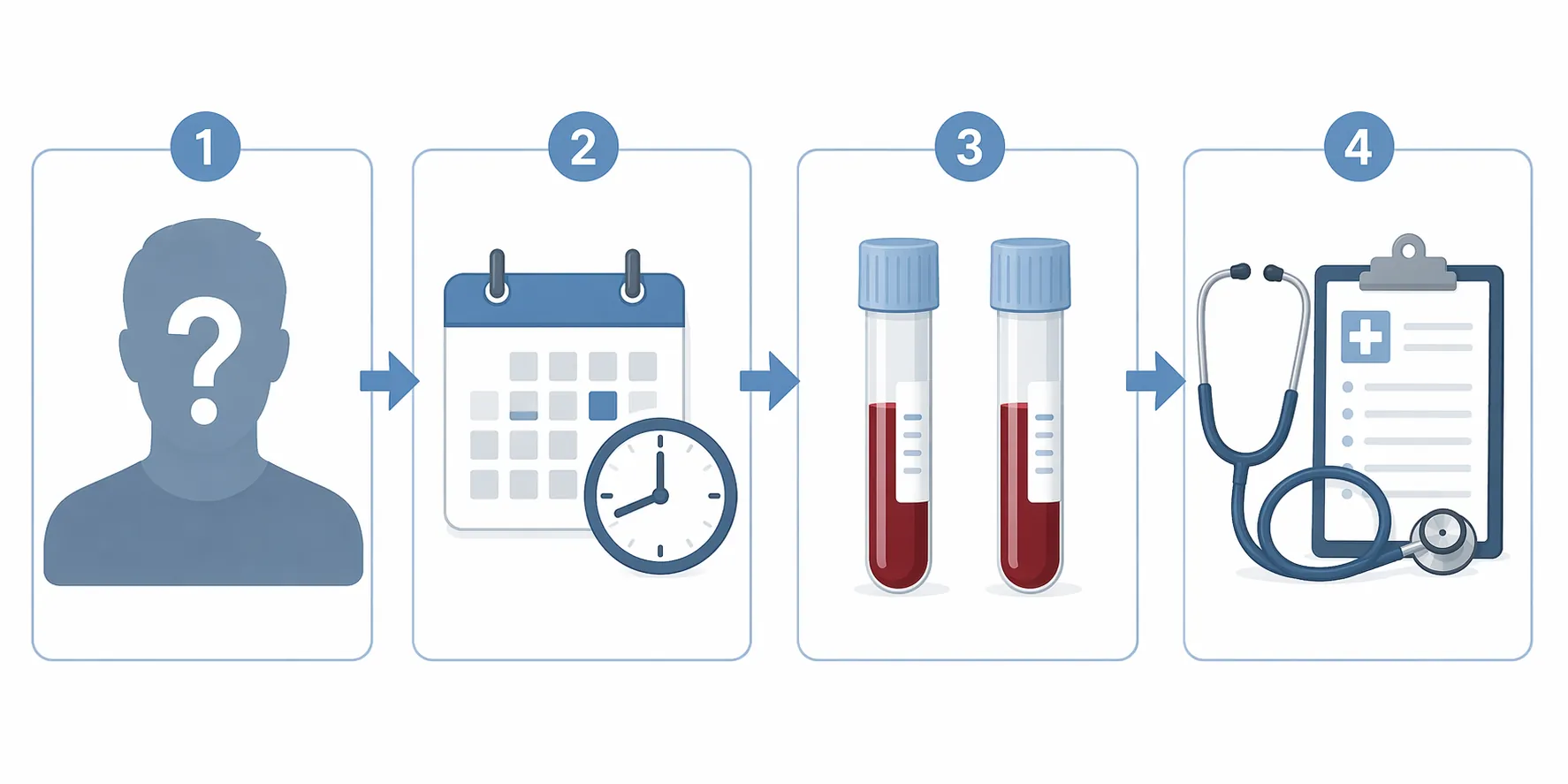
The testing sequence matters
A careful testosterone workup usually moves in this order: symptoms or risk condition, correctly timed blood draw, repeat confirmation, context labs if needed, then a treatment conversation. Skipping the order is how men end up with a label before anyone has explained what the number measured.
| Step | What it means in practice |
|---|---|
| Start with the reason | Name the symptom pattern or medical condition that makes testing useful. |
| Draw blood in the morning | Many clinicians order testosterone between about 7 and 10 a.m.; fasting may be requested depending on the lab and related tests. |
| Repeat a low result | A low total testosterone result should generally be confirmed with a second morning test on a different day. |
| Look for the cause | Follow-up labs may include LH, prolactin, hemoglobin, and hematocrit, depending on the situation. |
| Decide together | Treatment is considered only after symptoms, repeat labs, risks, goals, and alternatives are reviewed. |
Morning timing is not a fussy detail. Testosterone levels are typically higher earlier in the day, and both the Endocrine Society and AUA emphasize confirming low levels with repeat morning measurements rather than diagnosing from one stray result.[1][2]
The Cleveland Clinic and MedlinePlus both describe testosterone testing as a blood test and note that timing, preparation, and whether fasting is needed can depend on the clinician’s instructions and the lab’s process.[4][5]
The repeat test is where a lot of unnecessary worry gets prevented. Harvard Health notes that borderline-low testosterone readings normalize on repeat testing about 30% of the time.[6]
What the numbers can and cannot tell you
A testosterone number is not a moral score, a masculinity score, or a stand-alone explanation for every change that comes with aging. It is a lab value that has to be interpreted against symptoms, age, health status, medications, and the lab’s own reference range.
For one concrete reference point, LabCorp lists an adult male total testosterone reference interval for ages 50 to 59 of 215–878 ng/dL, but reference ranges vary by laboratory and test method.[7]
| Number or range | How to read it |
|---|---|
| LabCorp 50–59 reference interval: 215–878 ng/dL | A lab-specific reference range, not a universal treatment rule. |
| AUA low-testosterone cutoff: total testosterone below 300 ng/dL | A diagnostic threshold used with symptoms or signs, not by itself. |
| Endocrine Society marker: below 200 ng/dL for men over 50 | A lower marker associated with hypogonadism in its guideline discussion. |
| AUA on-treatment target: 450–600 ng/dL | A treatment-monitoring target for men already being treated, not a screening cutoff. |
The AUA uses total testosterone below 300 ng/dL as a reasonable cutoff supporting the diagnosis of low testosterone, but it also says the diagnosis should be made only after two early-morning measurements and in the presence of symptoms or signs.[2]
The Endocrine Society guideline uses a lower hypogonadal marker of less than 200 ng/dL for men over 50 in its diagnostic discussion, while still requiring symptoms and unequivocally, consistently low serum testosterone before treatment is considered.[1]
Treatment targets are a different matter. The AUA says clinicians should adjust testosterone therapy dosing to achieve a total testosterone level in the middle tertile of the normal reference range, and it identifies 450–600 ng/dL as a reasonable target range during treatment.[2] That number should not be read backward as a reason to treat every man below 450.
Low lab values become more common with age, but that is not the same as disease
Testosterone tends to decline gradually with age. The Urology Care Foundation describes testosterone levels as falling about 1% to 2% per year after age 30.[8] That trend can be frustrating, but a common age-related change is not automatically a disease needing treatment.
This is where screening every older man creates trouble. About 20% of men over 60, 30% over 70, and 50% over 80 have low testosterone by lab value alone, yet many do not have symptoms.[8] A lab report can be true and still not explain the problem in front of the family.
The reverse also happens. A man may have fatigue, low mood, poor sleep, and loss of strength with a testosterone level that is not low enough to explain the symptoms. That does not make the symptoms imaginary. It means the search should widen rather than forcing the hormone result to carry more weight than it can.
What happens after a low result
A first low testosterone result should usually lead to confirmation, not an immediate prescription. The second test should be another morning total testosterone level, preferably when the man is not acutely ill and when temporary factors have been considered.
If low testosterone is confirmed, clinicians often look for the reason. The AUA recommends measuring luteinizing hormone in patients with low testosterone, measuring prolactin when low testosterone is paired with low or low-normal luteinizing hormone, and checking hemoglobin and hematocrit before testosterone therapy because treatment can raise red blood cell levels.[2]
That follow-up is not paperwork. LH can help separate testicular causes from pituitary or signaling causes. Prolactin can point toward pituitary problems in the right setting. Hemoglobin and hematocrit help identify anemia before treatment and monitor a known therapy risk afterward.
The treatment conversation should be specific. What symptom is the patient hoping will improve? Is the main issue low libido, erectile dysfunction, loss of muscle, depressed mood, anemia, or bone health? Has sleep apnea, medication effect, depression, alcohol use, thyroid disease, or another common cause been considered? Is fertility relevant? Testosterone therapy can suppress sperm production, so that question should not be skipped in men who may still want children.
Lifestyle changes may be part of the plan, especially when sleep, weight, alcohol, inactivity, or chronic illness is contributing. That does not mean lifestyle advice “fixes” all low testosterone. It means the lab value should be handled inside the whole health picture, not as a stand-alone project.
At-home testosterone kits have a limited role
At-home testosterone tests are available, and for some men they may be the prompt that gets an overdue conversation started. They should not be treated as a final diagnosis. Collection method, timing, lab method, and follow-up all matter, and a low home result still needs clinician-directed confirmation and interpretation.
A practical way to use a home result is to bring it to a primary care clinician or urologist with the symptom list and medication list. A less helpful way is to buy treatment online before anyone has repeated the test or checked why the level is low.
A 2026 label-warning proposal does not change the screening rule
One current wrinkle is regulatory, not diagnostic. In June 2026, HHS asked the FDA to remove long-standing label warnings about heart and prostate risks from testosterone therapy products; AARP reported on the request in July 2026.[9] As of July 25, 2026, that was a proposal, not a finalized change.
Even if labels change later, the screening question stays the same. A possible change in drug warnings is not a reason for healthy men over 50 to add testosterone to every annual physical. Testing still needs a clinical reason, and treatment still needs confirmed low levels plus a symptom or condition worth treating.
The family decision rule
For a man over 50, testosterone screening is worth discussing when there are specific symptoms such as low sex drive, erectile dysfunction, loss of body hair, reduced muscle mass, unexplained fatigue, depressed mood, anemia, or bone density loss — or when a condition such as diabetes, HIV, chronic opioid use, chronic corticosteroid use, pituitary disease, infertility, or prior chemotherapy or testicular radiation makes testing clinically relevant.
Do not screen just because of age. Do not diagnose from one blood draw. Do confirm the diagnosis with two separate morning blood tests, then interpret the number against symptoms, medications, other illnesses, and the lab’s reference range before treatment enters the conversation.
References
- Testosterone Therapy in Men With Hypogonadism: An Endocrine Society Clinical Practice Guideline, Endocrine Society, 2018.
- Testosterone Deficiency Guideline, American Urological Association, 2024.
- Testosterone Treatment in Adult Men With Age-Related Low Testosterone: A Clinical Guideline From the American College of Physicians, Annals of Internal Medicine, 2020.
- Testosterone Test, Cleveland Clinic.
- Testosterone Levels Test, MedlinePlus.
- Testing your testosterone: It’s tricky, Harvard Health Publishing.
- Testosterone, Total, Labcorp.
- What is Low Testosterone?, Urology Care Foundation.
- HHS Seeks to Remove Warnings From Testosterone Products, AARP, July 5, 2026.
Browse more in the Glossary.