
Clinical term
How to Tell Tick-Borne Illness from Normal Aging in Older Adults
Last verified 2026-07-31
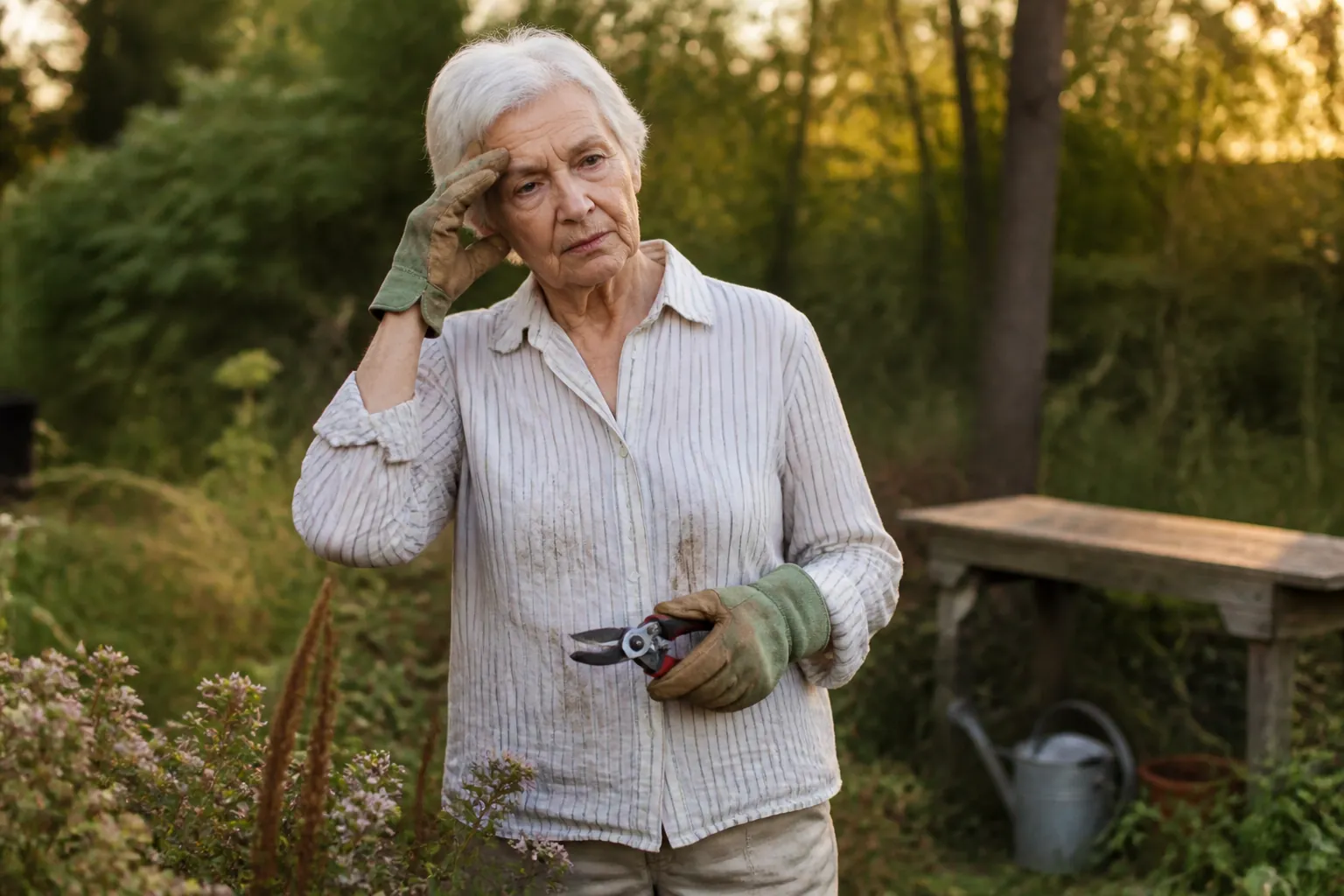
An older adult spends a warm afternoon gardening, walking near brush, or sitting on a porch that backs up to woods. A week or two later, the family notices something vague: more fatigue, more aching, a little confusion, a new unsteadiness. The easy explanation is age, especially if arthritis, mild memory loss, or balance trouble was already there. But “older” is not a diagnosis. The more useful question is whether the pattern has changed.
For caregivers trying to understand how to recognize tick-borne illness symptoms in older adults, the first clue is rarely one perfect symptom. It is usually a cluster: new fatigue that arrives quickly, joint pain that moves, fever with headache and muscle aches, sudden confusion, a rash that is expanding, or balance trouble that shows up over days rather than years.
The side-by-side pattern that matters most
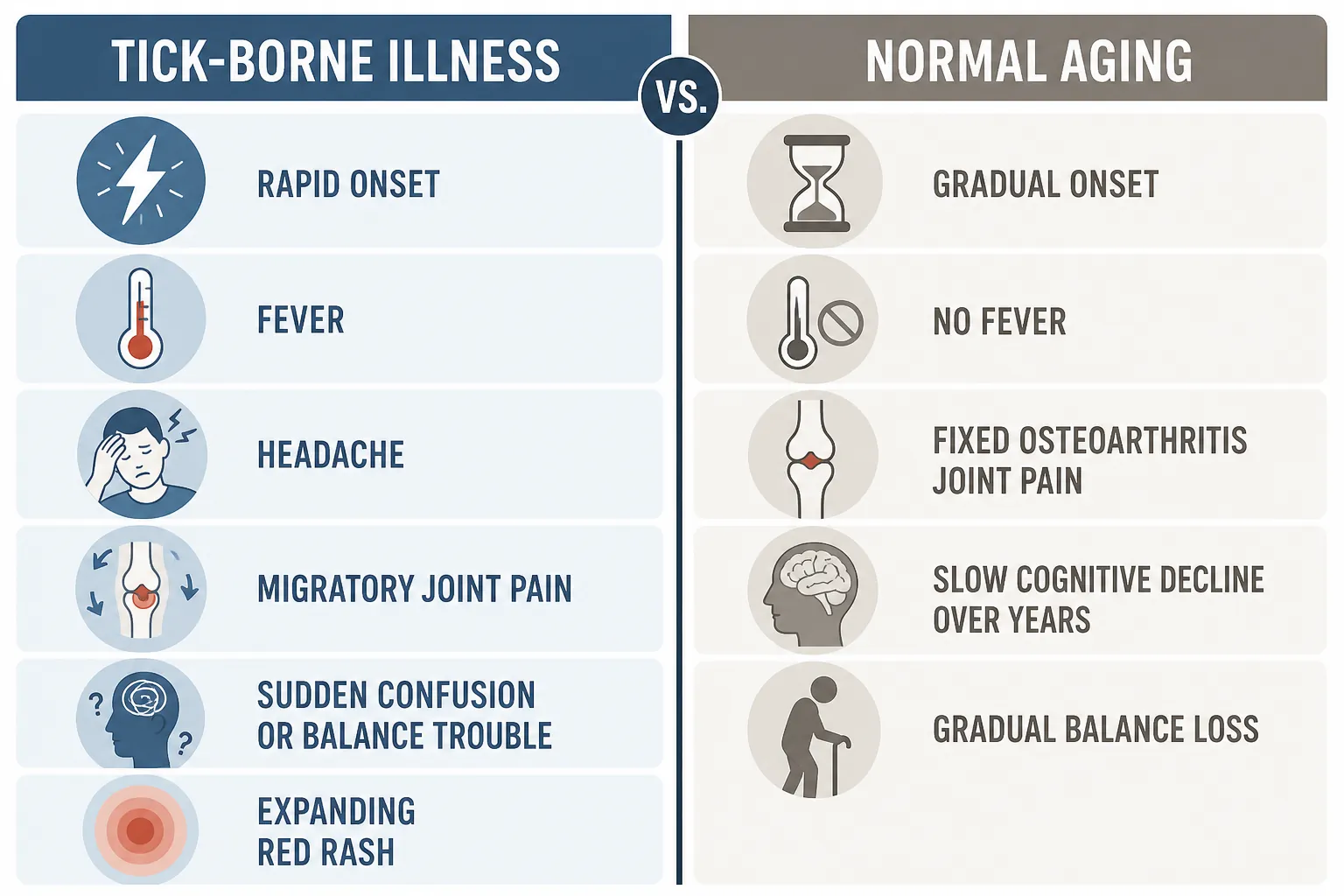
Normal aging and tick-borne illness can look frustratingly similar from across the kitchen table. Both can involve tiredness, aches, slower walking, and less mental sharpness. The difference is often speed, clustering, and departure from the person’s usual baseline.
| What the family notices | More consistent with normal aging or a chronic baseline | More concerning for tick-borne illness |
|---|---|---|
| Fatigue | Longstanding tiredness that changes slowly and fits the person’s usual pattern | New or clearly worse fatigue over days or weeks, especially after outdoor exposure or during tick season |
| Joint pain | Fixed pain in the same arthritic joint, often worse with use and familiar in quality | Pain or swelling that moves between joints, or a new joint problem that does not match the usual arthritis pattern |
| Thinking and memory | Gradual decline over months or years, similar to prior dementia or mild cognitive impairment changes | Rapid confusion, unusual sleepiness, personality change, or trouble following conversation over a short period |
| Aches and headache | Nonspecific soreness without fever and without a clear change from baseline | Fever plus headache plus muscle or joint pain, especially with recent gardening, hiking, yard work, pets, or wooded exposure |
| Balance | Slowly progressive unsteadiness that has been discussed before and is not sharply different | New imbalance, dizziness, falls, facial droop, severe headache, neck stiffness, or other neurologic change |
| Skin findings | No new rash, or a familiar skin irritation that is not expanding | An expanding rash, especially one larger than 2 inches, even if it is not a classic bullseye |
That comparison does not diagnose Lyme disease, babesiosis, anaplasmosis, or any other tick-borne infection. It does something more practical at home: it helps a caregiver decide whether the change is familiar and gradual, or new enough and clustered enough to call a clinician.
Older adults are not a fringe group in Lyme diagnoses
It is reasonable to be alert, not because every sore knee after yard work is Lyme disease, but because older adults are a substantial part of the diagnosed population. A CDC analysis of Medicare claims found 88,485 Lyme disease diagnoses among Medicare beneficiaries from 2016 through 2019, equal to about 123.5 diagnoses per 100,000 person-years among adults 65 and older. The authors estimated that this was roughly seven times higher than what traditional surveillance captured, while also noting that claims data can include some overdiagnosis because it reflects antibiotic-treated diagnoses rather than only confirmed surveillance cases. [1]
Data from Ontario point in the same general direction for age. During 2015 through 2022, reported Lyme disease incidence peaked in adults ages 50 to 79, with the highest rate in the 60 to 69 age group at 11.8 per 100,000. [2] That does not mean a 68-year-old with fatigue probably has Lyme. It means age should not be used to wave away a new illness pattern in a person who lives in or travels through tick-endemic areas.
Fatigue: look for a change in tempo
Longstanding fatigue has a history. The person has been taking an afternoon rest for years, tiring after errands, or moving more slowly after poor sleep. New fatigue behaves differently. It may arrive after a previously ordinary walk, make the person cancel usual routines, or come with fever, sweats, headache, body aches, or a sense that “something is off.”
Caregivers are often the only ones who can describe that tempo. “She is tired” is easy to dismiss. “She was watering the garden every morning last month, and now she has slept most afternoons for five days and had chills twice” gives the clinician a pattern to work with.
Joint pain: fixed arthritis is different from pain that moves
Osteoarthritis tends to have a geography. The right knee complains after stairs. The hands are stiff in the morning. The hip hurts after a long walk. Tick-borne illness raises more concern when the joint story changes: a swollen knee that was not the usual bad joint, pain that migrates from one joint to another, or aching that comes with fever, headache, or unusual fatigue.
The distinction is not always clean. An older adult can have arthritis and a tick-borne infection at the same time. That is why “worse arthritis” should be described carefully: which joint, how fast, whether swelling is visible, whether pain is moving, and whether systemic symptoms are present.
Confusion, memory change, and balance trouble need a shorter leash
A slow memory decline over years belongs in a different category from a sudden change over hours, days, or a couple of weeks. New confusion, marked sleepiness, agitation, trouble speaking, facial droop, severe headache, neck stiffness, fainting, or new falls should not be filed under “senior moments.” Those symptoms need prompt medical evaluation, whether the cause turns out to be a tick-borne illness, a medication effect, dehydration, stroke, another infection, or something else.
This is especially important when the older adult already has mild cognitive impairment or dementia. The baseline may be imperfect, but it is still a baseline. A caregiver can say, “He normally repeats questions, but he can dress, eat, and follow a TV show. Since Tuesday he cannot find the bathroom and is sleeping through meals.” That kind of comparison is more useful than arguing whether the person is “confused” in general.
The rash is helpful when it appears, but its absence does not clear the concern
The classic Lyme rash is often described as a bullseye, but that shorthand causes trouble. Harvard’s Lyme program notes that up to 30% of patients with Lyme disease never develop or notice an erythema migrans rash. A rash may be hidden on the scalp, back, groin, or behind the knees, and it may be harder to recognize on darker skin. [3]
An expanding rash larger than 2 inches after possible tick exposure deserves a call to a clinician, even if it is not perfectly round and even if no tick was found. Many people never see the tick. If a rash is visible, take a clear photo with a date and, if possible, something nearby for scale. Do not wait for it to become a textbook target.
Do not stop at Lyme when fever or systemic illness is prominent
Lyme disease gets most of the attention, but it is not the only tick-borne illness that matters in older adults. Babesiosis, anaplasmosis, ehrlichiosis, Powassan virus disease, and co-infections can also follow tick exposure. This matters because some of these illnesses are more likely to present with fever, sweats, marked weakness, abnormal blood counts, or severe systemic illness rather than a neat rash-and-joint-pain story.
Babesiosis deserves particular respect in older adults. CDC-reported cases rose from about 1,800 in 2014 to about 3,600 in 2023, and Stony Brook Medicine notes that babesiosis can be life-threatening for adults older than 65. [4] The 2020 IDSA guideline also lists advanced age as a risk factor for severe babesiosis. [5]
A caregiver does not need to name the organism. The useful sentence is simpler: “He had possible tick exposure, now he has fever and sweats with unusual weakness,” or “Her doctor mentioned anemia, and she has been much more short of breath and tired.” Those details help the clinician decide which testing and urgent evaluation are appropriate.
When to call, when to seek urgent care, and what to ask for
Escalation does not have to mean demanding a diagnosis. It means asking for an evaluation that fits the pattern. In an older adult, the threshold should be lower when symptoms are acute, clustered, or neurologic.
- Call a clinician promptly for an expanding rash larger than 2 inches, new fever after outdoor exposure, new migratory joint pain, or fatigue that is clearly worse than baseline and not explained by a known issue.
- Seek urgent care or emergency evaluation for facial droop, fainting, heart palpitations, chest discomfort, severe headache with neck stiffness, acute confusion, fever with altered mental status, or sudden balance trouble.
- Ask specifically whether tick-borne illness testing is appropriate when fever, headache, muscle or joint pain, sweats, anemia-like symptoms, or neurologic changes follow possible exposure.
- Mention geography and season: gardening, brush clearing, hiking, pets that go outdoors, wooded yards, travel to endemic areas, and any tick bite even if it seemed minor.
- Bring dates: the last normal day, first symptom day, rash appearance, fever readings, falls, confusion episodes, and any medication changes that could confuse the picture.
Testing is not always straightforward. Lyme serology can be falsely negative early, and interpretation can be complicated by prior exposure or immune response. That does not make testing useless; it means the exposure history and symptom timeline matter. A clinician may also consider blood counts, liver tests, or tests for non-Lyme tick-borne infections when fever, sweats, anemia-like symptoms, or severe illness are part of the presentation.
What to document before the appointment
The best caregiver notes are plain and specific. They do not need medical language. They need contrast.
- Baseline: what the person could do two weeks or one month ago.
- Change: what is new, worse, faster, or unlike the usual arthritis, fatigue, memory trouble, or balance problem.
- Timing: when symptoms started and whether they came together.
- Exposure: yard work, gardening, wooded walks, pets, travel, or known tick bite.
- Visible signs: rash photos, fever readings, swelling, falls, confusion episodes, sweats, shortness of breath, or unusual paleness.
- Lab clues already found: anemia, low platelets, abnormal liver tests, or other abnormalities the clinician has mentioned.
A useful appointment request might sound like this: “She is 78 and has arthritis, but this is different. Since last weekend she has had new fatigue, headache, low fever, and pain that moved from her shoulder to her knee after gardening near the woods. Could she be evaluated for tick-borne illness and other causes of acute change?”
The decision boundary
Normal aging is usually gradual, familiar, and pattern-consistent. Tick-borne illness becomes more plausible when symptoms are new, faster than expected, clustered, seasonal or exposure-linked, accompanied by fever or an expanding rash, neurologic or cardiac in character, or paired with lab abnormalities such as anemia or other blood count changes.
This guide cannot diagnose the cause or choose treatment. It can help a caregiver avoid the lazy shortcut of “just aging” when the pattern has changed. If an older adult has fever with headache and aches, acute confusion, sudden balance trouble, facial droop, fainting or palpitations, severe headache with neck stiffness, an expanding rash, sweats with marked weakness, or anemia-like symptoms after possible tick exposure, ask for timely medical evaluation and whether tick-borne illness testing belongs in the workup.
References
- Lyme Disease Diagnoses among Medicare Beneficiaries, United States, 2016–2019, Emerging Infectious Diseases, CDC, 2024.
- Lyme Disease, Ontario, Canada, 2015–2022, Emerging Infectious Diseases, CDC, 2024.
- Stages and Symptoms, Harvard Lyme Disease Research Program.
- Babesiosis: Tick-Borne Disease Symptoms, Diagnosis and Treatment, Stony Brook Medicine.
- IDSA 2020 Guideline on Diagnosis and Management of Babesiosis, PubMed, 2020.
Browse more in the Glossary.