
Clinical term
Time-restricted eating and cognitive health in older adults
Last verified 2026-07-28
Can time-restricted eating protect memory and thinking in older adults?
Maybe, but not strongly enough to treat it as a do-it-yourself brain-protection plan. The newest human evidence suggests that time-restricted eating may improve some thinking skills in older adults even when weight loss is similar to a standard diet. That is worth attention. It is also early, small, and not yet settled.
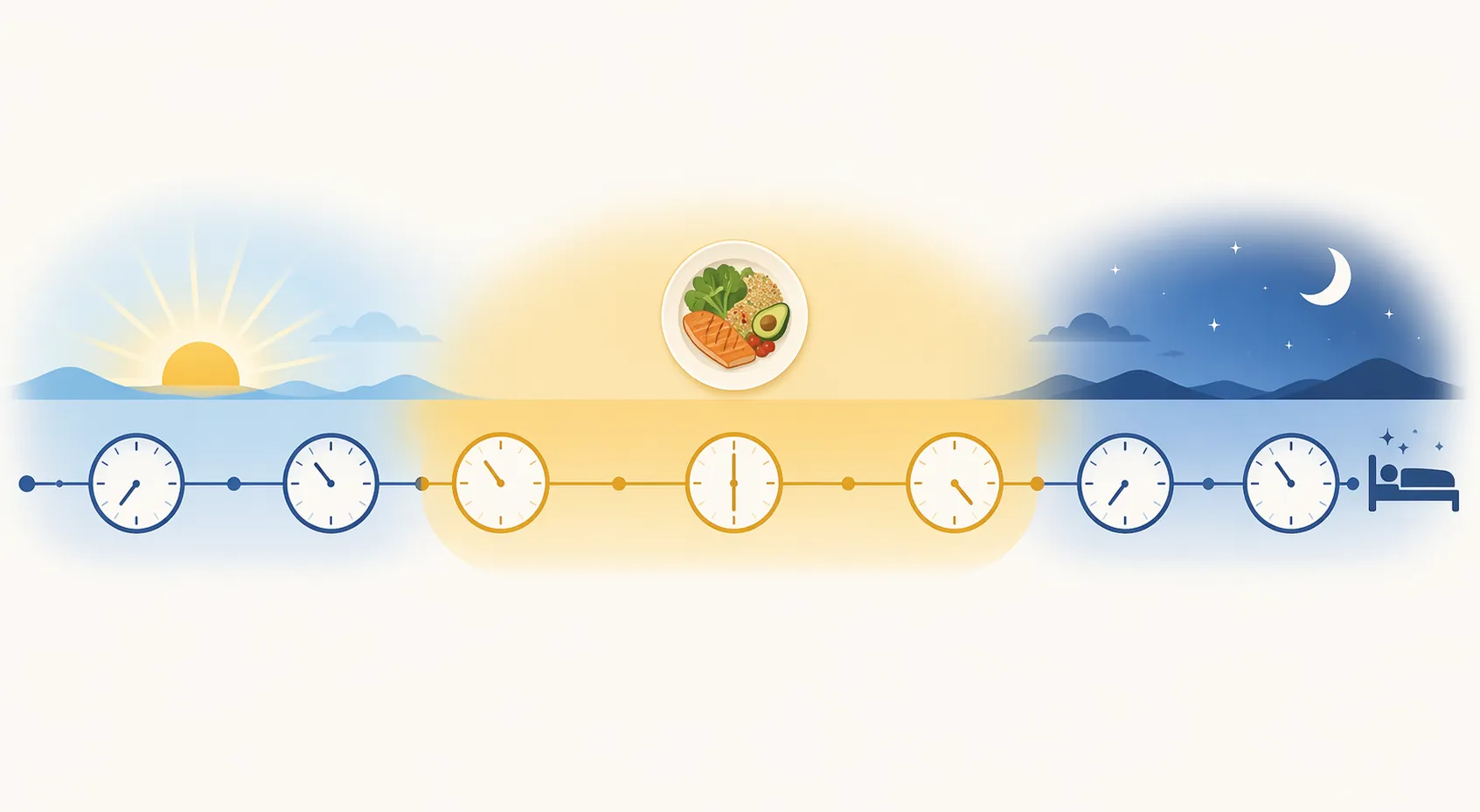
In the research most likely driving current interest, time-restricted eating meant eating during a daily 9-hour window, from 10 a.m. to 6 p.m., and then stopping food intake for the rest of the evening and overnight. That is different from a vague “skip meals for brain health” idea, and it is also different from more aggressive fasting patterns.

For an older adult living at home, the useful question is not whether a fasting schedule sounds elegant. It is whether it helps with the mental tasks that keep daily life safe: filling a pill organizer correctly, planning meals before blood sugar dips, turning off the stove, remembering to use a walker, noticing a loose rug, and following a routine without becoming exhausted or undernourished.
So the plain answer is this: time-restricted eating has possible cognitive benefits for some older adults, especially those who are overweight or metabolically at risk, but it is not a proven way to prevent dementia. It belongs in a conversation with a clinician, particularly if the person takes diabetes medication, blood pressure medication, anticoagulants, sedatives, or any drug that must be taken with food.
What did the 2026 Rutgers pilot trial actually find?
The Rutgers pilot trial is the strongest reason to take this topic seriously right now, but it should be read with its limitations in the same breath as its results. The study included 47 women ages 50 to 79. One group followed a 9-hour eating window from 10 a.m. to 6 p.m. for 6 months, while the comparison group followed a calorie-restricted diet without the same time window. Both groups lost about 15 pounds, but only the time-restricted eating group showed significant improvements in spatial planning and problem-solving tests. The findings were presented at Nutrition 2026 and had not yet been peer-reviewed at the time of the news release.[1]
That “both groups lost about 15 pounds” detail matters. If one group had lost much more weight, the cognitive difference might simply have looked like a side effect of weight loss or better metabolic control. Instead, the reported cognitive gains appeared in the time-restricted group despite similar weight loss. That does not prove the eating window caused the improvement, but it does make the finding more interesting than another diet-and-weight-loss headline.
The cognitive domains also matter. Spatial planning and problem-solving are not abstract laboratory luxuries. They are the skills someone uses to work out a route through a cluttered hallway, organize steps in a recipe, decide whether a chair is stable enough to use for support, or plan a morning that includes breakfast, pills, a shower, and a ride to an appointment. A modest improvement in those abilities could matter if it appears in real life. The Rutgers report, however, does not yet show that fewer medication errors, cooking accidents, falls, or missed appointments followed.
The trial also studied women only, and it was small. A 47-person pilot can help researchers decide whether a larger trial is worth doing. It cannot settle whether time-restricted eating is safe, effective, and useful across older men and women with different weights, frailty levels, medications, sleep problems, diabetes risk, caregiving arrangements, and early cognitive symptoms.
Why the larger 2023 study complicates the story
The main reason not to turn the Rutgers finding into a recommendation is that larger observational evidence has pointed in the opposite direction. A 2023 cross-sectional study of 1,353 Chinese community-dwelling older adults found that a shorter eating window of less than 10 hours was associated with higher cognitive impairment. The association was especially seen in orientation to place and attention/calculation.[2]
Those are not minor domains for aging at home. Orientation to place is part of knowing where one is and navigating familiar surroundings. Attention and calculation affect medication timing, bill payment, cooking, and following multi-step instructions. If a shorter eating window were truly worsening those skills, that would be a serious concern.
But this study cannot prove that time-restricted eating caused cognitive impairment. It was cross-sectional, meaning it looked at people at one point in time rather than assigning them to eating schedules and following what changed. The shorter-window group was also older and had higher rates of hypertension and stroke history.[2] That raises a very practical reverse-causation problem: frailer people, or people already developing cognitive and health problems, may naturally eat during shorter windows because they sleep later, tire earlier, cook less, live alone, have appetite loss, or depend on someone else for meals.
This is the kind of distinction that gets lost when “fasting” becomes a wellness slogan. A person who intentionally eats from 10 a.m. to 6 p.m. while meeting protein, fluid, medication, and social meal needs is not the same as a person who stops eating early because dinner is too much work, chewing is difficult, depression is blunting appetite, or memory loss has made food preparation unreliable.
What about older adults who already have mild cognitive impairment?
Another often-cited human study followed 99 older adults with mild cognitive impairment for 3 years and looked at a religious intermittent fasting pattern: Sunnah fasting on Mondays and Thursdays from sunrise to sunset. In that study, 24.3% of regular fasters reverted to “successful aging” cognitive status, compared with 3.7% of non-fasters.[3]
That is an intriguing difference, especially because the participants already had mild cognitive impairment. But it should not be treated as the same intervention as the Rutgers schedule. Twice-weekly sunrise-to-sunset religious fasting has different timing, frequency, food patterns, social context, and motivation than a daily 10 a.m. to 6 p.m. eating window. It may also come with community routines and other behaviors that are difficult to separate from the fasting itself.
For families, the key point is narrower than “fasting reverses cognitive decline.” The better reading is that some forms of intermittent fasting have been associated with better cognitive trajectories in some older adults, but the exact pattern, safety profile, and real-world usefulness remain uncertain.
How could an eating window affect the brain?
Researchers have several plausible reasons to study time-restricted eating for brain health. Reviews describe mechanisms that may include increased ketone body production as an alternative brain fuel, changes in brain-derived neurotrophic factor, lower inflammation markers such as C-reactive protein, improved insulin sensitivity, and better alignment between eating time and circadian rhythms.[4][5]

Those mechanisms are useful for understanding why the field exists. They are not proof that an older adult who narrows breakfast and dinner into a shorter day will preserve memory, avoid dementia, or stay safer at home. Biology can explain a possibility before clinical research proves a benefit.
The circadian piece may be especially relevant to the Rutgers-style schedule because it stopped eating several hours before bedtime. Late meals, poor sleep, blood sugar swings, and irregular routines can all make an older adult’s day harder to manage. Still, the safest version of this idea is not “skip dinner.” It is “ask whether meal timing can be adjusted without weakening nutrition, medication adherence, hydration, sleep, or fall safety.” Readers looking specifically at evening meal timing may want the narrower discussion in Does Skipping Dinner Improve Memory in Older Adults?.
Is time-restricted eating safe for older adults?
Short-term feasibility data are somewhat reassuring, but only for the kinds of people actually studied. Martens and colleagues reported that short-term time-restricted feeding was safe and feasible in non-obese healthy midlife and older adults.[6] That does not automatically apply to an 84-year-old with unintentional weight loss, dizziness, poor dentition, insulin use, kidney disease, nighttime confusion, or a history of falls.
Safety is where the conversation becomes less glamorous and more important. A shorter eating window can accidentally reduce protein, calories, fluid, fiber, or medication-compatible meals. In older adults, those losses may show up as weakness, constipation, lightheadedness, missed pills, low blood sugar, worse sleep, or less willingness to leave the chair. Any of those can matter more immediately than a small improvement on a cognitive test.
A practical clinician conversation should cover at least these points:
- Current weight trend: Is the person overweight and trying to lose weight, or already losing weight without meaning to?
- Medication timing: Do any pills require food, consistent carbohydrates, or morning/evening dosing?
- Diabetes risk: Could a longer fasting period increase hypoglycemia risk?
- Protein and strength: Can the person still get enough protein across fewer eating hours?
- Hydration: Will the schedule reduce drinking, especially in someone who already limits fluids because of urinary urgency?
- Sleep and alertness: Does the schedule improve evenings, or does it cause nighttime hunger, poor sleep, or morning dizziness?
- Cognition and meal reliability: Can the person remember the schedule without becoming anxious, rigid, or underfed?
What kind of eating window are researchers talking about?
In the Rutgers pilot, the schedule was not a severe fast. It was a daily 9-hour eating period from 10 a.m. to 6 p.m. for 6 months.[1] In many everyday conversations, people use “intermittent fasting” to mean anything from skipping breakfast to alternate-day fasting. That looseness makes the evidence easy to overstate.
| Pattern discussed in the evidence | What it involved | Why it should not be overgeneralized |
|---|---|---|
| Rutgers 2026 pilot trial | Daily 9-hour eating window, 10 a.m. to 6 p.m., for 6 months | Small, women only, conference presentation, not yet peer-reviewed |
| Li et al. 2023 observational study | Shorter-than-10-hour eating window identified in community-dwelling older adults | Cross-sectional association; frailer adults may have shorter windows because of existing health problems |
| Ooi et al. 2020 study | Sunnah fasting on Mondays and Thursdays from sunrise to sunset | Different from daily time-restricted eating in timing, frequency, and social context |
For readers who need a basic primer before comparing schedules, Can Time-Restricted Eating Help Prevent Cognitive Decline in Seniors? is a better starting point. For the narrower schedule question, see What Is the Best Intermittent Fasting Schedule for Older Adult Brain Health?.
What would count as a meaningful cognitive benefit at home?
A cognitive test can detect change before a family sees it. That is useful for research. But at home, the standard is more concrete. Does the person handle the medication box with fewer mistakes? Are meals more regular, not less? Is the person steadier when getting up in the morning? Are they still strong enough to climb stairs, carry groceries, and recover from a near trip? Can they notice that a throw rug has curled at the edge?
This is where time-restricted eating can either help or harm depending on the person. A consistent daytime eating routine might make meals and pills easier to organize for one older adult. For another, especially someone frail or forgetful, the same rule might mean breakfast is delayed, lunch is missed, evening pills are taken without food, and fatigue increases before bedtime.
Nutrition choices also affect fall risk through muscle, bone, hydration, and attention. If the goal is safer aging at home, meal timing should sit inside a broader nutrition and mobility plan, not replace it. The connection between diet quality and falls is covered more directly in How Anti-Aging Diet Tips for Seniors Can Prevent Falls.
When memory changes should not be blamed on diet
If a parent is repeating questions, getting lost in familiar places, missing bills, leaving burners on, confusing medications, or showing new personality changes, the priority is evaluation, not experimenting with an eating window. A diet schedule cannot tell the difference between early dementia, medication side effects, sleep apnea, depression, dehydration, low blood sugar, infection, hearing loss, or vision problems.
Families often notice these problems in fragments: a scorched pan, an unpaid utility bill, a new dent in the car, a pill bottle that empties too slowly. If that is the situation, start with the warning signs in 7 Early Dementia Warning Signs Families Often Miss, and bring the observations to a clinician. Sleep deserves particular attention because untreated sleep-disordered breathing can look like poor memory and can also raise safety risks; the overlap is discussed in Sleep Apnea Misdiagnosis Older Women.
So should an older adult try time-restricted eating for cognitive health?
The most defensible answer is conditional. Time-restricted eating is promising enough to discuss with a clinician, especially for an older adult who is overweight, has metabolic risk, eats late into the evening, and can maintain adequate protein, calories, fluids, and medication routines. A moderate daytime window like the Rutgers schedule is very different from prolonged fasting or casual meal skipping.
It is not a proven cognitive intervention. It should not replace a dementia evaluation, medication review, sleep assessment, fall-risk screening, or nutrition guidance. If the eating window makes daily routines simpler and safer, it may be worth studying and, for some people, trying under supervision. If it makes an older adult weaker, dizzy, underfed, anxious, or less reliable with medications, the brain-health promise is not worth the trade.
References
- Time-restricted eating may reduce cognitive decline in older age, researchers find, EurekAlert!, July 2026.
- Time restricted feeding is associated with poor performance in specific cognitive domains of Chinese community-dwelling older adults, Scientific Reports, 2023.
- Intermittent Fasting Enhanced the Cognitive Function in Older Adults with Mild Cognitive Impairment by Inducing Biochemical and Metabolic Changes: A 3-Year Progressive Study, PubMed Central, 2020.
- The Effects of Intermittent Fasting on Brain and Cognitive Function, PubMed Central.
- Intermittent fasting as a potential therapeutic approach for Alzheimer’s disease, PubMed Central.
- Short-term time-restricted feeding is safe and feasible in non-obese healthy midlife and older adults, GeroScience, 2020.
Browse more in the Glossary.