
Product term
Turn Caregiving Objects Into Tributes That Honor Your Parent
Last verified 2026-07-24
After the funeral calls stop and the borrowed chairs go back, the house can still look like a care plan. The walker is by the door because that is where it always had to be. The shower still has the grab bar you argued for, measured twice, and checked with your own hand. A medical alert pendant may be sitting in a dish by the bed, too quiet now for something that once carried so much worry.
If you feel grief and relief in the same day, or even in the same hour, that does not mean you loved your parent less. AgingCare describes relief after the death of someone you cared for as a common response for caregivers, especially after long periods of strain, vigilance, and decline.[1] Remembering A Life also frames guilt after the loss of an elderly parent as something that often reflects how much care was present, not proof that the care was lacking.[2]
That matters before any tribute idea is useful. A tribute should not become another assignment you must complete to prove you were a good daughter or son. It can be as small as moving one object from the hallway to a safer, gentler place. It can also wait.
For many former caregivers, the most fitting tribute ideas for an elderly parent who passed away begin with the things that are already in the house. The objects, rooms, routines, and hard-won knowledge left behind can be given a new job: not to prevent the next fall or manage the next appointment, but to honor the parent you loved and the care that shaped your last season together.

Let the Caregiving Object Become Something Else
Continuing Bonds Theory gives a useful name to something many families already do without naming it: a healthy grief process can include finding new ways to relate to the person who died, rather than trying to sever the bond completely.[3] In a caregiving home, that new relationship may pass through ordinary objects first.
A walker, cane, pendant, hospital bracelet, pill organizer, reading glasses, transfer belt, or handwritten medication note can feel almost rude in its plainness. These were not ceremonial things. They were tools. That is why they may carry more truth than a formal keepsake ordered after the fact.
Start by sorting objects by emotional weight, not by category. Some things may feel tender. Some may feel contaminated by exhaustion, fear, or the worst week of your parent’s illness. Some may mean nothing to you until months later. There is no need to make one decision for all of them.
| Object | Possible tribute | If you are not ready |
|---|---|---|
| Medical alert pendant | Place it in a small shadowbox with a photograph, note, or piece of fabric from a favorite shirt. | Put it in a labeled envelope inside a memory box. |
| Walker or rollator | Use the basket or seat to hold flowers, garden tools, or a plant near an entryway. | Move it out of daily sight and decide later whether to donate, keep, or discard it. |
| Reading glasses | Display them with a book, crossword, recipe card, or handwritten note. | Keep them with papers or photos until their meaning becomes clearer. |
| Hospital ID bracelet | Include it only if it brings a truthful memory, not if it reopens the hardest day. | Photograph it, then release the original if keeping it feels too heavy. |
| Pill organizer or care notebook | Save one page that shows the care you gave, then discard the rest if needed. | Box it for a set period so you are not deciding while raw. |
After.com suggests a memory table as one way families display meaningful items during a memorial service.[4] At home, that idea can be quieter and more specific: a caregiving shadowbox. It might hold the pendant that used to rest against your parent’s chest, the glasses they wore to read the paper, a hospital bracelet if that feels right, and a short note in your own handwriting: “These helped us keep you with us.”
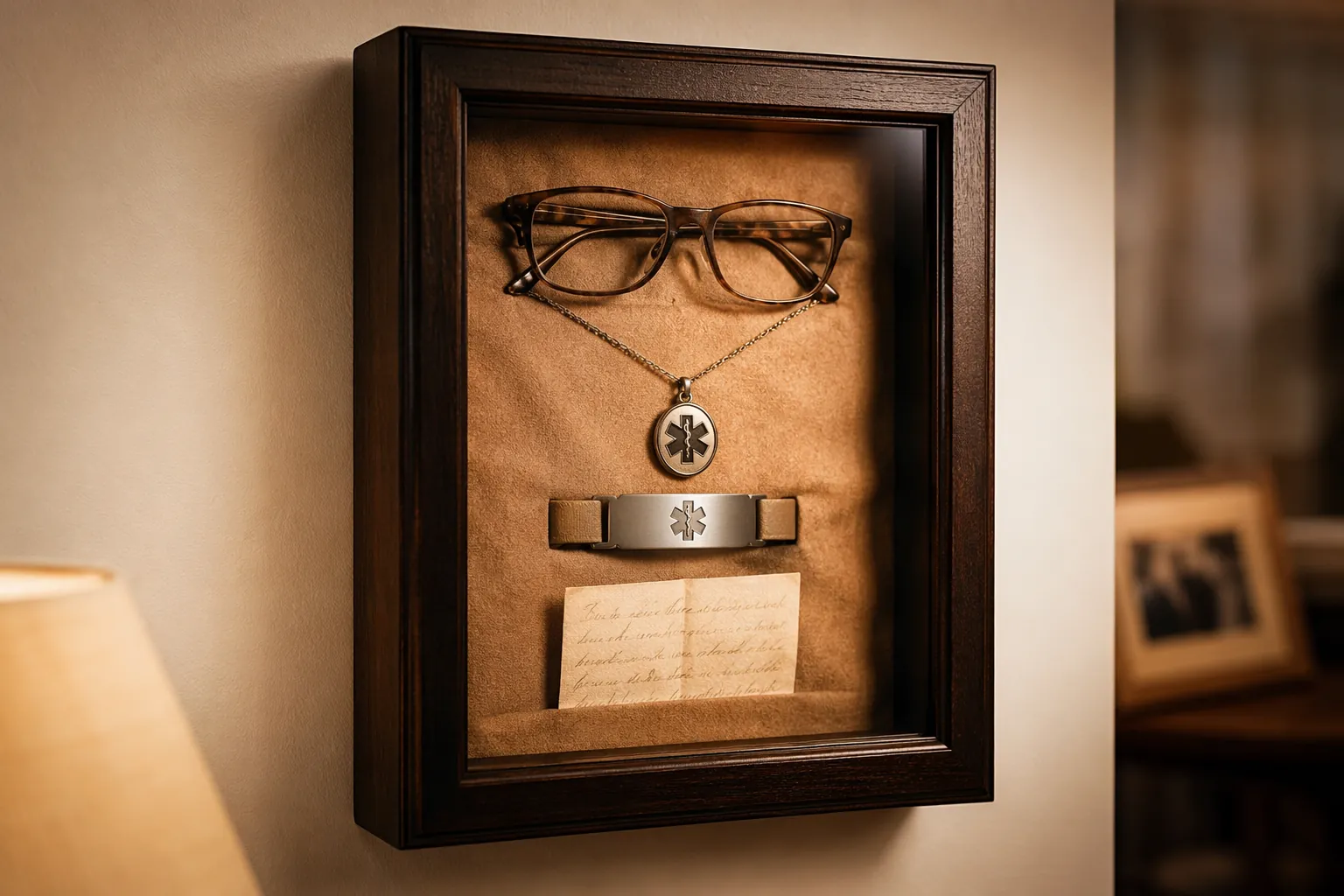
The note matters because caregiving objects can look strange without context. A visitor may see a pendant. You may see the nights you slept lightly because an emergency call could come. A visitor may see tennis balls on walker legs. You may remember cutting them open at the kitchen table because the walker scraped and caught on the threshold.
If displaying an object feels too public, make the tribute private. Wrap the item in a scarf or cloth and place it in a box with one sentence about what it did. “This cane got Dad from the bedroom to the porch.” “This pendant let Mom stay alone for short stretches.” Plain sentences are enough. They honor function, and function was part of the love.
When Keeping the Object Hurts
Not every object deserves a second life in your home. A commode, soiled bedding, wound-care supplies, or the hospital bed that dominated the room may hold more distress than comfort. Releasing those items is not a lesser tribute. Sometimes the respectful act is to clean the room, thank the object for what it allowed, and let it leave.
A middle option can help when the decision feels too sharp: take a photograph before donating or disposing of the item. The photograph keeps the record without requiring the object to keep occupying the hallway.
Treat the Modified Space as Part of Their Story
Caregiving changes a house. A rug disappears from the hallway. A ramp arrives at the entry. The bathroom gets brighter bulbs, a shower chair, non-slip strips, and a grab bar that may have been accepted only after several careful conversations. These changes were not decorations, but they became part of your parent’s final map of home.
If you once worked through a room-by-room home safety assessment or had to choose which aging-in-place home modifications mattered first, you already know how practical these spaces were. The tribute is not pretending the bathroom was sacred. It is admitting that the bathroom, bedroom, entryway, and stairs carried a great deal of care.
A remembrance corner can be simple. Near the ramp, place a weather-safe planter, a small bench, or a wind chime your parent would have liked. Near the entryway, hang a photograph from a better day and keep a basket for mail, keys, or walking shoes. In the bathroom, if the grab bar remains useful for someone else in the home, let it remain useful. A living tribute does not have to stop being practical.
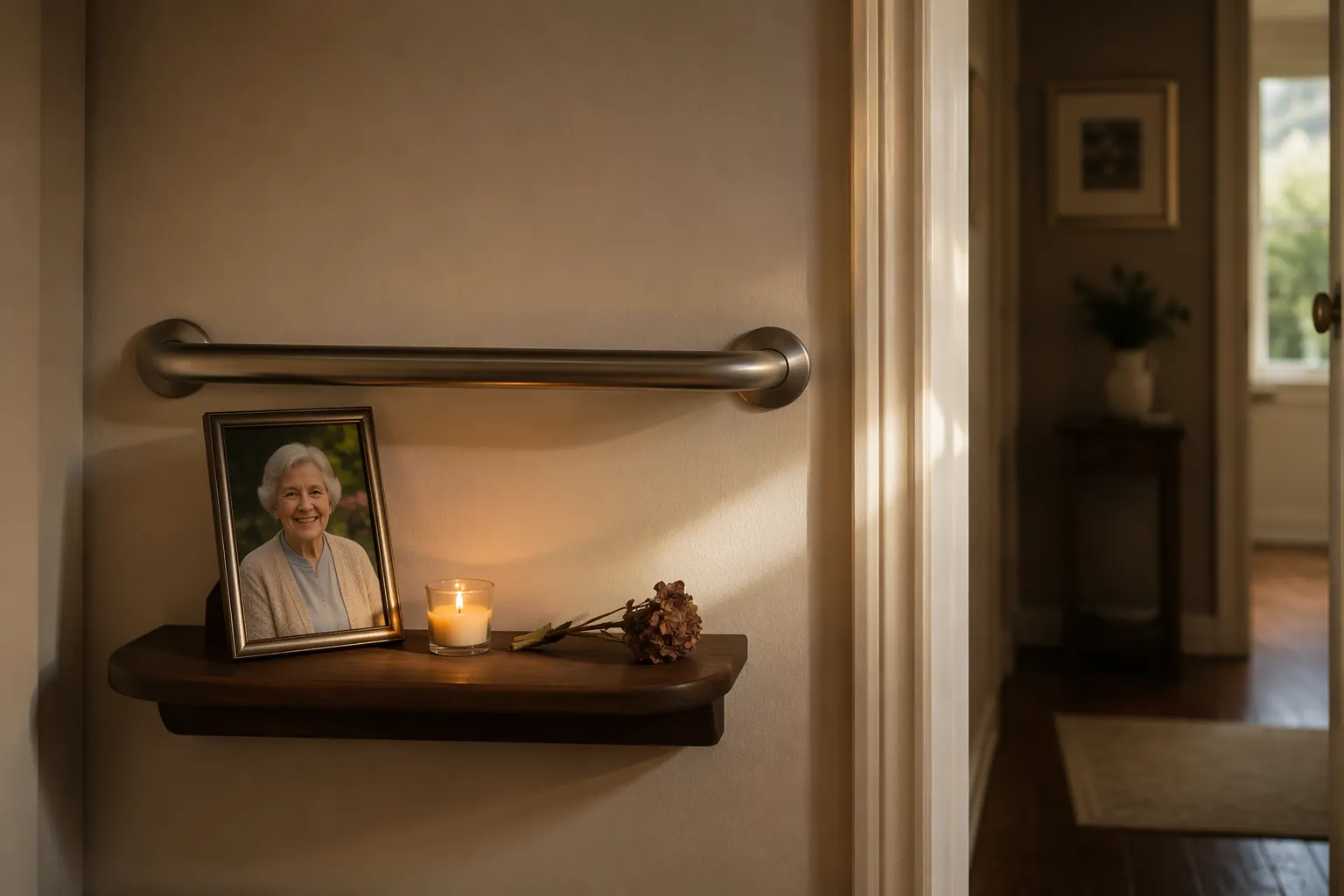
Some families prefer to remove the equipment and mark what happened in a softer way. The screw holes from a removed grab bar can be patched, painted, and covered with a small framed note or photograph. A cleared bedroom can become a reading room, sewing room, grandchild sleepover room, or ordinary guest room again. That is not erasing your parent. It is allowing the house to stop functioning as a sickroom.
The hardest spaces may be the ones that held conflict. Stairs are a good example. Many older adults resist visible safety changes because the change can feel like a public announcement of frailty; CareWise Guide’s discussion of stair safety resistance may feel familiar if your parent pushed back before eventually accepting help. If the handrail now reminds you of arguments, not peace, give that memory room. A tribute can include relief that the arguing is over.
A Small Dedication for a Room
One useful exercise is to dedicate a changed space with one practical sentence. Not a plaque, unless you want one. Just a written note for yourself, tucked into a drawer or taped inside a closet door.
- “This entryway helped Mom come home.”
- “This ramp carried Dad through his last winter.”
- “This bathroom changed because we were trying to keep her safe.”
- “This bedroom held hard nights and real care.”
Those sentences do not tidy the story. They mark it.
Pass Forward What Can Still Help Someone
After the most personal objects are handled, the next tribute may be outward-facing. Some former caregivers feel steadier when one item, one lesson, or one hour of experience helps another family avoid a little confusion.
Unused briefs, sealed supplies, mobility equipment, shower chairs, transport chairs, unopened gloves, or a hospital bed may be useful to another household, but donation rules vary. Call before loading the car. Ask local durable medical equipment loan closets, senior centers, faith communities, disability resource centers, hospice thrift programs, or mutual-aid groups what they accept, what condition they require, and whether they pick up.
Do not donate anything unsafe, broken, recalled, contaminated, or missing essential parts. If an item protected your parent badly, wobbled, pinched, or never fit through the doorway, it does not become a loving gift just because it is free.
Knowledge can be passed forward too. A one-page note for another family may be more useful than a polished essay. Include the practical things you wish someone had told you: which doorway was too narrow for the walker, how you labeled medications, what questions helped at discharge, which home changes mattered first, and what you would not buy again.
This kind of tribute should not become unpaid work you are not ready for. If caregiving left you depleted, start with your own recovery. CareWise Guide’s guide to caregiver burnout warning signs may be a better next read than any project list.
Write the Final Years Without Making Them Smaller
Memorial pages often collect photos, condolences, and stories. Ever Loved describes tribute pages as one way to honor a mother who has died.[5] For a caregiving tribute, the page can include the final years without reducing your parent to illness.
You might write: “In her last years, she worked hard to remain at home. She accepted a walker she never wanted, learned to use a pendant she joked about, and still insisted on sitting near the kitchen window every morning.” That kind of sentence respects both decline and character.
You can also include the decisions that weighed on you, if sharing them would help another family. Moving a parent, increasing supervision, or considering a senior living setting can carry grief long before death. If that was part of your family’s story, a link to a practical assessment guide, such as CareWise Guide’s senior citizen home assessment guide, may help frame the choice as care rather than abandonment.
Mark the End of the Caregiving Role
When a parent dies, the relationship does not end in the same way the tasks end. The pill schedule stops. The laundry changes. No one is waiting for help standing up. Your body may still listen for sounds at night because it has not yet learned that the shift is over.
A small ritual can help separate love from duty. It does not have to be public or religious. HealGrief includes a dissolving-paper letter among its remembrance ideas, a ritual in which written words are released in water.[3] A former caregiver might use that idea to write two letters: one to the parent, and one to the caregiving role itself.
- To your parent: what you miss, what you are sorry for, what you hope they knew.
- To the caregiving role: what it cost, what it taught, and what you are allowed to stop carrying.
- To yourself: one ordinary thing you are permitted to do now without guilt.
Another ritual is a practical retirement. Wash the last set of caregiving towels and put them away. Clear the medication shelf. Return borrowed equipment. Delete alarms from your phone one at a time. If deleting them feels too final, rename one alarm “Rest” for a week before removing it.
Annual rituals can stay just as concrete. On your parent’s birthday, plant flowers in the old walker basket if you kept it. On the anniversary of their death, donate a package of supplies, light a candle beside the pendant shadowbox, or make the meal they could still enjoy near the end. If anniversaries make you want to stay in bed instead, that is information, not failure.
When Grief Needs More Than a Tribute
A tribute can give the objects and rooms a new place in your life. It cannot treat traumatic grief, severe depression, panic, or exhaustion that has been building for years. If your parent received hospice care, ask whether bereavement support is available to family members. You can also speak with a grief counselor, therapist, physician, faith leader, or support group if guilt, intrusive memories, or hopelessness are making daily life hard.
The tribute does not have to make caregiving look perfect. It does not have to erase the times you were impatient, frightened, resentful, or relieved. It only has to tell the truth kindly: there was a parent here, there was care here, and now the tools of that care can be put down, passed on, saved, or changed into something that helps you keep living.
References
- Grief & Relief: When the Loved One You Cared for Dies, AgingCare, https://www.agingcare.com/articles/caregiving-ending-after-death-148071.htm
- Navigating Guilt After the Loss of an Elderly Parent, Remembering A Life, https://www.rememberingalife.com/blogs/blog/navigating-guilt-after-the-loss-of-an-elderly-parent
- 30 Ideas on How to Remember & Honor Your Person, HealGrief, https://healgrief.org/30-ideas-remember-honor-person/
- 40 Memorial Service Ideas to Honor a Loved One, After.com, https://www.after.com/articles/memorial-service-ideas
- 7+ Tribute Ideas for a Mother, Ever Loved, https://everloved.com/articles/obituaries-and-funeral-announcements/7-tribute-ideas-for-a-mother-who-has-passed-away/
Browse more in the Glossary.