
Clinical term
Is Tylenol with Naproxen Safer Than Ibuprofen for Seniors?
Last verified 2026-07-25
Last verified: July 25, 2026. This article is general education, not personal medical advice. If an older adult has kidney disease, liver disease, heart disease, a history of ulcers or bleeding, or takes blood thinners, steroids, blood pressure medicines, diuretics, or multiple daily medications, ask their clinician or pharmacist before starting any oral NSAID.
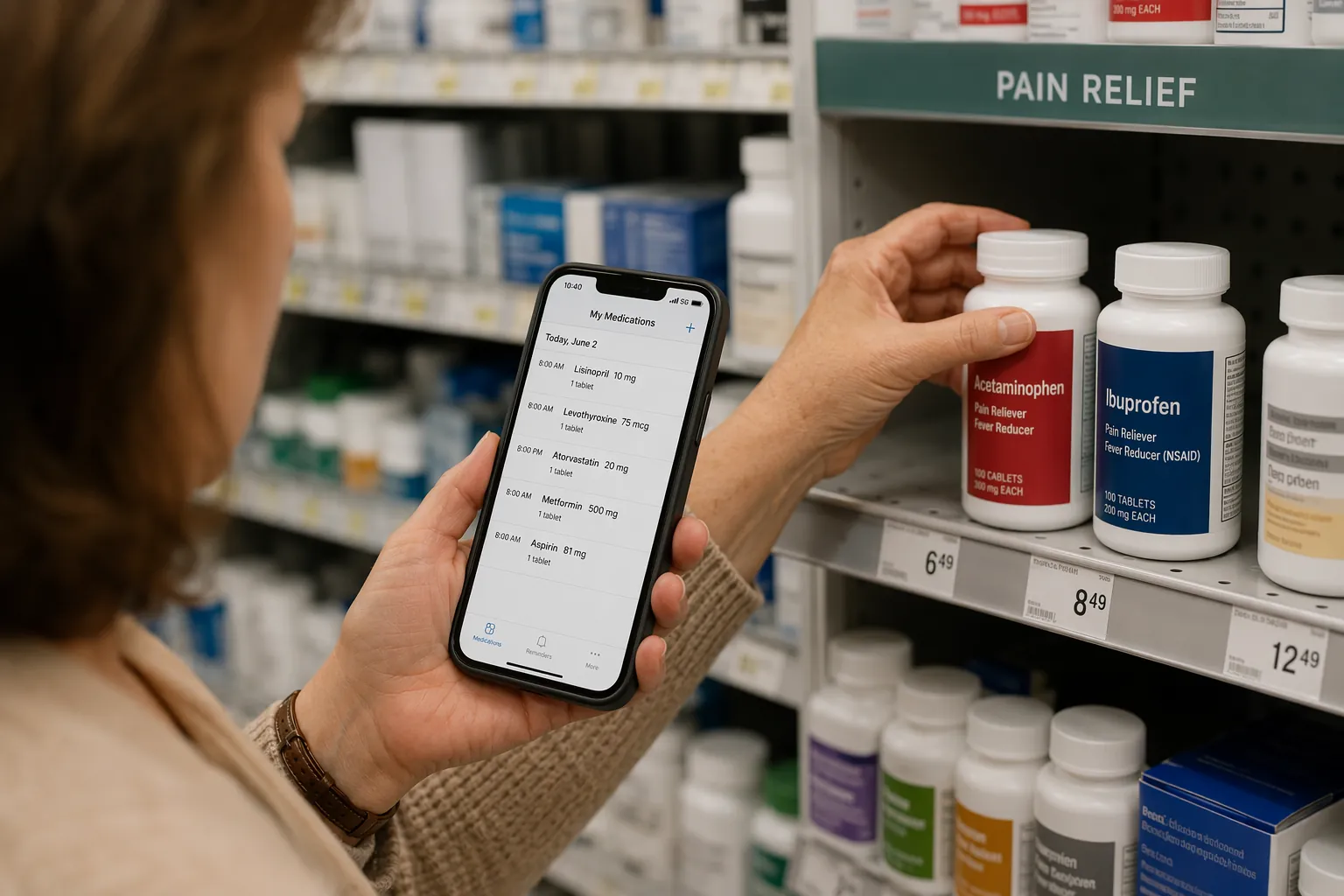
For a senior over 65, the new Tylenol with Naproxen combination should not be treated as safer than plain ibuprofen for everyday pain. The Tylenol name may make the box look familiar, but the naproxen inside is still an oral NSAID. That is the part that matters for older-adult safety.
The FDA approved the first over-the-counter fixed-dose acetaminophen-naproxen combination on July 24, 2026, which explains why caregivers are suddenly seeing the question come up now.[1] Approval means the product met the FDA’s standard for OTC use. It does not mean naproxen has stopped carrying the same class risks that matter in a 70-, 80-, or 90-year-old body.
A useful first sort is this: plain acetaminophen is not an NSAID; topical NSAIDs act mostly where they are applied; oral NSAIDs include naproxen and ibuprofen. Tylenol with Naproxen sits in two categories at once because it contains acetaminophen plus an oral NSAID. For seniors, that combination does not erase the oral NSAID problem.

The Safer Starting Point Is Usually Not an Oral NSAID
When the pain is everyday knee, back, or arthritis pain, most older adults are usually better served by starting with plain acetaminophen within the labeled daily limit, or a topical NSAID for localized joint pain, before reaching for oral naproxen or ibuprofen. The acetaminophen ceiling used here is 3,000 mg per day unless a clinician gives different instructions.
| Option | What it means for a senior |
|---|---|
| Plain acetaminophen | Often the simpler first choice for everyday pain when total daily dose and liver risk are watched. |
| Topical NSAID | Often useful for localized joint pain because less medicine circulates through the whole body than with oral NSAIDs. |
| Oral NSAID: naproxen or ibuprofen | Can help pain and inflammation, but raises more concern for stomach bleeding, kidney strain, cardiovascular effects, and drug interactions in older adults. |
| Tylenol with Naproxen | Still contains an oral NSAID, so it should be judged by naproxen’s risks, not only by the Tylenol name on the front. |
That does not mean an older adult can never use ibuprofen or naproxen. Occasional use may be reasonable for some people. The higher-risk pattern is routine use, especially when no one has checked kidney function, bleeding history, heart risk, liver status, and the rest of the medication list.
Why the Naproxen Part Still Carries the Senior-Safety Concern
The 2023 American Geriatrics Society Beers Criteria cautions against regular NSAID use in older adults because of gastrointestinal bleeding, peptic ulcer disease, kidney injury, and other risks that become more important with age and with interacting medications.[2] That warning applies to oral NSAIDs as a class. Naproxen does not get a pass because it is paired with acetaminophen.
Yale Medicine’s patient guidance makes the practical version of the same point: adults 65 and older who take naproxen should use lower doses for shorter periods.[3] That is not a packaging detail. It is the difference between taking something for a short flare and letting it quietly become part of the morning routine next to the blood pressure pills.
Older bodies also do not always handle naproxen like younger bodies. Pharmacokinetic data found free naproxen concentrations 57% higher in elderly patients, with unbound plasma clearance reduced by about 60%.[4] In plain English: more active drug may be available in the body, and the body may clear the unbound portion more slowly. That helps explain why “same dose, same bottle” can still be a different safety situation at age 78 than at age 45.
The consequences are not just theoretical. Better Health While Aging cites an estimate of 41,000 hospitalizations and 3,300 deaths annually among older adults from NSAID-related complications.[5] That estimate covers NSAID complications broadly, not this new combination specifically, but it is exactly why a caregiver should not treat an oral NSAID as a casual add-on just because the product also contains acetaminophen.
What to ask about before routine use
- Stomach and intestinal bleeding: the concern rises with age, prior ulcers or bleeding, blood thinners, steroids, and regular NSAID use.
- Kidney strain: NSAIDs can be a problem for people with reduced kidney function or those taking medicines that affect kidney blood flow.
- Cardiovascular effects: blood pressure, heart failure, prior heart attack or stroke, and overall cardiovascular history matter when choosing any oral NSAID.
- Medication interactions: blood thinners, steroids, diuretics, ACE inhibitors, ARBs, and some other daily medicines can change the risk calculation.
- New dizziness, weakness, dark stools, stomach pain, swelling, shortness of breath, or confusion: these should not be dismissed as “just aging” after starting a new pain reliever.
This is where “ask your doctor” needs to become more specific. Ask whether the older adult has kidney function limits, liver concerns, a bleeding history, cardiovascular disease, or a medication combination that makes oral NSAIDs a poor fit. Ask how many days in a row is acceptable. Ask what symptom should make the family stop the medicine and call.
Naproxen vs. Ibuprofen Is Not a Simple Winner-Takes-All Choice
Inside the NSAID class, naproxen and ibuprofen are not identical. Naproxen lasts longer, which can be convenient for pain control, but longer exposure can also be part of the gastrointestinal concern. Ibuprofen is shorter-acting, but it may carry a stronger cardiovascular signal in some comparisons. That is why the honest answer is not “naproxen is safer” or “ibuprofen is safer” for every senior.
For a parent with a history of stomach bleeding, the GI side of the decision may dominate. For someone with heart failure or difficult blood pressure control, the cardiovascular and fluid-retention side may dominate. For someone with chronic kidney disease, either oral NSAID may be a bad trade for routine use. The right comparison is not brand against brand; it is the person’s risks against the reason for taking the medicine.
The new combination can also make the medicine cabinet harder to audit. A caregiver may already be counting acetaminophen from plain Tylenol, cold medicines, sleep aids, or prescription pain combinations. Adding another product with acetaminophen increases the chance of accidentally stacking doses. Acetaminophen is often a safer starting point for many seniors, but it is not risk-free, especially when total daily dose, alcohol use, or liver disease is in the picture.
What the Osteoarthritis Evidence Adds — and What It Does Not
The RETHINK study is useful because it tests a common assumption: that older adults with osteoarthritis necessarily need an NSAID for meaningful pain relief. In adults 65 and older with osteoarthritis, acetaminophen achieved similar pain reduction to NSAIDs over 8 weeks, with fewer gastrointestinal adverse events.[6]
That finding supports a practical starting rule: if acetaminophen can do the job, there may be no need to add an oral NSAID risk. For a caregiver trying to simplify a parent’s routine, that matters. Fewer moving parts can mean fewer symptoms to untangle later.
The study should not be stretched beyond what it tested. It was conducted in a Japanese population and used loxoprofen and celecoxib rather than the exact OTC ibuprofen or naproxen products many U.S. shoppers are comparing.[6] It does not prove that every older adult should avoid every NSAID in every situation. It does make the new combination look less necessary as a default answer for routine osteoarthritis pain.
How to Make the Pharmacy-Shelf Decision Tonight
If the older adult is choosing something for routine or recurring pain, start by separating the pain reliever options rather than comparing front-of-box brand names. A Tylenol-branded product with naproxen is not the same safety category as plain Tylenol. It belongs in the oral NSAID conversation.
- For everyday aches or osteoarthritis pain: consider plain acetaminophen within the stated daily ceiling first, if liver status and other acetaminophen-containing products allow.
- For one painful joint, such as a knee or hand: ask whether a topical NSAID is appropriate before using an oral NSAID.
- For short flares where an oral NSAID is being considered: use the lowest effective dose for the shortest reasonable time, and avoid letting it become automatic.
- For anyone on blood thinners, steroids, heart medicines, diuretics, ACE inhibitors, ARBs, or multiple prescriptions: check with a clinician or pharmacist before using naproxen or ibuprofen.
- For anyone with kidney disease, liver disease, heart failure, prior ulcer or GI bleed, uncontrolled blood pressure, or a history of stroke or heart attack: do not assume an OTC label means it is low-risk for that person.
Also check the whole medicine list for duplicate ingredients. Acetaminophen can appear in pain relievers, cold and flu products, and some prescription combinations. NSAIDs can appear under brand names that do not make “ibuprofen” or “naproxen” obvious unless you read the active ingredient panel.
Medication side effects can also feed into fall risk, especially when bleeding, dizziness, weakness, low blood pressure symptoms, or confusion enter the picture. If you are reviewing a parent’s home setup, it is worth pairing the medicine-cabinet check with a look at fall-prevention medication risks.
Bottom Line
Tylenol with Naproxen is not meaningfully safer than ibuprofen for most seniors simply because it carries the Tylenol name. Its naproxen component is still an oral NSAID, and oral NSAIDs are the category that raises concern for routine older-adult use.
For most older adults, plain acetaminophen at an appropriate total daily dose or a topical NSAID is the safer first-line choice for everyday pain. Oral naproxen or ibuprofen should be an occasional, lower-dose, shorter-duration decision made with attention to kidney function, cardiovascular history, liver status, bleeding risk, and the rest of the medication list.
References
- FDA approval of the first OTC fixed-dose acetaminophen-naproxen combination, FDA.gov, July 24, 2026.
- AGS Beers Criteria 2023 listing regular NSAID use as a caution for older adults, HealthInAging.org, 2023.
- Yale Medicine guidance on naproxen use in adults 65 and older, Yale Medicine.
- Published pharmacokinetic studies on naproxen in elderly patients, DrOracle.
- Estimate of hospitalizations and deaths among older adults from NSAID-related complications, Better Health While Aging.
- RETHINK study, Osteoarthritis and Cartilage Open, 2026.
Browse more in the Glossary.