
Clinical term
Is Tylenol or naproxen safer for older adults?
Last verified 2026-07-25
For most older adults choosing between Tylenol and naproxen, Tylenol is usually the safer first oral pain reliever if the total acetaminophen dose stays at or below 3,000 mg per day and all other medicines are checked for hidden acetaminophen. Naproxen can be useful for short-term inflammatory pain, but it brings more ways for a typical senior to get into trouble at home: stomach bleeding, kidney strain, higher blood pressure, heart-related warnings, blood thinner interactions, and added fall-risk concerns.
That is not the same as saying Tylenol is harmless or naproxen is never appropriate. It means the first question is not “Which one is stronger?” It is “Which one is less likely to harm this particular older adult tonight, with the medicines and medical conditions they already have?”
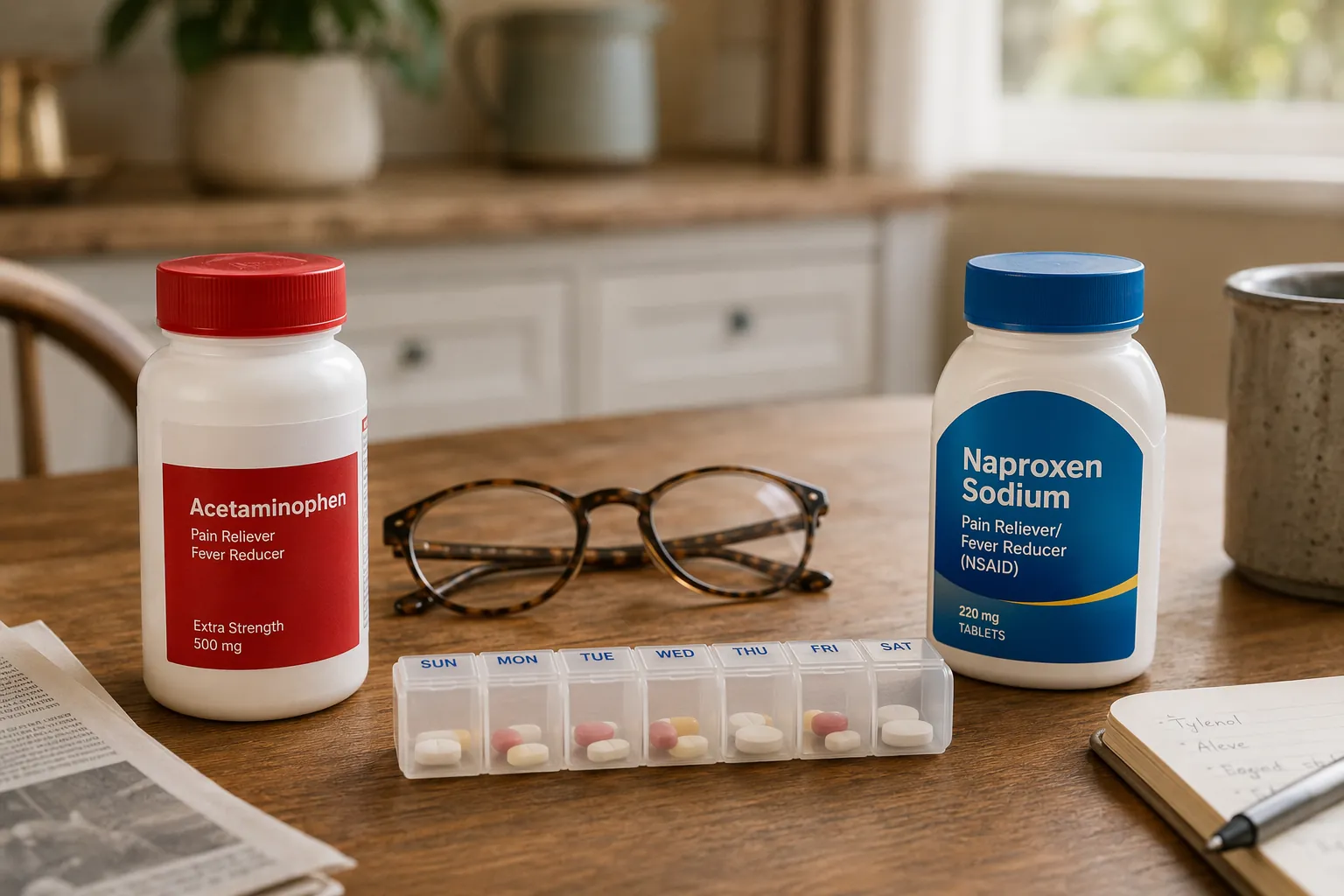
The Safer Default: Tylenol, With a Real Dose Cap
Acetaminophen, sold under the Tylenol name and many store brands, treats pain and fever. It is not an NSAID, so it does not carry the same stomach-bleeding, kidney, blood pressure, and blood thinner concerns that naproxen does. That is why geriatric-focused guidance often treats it as the first oral option for many older adults with everyday aches, osteoarthritis pain, or soreness after overuse.
The senior-specific catch is the dose. AARP advises that older adults should generally keep acetaminophen to 3,000 mg per day, even though some standard packaging has historically referenced a 4,000 mg adult maximum. The lower ceiling matters because aging, liver vulnerability, alcohol use, and multiple medicines shrink the margin for error. AARP also notes that acetaminophen appears in more than 600 products, including cold, flu, sleep, and combination pain medicines, which is how careful people can accidentally double-dose without realizing it.[1]
A practical check is simple: before taking Tylenol, look for “acetaminophen,” “APAP,” or “paracetamol” on every prescription and over-the-counter label in the house. If one pill for back pain, one nighttime cold medicine, and one prescription pain tablet all contain acetaminophen, the bottle count may look safe while the daily total is not.
Where Naproxen Becomes Risky Faster
Naproxen, sold as Aleve and other brands, is an NSAID. That makes it a better fit for some inflammatory pain, such as a swollen joint flare or tendon irritation, because it reduces inflammation as well as pain. The problem is that the same NSAID action that helps inflammation can also interfere with protective processes in the stomach, kidneys, blood vessels, and platelet-related bleeding balance.
| Safety question | Tylenol / acetaminophen | Naproxen / NSAID |
|---|---|---|
| Stomach bleeding | Not the main concern at normal doses, though newer evidence has raised caution with regular use | OTC NSAID labels specifically say stomach bleeding risk is higher at age 60 or older |
| Kidneys | Usually less kidney strain than NSAIDs | Can worsen kidney function, especially with dehydration, kidney disease, diuretics, ACE inhibitors, or ARBs |
| Blood pressure | Usually less direct effect, though one large 2024 study associated regular use with elevated blood pressure | Can raise blood pressure or blunt blood pressure medicines |
| Blood thinners | Still needs review, but generally fewer bleeding interactions than NSAIDs | Higher concern with warfarin, apixaban, rivaroxaban, clopidogrel, aspirin, and similar medicines |
| Main home-use trap | Accidental overdose from multiple acetaminophen-containing products | Assuming OTC status means it is safe for repeated use in seniors |
The stomach warning is not a vague internet caution. OTC NSAID labeling warns that stomach bleeding risk is higher if the user is age 60 or older, has had stomach ulcers or bleeding problems, takes a blood thinner or steroid, takes other NSAIDs, has three or more alcoholic drinks daily, or takes the medicine for longer than directed.[2] For a 68-year-old taking naproxen once after a strained knee, that warning may not end the discussion. For an 82-year-old taking it twice a day for chronic arthritis while also taking aspirin or a blood thinner, it should.
The American Geriatrics Society’s 2023 Beers Criteria, summarized for the public by HealthInAging.org, lists oral NSAIDs among medicines older adults should avoid or use with caution, especially for regular long-term use, because of risks including stomach bleeding, kidney problems, and blood pressure effects.[3] That guidance is aimed exactly at the pattern that causes trouble: not one carefully chosen dose, but repeated use that quietly becomes part of the weekly routine.
The population-level harm is not new, but it is still a useful warning light. A 2010 review in Annals of Long-Term Care estimated that NSAID complications in older adults were associated with 41,000 hospitalizations and 3,300 deaths each year in the United States. Because that estimate is from 2010, it should not be treated as current surveillance data, but it remains a widely cited benchmark for why chronic NSAID use in seniors is taken seriously.[4]
The Fall-Risk Piece Many People Miss
Pain medicine decisions after a fall deserve extra caution. If an older adult fell, hit their head, has new confusion, cannot bear weight, has severe swelling, or is taking a blood thinner, the medication choice should not be handled as a simple shelf comparison. They need clinical advice, and sometimes urgent evaluation.
Even when the injury seems minor, naproxen can complicate the fall-prevention picture. Mayo Clinic lists NSAIDs among medicines that can increase fall risk in older adults because of effects on blood pressure.[5] That does not mean naproxen directly causes every fall, and it does not mean one dose will make someone unstable. It does mean that for a senior already dealing with dizziness, dehydration, blood pressure medicines, or a recent fall, adding naproxen is not a neutral choice.
When Naproxen May Still Make Sense
Naproxen has a legitimate place. If the main problem is short-term inflammatory pain, and the older adult does not have kidney disease, uncontrolled high blood pressure, heart failure, a history of stomach ulcer or bleeding, significant reflux complications, heavy alcohol use, or blood thinner use, a clinician may decide that a brief course is reasonable. That is a different situation from keeping a large bottle in the kitchen and taking it whenever arthritis flares.
Blood thinners are one of the clearest stop-and-check situations. Harvard Health warns that combining NSAIDs with blood thinners can increase bleeding risk, and that includes common drugs used for atrial fibrillation, clots, heart disease, and stroke prevention.[6] Many older adults do not describe these as “blood thinners” when asked casually; they may say “my heart pill,” “my clot medicine,” or “the one I take so I don’t have a stroke.” The label review has to be specific.
- Do not use naproxen without clinician or pharmacist input if the older adult takes warfarin, apixaban, rivaroxaban, dabigatran, clopidogrel, daily aspirin, or another bleeding-risk medicine.
- Do not treat naproxen as a long-term arthritis plan unless a clinician is monitoring kidney function, blood pressure, stomach risk, and other medicines.
- Do not combine naproxen with ibuprofen or other oral NSAIDs unless a clinician specifically directs it.
- Use the shortest reasonable duration when naproxen is chosen, and stop if black stools, vomiting blood, severe stomach pain, chest pain, shortness of breath, sudden weakness, swelling, or reduced urination occurs.
Tylenol’s Risk Is Quieter, So It Needs a Different Kind of Discipline
The main acetaminophen danger is not usually stomach bleeding after one dose. It is dose stacking. A caregiver gives two extra-strength Tylenol tablets for knee pain, then later gives a nighttime cold medicine, while a prescription pain pill after dental work also contains acetaminophen. No one meant to overdose. The labels simply did not get added together.
Tylenol also deserves more respect than it sometimes gets. AARP reported on a 2024 Arthritis Care & Research study of 180,483 adults over 65 in which regular acetaminophen use was associated with peptic ulcer bleeding, lower GI bleeding, and elevated blood pressure.[1] Because this point comes from AARP’s report rather than an independent review of the full study, it should not be stretched into “Tylenol is just as risky as NSAIDs.” It is better read as a reminder that regular use in older adults still deserves a medication review.
The safer Tylenol pattern is plain: keep a written daily total, stay at or below 3,000 mg unless a clinician gives a different limit, avoid alcohol-heavy use, and get medical advice first if there is liver disease, frailty, poor nutrition, or repeated daily need. Pain that needs daily medication for more than a short stretch is no longer just an OTC decision.
A Third Path for Localized Joint Pain
For pain in one or two joints, especially hand or knee arthritis, a topical NSAID such as diclofenac gel may be worth asking about before reaching for oral naproxen. Yale Medicine describes topical NSAIDs as an option that delivers anti-inflammatory treatment locally with less whole-body exposure than oral NSAIDs.[7] That distinction matters for seniors who need inflammation relief but are poor candidates for naproxen because of kidney, blood pressure, stomach, or bleeding concerns.
Topical does not mean risk-free. It still needs label-following, handwashing after application unless treating the hands, and a check with a pharmacist if the person takes blood thinners or already uses oral NSAIDs. But for a sore knee that hurts with stairs, it may create fewer system-wide problems than swallowing naproxen for days.
The Decision Rule
If an older adult needs an OTC oral pain reliever and there is no known allergy or clinician instruction against it, start with acetaminophen rather than naproxen for most routine pain. Keep the total acetaminophen dose at or below 3,000 mg per day, count every product that contains it, and avoid turning it into an open-ended daily habit without a medication review.
Consider naproxen only briefly and selectively when inflammation is the main problem and kidney disease, high blood pressure, heart disease concerns, stomach ulcer or bleeding history, blood thinner use, steroid use, other NSAID use, heavy alcohol use, and recent falls have been considered. If any of those are present, the safer next step is a clinician or pharmacist review, not a stronger guess from the pain aisle.
This article is general education, not personal medical advice. Older adults and caregivers should check with a healthcare professional before changing pain medicines, especially after a fall, before surgery, with new severe pain, or when prescription medicines are already in the picture.
References
- What Older Adults Should Know About Acetaminophen, AARP
- Safety Concerns for Pain Medicines for Older Adults, BeMedWise
- Ten Medications Older Adults Should Avoid or Use with Caution, HealthInAging.org / American Geriatrics Society
- Recognizing the Risks of Chronic Nonsteroidal Anti-Inflammatory Drug Use in Older Adults, PMC / Annals of Long-Term Care
- Medicines that increase fall risk in older adults, Mayo Clinic, January 2025
- Bad Mix: Blood Thinners and NSAIDs, Harvard Health
- NSAIDs vs. Acetaminophen: Which Over-the-Counter Medicine Should I Use?, Yale Medicine
Browse more in the Glossary.