
Stop Using Fans for Senior Bedroom Cooling — Try These Alternatives
Learn why electric fans can actually increase heat risk in seniors over 60, and discover safe, low-cost alternatives to cool a bedroom without a fan or central air conditioning.
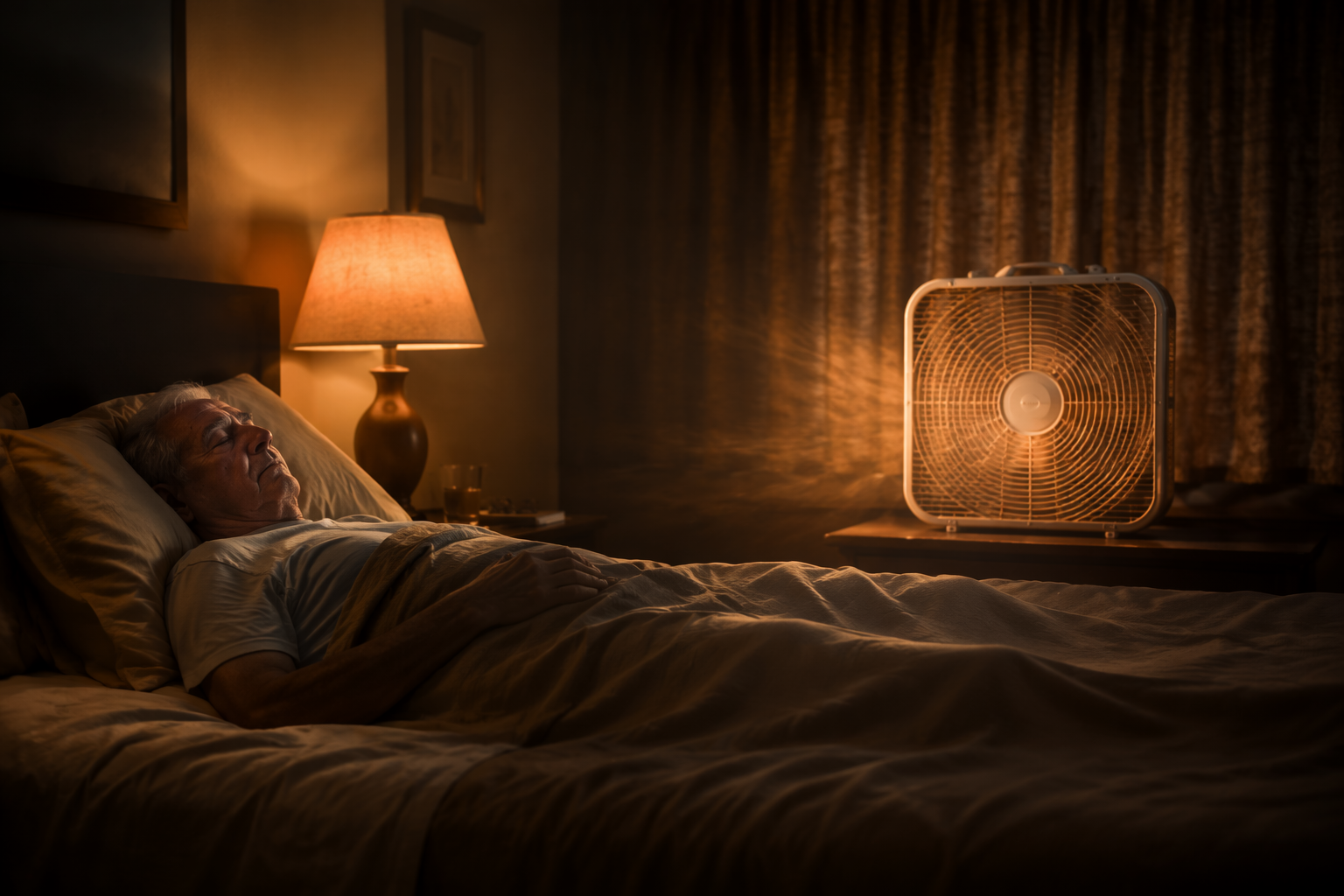
The box fan is usually the cheap, obvious answer. It sits on the dresser, points toward the bed, and makes an older parent’s hot bedroom feel at least a little less still. That is why the advice to avoid fans can sound overdramatic at first. For many families searching for bedroom cooling tips for elderly without fan use, the question is not theoretical: a parent is trying to sleep tonight in an apartment without central air.
The unsettling part is that a fan can feel like relief while the body is working harder. In a 2016 JAMA study of adults ages 60 to 90, electric fan use during 107°F dry heat raised heart rate by about 10 beats per minute and core temperature by about 0.5°F compared with no fan exposure.[1] A 2024 JAMA Network Open study found a similar direction of harm in adults 60 and older at 100.4°F dry heat: fan use raised core temperature by about 0.5°F and tripled cardiac strain.[2]
That does not mean every fan, in every bedroom, on every summer night is dangerous. It does mean a fan should not be treated as the main cooling plan for an older adult during very hot, dry conditions around 95°F to 100°F and above. At that point, moving hot air across older skin may add strain instead of removing heat.
Why a Fan Can Backfire in Dry Extreme Heat
A fan does not lower the temperature of a room. It helps people feel cooler mainly by moving air across the skin and helping sweat evaporate. That distinction matters more with age. Older adults sweat less efficiently, which weakens one of the main ways fan airflow is supposed to help the body cool itself.[3]
In dry extreme heat, the air moving across the body may be hotter than the skin. If sweat production or evaporation is not enough to offset that heat gain, the fan becomes less like a cooling tool and more like a steady push of hot air. The studies above did not merely show that fans failed to help. They showed higher core temperature and greater cardiovascular load in older participants under dry hot conditions.[1][2]
This is where vague advice about “staying comfortable” becomes useless. Comfort is not the same as heat safety. An older adult may like the airflow, may sleep better with the sound, and may still be accumulating heat stress. The body does not care that the fan has been part of the summer routine for decades.
The Fan Rule Is Conditional, Not Absolute
A flat “never use fans” rule is too blunt. Fan risk is strongest in dry extreme heat. In more humid conditions and at lower temperatures, airflow may still help some people feel cooler. The safer rule is narrower and more useful: when the room is very hot, especially in dry heat near or above the high 90s, do not rely on a fan as the primary cooling method for an older adult.
The CDC makes the same practical point without turning it into a slogan: older adults should not rely only on electric fans when temperatures are really hot, and people without air conditioning should use cooler places, cool showers or baths, and other heat-reduction steps.[4]
Medication can narrow the margin further. AARP identifies several medication classes that can interfere with heat regulation, including diuretics, beta blockers, antidepressants, antipsychotics, and anticholinergics.[5] That does not mean a caregiver should stop or change a medication during a heat wave. It does mean “she always runs hot” deserves a medication review with a clinician or pharmacist, especially before the next stretch of extreme heat.
A No-Fan Bedroom Plan for Tonight
The substitute for a fan is not one magic gadget. It is a short sequence that keeps heat out of the room where possible, cools the body directly, and removes small heat sources that are easy to miss. This is the version that can be done without central air, renovation, or pretending everyone has the strength to rearrange a house at 10 p.m.
| When | What to do | Why it matters |
|---|---|---|
| Late afternoon | Close blinds or curtains before the sun hits the bedroom. | Blocking heat before it enters is easier than cooling the room later. |
| Early evening | Turn off unused electronics and lamps that add heat. | Small heat sources matter more in a closed, hot bedroom. |
| Before bed | Use a cool shower, cool bath, or damp washcloths on pulse points. | Direct body cooling does not depend on hot room air moving across the skin. |
| Bed setup | Switch to lightweight cotton or linen bedding and consider a cooling gel pad. | Heavy bedding traps heat around the body. |
| Overnight | Open windows only if outdoor air has dropped below indoor temperature and the area is safe. | Ventilation helps only when it brings in cooler air. |
| If upstairs stays hot | Move sleep to a lower floor if the person can do it safely. | Lower floors are often cooler, but stairs and nighttime falls are not a fair trade. |
Start with the room before the person is exhausted. If the bedroom gets afternoon sun, close the blinds or curtains while the sun is still on that side of the building. Do not wait until bedtime and then try to undo hours of heat buildup with a fan. If the room has a television, desktop computer, bright lamp, or charger cluster running beside the bed, turn off what is not needed.
Then cool the body directly. A cool shower before bed can help, but it is not realistic for everyone. Some older adults cannot shower safely at night. Some are afraid of slipping. Some need help transferring. In those cases, a basin of cool water and several washcloths may be the better tool: one for the neck, one for the wrists, one for the temples, and a dry towel nearby so damp bedding does not become uncomfortable.
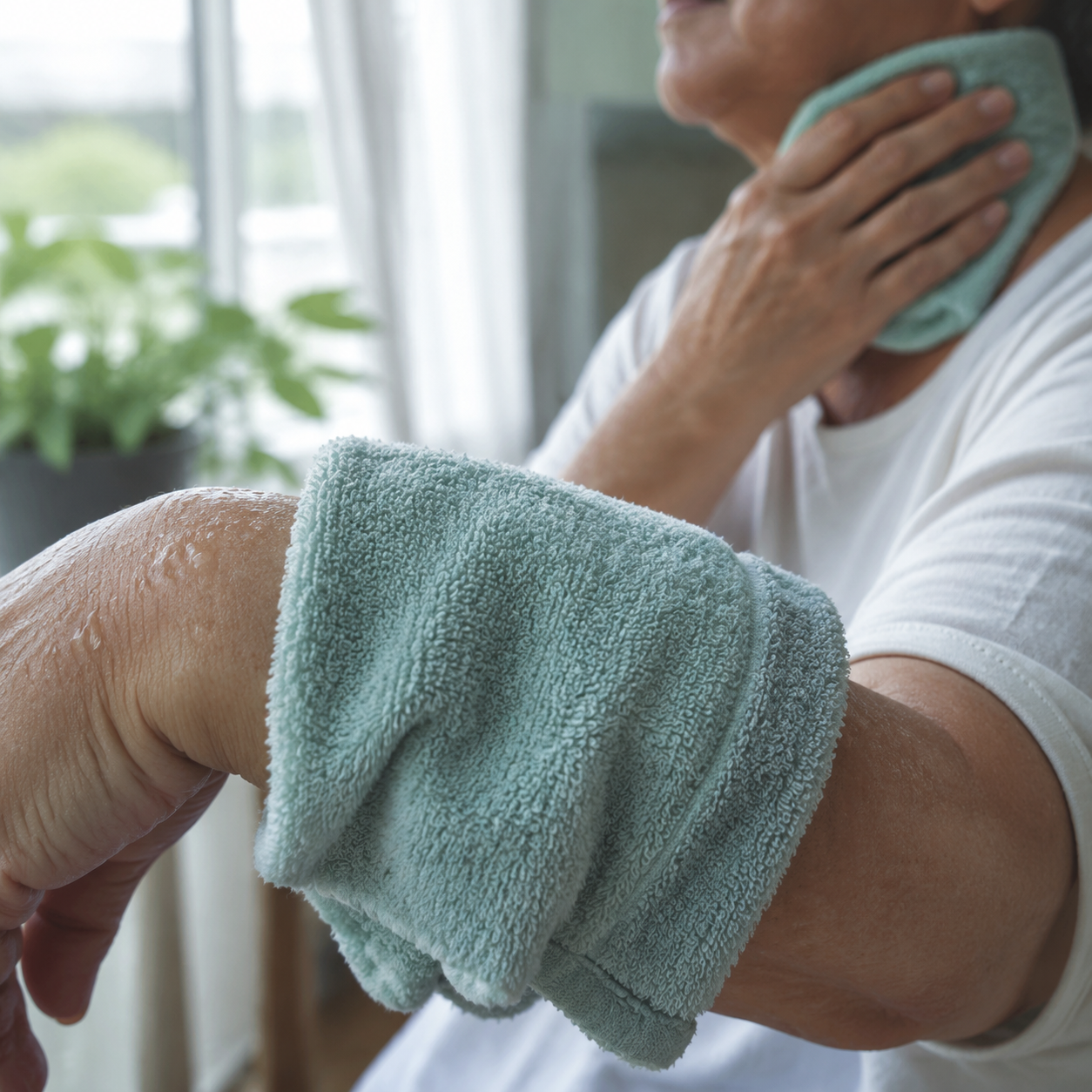
Pulse-point cooling is not fancy, which is one reason it is useful. The neck and wrists are easy to reach, easy to rewet, and easy for a caregiver to check without making bedtime feel like a medical procedure. If the parent has fragile skin or reduced sensation, the cloth should be cool rather than icy, and it should be checked often enough to avoid irritation.
Bedding needs the same practical treatment. Put away heavy comforters, thick mattress pads, fleece blankets, and decorative layers that trap heat. Use light cotton or linen sheets if available. A pillowcase or top sheet can be placed in a sealed bag in the freezer for about 30 minutes before bed, then used briefly to help the body settle. The sealed bag matters; no one needs a damp freezer-smelling pillow at midnight.
Cooling gel pads can help some people, especially when they are used as a body-cooling aid rather than sold to the family as a cure for a dangerously hot room. They should not make it harder to move in bed, transfer, or sense overheating. For a parent who already struggles to get up at night, any pad or mat that bunches, slides, or creates a trip edge is the wrong solution.
Hydration Belongs Beside the Cooling Plan
Water should be within reach before sleep, not across the apartment. Cooling foods such as watermelon or cucumber can be useful earlier in the evening if they fit the person’s diet. This is another place where the caregiver has to be careful with generic advice. Some older adults have fluid restrictions, swallowing issues, diabetes considerations, or medications that change what “drink more water” safely means. When those apply, the heat plan should match the clinician’s instructions rather than a one-size-fits-all summer tip.
When Opening the Window Helps, and When It Does Not
Opening windows at night only helps if the outdoor air has actually cooled below the indoor air and the neighborhood conditions make it safe. If the outside temperature is still high, the window may simply bring in more heat. If the parent lives on a ground floor, has limited mobility, or cannot safely manage window locks, nighttime ventilation needs a safety check, not just a temperature check.
A lower-floor sleep setup can help when heat collects upstairs, but it should not create a fall hazard. A couch on the first floor may be cooler; it may also be too low, too soft, or too hard to get out of quickly. If moving downstairs means carrying bedding, navigating stairs in the dark, or skipping a needed bathroom routine, the safer answer may be to cool the person directly and arrange an air-conditioned place the next day.
The Point Where Bedroom Tricks Are Not Enough
There is a ceiling to washcloths, chilled pillowcases, and closed blinds. If the room cannot be kept reasonably cool, the plan has to leave the bedroom. The CDC advises people without air conditioning to seek cooler places such as cooling centers, libraries, malls, or other public spaces, and it points people toward assistance resources including the Low Income Home Energy Assistance Program, or LIHEAP.[6]
That part needs to be decided before the parent is confused, weak, or embarrassed to ask for help. Write down the nearest air-conditioned public place, its hours, transportation options, and who can take the parent there. If the person lives alone, set a check-in time during heat advisories. A phone call that only asks “Are you okay?” is too easy to answer automatically. Ask what the bedroom temperature feels like, whether they have used the cooling cloths, whether they are drinking, and whether they feel dizzy, nauseated, unusually tired, or confused.
The CDC lists heat-related warning signs in older adults that include symptoms such as dizziness, headache, nausea, weakness, heavy sweating or hot dry skin, fast pulse, confusion, and loss of consciousness.[4] Confusion, fainting, or signs of heat stroke are not “try another cooling tip” moments. They are emergency moments.
A Clear Decision Rule for Caregivers
During dry extreme heat, do not use a fan as the main cooling strategy for an older adult’s bedroom. Use direct body cooling first: cool washcloths, a cool shower if safe, light bedding, chilled pillowcases or sheets used carefully, hydration, and daytime heat blocking. Use windows and lower-floor sleeping only when they actually reduce heat without adding fall, security, or mobility risks.
If the room stays hot despite those steps, move the cooling plan to an air-conditioned public or community space. The goal is not to win an argument with a box fan. The goal is to keep an older body from doing extra work all night in air that is too hot to be helpful.
References
- Electric Fan Use for Cooling During Hot Weather: A Biophysical Modelling Study, JAMA
- Electric Fan Use in Extreme Heat and Cardiovascular Strain in Older Adults, JAMA Network Open
- Mechanisms of Heat Loss and Heat Gain in Older Adults, PMC
- Heat and Older Adults Aged 65+, CDC
- Medications and Heat Intolerance, AARP
- Heat and People without Air Conditioning, CDC
Related decisions
Suggest a correction
We keep this content strictly product-neutral and reviewed against CDC STEADI, NIA, and AARP HomeFit guidance. If something here looks outdated, unclear, or inaccurate, tell us — this page does not carry open public comments, because it touches medical urgency, cost, or capacity-adjacent decisions where a discussion thread is a trust liability rather than a trust asset.
See the correction process on our editorial standards page →