
Flood Safety Checklist for Seniors Aging in Place
This room-by-room checklist helps caregivers prepare an older adult's home for a flood — covering medication supply, medical device backup, mobility access, and post-flood health risks specific to seniors.
Start at the front door and walk the house the way an older adult would have to move through it during a flood warning: slowly, with a walker or cane if they use one, in dim light, while trying to remember medications, chargers, glasses, hearing aids, and where the insurance papers went. These flood safety tips for seniors at home are meant for that walkthrough — before water rises, before roads close, and before a caregiver three towns away has to explain the plan over the phone.
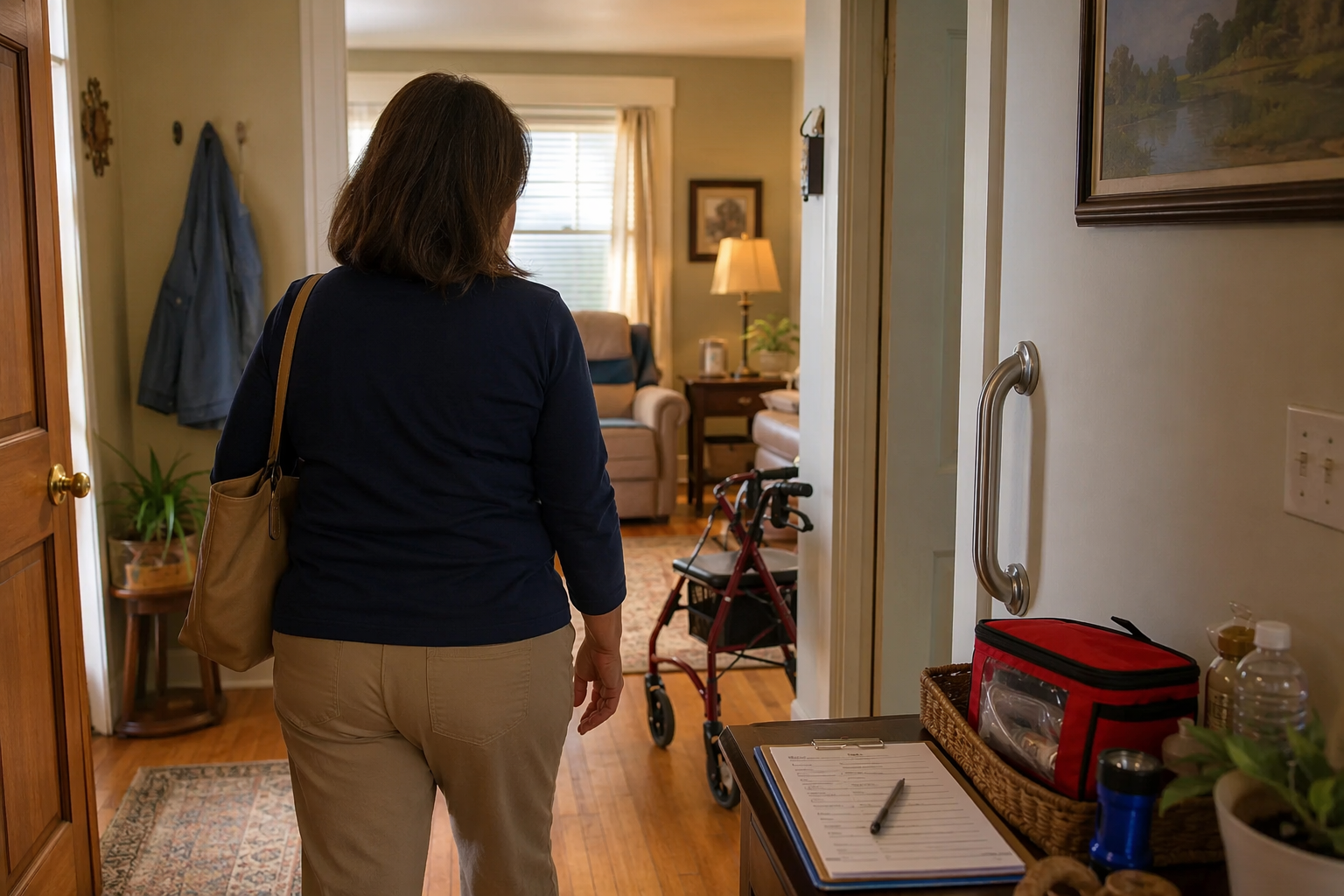
The goal is not to renovate the whole house in one weekend. It is to make the most important things findable, reachable, powered, labeled, and movable: medications, medical devices, safe exits, utility shutoffs, transportation contacts, and the path out of the home.
Quick-scan flood checklist for an older adult’s home
| Area | Do before flood season | Do when flooding is forecast |
|---|---|---|
| Basement or ground floor | Check the sump pump, drains, gutters, downspouts, backflow protection, and whether major equipment can be elevated by a qualified professional. | Move stored medical supplies, documents, chargers, and valuables above expected water level; do not send an older adult downstairs to check water. |
| Main living areas | Create two clear exit routes where possible; label utility shutoffs in large print; keep documents in a waterproof grab folder. | Clear walkers, wheelchair paths, cords, rugs, and outdoor items that could block a doorway or ramp. |
| Bedroom | Pack a bedside go-bag with medications, glasses, hearing aid supplies, device chargers, flashlight, emergency contacts, and copies of medical information. | Place shoes, mobility aid, phone, charger, flashlight, and go-bag within reach from the bed. |
| Medical devices | Write down what each device needs: electricity, batteries, distilled water, oxygen supplier, replacement parts, or refrigeration. | Charge batteries and phones; confirm backup power limits; call the device supplier if the plan depends on electricity. |
| Bathroom | Store essential supplies in waterproof containers; check grab bars, lighting, and nonslip surfaces. | Move medications, hearing aids, and wound-care supplies out of low cabinets. |
| Entryways and exterior | Keep ramps, steps, railings, porch lights, and driveway access usable for a walker, wheelchair, stretcher, or neighbor helping evacuate. | Install flood barriers or sandbags only if they do not block the accessible exit route. |
| Transportation and communication | Choose who calls, who drives, who has a key, and who can enter if the caregiver cannot arrive. | Confirm pickup time, destination, medication bag, mobility equipment, pets, and backup contact. |
| During and after flooding | Decide in advance that the older adult will not walk or drive through floodwater. | Watch for infection, injury, medication interruption, heat or cold exposure, confusion, and delayed symptoms after cleanup begins. |
For medications, use a longer standard than the usual three-day emergency kit. The American Red Cross recommends that older adults prepare a 30-day supply of medications and plan for the possibility of sheltering at home for at least two weeks. [1]
Why this checklist has to be senior-specific
Older adults are not just another group included in flood risk. In Hurricane Katrina, adults age 75 and older made up about half of the fatalities while representing about 6% of the New Orleans population; in Hurricane Ian, 61 of 87 fatalities were people age 60 and older. [2]
Those figures change the tone of the home walkthrough. A plan that sounds complete for a healthy adult can fail quickly when the person at home cannot lift wet sandbags, cannot see a small shutoff label, cannot hear a phone alert without hearing aids, or cannot leave without a wheelchair-accessible ride.
Flood safety for an older adult is also a health plan after the water recedes. A 2025 study covering 72 flood events and 4.5 million Medicare hospitalizations found that, among adults 65 and older, hospitalizations rose within four weeks after flooding for skin diseases, nervous system diseases, and injuries or poisoning. [3]
Basement or ground floor: protect the systems, then get people out of the way
If the home has a basement, garage, crawl space, or low ground floor, start there before storm season — not during the warning. This is where water usually finds the furnace, water heater, electrical panels, stored papers, holiday bins, and sometimes the only laundry area. It is also one of the worst places to send an older adult once flooding has started.
- Test the sump pump before storm season and after long dry periods. If it has a battery backup, confirm the battery is not expired and that someone in the household knows what the alarm sounds like.
- Clear floor drains, gutters, downspouts, and exterior drain paths. A downspout that dumps water beside the foundation can undo other preparation.
- Ask a licensed plumber or qualified contractor whether a backflow valve is appropriate for the home. This is not a guesswork installation.
- Move stored medications, wound-care supplies, incontinence supplies, oxygen tubing, device manuals, and important papers out of low cabinets, cardboard boxes, and basement shelves.
- If the home has major equipment in a flood-prone area — HVAC, water heater, furnace, washer, dryer, freezer, or electrical components — get a local professional opinion on elevation, relocation, or flood-resistant alternatives.
Costs for sump pumps, backflow valves, equipment elevation, drainage work, and flood barriers vary widely by region, home age, permitting rules, labor availability, and the condition of existing plumbing or electrical systems. Treat online cost ranges as rough screening tools only. A local quote matters more than a national average when the work affects electricity, gas, sewage, or safe egress.
If a caregiver has only one weekend, do the low-regret work first: lift supplies off the floor, photograph equipment, label shutoffs, clear drains, and make sure the older adult is not the person expected to inspect the basement during rain.
Main living areas: make exits and information obvious
In the living room, kitchen, and hallways, the work is less dramatic than floodproofing, but it is what helps someone leave without tripping, searching, or waiting for a relative to remember where papers are kept.
Create a waterproof grab folder
Put the folder somewhere a neighbor, adult child, or emergency contact can describe in one sentence: “top drawer of the entry table,” “red pouch hanging inside the pantry door,” or “clear box on the kitchen counter.” Avoid hiding it so well that no one can retrieve it under stress.
- Current medication list, including dose, schedule, prescribing clinician, and pharmacy
- Medical conditions, allergies, implanted devices, and recent surgeries
- Copies of insurance cards, ID, Medicare or Medicaid information if applicable, and advance directives if the person has them
- Emergency contacts, including one nearby person with a key
- Veterinarian, pet medication, and pet carrier information if the older adult has animals
- Photos of medical devices, mobility equipment, and assistive technology in case replacement or repair is needed
Label shutoffs so they can be read in bad light
Utility shutoff labels should be large, plain, and placed where a helper can see them quickly. If a valve requires a tool, tape the tool nearby or write exactly where it is kept. Do not assume the older adult will be able to bend, grip, kneel, or read small print during an emergency.
If gas, electricity, or water shutoff instructions are unclear, ask the utility company or a qualified professional before flood season. During flooding, the safer answer may be to leave and let trained responders handle utilities.
Clear two routes where the house allows it
Walk from the favorite chair to the bedroom, bathroom, kitchen, front door, back door, garage, ramp, and driveway. Move throw rugs, cords, plant stands, small tables, laundry baskets, shoes, and pet bowls that narrow the route. Check the route with the actual mobility aid, not by eyesight alone.
For a wheelchair user, measure the practical path: Can the chair turn? Can the door open fully? Does a flood barrier block the only usable exit? For a walker user, check thresholds and mats. A half-inch lip that is annoying on a normal day can become the reason someone cannot leave quickly.
Bedroom: build the bag around the night problem
The bedroom deserves extra attention because many flood emergencies become worse at night. The older adult may wake up without glasses, shoes, hearing aids, a charged phone, or the strength to search the house. Keep the essential kit reachable from the bed or from the first standing position beside it.
What to keep in the bedside go-bag
- A current medication supply in a waterproof container, planned around the Red Cross 30-day recommendation for older adults
- Medication list printed in large type, plus a photo copy stored on the caregiver’s phone
- Glasses, hearing aid case, hearing aid batteries or charger, and any communication device the person relies on
- Phone charger, portable power bank, and charging cords labeled for the right device
- Flashlight or headlamp with fresh batteries
- Sturdy shoes, socks, and a change of clothes that can be put on without complicated fasteners
- Copies of ID, insurance cards, emergency contacts, pharmacy information, and clinician contacts
- Small hygiene supplies, incontinence products if used, wound dressings if needed, and hand sanitizer
- A written note saying where larger equipment is stored: walker, wheelchair, oxygen supplies, CPAP case, transport chair, or pet carrier
If medications are normally stored in three places — pill organizer on the counter, insulin in the refrigerator, eye drops in the bathroom — write that down. The go-bag should not depend on one tired person remembering the full medication geography of the house.
Set up the bed area for a power outage
Put a flashlight where the older adult’s hand naturally reaches, not across the room. Keep shoes in the same place every night. If the person uses a medical alert device, confirm it is charged, worn, and programmed with current contacts. If the alert system depends on household internet or a base station, ask the company how it works during power and network outages.
For someone with memory changes, label the bag with a plain instruction: “Emergency bag — take this if leaving home.” A confusing pile of useful supplies is not a plan.
Medical devices: write the backup plan before you need it
Medical device preparation is where general flood checklists often become too thin. “Charge devices” is not enough if the older adult uses a CPAP, oxygen concentrator, nebulizer, power wheelchair, lift chair, hospital bed, refrigerated medication, or a communication device.
| Device or need | Questions to answer before a flood warning |
|---|---|
| CPAP or BiPAP | Does it have a battery option? How many hours does the battery actually last? Is distilled water needed? Is the mask packed? |
| Oxygen equipment | Who is the supplier? Is there a backup tank? Can the older adult safely evacuate with it? Is the tubing packed and untangled? |
| Power wheelchair or scooter | Is it fully charged? Can it fit through the planned exit? Is there a manual backup or transport chair? |
| Refrigerated medication | How will it stay cold during evacuation or power loss? Is there an insulated container ready? |
| Hearing aids | Are spare batteries or the charger in the go-bag? Is the case waterproof or inside a waterproof pouch? |
| Medical alert system | Does it work outside the home? Does it use cellular service, landline, Wi-Fi, or a base station? |
| Hospital bed or lift chair | Can the person transfer if power is out? Is there a manual release? Who knows how to use it? |
Call device suppliers before storm season and ask for backup instructions in writing. If the older adult relies on electricity for life-sustaining equipment, ask the utility company whether a medical needs registry or outage notification program exists locally. Enrollment does not guarantee uninterrupted power, so it should support the evacuation plan, not replace it.
Put device instructions in the waterproof folder in ordinary language. A neighbor who is willing to help may not know the difference between a CPAP hose, oxygen tubing, and a wheelchair charger. Label the cord, the bag, and the outlet if that helps the right item leave with the person.
Bathroom: assume low cabinets and wet floors will fail first
Bathrooms collect small essential items that are easy to lose in a rushed evacuation: hearing aids, dentures, eye drops, ointments, wound supplies, incontinence products, and daily medications. Anything essential stored under a sink should be moved to a waterproof container above likely water level.
- Move medications and medical supplies out of bottom drawers and under-sink cabinets.
- Keep hearing aids and dentures in labeled containers that can go into the bedside bag quickly.
- Check grab bars for secure installation; towel bars are not substitutes.
- Use nonslip surfaces, but remove any loose mat that slides, bunches, or blocks a walker.
- Add a nightlight or battery-powered light if the bathroom route is used at night.
- Keep a small supply of hygiene and incontinence products in the go-bag, not only in the bathroom closet.
If water enters the bathroom, do not treat grab bars as permission to walk through it. Stability aids help with normal transfers; they do not make contaminated or moving water safe.
Entryways and exterior: protect the exit route, not just the door
The entryway plan has to work for the person who lives there, not for the strongest adult in the family. A flood barrier that a younger caregiver can step over may trap a wheelchair user. Patio furniture that seems harmless on a sunny day can become a blocked ramp after wind and rain.
Walk the exit with the actual equipment
- Start at the bed or favorite chair and move to the door using the walker, cane, wheelchair, scooter, or transport chair the person actually uses.
- Open every door along the route fully. Check whether furniture, shoe racks, umbrella stands, pet gates, or storage bins narrow the path.
- Check thresholds, porch lips, ramp edges, loose boards, uneven pavers, and gravel that could stop small wheels.
- Move outdoor furniture, planters, hoses, trash bins, and decorations away from the ramp, stairs, gate, and driveway before storms.
- Make sure porch lights, motion lights, or battery lights cover the route to the pickup point.
- Confirm that a car, paratransit vehicle, ambulance, or neighbor’s vehicle can reach the pickup spot without the older adult crossing soft ground or standing water.
Use sandbags and barriers carefully
Sandbags, temporary flood barriers, door dams, and plastic sheeting may reduce water entry in some homes, but they can also create a trip hazard or block the only accessible exit. If the older adult cannot step over the barrier without help, the plan must say who removes it, when, and how the person exits if that helper cannot arrive.
Do not make the spouse caregiver the invisible labor force unless that person can safely do the work. Many older adults aging in place are supported by another older adult, and lifting wet sandbags or dragging patio furniture may be unsafe for both of them.
Pre-arrange the ride
Transportation should not be a vague promise to “leave if needed.” Write the first-choice driver, backup driver, pickup location, destination, and what equipment goes in the vehicle. If the older adult uses a wheelchair, oxygen, or a service animal, confirm that the destination and transportation can handle that before the warning.
- Who has a house key?
- Who can arrive fastest if roads start closing?
- Who can lift or fold the walker, transport chair, oxygen tank, or wheelchair ramp if needed?
- Where will the older adult go if the usual caregiver is unavailable?
- Does the receiving home, hotel, shelter, or relative’s house have stairs, a usable bathroom, and space for equipment?
Insurance and assistance notes to handle before storm season
Flood insurance is not something to buy after a storm is on the map. The National Flood Insurance Program generally has a 30-day waiting period before a new flood insurance policy takes effect, which makes advance planning important for homeowners and renters in flood-prone areas. [4]
Keep policy numbers, agent contacts, photos of major equipment, and a simple home inventory in the waterproof folder and in a cloud account a trusted caregiver can access. For an older adult, the insurance file should also document mobility equipment, medical devices, ramps, grab bars, and accessibility modifications, because those items affect whether the home can function after damage.
For eligible disaster survivors with disabilities, FEMA’s 2024 program updates state that items such as wheelchair ramps, grab bars, and paved pathways may be funded without counting against the Housing Assistance maximum. [5]
That does not replace insurance, local emergency services, or pre-flood home preparation. It is a recovery note to keep in mind if damage affects accessibility: take photos, keep receipts, save denial letters or repair estimates, and ask specifically about disability-related repairs or replacements when applying for assistance.
During the flood: do less, sooner
Once water is moving, the home checklist changes from preparation to avoiding bad decisions. The Centers for Disease Control and Prevention warns that 6 inches of moving water can knock a person down and 12 inches can carry away a vehicle. [6]
For an older adult with slower balance reactions, neuropathy, low vision, arthritis, dizziness, medication side effects, or a walker, the practical threshold is even lower: do not walk through floodwater. Do not drive through it. Do not send someone to retrieve a bin, check the basement, move the car, or open a gate if water is already crossing the route.
- Move to the safest pre-planned area only if the route is dry and usable.
- Keep the go-bag, phone, charger, shoes, mobility aid, and medical devices together.
- Follow local evacuation orders early, especially if accessible transportation is needed.
- If evacuation requires help, call before the water reaches the doorway or driveway.
- If the older adult depends on powered medical equipment and power is unstable, treat that as a medical planning issue, not an inconvenience.
After the flood: health monitoring is part of flood safety
Standing floodwater can contain sewage, chemicals, sharp debris, downed power lines, and other hazards. [6]
Cleanup can also push older adults into problems that do not look like disaster injuries at first: skin infections from contaminated water, falls on wet flooring, missed medications, dehydration, breathing problems from damp materials, exhaustion, and confusion from disrupted sleep or routine. The post-flood hospitalization findings are a reminder to keep watching for health changes for weeks, not just during the storm. [3]
- Do not let the older adult enter standing water or damaged rooms to “take a quick look.”
- Check skin, especially feet and lower legs, for cuts, redness, swelling, blisters, or drainage.
- Confirm medications were not missed, contaminated, overheated, or left behind.
- Replace wet pill organizers, dressings, tubing, and supplies that may have been exposed to floodwater.
- Watch for new weakness, dizziness, confusion, worsening pain, breathing symptoms, fever, or signs of infection.
- Photograph damage before moving items if it is safe to do so, but do not delay medical care or safe relocation for documentation.
- Keep the older adult out of cleanup work that requires lifting, climbing, mold exposure, electrical contact, or walking on unstable flooring.
If the home cannot support medications, sleep equipment, bathroom access, safe transfers, or temperature control after the flood, it is not functionally safe for aging in place until those needs are restored.
References
- Older Adults, American Red Cross.
- Disaster Risks to Older Adults, AARP.
- Flood events and Medicare hospitalizations among older adults, Columbia University Mailman School of Public Health, 2025.
- Flood Insurance, FEMA.
- Updates to FEMA Programs for People with Disabilities, FEMA.
- About Floods, Centers for Disease Control and Prevention.
Related decisions
Suggest a correction
We keep this content strictly product-neutral and reviewed against CDC STEADI, NIA, and AARP HomeFit guidance. If something here looks outdated, unclear, or inaccurate, tell us — this page does not carry open public comments, because it touches medical urgency, cost, or capacity-adjacent decisions where a discussion thread is a trust liability rather than a trust asset.
See the correction process on our editorial standards page →