
Agitation in Dementia: A BPSD Behavior Reference for Caregivers
A returnable reference guide for family caregivers managing agitation in a person with Alzheimer's or another dementia — covering behavior types, trigger identification, the delirium distinction, in-the-moment response steps, non-pharmacological strategies, and the current medication landscape including the April 2026 FDA approval of the first non-antipsychotic treatment for Alzheimer's-related agitation.

What Is Agitation in Dementia?
Agitation in dementia is not stubbornness, manipulation, or a personality change. It is a neurologically driven symptom — one of a cluster of behaviors clinicians call behavioral and psychological symptoms of dementia (BPSD). The underlying biology involves dysfunction in the frontal lobes — specifically the orbitofrontal cortex and anterior cingulate cortex — combined with neurotransmitter imbalances and a progressive loss of the brain's ability to regulate emotion, interpret the environment, and communicate distress through words.
When someone with dementia paces relentlessly, shouts, strikes out, or becomes inconsolable, they are typically experiencing something they cannot name or explain. The behavior is communication — of pain, fear, confusion, or unmet need — filtered through a brain that can no longer process or express it in ordinary ways.
The prevalence is significant. Research indicates that up to 97% of community-dwelling people with dementia will develop some form of BPSD at some point in the disease course. Agitation specifically affects approximately 30–50% of people with Alzheimer's disease and up to 80% of nursing home residents with dementia.
Agitation is not confined to the middle or late stages of dementia, though it often intensifies as the disease progresses. It can appear early, particularly when a person is struggling with the awareness of their own cognitive changes. Recognizing this early is important: it means the strategies in this guide are relevant across the full disease trajectory.
Types of Agitation: The CMAI Framework
Not all agitation looks the same, and the type of behavior you are seeing matters for choosing the right response. Clinicians use the Cohen-Mansfield Agitation Inventory (CMAI) to classify agitated behaviors into four categories based on whether they are physical or verbal, and aggressive or non-aggressive. Understanding which category applies helps you match your response strategy more precisely.
| Category | What It Looks Like | Common Examples |
|---|---|---|
| Physical aggressive | Hitting, kicking, scratching, biting, throwing objects | Striking out during personal care; throwing a glass; grabbing and squeezing |
| Physical non-aggressive | Repetitive movements, restlessness, wandering | Pacing; repeatedly opening and closing drawers; trying to leave the house |
| Verbally agitated (non-aggressive) | Repetitive sentences or questions, complaining, constant requests for attention | Asking the same question every few minutes; calling out for a family member; moaning |
| Verbal aggressive | Screaming, cursing, threatening | Shouting at a caregiver; making threats; using profanity that was previously out of character |
Physical non-aggressive behaviors include wandering and elopement attempts, which carry their own specific safety risks and management strategies. Because wandering warrants a dedicated response plan — including environmental safeguards, GPS options, and Safe Return programs — this guide does not cover it in depth. For a full guide on that behavior, see Understanding Wandering in Dementia: Causes, Warning Signs, and a Caregiver Action Plan.
Identifying Triggers: A Four-Category Checklist
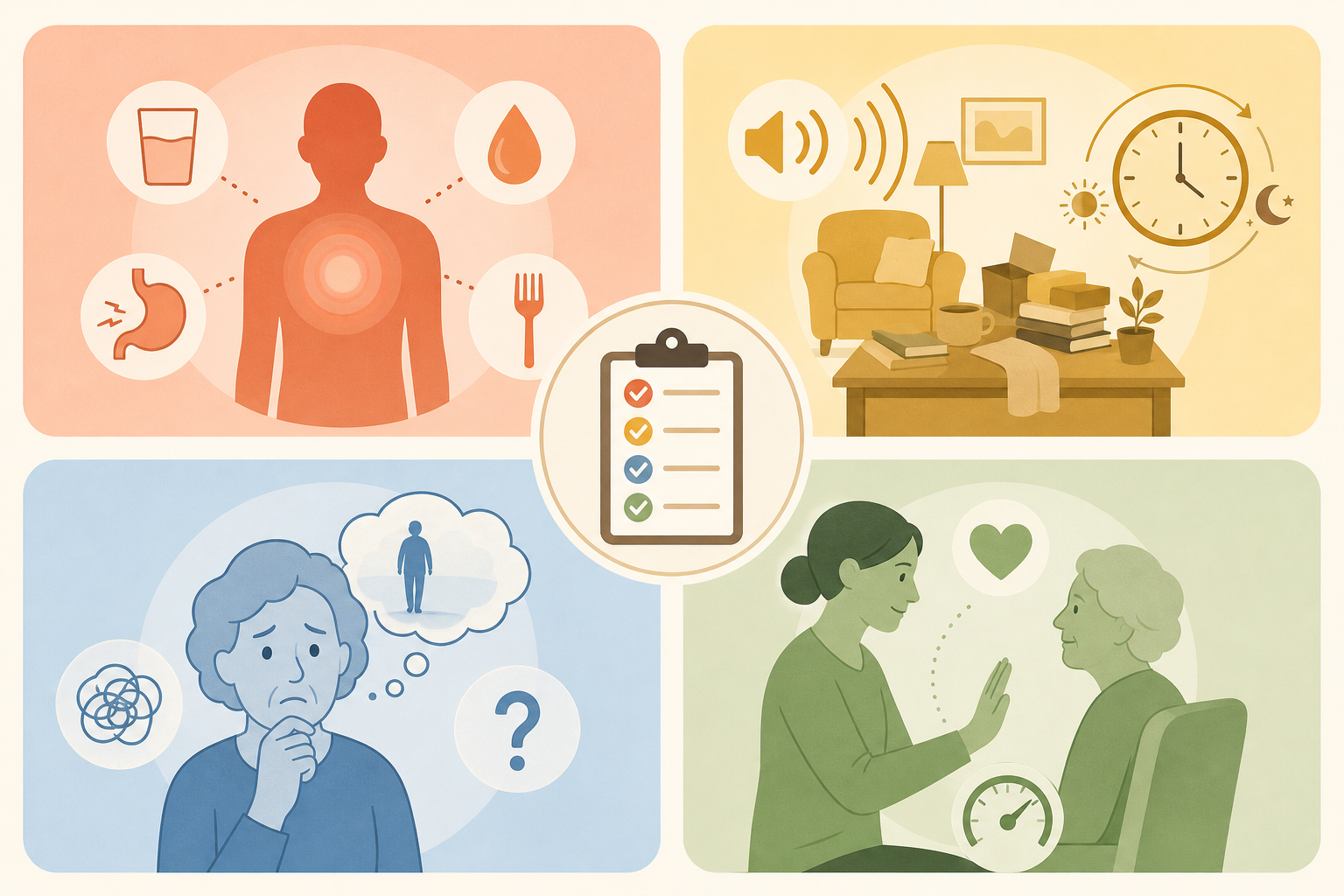
Every episode of agitation has a trigger — even when it is not immediately obvious. Working through these four categories systematically, either during a calm moment after an episode or when you sense one building, is the most practical first step in management.
1. Unmet Physical Needs
Physical discomfort is the most commonly overlooked trigger — and the most important to rule out first. Pain is present in an estimated 46–56% of people with dementia, yet many cannot report it verbally. An 8-week study of stepwise empiric pain treatment reduced agitation scores by 17% — an effect comparable to antipsychotic medication.
- Pain — including dental pain, arthritis, headache, or post-procedural discomfort the person cannot describe
- Urinary tract infection (UTI) — one of the most common causes of sudden behavioral change in older adults
- Constipation or urge to use the bathroom
- Hunger or thirst
- Fatigue or disrupted sleep
- Medication side effects or a recent medication change
- Dehydration, particularly in warm weather or after illness
2. Environmental Factors
- Excessive noise — television, multiple conversations, background music
- Visual clutter or a disorganized environment
- Unfamiliar surroundings — a hospital, a new home, or even a rearranged room
- Time of day — late afternoon and early evening are particularly common trigger windows (see the sundowning section below)
- Poor lighting that creates shadows or makes the environment harder to interpret
- A disrupted routine — an unexpected visitor, a canceled activity, or a change in schedule
3. Emotional and Psychological Factors
- Fear — of being abandoned, of an unfamiliar person, or of a misinterpreted situation
- Loss of control — being told what to do, being rushed, or having choices taken away
- Grief or sadness — particularly in early-stage dementia when the person retains some awareness of their losses
- Transitions — moving between activities, rooms, or caregivers
- Misidentification — not recognizing a caregiver or family member
4. Caregiver-Related Factors
- Rushing through personal care tasks — bathing, dressing, or grooming done too quickly
- A tense or hurried tone of voice, even when words are gentle
- Over-stimulation — too many instructions, too many questions, or too many people in the room
- Asking the person to do something the disease has made genuinely impossible
- Caregiver stress that is visible in body language or facial expression
Delirium vs. Dementia Agitation: A Critical Distinction
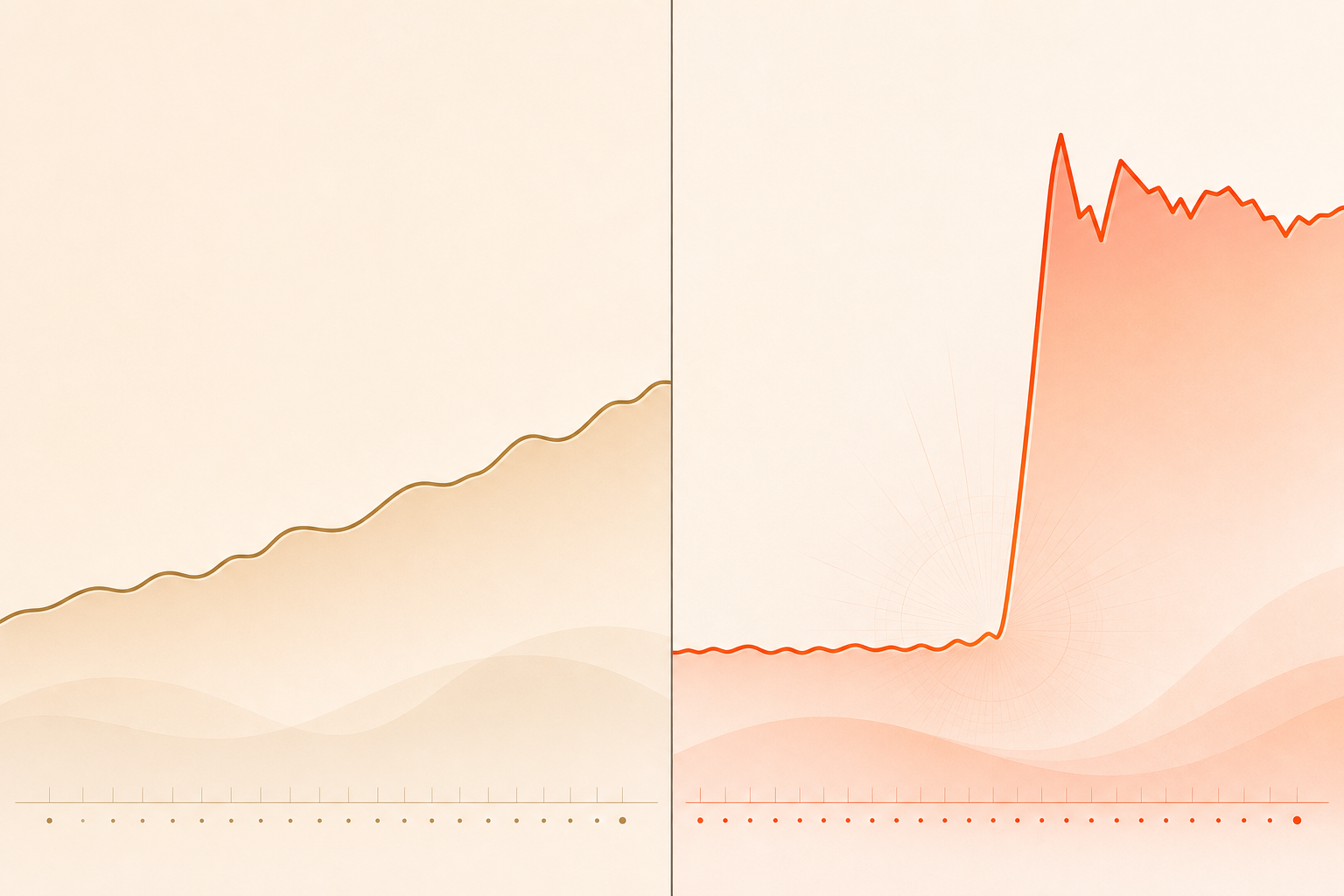
This is the single most important clinical distinction for family caregivers to understand: sudden-onset or sharply worsening agitation is not typical BPSD — it is a red flag for delirium, which is an acute medical condition requiring same-day evaluation.
Chronic BPSD agitation builds gradually over weeks to months and fluctuates in severity. Delirium looks different: it appears over hours to a few days, consciousness fluctuates hour to hour, and the person's ability to focus attention is markedly impaired — more so than their usual baseline. A person who was managing reasonably well yesterday and is profoundly confused and agitated today warrants a phone call to the doctor, not a wait-and-see approach.
| Feature | Chronic BPSD Agitation | Delirium |
|---|---|---|
| Onset | Gradual — worsens over weeks to months | Acute — develops over hours to a few days |
| Consciousness | Baseline level of alertness is maintained | Fluctuates — person may seem drowsy, then agitated, then confused |
| Attention | Difficulty with complex tasks, but can usually focus | Marked inability to sustain or shift attention |
| Pattern through the day | May have a predictable time pattern (e.g., late afternoon) | Unpredictable fluctuation hour to hour |
| Trigger | Identifiable behavioral or environmental triggers | Often a medical cause — UTI, dehydration, medication change, infection |
| What to do | Apply the strategies in this guide | Call the doctor the same day — do not wait overnight |
In-the-Moment Response: A Step-by-Step Protocol
When an episode is happening, the goal is to reduce distress safely — for the person with dementia and for you. These steps are drawn from guidance by the Alzheimer's Association and the National Institute on Aging and reflect the most consistently supported caregiver response practices.
- Regulate yourself first. Lower your own voice, slow your movements, and take a breath. Your nervous system is contagious — a calm caregiver presence is itself a de-escalation tool.
- Check for immediate physical discomfort. Ask or observe: Does the person need to use the bathroom? Are they hungry or thirsty? Are they in an uncomfortable position? Is something hurting them?
- Reduce environmental stimulation. Turn off the television or radio. Ask other people to leave the room. Move to a quieter, more familiar space if possible.
- Use calm, reassuring language. Short, simple, positive statements work best. Phrases like 'You are safe here' and 'I will stay with you until you feel better' address the fear or disorientation that is often driving the behavior.
- Offer a simple guided choice. Giving two options — 'Would you like to sit by the window or in your chair?' — restores a small sense of control without overwhelming the person with open-ended decisions.
- Redirect to a familiar, calming activity. A familiar song, a photo album, a simple repetitive task, or a short walk can shift attention away from the source of distress. Match the activity to what the person has historically found comforting.
Non-Pharmacological Strategies by Behavior Type
Every major clinical guideline — including those from the Alzheimer's Association, the National Institute on Aging, and peer-reviewed clinical literature — positions non-pharmacological approaches as the first-line treatment for BPSD agitation. Medications are a second choice, reserved for situations where non-drug strategies have been genuinely tried and have not adequately controlled the behavior, or where safety is at immediate risk.
The following strategies are matched to behavior type where practical, so you can focus on what is most relevant to what you are seeing.
| Strategy | Best Matched To | Evidence Basis |
|---|---|---|
| Caregiver communication training | All behavior types, especially verbal aggression and physical aggression during personal care | Among the most consistently evidence-supported non-pharmacological interventions; focuses on understanding behavior as communication of unmet needs |
| Music therapy — especially group music intervention | Verbally agitated behaviors, general restlessness, physical non-aggressive behaviors | Meta-analysis supports group music intervention for reducing agitation in cognitively impaired patients |
| Environmental modification (reduce noise, maintain familiar objects, consistent routine) | All behavior types; particularly effective for environmentally triggered agitation | Widely supported across clinical guidelines; familiar objects and reduced stimulation lower baseline arousal |
| Person-centered activity engagement | Physical non-aggressive behaviors, verbal agitation from boredom or understimulation | Matching activities to the person's history, preferences, and remaining abilities reduces behavioral frequency |
| Sensory approaches (gentle touch, aromatherapy, weighted blankets) | Physical non-aggressive restlessness, anxiety-driven verbal agitation | Evidence is more limited but sensory comfort is low-risk and often effective for individual patients |
| Empiric pain treatment | Any behavior type when pain cannot be ruled out | An 8-week RCT of stepwise pain treatment reduced agitation scores comparably to risperidone |
Caregiver communication training deserves particular emphasis. Learning to interpret behavior as a communication of discomfort or unmet need — rather than as a problem to be controlled — changes the quality of every interaction. Caregivers who make this shift report less burnout and manage episodes more effectively over time.
Sundowning: When Agitation Has a Time Pattern
Sundowning is a time-patterned BPSD subtype — a cluster of behaviors including increased confusion, restlessness, and agitation that typically emerges in the late afternoon and continues through the evening. It is not a separate disease but a predictable behavioral pattern that many caregivers recognize by the time of day alone.
The management elements unique to sundowning include: maximizing natural light exposure during the day, scheduling more demanding activities in the morning when the person is typically at their best, reducing stimulation in the late afternoon, and avoiding caffeine and heavy meals in the evening. An internal body clock disruption — where the person becomes fatigued during the day and wakeful at night — is a common contributing factor.
When to Call the Doctor
Most agitation episodes can be managed at home with the strategies in this guide. The following situations warrant same-day or urgent medical contact:
- Sudden-onset agitation — new or dramatically worsened behavior that appeared over hours or a day or two, not gradually over weeks
- Signs of delirium — confusion that fluctuates hour to hour, marked difficulty sustaining attention, new drowsiness alternating with agitation
- Injury — the person with dementia has injured themselves, or a caregiver has been injured during an episode
- Refusal of basic needs — refusal of food, fluids, or essential medications for more than 24 hours
- Failure of non-pharmacological strategies — consistent, well-applied non-drug approaches have not reduced the frequency or intensity of episodes over several weeks
- Caregiver safety concern — you do not feel safe in the home environment, or you are unable to provide care safely
Medication Options: What Caregivers Should Know Before the Doctor Conversation
This section is not a prescribing guide. It is background information to help you understand the medication landscape before speaking with a physician or care team. All treatment decisions should be made in partnership with a licensed clinician who knows the specific person's diagnosis, other medications, and overall health status.
As of the date this article was reviewed, two medications have received FDA approval with a primary indication for agitation associated with dementia due to Alzheimer's disease.
The Two FDA-Approved Options
| Medication | FDA Approval | Drug Class | Key Considerations |
|---|---|---|---|
| Brexpiprazole (Rexulti) | May 2023 | Atypical antipsychotic | Carries the FDA black-box warning for antipsychotics in elderly dementia patients (see below). Discuss the risk-benefit balance carefully with the physician. |
| Dextromethorphan-bupropion (Auvelity) | April 30, 2026 | Non-antipsychotic (NMDA receptor antagonist + norepinephrine-dopamine reuptake inhibitor) | First non-antipsychotic with a primary FDA indication for this condition. Efficacy demonstrated in two randomized studies using the CMAI as a primary endpoint. Carries a boxed warning about suicidal thoughts in adolescents and young adults on antidepressants — not specific to elderly dementia patients. Blood pressure assessment and bipolar disorder screening recommended before starting. |
Other Pharmacological Approaches
Beyond the two FDA-approved options, physicians may consider other approaches depending on the clinical picture:
- SSRIs (selective serotonin reuptake inhibitors) — sometimes used as a safer intermediate option, particularly when depression or anxiety appears to be contributing to the agitation
- Empiric pain treatment — when pain cannot be ruled out, a structured trial of pain management may reduce agitation significantly before any psychiatric medication is considered
A Critical Note on Dementia Type
The medication landscape differs significantly depending on the specific dementia diagnosis. In Lewy body dementia and Parkinson's disease dementia, most antipsychotics — including both typical and many atypical agents — are largely contraindicated. They can severely worsen parkinsonism and in some cases trigger a life-threatening reaction called neuroleptic malignant syndrome. If the person in your care has Lewy body dementia or Parkinson's disease dementia, make sure the treating physician is aware of this before any antipsychotic is prescribed.
Tracking Agitation: The Behavior Diary
A behavior diary is one of the most practical tools available to a family caregiver — and one of the most underused. You do not need a special form. A notebook, a phone note, or a simple spreadsheet works equally well.
For each episode, record the following:
- Date and time of the episode
- Behavior type — using the CMAI categories (physical aggressive, physical non-aggressive, verbally agitated, verbal aggressive) helps you communicate precisely with the medical team
- Duration — how long the episode lasted
- Likely trigger — what was happening before it started, or what you think may have caused it
- What helped or did not help — what you tried and how the person responded
- Any physical symptoms noted — signs of pain, possible UTI, unusual fatigue, or other physical changes
Over two to four weeks, patterns typically become visible — a particular time of day, a specific activity, a consistent trigger that you can address proactively. The diary also gives a physician or care team concrete data to evaluate whether a medication is working, whether a non-drug strategy is helping, or whether the behavior has changed in a way that warrants re-evaluation.
A Note on Caregiver Impact
Managing agitation is one of the most demanding aspects of dementia caregiving. The unpredictability, the physical intensity, and the emotional weight of watching someone you love in distress — while staying calm enough to help them — takes a real toll. Burnout is not a personal failure. It is a predictable outcome of sustained high-stress caregiving without adequate support.
There is also a practical reason to take your own wellbeing seriously: caregivers who understand BPSD as communication of unmet needs, and who have had the chance to rest and recover, respond more effectively during episodes and sustain care for longer. Your capacity to be present and calm is a direct input into the person's wellbeing.
Related reading
Noticed something outdated or inaccurate on this page? Flag a correction. We review every report against CDC, NIA, and AARP HomeFit guidance before updating a page.
Part of the Fall Prevention section.