
Daily Diet Soda Linked to Cognitive Decline in Older Adults
Multiple large studies show a consistent link between daily diet soda and faster cognitive decline, but the evidence is more nuanced than headlines suggest. This article breaks down what the research actually means for family caregivers and when to consider a conversation about reducing intake.
If your parent drinks diet soda every day, the honest answer is this: the link between daily diet soda and cognitive decline is real enough to take seriously, but it is not proof that diet soda causes dementia. The better response is usually a calm reduction plan, not a family showdown over one can in the refrigerator.
Three large observational studies now point in the same general direction. The older Framingham Heart Study found that daily artificially sweetened beverage drinkers were about three times more likely to develop ischemic stroke and Alzheimer’s dementia over 10 years.[1] More recent work adds important detail: the ELSA-Brasil study found faster cognitive decline among the highest artificial sweetener consumers, while the NOMAS study found higher dementia risk among people drinking diet soda daily.[2][3]
That sounds alarming until you ask the caregiver questions that matter most: How old is the person? Do they have diabetes? Are they drinking diet soda because a metabolic problem was already there? And are we talking about preventing future risk, or trying to change the course of dementia that has already been diagnosed?

What The Newer Studies Actually Found
The ELSA-Brasil study followed 12,772 adults for eight years and looked at intake of several low- and no-calorie sweeteners. The highest consumers, roughly equivalent to one diet soda a day, showed 62% faster global cognitive decline than non-consumers. The researchers described that difference as similar to about 1.6 years of brain aging over the study period.[2]
The same study did not treat every person as if they carried the same risk. The signal was strongest in participants under 60 and in participants with diabetes. It was not statistically significant in participants over 60.[2] That matters for families. A headline about “older adults” may feel directly aimed at someone caring for an 80-year-old parent, but this particular study’s clearest age signal was not in that group.
ELSA-Brasil also looked beyond the word “diet soda” and examined specific sweeteners. Aspartame, saccharin, acesulfame-K, erythritol, sorbitol, and xylitol were linked with faster decline, while tagatose was not.[2] That does not mean each sweetener has been proven harmful to the brain. It means the study found associations that deserve attention, especially when intake is routine rather than occasional.
The NOMAS study, published in 2026, followed 947 participants and found that each daily diet soda was associated with a 34% higher dementia risk. People drinking more than one diet soda per day had about four times the risk of those drinking one or fewer per day.[3]
Then comes the part that should keep everyone from turning this into a simple blame story: in NOMAS, the association disappeared when researchers excluded participants with obesity or diabetes. Among high consumers, 41% had diabetes, compared with 18% of the rest of the participants.[3]
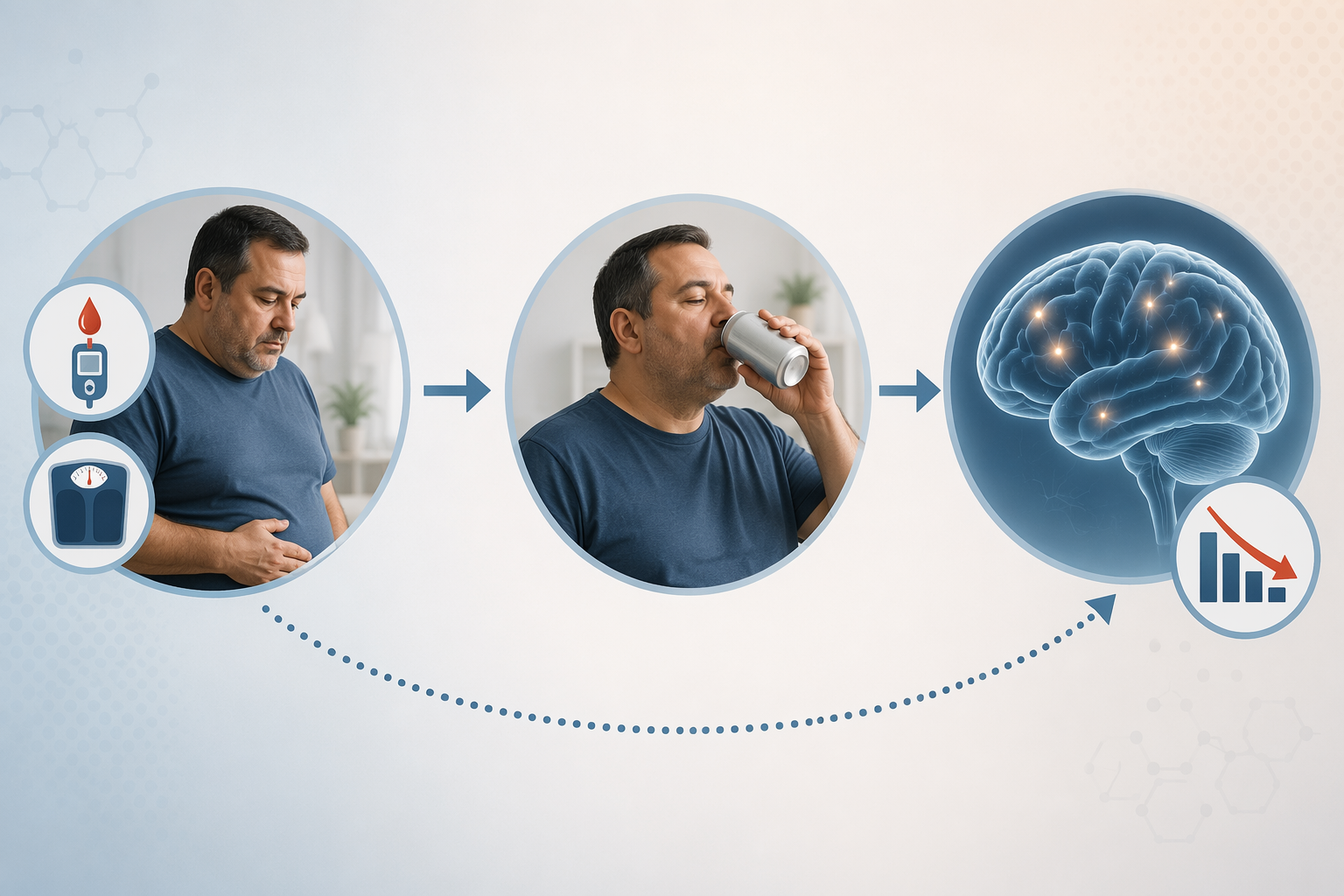
Why Diabetes And Reverse Causation Change The Meaning
Reverse causation is not a technical excuse. It is a very practical possibility. A person may switch to diet soda because they have diabetes, prediabetes, weight gain, or a clinician telling them to cut sugar. Those same underlying health issues may also be related to later cognitive decline. In that situation, diet soda can look like the culprit when it may partly be a marker of existing metabolic risk.
The NOMAS result makes that concern hard to ignore. If the diet soda association fades when people with obesity or diabetes are removed, then a fair reading is not “diet soda has been cleared.” It is also not “diet soda causes dementia.” The fair reading is that daily diet soda may be tied up with a broader metabolic-risk pattern, and that pattern is where caregivers should pay attention.
That is also why the diabetes finding in ELSA-Brasil carries weight. When two newer studies both point toward diabetes or metabolic risk as a key part of the story, the family conversation should not stop at the beverage. It should include blood sugar control, overall diet quality, physical activity, sleep, medications, and whether the person is getting regular follow-up for cardiovascular risk.
| Finding | What It Means For A Caregiver |
|---|---|
| Daily intake was linked with faster decline in several studies | A daily habit is worth discussing, especially if it has become automatic |
| The strongest ELSA-Brasil signal appeared under age 60 and in diabetes | The evidence may apply differently to a 58-year-old with diabetes than to an 85-year-old without it |
| The NOMAS association disappeared after excluding obesity or diabetes | Existing metabolic risk may explain part or much of the observed link |
| All three studies were observational | They can guide risk reduction, but they cannot prove that diet soda causes dementia |
This is where a lot of health headlines fail families. They turn a pattern into a verdict. The studies are useful because they identify a habit that clusters with risk; they are not strong enough to say that removing diet soda will prevent dementia in a specific parent.
The Age Detail Is Not A Footnote
For an adult child caring for a parent in their 70s, 80s, or 90s, the age detail matters. ELSA-Brasil found no significant association in participants over 60.[2] That does not make daily diet soda automatically harmless for older adults, but it does mean the most precise version of the finding is narrower than many headlines suggest.

That distinction should change the tone of the conversation at home. A 55-year-old with diabetes who drinks several diet sodas a day is closer to the strongest risk pattern described in the newer research. An 82-year-old who drinks one can with lunch, has stable nutrition, and resists most dietary changes may be a different situation. The evidence does not support treating both people the same way.
For a parent who already has dementia, the calculus changes again. Cutting out diet soda should not be presented as a treatment that will alter the disease course. If the drink helps them stay hydrated, take pills, or maintain a familiar routine, those immediate caregiving realities matter. A swap may still be reasonable, but it should not create a new problem with fluid intake, appetite, agitation, or trust.
What Not To Do: Switch Back To Regular Soda
The wrong lesson is to replace diet soda with sugar-sweetened soda. That simply trades one concern for another, especially when diabetes, prediabetes, weight, or cardiovascular risk is already part of the picture. If the goal is brain health, the better move is not to find a more old-fashioned soda. It is to make sweet drinks less central.
The industry counterpoint is also worth separating from the caregiving decision. The International Sweeteners Association and manufacturers argue that artificial sweeteners used in foods and beverages are safe when consumed within approved limits. That does not answer the whole question families are asking. A substance can meet general safety standards and still be something a person chooses to reduce when long-term observational studies keep raising concerns.
A Sensible Family Rule
If the habit is occasional, this evidence does not justify alarm. If it is daily, especially more than once a day, it is reasonable to start lowering exposure. That is even more true when the person has diabetes, obesity, prediabetes, vascular disease, or other metabolic risk factors.
The most workable approach is gradual. Replace one serving at a time with water, seltzer, unsweetened iced tea, coffee without heavy sweetening, or another drink the person actually accepts. If carbonation is the main comfort, keep the bubbles and lose the sweet taste slowly. If caffeine is part of the routine, do not remove it abruptly and then wonder why everyone is irritable.
- Bring it up when diet soda is a daily or multiple-daily habit, not when it is an occasional treat.
- Prioritize the conversation if diabetes, prediabetes, obesity, or cardiovascular risk is already present.
- Avoid framing the drink as the cause of memory problems, because the research cannot support that claim.
- Do not replace diet soda with regular soda as a “safer” brain-health choice.
- For someone with existing dementia, protect hydration, nutrition, medication routines, and calm first.
This also fits better with what dementia-prevention conversations can realistically achieve. Diet soda is one possible exposure. It is not the whole diet, the whole vascular picture, or the whole life. Mediterranean- and MIND-style eating patterns, sleep, movement, social connection, hearing support, blood pressure control, and diabetes management are all part of the larger brain-health frame. Families already tracking memory changes may also need a broader way to monitor function, not just a beverage target; a cognitive decline monitoring framework can help keep the focus on patterns that matter.
So yes, the research signal is real. The careful version is less dramatic and more useful: daily diet soda intake is associated with worse cognitive outcomes in observational studies, the strongest newer signals involve adults under 60 and people with diabetes, and reverse causation may explain part of the link. That is enough reason to reduce a daily habit gently. It is not enough reason to scare a parent, overrule them, or pretend one drink explains dementia.
References
- Sugar- and Artificially Sweetened Beverages and the Risks of Incident Stroke and Dementia: A Prospective Cohort Study, Stroke, 2017.
- Low- and No-Calorie Sweeteners and Cognitive Decline: The Brazilian Longitudinal Study of Adult Health (ELSA-Brasil), Neurology, 2025.
- Could Diet Soda Increase Dementia Risk?, University of Miami Miller School of Medicine, 2026.
Related reading
Noticed something outdated or inaccurate on this page? Flag a correction. We review every report against CDC, NIA, and AARP HomeFit guidance before updating a page.
Part of the Fall Prevention section.