
Caregiver decision guide
Cancer Treatment Options for Seniors on Medicare in 2026
Medicare covers cancer treatment for seniors, but out-of-pocket costs vary widely between Part B and Part D. The 2026 Part D out-of-pocket cap provides critical relief for oral chemotherapy, while Part B infusion costs remain uncapped and require separate planning.
When a senior parent is diagnosed with cancer, “Medicare covers cancer treatment” is only the beginning of the conversation. The harder question is what Medicare will pay for this specific treatment, in this specific setting, under this specific plan — and what could still land on the family after the appointment is over.
That distinction matters because people with cancer spent an estimated $5.6 billion out of pocket in 2020, according to American Cancer Society Cancer Action Network data cited by Paying for Senior Care.[1] The number is large, but the family version of it is usually smaller and more urgent: a pill bottle, an infusion chair, a surgery date, a portal message, and someone at the kitchen table trying to figure out which bill comes next.

For cancer treatment options for seniors on Medicare in 2026, the most important first split is not the cancer type. It is whether the treatment is billed as a drug under Part D, a medical service under Part B, a hospital stay under Part A, or through a Medicare Advantage plan with its own network and cost rules.
Start With The Treatment Setting, Not The Treatment Name
Two patients can both be receiving “chemotherapy” and face very different Medicare costs. A pill taken at home may fall under Part D prescription drug coverage. An IV chemotherapy infusion given in a doctor’s office or hospital outpatient department generally falls under Part B. That difference can decide whether the family is protected by a 2026 out-of-pocket cap or exposed to ongoing coinsurance.
| Treatment or service | Medicare part commonly involved | Main cost issue to verify |
|---|---|---|
| Oral chemotherapy, targeted therapy, and many cancer pills taken at home | Part D | Whether the drug is covered by the plan formulary and counts toward the 2026 Part D out-of-pocket cap |
| IV chemotherapy or immunotherapy given in an office or hospital outpatient setting | Part B | 20% coinsurance after the Part B deductible, with no Original Medicare annual out-of-pocket cap |
| Cancer surgery during an inpatient hospital stay | Part A, with possible Part B physician charges | The Part A benefit-period deductible and any separate physician or outpatient charges |
| Radiation therapy | Often Part B when outpatient | Coinsurance, treatment location, and whether supplemental coverage applies |
| Medicare Advantage cancer care | Part C | Network status, prior authorization, drug coverage rules, and the plan’s maximum out-of-pocket limit |
| Home health after treatment | Medicare home health benefit when eligibility rules are met | Skilled, part-time care may be covered; custodial help is not the same thing |
This table is a starting point, not a bill estimate. The same drug can be handled differently depending on whether it is administered by a clinician, dispensed by a pharmacy, bundled into a facility charge, or managed by a Medicare Advantage plan. The practical move is to ask the oncology office to identify the billing path before treatment starts.
The 2026 Part D Cap Is Real Relief For Covered Cancer Pills
In 2026, Medicare Part D has a $2,100 out-of-pocket cap. After a beneficiary reaches that amount for covered Part D drugs, covered prescriptions cost $0 for the rest of the year.[2] For seniors taking oral chemotherapy, targeted therapy, or other high-cost cancer medications that are covered under their Part D plan, this is one of the clearest protections available.
The word “covered” is doing real work. The cap does not mean every cancer pill is automatically affordable. The caregiver still has to check whether the drug is on the plan’s formulary, whether prior authorization or step therapy applies, whether the preferred pharmacy matters, and whether the prescription is being billed under Part D rather than another benefit.
Still, the cap changes the conversation. Before this protection, a family could watch pharmacy costs stretch across the year with no simple stopping point. In 2026, once the covered Part D out-of-pocket total reaches $2,100, the family should be able to write down a hard number for covered Part D drugs for the rest of that calendar year.[2]
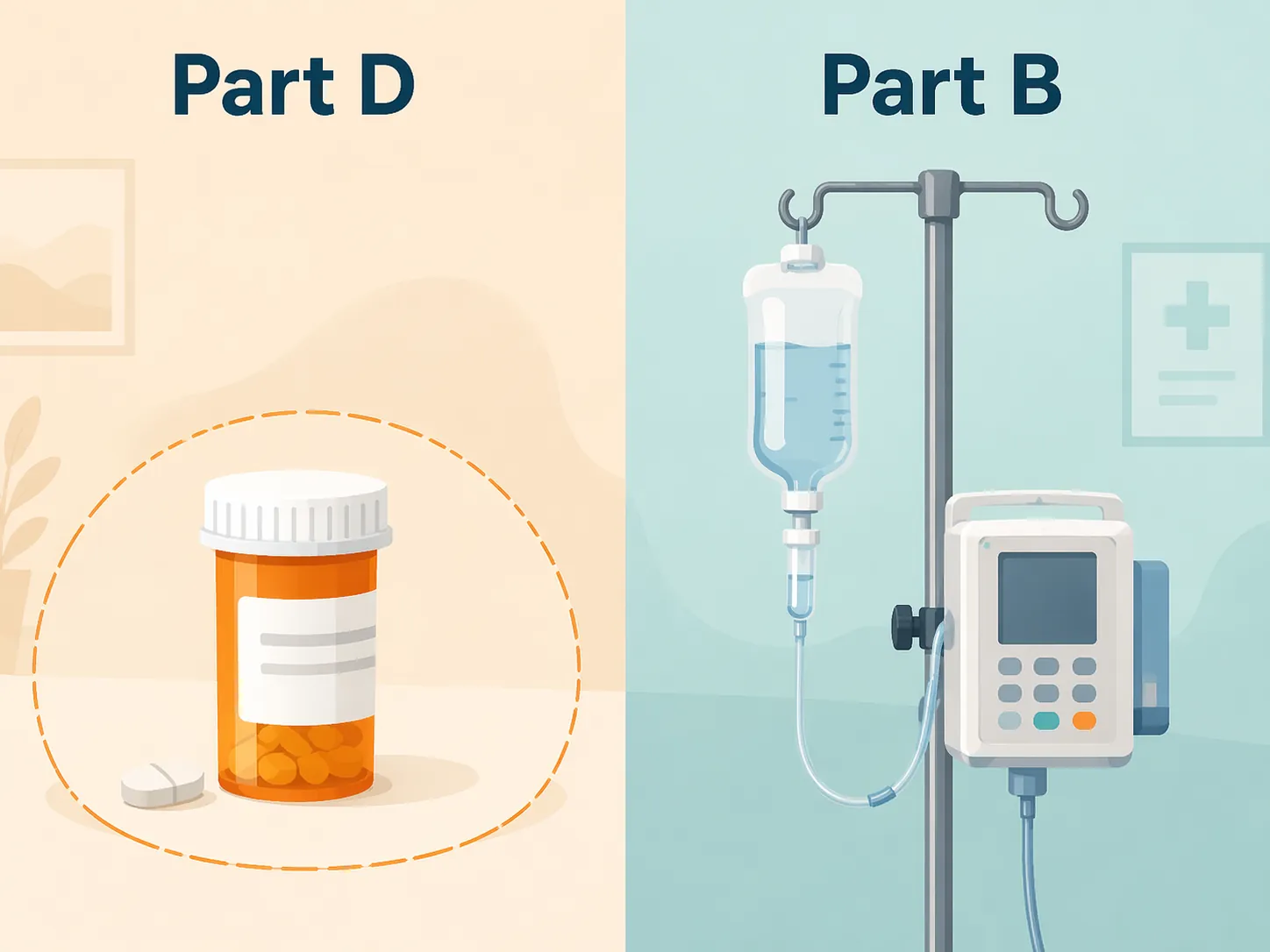
That is why the first caregiver question for an at-home cancer drug should be direct: “Will this medication be billed under my parent’s Part D plan, and will the amount paid count toward the 2026 $2,100 out-of-pocket cap?” If the answer is yes, ask for the expected first-fill cost, the pharmacy requirements, and any prior authorization timeline.
Part B Infusion Chemotherapy Is A Different Financial Problem
Infusion chemotherapy and many other cancer drugs administered in a doctor’s office or hospital outpatient setting are generally covered under Medicare Part B. Under Original Medicare, Part B pays 80% of the Medicare-approved amount after the Part B deductible is met, leaving the patient responsible for 20% coinsurance.[3]
In 2026, the Part B deductible is $283, and the standard Part B premium is $202.90 per month.[2] The deductible is not usually the part that shocks families. The harder issue is that Original Medicare does not place an annual cap on the 20% Part B coinsurance.[3] For a high-cost infusion regimen, 20% can remain 20% again and again unless other coverage fills the gap.
This is the part that gets hidden when someone says, “Medicare covers chemo.” Yes, Medicare may cover it. But “covered” can still mean the patient owes a share of every approved charge. A Medigap policy, retiree coverage, Medicaid, or another secondary payer may reduce or eliminate that exposure, but Original Medicare alone does not create the same kind of annual stopping point that Part D now has for covered drugs.
The caregiver’s question for infusion treatment is not just “Is this covered?” It is: “What is the Medicare-approved amount expected to be, what 20% coinsurance could remain, and does my parent have any supplemental coverage that pays it?” The billing office may not be able to promise the final claim amount, but it should be able to explain which benefit is being billed and whether financial counseling is available.
Surgery, Radiation, And Hospital Care Can Add Separate Bills
Cancer treatment is rarely one clean transaction. A senior may have surgery, imaging, pathology, radiation, oncology visits, prescriptions for side effects, and follow-up scans. Medicare may touch each one differently.
If the patient is formally admitted as an inpatient, Part A can cover hospital care. In 2026, the Part A inpatient hospital deductible is $1,736 per benefit period.[2] That phrase “benefit period” matters because it is not the same as a calendar-year deductible. A new benefit period can begin after the patient has been out of inpatient hospital or skilled nursing facility care for a required period, so caregivers should not assume one annual hospital deductible covers every possible admission.
Physician services, outpatient radiation, diagnostic tests, and many outpatient cancer services often involve Part B cost-sharing. If the patient has Medigap, the secondary policy may pick up some or all of the coinsurance depending on the plan. If the patient has Medicare Advantage, the plan’s own copays, coinsurance, network rules, and authorizations take over.
This is why a single “treatment plan” should be translated into billing pieces. The oncologist may be thinking medically: surgery first, then radiation, then a drug. The caregiver has to ask the administrative version: inpatient or outpatient, Part B or Part D, in network or out of network, prior authorization required or not, capped or uncapped.
Medicare Advantage Has A Cap, But The Plan Rules Matter
Medicare Advantage plans must set a maximum out-of-pocket limit for covered Part A and Part B services. For 2026, the maximum is $9,250.[2] That sounds like a clean answer, and compared with uncapped Original Medicare Part B exposure, it can be an important protection.
But Medicare Advantage is plan-specific. A plan may require the cancer center, oncologist, infusion site, imaging facility, and pharmacy to be in network. It may require prior authorization for chemotherapy, radiation, imaging, hospital care, or certain drugs. It may handle drug costs differently depending on whether the medication is treated as a medical benefit drug or a pharmacy benefit drug.
For a caregiver, the safest approach is to verify the actual plan rules in writing or through a documented call. Ask whether the oncologist is in network, whether the hospital is in network, whether the infusion location is in network, whether prior authorization has been approved, what the expected copay or coinsurance is, and whether the charge counts toward the plan’s maximum out-of-pocket limit.
The maximum out-of-pocket limit is not a reason to stop asking questions. It is one number in a plan that may still decide where treatment can happen, how quickly it is approved, and how much the patient owes before the cap is reached.
Pre-Treatment Coverage Steps For Caregivers
The best time to ask cost questions is before the first infusion, first prescription fill, or first radiation session. Once treatment has started, everyone is tired, the patient may be symptomatic, and bills can arrive from offices the family does not recognize.
- Ask the oncology team for the treatment plan in plain billing language: drug names, route of administration, treatment location, expected frequency, and whether each item is inpatient, outpatient, office-based, or pharmacy-dispensed.
- Identify the Medicare path for each major item: Part A for inpatient hospital care, Part B for office or outpatient services and clinician-administered drugs, Part D for covered prescription drugs, or Medicare Advantage plan rules if the parent is enrolled in Part C.
- Write down the cost-sharing rule: deductible, copay, coinsurance percentage, annual cap if one applies, and whether a supplemental policy or Medicaid pays after Medicare.
- Check drug coverage before the prescription is filled: formulary status, prior authorization, step therapy, specialty pharmacy requirements, and whether the drug counts toward the 2026 Part D out-of-pocket cap.
- Confirm network and authorization status for Medicare Advantage: oncologist, cancer center, hospital, lab, imaging center, infusion suite, radiation facility, and pharmacy.
- Ask for financial counseling early: hospital charity care, manufacturer assistance if allowed, foundation grants, Extra Help, Medicaid screening, and disease-specific assistance programs.
A caregiver does not need to master oncology billing. The goal is to make the system name the payer, the patient share, and the next approval step while there is still time to fix a missing authorization or apply for help.
The Questions Worth Asking Out Loud
Some questions feel too blunt in a medical appointment, especially when the patient is frightened. They are still fair questions. The family is not asking the oncologist to choose a cheaper treatment over an appropriate one. The family is asking how the proposed treatment will move through Medicare.
- “Is this drug taken at home, or is it administered in the office or hospital?”
- “Will this be billed under Part B, Part D, or our Medicare Advantage plan?”
- “If this is Part D, will it count toward the 2026 $2,100 out-of-pocket cap?”
- “If this is Part B, what 20% coinsurance could remain after Medicare pays?”
- “Has prior authorization been approved, and can we see that confirmation?”
- “Is there a financial counselor or social worker who helps cancer patients apply for assistance before treatment begins?”
If the answer is “we do not know yet,” the next step is not to drop the question. Ask who does know: the oncology billing office, the specialty pharmacy, the Medicare Advantage plan, the Part D plan, the hospital financial assistance office, or a Medicare counselor.
What Medicare May Not Cover Around Cancer Treatment
Cancer bills are not only drug bills. Families often discover the uncovered pieces after the treatment plan has already reorganized daily life.
Medicare home health coverage can help when a patient meets eligibility rules and needs part-time skilled care, but it is not a general custodial-care benefit. Help with bathing, dressing, meal preparation, supervision, and long hours of household support may fall outside Medicare coverage if those are the only services needed.[3] That gap often lands directly on a spouse or adult child.
Dental and oral complications can also be difficult. Original Medicare generally does not cover routine dental care, and cancer treatment can create mouth, jaw, or dental problems that still may not fit neatly into covered Medicare benefits.[3] Families should ask the cancer center whether dental evaluation is recommended before treatment and whether any related services are covered under the patient’s specific plan.
Transportation is another quiet cost. Original Medicare generally does not cover non-emergency transportation to medical appointments.[3] A Medicare Advantage plan may offer some transportation benefits, but that depends on the plan. If the patient needs daily radiation or frequent infusions, rides can become a real treatment-access issue rather than a convenience.
Where To Look When The Math Does Not Work
Financial help is easier to pursue before a bill goes to collections. Start with the cancer center’s financial counselor or social worker. Many hospitals have charity care or financial assistance policies, and oncology offices may know which foundations are currently open for specific diagnoses.
For prescription drug costs, Medicare Extra Help, also called the Low-Income Subsidy, can reduce Part D premiums, deductibles, and prescription costs for people who qualify.[4] It is especially important to screen for Extra Help if the patient takes multiple medications in addition to cancer drugs.
The National Cancer Institute maintains information on financial resources for people with cancer, including help with treatment costs, transportation, lodging, and related needs.[5] CancerCare also operates co-payment assistance programs when funding is available for eligible diagnoses and medications.[6] Availability changes, so caregivers should treat any assistance list as a place to start calling, not as a guarantee.
If the patient’s income is low, ask about Medicaid eligibility as well. Medicaid can be a major secondary payer for people who qualify, but eligibility is state-specific and should be checked through the state Medicaid agency or a trusted benefits counselor.
The Practical Bottom Line For 2026
The 2026 Part D out-of-pocket cap is a major protection for seniors whose covered cancer drugs are billed through Part D. A family facing an expensive oral cancer medication should know that after $2,100 in covered Part D out-of-pocket spending, covered drugs cost $0 for the rest of the year.[2]
That protection does not solve the separate problem of Part B infusion chemotherapy, outpatient radiation, clinician-administered drugs, or other medical services that can leave ongoing coinsurance under Original Medicare. It also does not erase Medicare Advantage prior authorization rules, network limits, uncovered custodial help, dental complications, or transportation needs.
The useful question is not whether Medicare covers cancer. The useful question is which part of Medicare covers each piece of the treatment plan, what number the family should expect to pay, and who can help if that number is too high. Ask those questions before treatment starts, while authorizations can still be checked, assistance applications can still be filed, and the person keeping the paperwork together still has a little room to breathe.
References
- Cancer Costs for Seniors, Paying for Senior Care, payingforseniorcare.com
- What Medicare Out-of-Pocket Costs Look Like in 2026, National Council on Aging, ncoa.org
- Medicare Coverage, Medicare.gov, Medicare.gov
- Extra Help with Medicare Prescription Drug Plan Costs, Medicare.gov, Medicare.gov
- Financial Assistance and Other Resources for People With Cancer, National Cancer Institute, cancer.gov
- Co-Payment Assistance Foundation, CancerCare, cancercare.org
Questions to bring to a clinician or OT
This is not medical, legal, or a family's final decision — only a framework. Bring these questions to a clinician, occupational therapist, or your local Area Agency on Aging.
Find Local HelpRelated reading
Noticed something outdated or inaccurate on this page? Flag a correction. We review every report against CDC, NIA, and AARP HomeFit guidance before updating a page.