
Caregiver decision guide
Your Elderly Parent Can Eat Lettuce — Just Cook It First
Caregivers worried about lettuce recalls can serve leafy greens safely by cooking them to 165°F. Braising, sautéing, or grilling lettuce kills harmful bacteria while softening the texture for easier chewing.
Yes, your elderly parent can still eat lettuce. When safety is the priority, the safer route is not a longer rinse or a more expensive clamshell. It is washed lettuce cooked until the center reaches at least 165°F.
The CDC’s food-safety guidance for adults 65 and older puts “washed and then cooked” vegetables in the safest category, ahead of raw washed vegetables.[1] That matters because a head of romaine at the sink can feel like a small decision, but for an older adult the consequence of a bad leaf is not small.
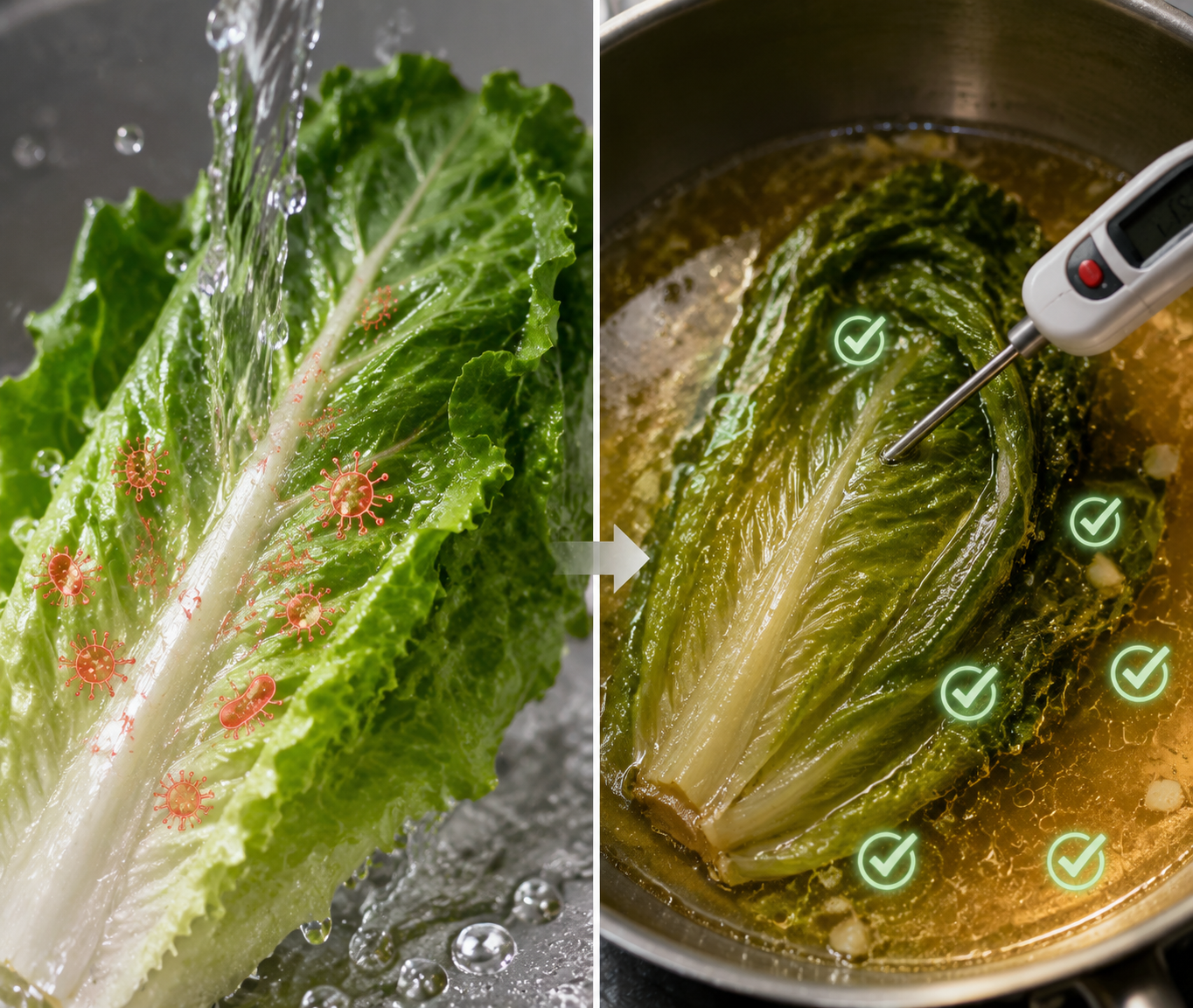
Why cooked lettuce belongs on the safe list
Raw lettuce is not automatically off the table for every older adult, but it is the weaker choice when you are feeding someone with a less resilient immune system. The CDC says nearly half of adults 65 and older with a lab-confirmed foodborne illness from Salmonella, Campylobacter, Listeria, or E. coli are hospitalized.[2] The FDA also notes that immune function declines with age, especially after 75, and that some medical conditions raise the stakes further; people on dialysis are 50 times more likely to get a Listeria infection than other healthy adults.[3]
That does not make lettuce the enemy. It makes heat useful. Cooking lettuce to 165°F gives the caregiver a real endpoint instead of a hope that rinsing was enough. E. coli O157:H7, Listeria monocytogenes, and Salmonella are the pathogens to keep in mind here; the practical defense is to get the lettuce hot all the way through, not merely limp around the edges.
The other benefit is texture. Cooked lettuce softens quickly, which can help when an older adult has dental problems, tires easily while chewing, or has swallowing difficulty. Crisp salad may be what they remember wanting. A tender lettuce side dish is not the same sensory experience, but it can keep leafy greens in the meal without asking a frail person to manage cold, fibrous leaves.
Washing helps, but it is not a kill step
Washing lettuce is still worth doing. It can reduce dirt and some surface contamination, and it is part of the safer workflow. But rinsing is not the same as cooking. Consumer Reports notes that washing can remove about 90% of surface microbes, while bacteria such as E. coli may survive if they have moved into leaf tissue.[5]
That is the annoying but important gap in a lot of produce advice. “Wash it well” sounds responsible, and it is better than doing nothing. It does not give you the same margin of safety as heat, especially when the person eating the lettuce is 82, recovering from illness, or already eating less than they used to.
Prewashed greens do not erase the problem either. If a product is labeled ready-to-eat, extra rinsing may not improve safety and can introduce new contamination from the sink, colander, hands, or counter. For a high-risk older adult, the cleaner decision is often to move away from raw salad altogether and cook the lettuce after sensible handling.
Start with lettuce that gives you fewer problems
If you are buying lettuce for an older adult, whole heads give you more control than loose mixed greens. Oregon State University Extension recommends cabbage and head lettuce as safer produce choices for at-risk people when the outer leaves are removed and the lettuce is washed well.[4] Consumer Reports makes a similar practical point: the inner leaves of a whole head are more protected than leaves that have already been cut and mixed.[5]
| Lettuce form | Caregiver judgment |
|---|---|
| Whole romaine hearts | Good choice for braising, grilling, or sautéing; remove damaged outer leaves and wash before cooking. |
| Butterhead or little gem | Tender and well suited to braising; watch closely because leaves soften fast. |
| Iceberg | Works for stir-frying or sautéing; the ribs may need extra time to heat through. |
| Bagged chopped salad greens | Convenient, but less ideal for a high-risk older adult if served raw; cooking is still the safer route. |
| Hydroponic or indoor-grown lettuce | Do not treat the growing method as a safety guarantee; use the same wash-and-cook standard. |
None of this requires boutique sourcing. The reliable habit is ordinary: buy lettuce that looks fresh, keep it cold, discard slimy or damaged leaves, wash whole leaves under running water, and cook them until the thickest part reaches 165°F.
A safer lettuce workflow for an older adult
- Choose a whole head, romaine heart, butterhead, little gem, or iceberg when possible.
- Remove damaged, wilted, or outer leaves, especially on head lettuce.
- Wash leaves under running water, then dry enough that they cook instead of splatter.
- Cook by braising, sautéing, stir-frying, or grilling.
- Check the thickest leaf rib or center wedge with a food thermometer; the target is 165°F.
- Serve tender pieces that match the older adult’s chewing and swallowing ability.
The thermometer is not fussiness. Lettuce can look wilted before the center has reached the temperature you need, especially when the leaves are folded, stacked, or cooked as wedges. For an older adult, “looks cooked” is not as useful as a number.
Braising is the easiest method to trust
Braising lettuce sounds odd only if salad is the only way you have seen lettuce used. In the pan, romaine, butterhead, and little gem soften into something closer to a warm vegetable side dish. A simple food-blog version cooks lettuce in chicken broth, which is useful proof that this is an edible, normal kitchen method, not a medical workaround.[6]
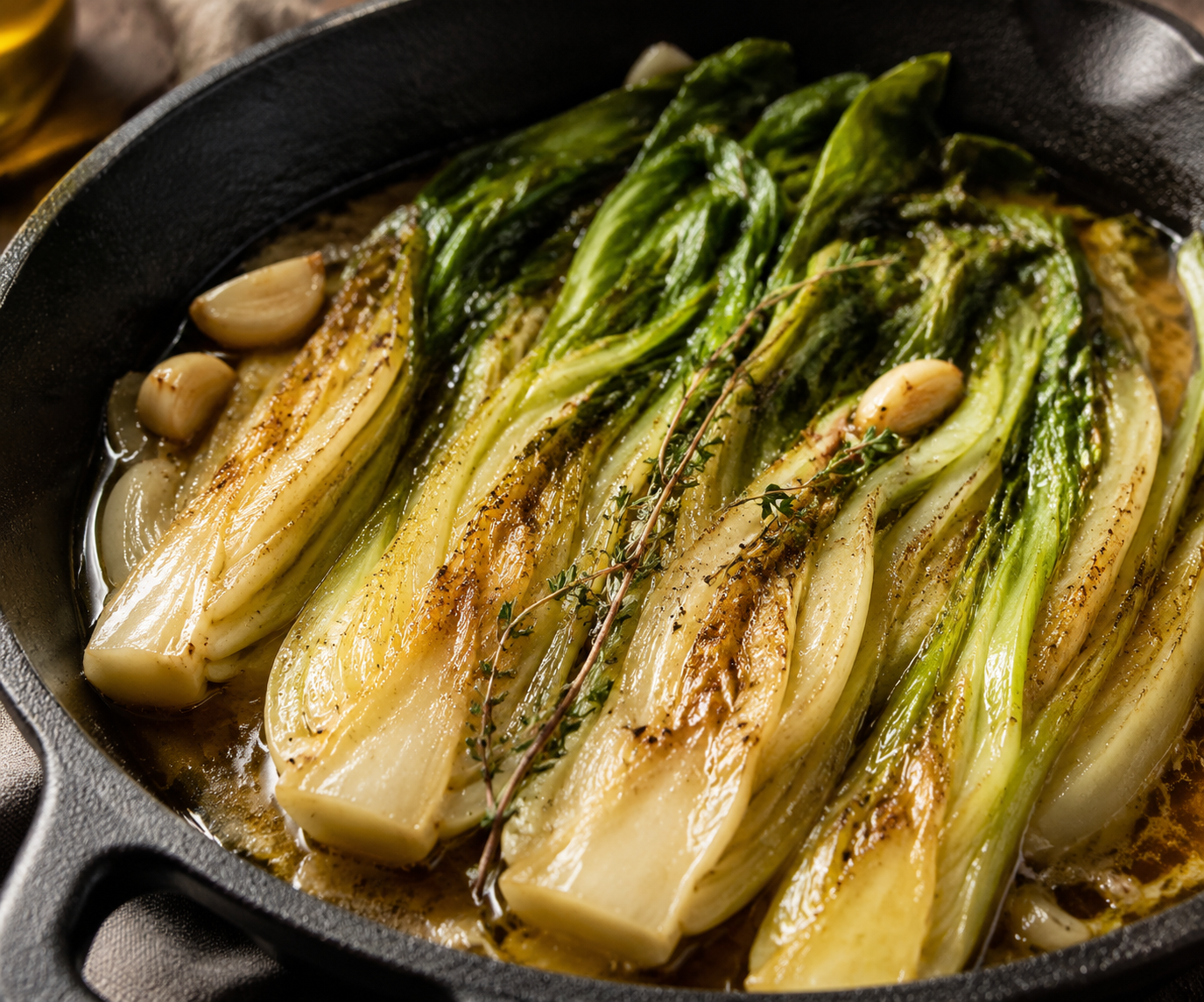
For a caregiver, braising has two advantages. First, simmering liquid surrounds the leaves more evenly than a dry pan does. Second, the finished lettuce is soft, which helps when chewing is tiring or dentures make raw salad unpleasant. It is not crisp. That is the trade. But it can be savory, mild, and easy to eat.
Cut romaine hearts lengthwise or separate softer leaves from a butterhead. Rinse, shake dry, and place the lettuce in a skillet with a shallow layer of broth or water. Add a little olive oil or butter if that fits the person’s diet. Cover the pan so steam reaches the folded parts. Turn once, then check the thickest rib or center with a thermometer. Stop when it reaches 165°F.
If swallowing is a concern, cut the cooked lettuce across the fibers before serving. Do not leave long slippery strips on the plate for someone who already coughs with thin liquids or struggles with mixed textures. Food safety and swallow safety are separate problems, and dinner has to satisfy both.
Sautéing, stir-frying, and grilling can work, with one caution
Sautéed lettuce is faster than braised lettuce. It works best with romaine or iceberg cut into manageable pieces, a hot pan, and enough movement that the leaves do not scorch before the ribs heat. Garlic, ginger, a small amount of oil, or low-sodium broth can make it taste intentional instead of like a rescued salad.
Stir-frying is similar but quicker and hotter. The risk is uneven cooking: thin leaf edges collapse almost immediately, while thicker ribs may lag behind. If you use this method for an older adult, cut pieces evenly, avoid crowding the pan, and check a thick piece rather than the limpest leaf.
Grilled romaine wedges can be pleasant, especially for someone who misses the shape of salad. They also create the easiest illusion of doneness. A charred outside does not prove that the inner rib reached 165°F. Grill cut-side down, turn, cover briefly if needed, and check near the base where the wedge is thickest.
| Method | Best use | What to watch |
|---|---|---|
| Braising | Romaine, butterhead, little gem; soft side dish | Use enough liquid and time for the center rib to reach 165°F. |
| Sautéing | Chopped romaine or iceberg | Edges wilt quickly; thick ribs still need a thermometer check. |
| Stir-frying | Small, even pieces | High heat can cook unevenly if the pan is crowded. |
| Grilling | Romaine wedges | Char is not a temperature reading; check the wedge center. |
What to do when there is a recall
If lettuce in your refrigerator is part of an active recall, do not try to save it by washing or cooking it. Follow the recall instructions and throw it out. Cooking is a safer routine for lettuce you have reason to use; it is not a reason to keep a product that public health officials have told consumers to discard.
For lettuce that is not recalled, the calmer routine is this: choose a whole head when you can, remove outer leaves, wash, cook, check 165°F, and serve in a texture the person can manage. That is more dependable than standing at the sink trying to decide whether another rinse has made raw lettuce safe enough.
The practical answer
Safe lettuce options for elderly parents do not have to mean no lettuce. They do mean treating lettuce like a vegetable that can be cooked, not a salad ingredient that must stay raw. Braised romaine, sautéed iceberg, stir-fried lettuce, or grilled romaine can all belong in the meal rotation when the lettuce is washed first and cooked all the way to 165°F.
For a healthy younger adult, a raw salad may be an ordinary risk. For an older parent, especially one past 75 or living with serious medical issues, the safer standard is stricter. The endpoint is not wilted leaves, a nicer brand, or a promise on the package. It is the thermometer reading.
References
- Safer Food Choices for Adults 65 and Older — CDC
- People at Increased Risk for Food Poisoning — CDC
- Food Safety for Older Adults and People with Cancer, Diabetes, HIV/AIDS, Organ Transplants, and Autoimmune Diseases — FDA
- Food Safety Tips for At-Risk Populations — Oregon State University Extension
- Your Guide to Safer Lettuce — Consumer Reports
- Cooked Lettuce in Chicken Broth — Brooklyn Farm Girl
Questions to bring to a clinician or OT
This is not medical, legal, or a family's final decision — only a framework. Bring these questions to a clinician, occupational therapist, or your local Area Agency on Aging.
Find Local HelpRelated reading
Noticed something outdated or inaccurate on this page? Flag a correction. We review every report against CDC, NIA, and AARP HomeFit guidance before updating a page.