
Caregiver decision guide
A Complete Guide to Flying to Honolulu With a Senior Parent
This guide walks caregivers through every step of flying to Honolulu with a senior parent — from medical clearance and TSA pre-planning to in-flight DVT prevention and accessible ground transportation at HNL. Learn what to prepare, what to pack, and how to navigate the airport for a safe and manageable trip.
Honolulu is not one travel task when you are flying with an older parent. It is a chain of handoffs: the doctor who clears the trip, the airline that records the wheelchair request, TSA staff at security, the gate agent who tags mobility equipment, the flight crew managing a long cabin stretch, the Daniel K. Inouye International Airport arrival path, the driver at the curb, and the hotel desk at the end of it all.
The best travel tips for seniors flying to Honolulu are the ones that protect the weak points in that chain. A beautiful trip can still be a hard trip: mainland-to-Hawaii flights commonly run about 5 hours from the West Coast and about 10 to 11 hours from the East Coast, which changes medication timing, dehydration risk, meal planning, and how often your parent needs to move. The goal is not to make the trip feel clinical. It is to keep one preventable problem from cascading into five.
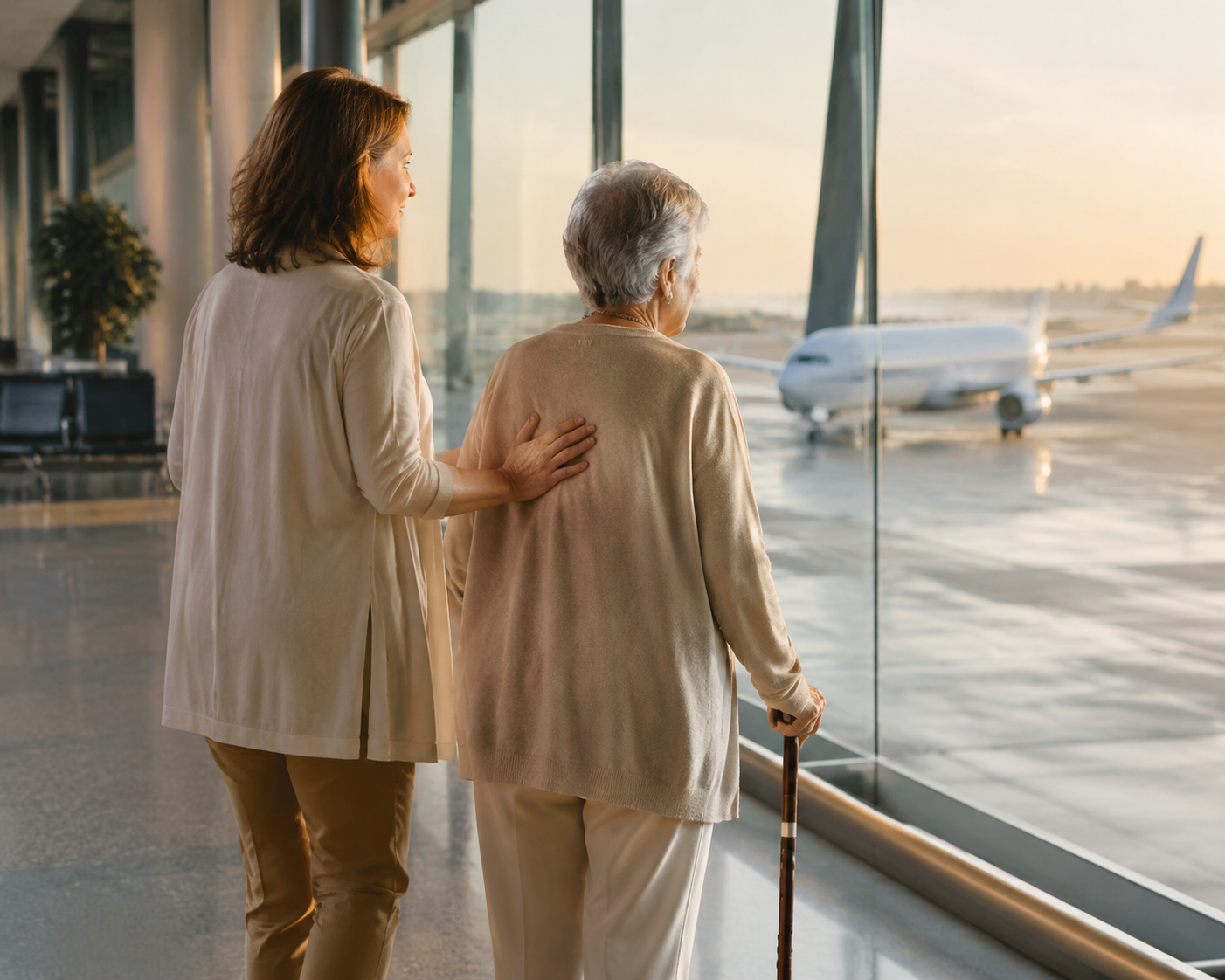
The Whole Trip, in the Order It Actually Fails
Before getting into the details, put the trip on one timeline. This is the version that belongs on the refrigerator, in a shared family note, or in whatever document the sibling who “will help with anything” can actually see.
| When | What to Handle | Why It Matters |
|---|---|---|
| 4–6 weeks before departure | Doctor clearance, medication review, documentation pack, mobility needs | This is where you learn whether the flight is safe and what accommodations are nonnegotiable. |
| When booking or soon after | Airline wheelchair assistance, seating, layover length, mobility equipment details | Airports can be long, rushed, and inconsistent; the request needs to be in the reservation. |
| At least 72 hours before departure | Call TSA Cares if your parent needs help through screening | Security is easier when support is arranged before the line starts moving. |
| The week of travel | Confirm medications, carry-on packing, transportation, hotel accessibility, HNL arrival plan | This is where small missing details become airport delays. |
| Day of departure | Arrive early, use wheelchair assistance, keep medications with you, protect mobility devices | The caregiver’s job is to slow the system down enough to keep your parent safe. |
| During the flight | Hydration, movement, compression socks if advised, medication timing, rest | The length of a Honolulu flight makes circulation and comfort part of the plan. |
| At HNL arrival | Bathroom stop, equipment check, curbside pickup, accessible transport, hotel check-in | The first hour after landing is when fatigue, heat, luggage, and transportation all collide. |
Start With the Doctor, Not the Suitcase
AARP recommends planning a trip with an older parent by starting 4 to 6 weeks ahead with medical clearance, a medication inventory, and a documentation pack.[1] That timing is not overly cautious for Honolulu. It gives you enough room to adjust prescriptions, ask about compression socks, request written instructions, and rethink flight times before everything is locked.
At the appointment, do not ask only, “Can Mom fly?” Ask the questions that match the trip:
- Is a nonstop flight preferable, or would a break help more than it hurts?
- Should she wear compression socks, and are there any conditions that make them inappropriate?
- How should blood-pressure, diabetes, heart, pain, or sleep medications be timed across time zones?
- What symptoms during travel mean “get medical help now” rather than “rest at the hotel”?
- Does she need a letter for medical devices, injectable medications, oxygen, implants, or other screening issues?
- How much walking is reasonable between airport wheelchair transfers, bathrooms, boarding, and arrival?
This is also the moment to be honest about the parent who says “I’m fine” because they do not want to be a burden. A 10-minute grocery store walk is not the same as a departure terminal, a security line, a jet bridge, a long flight, baggage claim, humid air, and hotel check-in. If your parent uses a cane only “sometimes,” ask what happens after a full day of transfers.
Build a documentation pack after the appointment. Keep it in your carry-on, not in checked luggage. Include a current medication list with dosages, pharmacy information, physician contacts, insurance cards, emergency contacts, copies of key documents, and any medical letters. If several siblings are involved, send them a copy. The person meeting you at the hotel should not be the only one who knows where the medication list is.
Book the Flight Around Stamina, Not Just Price
For a senior parent, the cheapest Honolulu itinerary can become expensive in effort. A tight connection may look efficient until wheelchair assistance is delayed. A red-eye may save a hotel night and cost two days of recovery. A long layover may be restful for one parent and exhausting for another.
When choosing the flight, look first at total physical demand. Nonstop flights reduce handoffs, but they also mean a longer single stretch in the cabin. Connecting flights break up sitting time, but they add another airport, another wheelchair transfer, another restroom search, and another chance for a delay. There is no universal answer; the right itinerary is the one that best matches your parent’s circulation risk, bladder needs, pain level, cognition, and ability to tolerate disruption.
Once you book, add accessibility requests immediately. Do not wait until check-in. Tell the airline whether your parent can walk short distances, climb aircraft stairs, transfer into an aisle chair, or needs wheelchair assistance from curb to gate. If your parent travels with a personal wheelchair or scooter, give the airline the dimensions, weight, battery type if applicable, and any handling instructions.
Seat choice deserves more attention than it usually gets. An aisle seat may make bathroom trips and movement easier, but it may also expose a frail shoulder or knee to cart bumps. A bulkhead may offer more room on some aircraft but can limit under-seat access to medication and supplies during takeoff and landing. If your parent needs frequent access to a bag, plan exactly where that bag will go and who can reach it.
Make the Carry-On the Medical Bag
Checked luggage is for clothes. The carry-on is for anything that would turn a delay into a health problem. NCOA advises older travelers to manage medications carefully when crossing time zones and to keep medications accessible during travel.[5] For Honolulu, that means packing as if you might be separated from checked bags until late that night.
- All prescription medications in original containers when practical, plus an updated medication list
- A full travel day’s extra medication supply, in case of delays
- Glasses, hearing aids, chargers, mobility-device chargers, and spare batteries where allowed
- Snacks that match medical needs, such as low-sugar or low-sodium options if advised
- A refillable water bottle to fill after security
- A light layer, because aircraft cabins can be cold even when Honolulu is not
- A change of clothes and basic hygiene supplies for both parent and caregiver
If your parent takes medications at strict times, write the schedule in both home time and Hawaii time before the travel day. Do not rely on doing time-zone math while standing at a gate with boarding announcements playing over each other. A simple written schedule prevents the familiar argument over whether the morning pill was already taken.
Call TSA Cares Before the Security Line Starts Moving
TSA says passengers age 75 and older may keep shoes and light jackets on during screening, and passengers who cannot stand may request seated screening.[2] Those two details matter because security lines are where dignity can get thin fast: shoes half-off, bins moving, a parent trying to stand longer than they safely can, and a caregiver trying to watch both the person and the bags.
If your parent has mobility, medical, sensory, or cognitive needs, call TSA Cares at 855-787-2227 at least 72 hours before travel to request assistance through the screening process.[2] Put the call on the calendar. Do not leave it as one more thing to remember “after work.”
When you call, be specific. Say whether your parent uses a cane, walker, wheelchair, implanted device, insulin, ostomy supplies, joint replacement, hearing aids, or has difficulty standing, following rapid instructions, or being separated from a caregiver. Ask where to go when you arrive at the airport and what to do if the arranged support is not immediately visible.
On the travel day, tell the TSA officer early if your parent needs seated screening or cannot lift arms, remove shoes, or stand steadily. This is not asking for special treatment. It is preventing a fall in a place designed for speed.
Protect the Wheelchair or Walker Like It Is the Trip
If your parent depends on a wheelchair, scooter, walker, or rollator, treat that equipment as medical infrastructure, not luggage. Civil Beat reported in July 2026, citing national Department of Transportation data, that airlines damage roughly 1 in 100 wheelchairs they handle nationally.[3] That figure is not a prediction for your specific mainland-to-Honolulu flight, but it is enough reason to document the device before it leaves your hands.
Before gate-checking a wheelchair or mobility device, take clear photos from multiple angles. Photograph existing scratches, wheels, brakes, joystick controls, footrests, battery labels if applicable, and any custom parts. Keep the airline’s claim information and baggage tag in the same folder as your boarding passes. If something is damaged at arrival, report it before leaving the airport if possible.
For walkers and canes, add a name label and phone number. If a device folds, practice folding and unfolding it before the trip so you are not learning under boarding pressure. If your parent can walk only short distances, do not surrender the device too early unless an airport wheelchair is already there and your parent is safely seated.
The Departure Airport: Slow the System Down
Arrive earlier than you would for yourself. Not because older travelers are difficult, but because every transfer takes time when it is done safely. The curb-to-gate path may include unloading, finding wheelchair assistance, checking bags, security, bathroom stops, food, medication timing, and boarding. If the wheelchair attendant is late, the airline counter line is long, or your parent needs a restroom before security, a thin schedule becomes a problem.
At the airline counter, confirm the wheelchair request out loud. Ask whether the assistance is curb-to-gate, gate-to-aircraft-door, or includes an aisle chair if needed. If you have a connection, confirm the request for every airport in the itinerary, not just the first departure. If your parent needs preboarding, ask how the gate agent will handle it.
The caregiver’s airport bag should be boring and visible: documents, medications, water bottle, snacks, light layer, phone chargers, and the medical plan. Keep it under your control. If another family member wants to help, give them a task that can be done without losing the bag: stand in the food line, check the gate board, or ask the agent when preboarding begins.
During the Flight to Honolulu
A Honolulu flight is long enough that “sit tight and we’ll be there soon” is not a plan. NCOA recommends that older adults reduce deep vein thrombosis risk on long flights by staying hydrated, doing leg exercises, wearing compression socks when appropriate, and walking the aisle about once an hour when it is safe to do so.[5] The doctor’s advice should decide what is appropriate for your parent, especially if they have heart, vascular, kidney, or mobility issues.
The practical version is simple. Fill water after security. Offer small amounts regularly instead of waiting until your parent feels thirsty. Encourage ankle circles, heel raises, and gentle leg movement while seated. If the seatbelt sign is off and your parent can walk safely, take short aisle walks with them rather than sending them alone. If walking is not safe, ask the clinician ahead of time what seated movement is acceptable.
Cabin air can be drying, and NCOA specifically notes that low cabin humidity can contribute to dehydration and discomfort for older adults.[5] Dry eyes, dry mouth, headache, dizziness, or unusual confusion deserve attention, not a cheerful “almost there.” Alcohol and heavy caffeine can make hydration harder for some travelers; follow your parent’s medical guidance.
Medication timing is the other flight-length problem. If your parent normally takes medicine with food, do not assume the airline meal schedule will match. Pack acceptable snacks. If medication causes frequent urination, dizziness, drowsiness, or low blood sugar, plan bathroom access and monitoring around that, especially on an overnight or East Coast itinerary.
Landing at HNL: Do Not Rush the First Hour
Daniel K. Inouye International Airport is workable for travelers with disabilities, but it is still a major airport with multiple terminals and a lot happening at once. The official airport accessibility page lists services for persons with disabilities, including accessible curbside loading zones, elevators, family restrooms with adult changing tables, and a 24-hour medical clinic in the main terminal garden court area.[4] That is useful information only if you know it before you are standing there tired.
According to HNL’s official accessibility information, accessible curbside loading zones are distributed by terminal: 2 zones at Terminal 1, 7 zones at Terminal 2, and 1 zone at Terminal 3.[4] Most mainland arrivals use the larger terminal areas, but do not rely on memory or guesswork. Check your airline’s arrival terminal, then identify the closest accessible pickup area before the plane lands.
The first HNL sequence should be slow and boring: wait for wheelchair assistance if requested, use the restroom before baggage claim or before leaving the secure area when practical, check the mobility device, collect bags, confirm the driver or transport location, then go to the curb. If your parent insists they can walk because they are excited to be in Hawaii, remember that the hotel check-in line still exists.
Family restrooms matter here. They give a caregiver room to assist without forcing an older parent into a public stall that was not designed for a cane, walker, travel bag, and another adult. HNL’s accessibility page notes family restrooms with adult changing tables, so mark their locations in advance if toileting, incontinence care, transfers, or clothing changes are part of your parent’s travel reality.[4]
Getting From HNL to Waikiki or Your Lodging
Ground transportation is where a lot of well-planned trips get messy. Everyone is tired, phones are low, baggage is awkward, and the curb is not a calm place to compare options. Decide before landing how your parent will get from HNL to the hotel, and write down the backup.
Current provider information identifies Roberts Hawaii Express Shuttle at 808-439-8800 as an on-demand accessible door-to-door option from HNL with portable ramps, and AMPCO Express accessible taxis at 808-831-2023 as lift-equipped taxis bookable in advance. If your parent uses a wheelchair or cannot climb easily into a standard vehicle, confirm accessible transportation before the trip. Because transportation availability and phone numbers can change, verify these directly with the provider and with HNL’s current ground transportation information before travel.
TheBus may be useful for some older adults once they are settled, but it is not automatically the best first ride after a long flight. Honolulu’s Department of Transportation Services lists the senior fare at $1.25 per ride with 2.5 hours of unlimited transfers for riders 65 and older with valid ID or a Senior HOLO Card.[6] That is helpful for a rested traveler with light bags and good mobility. It is less helpful if you are managing luggage, a walker, medications, and a parent who has been awake since 4 a.m.
For most caregiver-managed arrivals, the cleanest plan is door-to-door transport to the hotel or lodging. Before the trip, ask the hotel where accessible vehicles should unload, whether there are steps at the entrance, how far the lobby is from the curb, and whether early check-in or luggage hold is available. A hotel that says “we are accessible” should still be able to answer concrete questions about ramps, elevators, shower setup, bed height, and distance from drop-off to room.
Honolulu Heat, Humidity, and the First Day
The climate shift can catch people after the logistics are technically over. Hawaii Guide estimates that ultraviolet exposure at Hawaii’s tropical latitude can be 20% to 30% stronger than on the mainland, though that figure should be checked against primary public-health sources when making medical decisions.[7] The safer practical assumption is modest: older skin and eyes need sun protection immediately, not after the first beach walk.
Humidity can also make breathing, cooling down, and post-flight fatigue harder for some older adults. Build the first Honolulu day around recovery: water, shade, food, medication timing, a shower if safe, and rest. If the room is not ready, find a seated, air-conditioned place rather than trying to “use the time” with a scenic walk.
A gentle first day is not a wasted day. It is what lets the rest of the trip happen. The win is not how quickly you reach Waikiki Beach after landing; it is having enough energy left to enjoy being there.
A Caregiver’s Final Pass Before Departure
A few days before travel, do one final pass through the chain. Not to control every minute, but to make sure no critical handoff depends on hope.
- Doctor clearance completed, with medication and symptom guidance written down
- Airline wheelchair assistance confirmed for departure, connection if any, arrival, and return
- TSA Cares called at least 72 hours before departure if screening support is needed
- All medications, documents, medical devices, chargers, snacks, and hydration plan kept in carry-on
- Mobility equipment photographed, labeled, and described in the airline reservation when required
- HNL arrival terminal, family restroom options, accessible curbside zone, and transport plan identified
- Hotel accessibility, drop-off point, room needs, and first-day rest plan confirmed
After that, let the plan do its job. The point is not to turn Honolulu into a medical evacuation drill. It is to remove the avoidable pressure from the moments that are already hard: the long walk, the rushed screening, the missing wheelchair, the dry cabin, the crowded curb, the parent who says they are fine because they do not want to slow anyone down.
Once you reach the hotel, stop managing the whole vacation for a while. Account for the medications. Check the mobility device. Get water. Let your parent sit down. The first stable hour on the ground is enough of an achievement.
References
- 8 Steps to Planning a Successful Trip With Your Older Parent, AARP
- Screening for Passengers 75 and Older, Transportation Security Administration
- For Hawaiʻi Wheelchair Users, Air Travel Means Risking Mobility, Civil Beat, July 2026
- Persons With Disabilities, Daniel K. Inouye International Airport
- How to Travel Safely as an Older Adult, National Council on Aging
- Fares — Senior, Honolulu Department of Transportation Services
- Hawaiʻi for Seniors: Accessibility Tips and Low-Impact Activities, Hawaii Guide, 2026
Questions to bring to a clinician or OT
This is not medical, legal, or a family's final decision — only a framework. Bring these questions to a clinician, occupational therapist, or your local Area Agency on Aging.
Find Local HelpRelated reading
Noticed something outdated or inaccurate on this page? Flag a correction. We review every report against CDC, NIA, and AARP HomeFit guidance before updating a page.