
Caregiver decision guide
Garmin Cirqa arrives at $200 — but lacks fall detection for seniors
Learn the Garmin Cirqa price and release date, and discover whether screenless health monitoring bands like it, the Fitbit Air, and Whoop 5.0 are suitable for senior safety — and why the lack of automatic fall detection is a critical decision factor.
Garmin Cirqa costs $199.99, was announced July 21, 2026, and is scheduled to be available July 24 through Garmin.com.[1] For families searching “Garmin Cirqa price and release date for seniors,” those are the easy facts. The harder question is whether a screenless band can replace a safety device for an older adult.
It should not be treated that way. Cirqa does not provide passive automatic fall detection for everyday wear. Garmin’s incident detection is tied to supported GPS-tracked activities rather than quiet daily use around the house, where many family safety worries actually live.[3] Fitbit Air and Whoop 5.0 also lack passive fall detection as of mid-2026.[4][2] That one missing feature changes the whole decision.
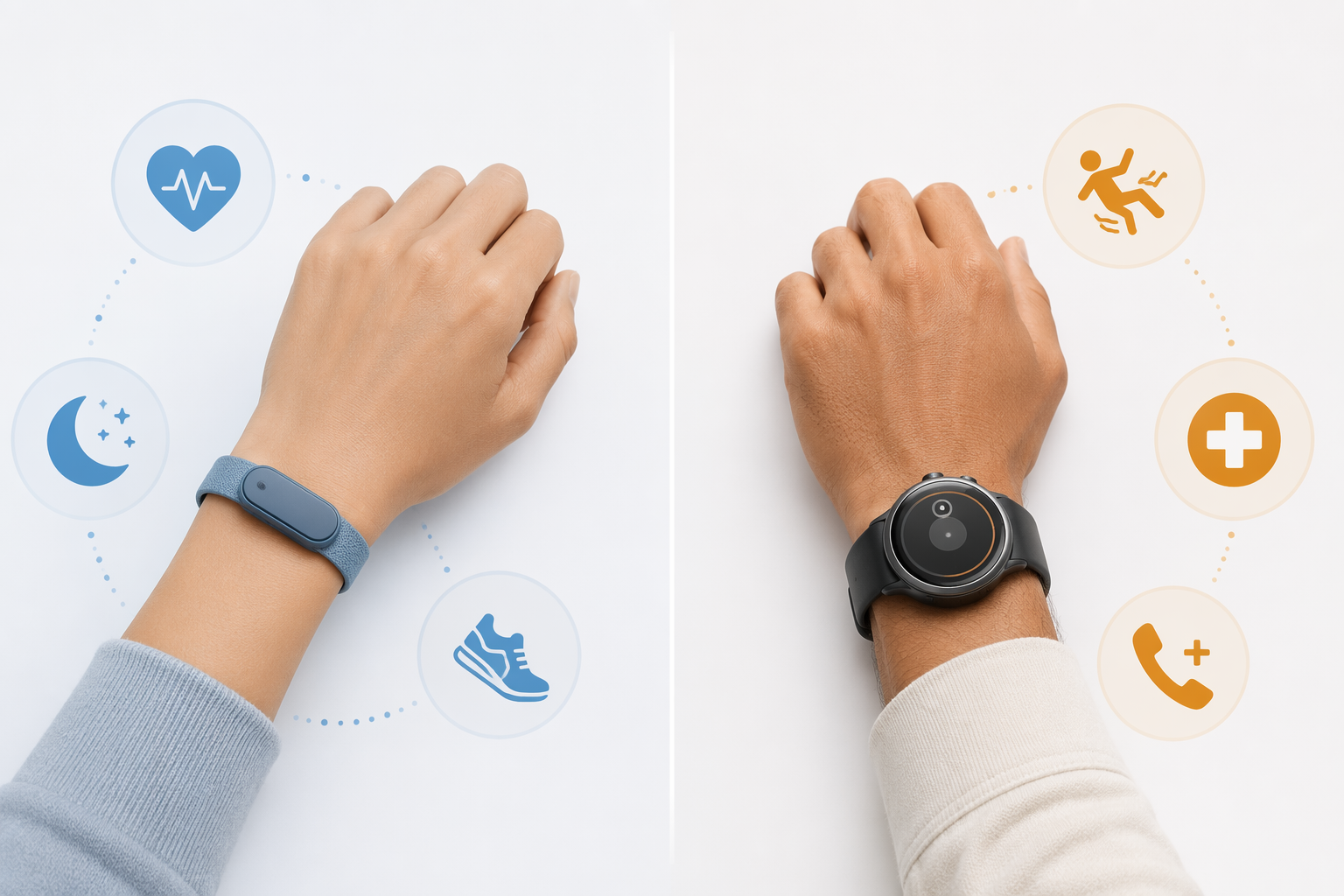
What Cirqa gets right for older adults
No source has reviewed Garmin Cirqa specifically as a senior device. The senior-use case has to be judged from the features Garmin has disclosed, early hands-on coverage, and how those features compare with medical-alert needs. That matters because a device can be considerate without being protective enough.
On the considerate side, Cirqa has several details that are easy to respect. It has no screen to wake, swipe, dismiss, or misread. It uses a fabric Velcro-style band in S/M and L/XL sizes, has a single physical side button, and can be worn on the wrist or upper arm with a $59.99 armband accessory.[2] For someone with stiff fingers, tremor, arthritis, or plain dislike of tiny watch menus, those are not cosmetic details. They are the difference between wearing the thing and leaving it on the dresser.
The battery life is another practical point. Garmin lists up to 10 days for Cirqa, compared with 7 days for Fitbit Air and 4–5 days for Whoop 5.0.[1][4][2] A longer battery does not make a device safer in an emergency, but it does reduce the number of charging reminders, missed nights, and “Mom, did you put it back on?” phone calls. In family caregiving, that kind of friction has a cost even when it never appears on a spec sheet.
Cirqa is also rated 5ATM, making it suitable for showering and pool use under Garmin’s stated water-resistance category.[1] That is useful for older adults who may not remember to remove a band before bathing, or who should not be fussing with a clasp on a wet bathroom floor.
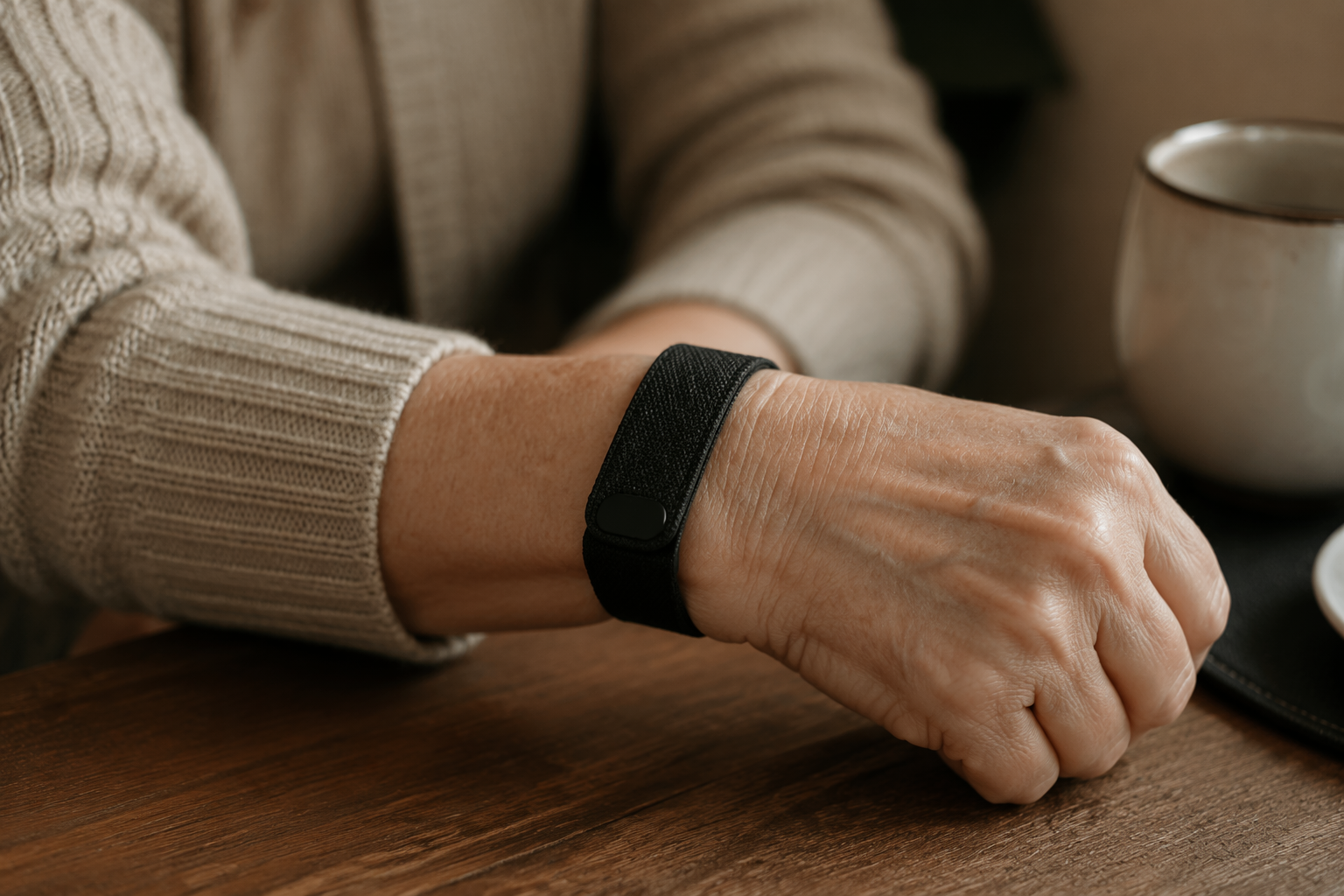
Wellness awareness is not emergency protection
Cirqa can still be useful. Garmin says it tracks health and fitness metrics through Garmin Connect, and hands-on coverage notes that it does not require a mandatory subscription.[1][2] For a generally healthy older adult who wants sleep visibility, activity tracking, and fewer screen distractions, that may be enough. A family member could notice that walking has dropped, sleep is poor, or resting heart rate looks unusual, then use that as a reason to check in.
Garmin also offers features that can matter to caregivers, including LiveTrack location sharing, abnormal heart-rate alerts, and sleep score visibility through the Garmin Connect app.[1][2] Those features can support a lighter-touch arrangement: the older adult keeps privacy and independence most of the time, while the family has some signals to discuss if patterns change.
But the signals are not the same as a help button backed by emergency response, and they are not the same as automatic fall detection. If an older adult falls in a hallway, becomes confused, or cannot reach a phone, a wellness trend from last night’s sleep score does not solve the immediate problem. That is the line families should draw before they get charmed by the quiet design.
Garmin’s own boundary is explicit: “This device is not a medical device and is not intended for use in the diagnosis or monitoring of any medical condition.”[1] That language should not be buried in the fine print when the buyer is thinking about an older parent with real health risks.
The missing features are not small
Across Cirqa, Fitbit Air, and Whoop 5.0, the senior-safety gaps are similar: no passive fall detection, no ECG, no Afib detection, no professional emergency monitoring, and no medical-device positioning.[1][4][2] Some of those omissions may be acceptable for fitness or wellness tracking. They are harder to accept if the purchase is meant to reduce the risk of an older adult being alone and unable to call for help.
Fall detection deserves special caution because even devices that do offer it are not perfect. The National Council on Aging notes that Apple Watch fall detection may miss softer fall patterns that are common among older adults.[5] So the issue is not that Cirqa lacks a flawless feature. The issue is that it lacks the feature category families usually mean when they ask whether a device can help after a fall.
The cost comparison only makes sense if the job is the same
At checkout, Garmin Cirqa looks straightforward: $199.99, with no mandatory subscription.[1][2] Garmin Connect+ is optional at $69.99 per year, and the available information does not suggest that it adds anything essential for basic senior wellness use.[2] For a family already managing pharmacy refills, appointment portals, and subscription creep, one-and-done pricing is a real advantage.
Fitbit Air is cheaper upfront at $99, with optional Fitbit Premium at $99 per year.[4] Whoop 5.0 flips the model: the hardware is free, but the subscription costs $199–$359 per year, which makes the three-year total $597–$1,077.[2] That does not automatically make one better than another. It means the family has to count the cost in the same time frame they will actually live with the device.
| Device type | Upfront cost | Ongoing cost | Three-year cost context | Passive fall detection |
|---|---|---|---|---|
| Garmin Cirqa | $199.99 | No mandatory subscription; optional Connect+ at $69.99/year | $199.99 before optional services or accessories | No |
| Fitbit Air | $99 | Optional Fitbit Premium at $99/year | $99 before optional Premium | No |
| Whoop 5.0 | Free hardware | $199–$359/year | $597–$1,077 | No |
| Medical alert watches | $199–$299 equipment fees | $38.95–$84.95/month, plus about $10/month extra for fall detection | About $1,401–$3,057 | Often available, depending on plan/device |
Medical alert watches look expensive beside screenless wellness bands. NCOA’s 2026 medical alert watch baseline lists $38.95–$84.95 per month, about $10 per month extra for fall detection, and $199–$299 in upfront equipment fees; over three years, that works out to roughly $1,401–$3,057.[5] That higher cost is not just a markup for a fancier wearable. It pays for a different promise: emergency-oriented monitoring, alert workflows, and safety functions that wellness bands do not claim to provide.
That is why “cheapest” is the wrong finish line. If the older adult wants activity and sleep awareness without a watch screen, Cirqa’s price and battery life are attractive. If the family is trying to cover a serious fall risk, the lower price is only lower because the device is not doing the emergency job.
Where screenless bands fit for seniors
A screenless band can make sense for an older adult who is mobile, generally healthy, comfortable wearing a simple band, and interested in wellness patterns rather than emergency coverage. It may be especially appealing when a smartwatch has already failed for ordinary reasons: too many notifications, too much charging, too much tapping, or too much feeling watched.
Cirqa’s strongest senior-friendly qualities are the ones that reduce maintenance: no screen, a fabric Velcro-style band, a single side button, 10-day battery life, 5ATM water resistance, and no required subscription.[1][2] Those features can help a device stay on the body, and staying on the body is the first hurdle for any wearable.
The fit changes when the older adult has a history of falls, uses mobility aids, lives alone with known safety concerns, has episodes of dizziness or fainting, needs arrhythmia monitoring, or would need someone outside the family to respond quickly in an emergency. In those situations, the relevant comparison is not Cirqa versus Fitbit Air versus Whoop. It is a wellness band versus a dedicated medical alert system.
Early hands-on impressions also do not prove accuracy for older adults. Cirqa had only just been announced at the time of the initial reviews, and there is no senior-specific testing showing how well its heart-rate, sleep, or activity estimates perform for older users with different skin, gait, medication, or circulation patterns.[2] That does not make the product suspect. It means families should not treat first-impression comfort as clinical confidence.
The practical decision
Garmin Cirqa is priced at $199.99 and arrives July 24, 2026, with a design that may be easier for some seniors to tolerate than a smartwatch.[1] That is genuinely useful for wellness awareness. It is not enough for primary senior safety.
- Consider Cirqa or another screenless band if the goal is low-friction sleep, activity, and heart-rate awareness for a generally healthy older adult.
- Do not rely on Cirqa, Fitbit Air, or Whoop 5.0 as the main device for fall-risk coverage, because none provides passive everyday fall detection as of mid-2026.
- Look at dedicated medical alert systems when the need includes fall detection, emergency response, or a clearer safety workflow.
- Treat any wellness data as a prompt for conversation, not as diagnosis or medical monitoring.
Cirqa may be a useful wellness band for some seniors. It should not be treated as a primary senior safety device.
References
- Meet Cirqa Smart Band, the Screen-Free Health and Fitness Tracker from Garmin, Garmin, July 21, 2026.
- Garmin Cirqa: Everything You Need to Know, DC Rainmaker.
- Incident Detection, Garmin Support.
- Garmin Cirqa vs Fitbit Air, Gadgets & Wearables.
- Best Medical Alert Watches 2026, National Council on Aging, 2026.
Questions to bring to a clinician or OT
This is not medical, legal, or a family's final decision — only a framework. Bring these questions to a clinician, occupational therapist, or your local Area Agency on Aging.
Find Local HelpRelated reading
Noticed something outdated or inaccurate on this page? Flag a correction. We review every report against CDC, NIA, and AARP HomeFit guidance before updating a page.