
Caregiver decision guide
GPS Tracker Features That Actually Matter for Dementia: A Decision Framework for Caregivers
There is no single 'best' GPS tracker for dementia. This guide provides a product-neutral, feature-dimension framework to help family caregivers match device categories to their loved one's specific dementia stage, wandering behavior, and willingness to wear a device.
Why the 'Best' GPS Tracker Doesn't Exist for Dementia Wandering
If you have searched for a GPS tracker for a loved one with dementia, you have likely encountered lists of "best" devices, comparison charts, and affiliate-linked reviews. These lists create the impression that one tracker is objectively superior to all others. That framing is not just unhelpful — it is actively misleading for dementia care.
The reality is that a tracker that works well for an early-stage senior who carries a smartphone will fail completely for a middle-stage senior who removes anything around their wrist. A device with excellent outdoor GPS accuracy may be nearly useless for someone living in a dense urban apartment building. The right choice depends entirely on the match between the device's feature profile and the senior's specific dementia stage, wandering behavior, living situation, and willingness to wear a device.
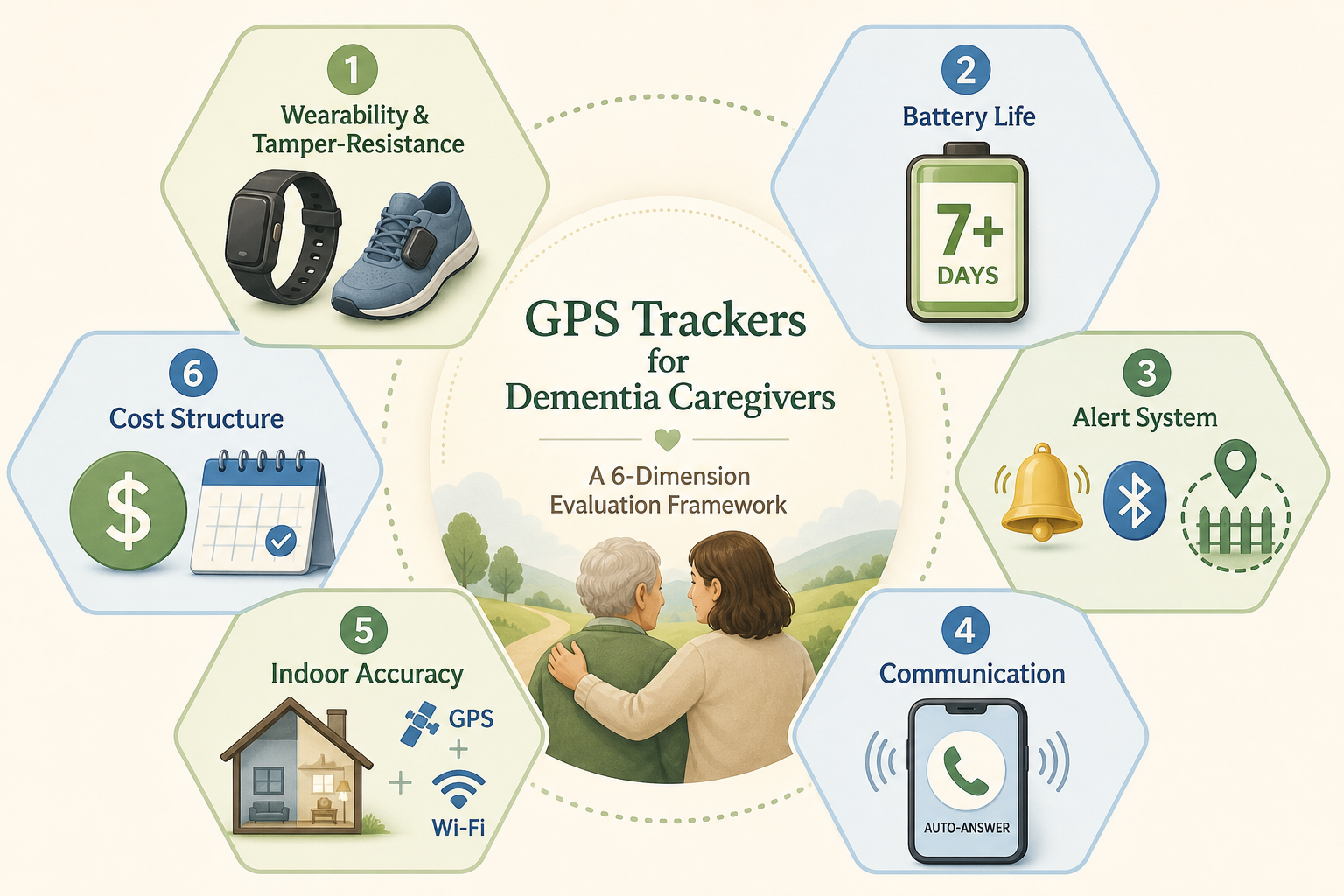
This article provides a structured, product-neutral decision framework built around six evaluation dimensions. It is designed for family caregivers who have already decided to explore GPS tracking and need a way to evaluate options without being swayed by marketing claims or brand rankings. The framework is grounded in published research, including a 2024 feasibility study by Doyle et al. involving 45 wearer-caregiver dyads, and device specifications compiled by the University of Waterloo's Aging and Innovation Research Program.
Step 1: Match the Tracker to the Senior's Dementia Profile
Before evaluating any device features, you need to identify where your loved one falls on the dementia progression spectrum. The Alzheimer's Association reports that six in 10 people living with dementia will wander at least once, and many do so repeatedly. But the way someone wanders — and their ability to interact with a device — changes significantly as the disease progresses.
The table below maps three common dementia profiles to the device categories most likely to succeed. This is the starting point for your decision.
| Profile | Typical Characteristics | Wandering Pattern | Recommended Device Category |
|---|---|---|---|
| Early Stage | Still oriented to time and place; may carry a smartphone; can follow multi-step instructions; often aware of their diagnosis | Occasional disorientation on familiar routes; may return from walks later than usual; can still use a phone to call for help | Smartphone app with GPS sharing; pendant or keyring tracker; standard watch-style tracker |
| Middle Stage | Frequent confusion; may remove watches, jewelry, or clothing items; sundowning common; difficulty learning new devices | Purposeful wandering with no clear destination; may leave home at any hour; often cannot describe where they are going | Locking watch strap; clothing clip (difficult to remove); tracker sewn into a jacket or shoe |
| Advanced Stage | Limited communication; may not understand what a device is for; often non-ambulatory or requires close supervision | Wandering may be less purposeful but still possible; risk of leaving home unnoticed during caregiver brief absence | Hidden insole tracker; device sewn into clothing; non-interactive pendant worn under clothing |
Questions to bring to a clinician or OT
This is not medical, legal, or a family's final decision — only a framework. Bring these questions to a clinician, occupational therapist, or your local Area Agency on Aging.
Find Local HelpRelated reading
Noticed something outdated or inaccurate on this page? Flag a correction. We review every report against CDC, NIA, and AARP HomeFit guidance before updating a page.