
Caregiver decision guide
How to Protect Your Aging Parent from Legionnaires' Disease Outbreaks
Learn why seniors face a greater risk from Legionnaires' disease outbreaks, how to recognize the often-atypical symptoms in older adults, and practical steps to reduce exposure at home and in senior living facilities.
If you just saw a headline about a Legionnaires’ disease outbreak and your parent is older, the calm answer is: yes, pay attention. Not panic. Not bleach-the-house panic. But this is one of those infections where age changes the math, and where waiting for a “classic” cough can be a dangerous delay.
The reason is blunt. The World Health Organization reports that 75% to 80% of Legionnaires’ disease cases occur in people age 50 and older, and the CDC says about 1 in 10 people who get Legionnaires’ disease die; for healthcare-associated cases, that rises to about 1 in 4. [1][2]
A Mayo Clinic study of 344 adults treated from 2019 through 2025 found a median patient age of 66.6 years and a 30-day death rate of 11.9%. That study came from one health system, so it should not be treated as a national rule, but it does match the larger pattern caregivers need to respect: older adults and people with underlying illness can become very sick, very quickly. [3]
There is also a trend reason this keeps showing up in the news. CDC surveillance describes U.S. Legionnaires’ disease cases as rising since the early 2000s and rebounding after the COVID-19 pandemic period; the 2024 and 2025 national data on that page are labeled provisional. [4]

What an outbreak means for your parent
Legionnaires’ disease is a serious form of pneumonia caused by Legionella bacteria. The part that often gets misunderstood is how people are exposed. The main concern is not sitting next to someone who is sick. The CDC says people usually get Legionnaires’ disease by breathing in small droplets of water containing Legionella; possible sources include showers, hot tubs, decorative fountains, cooling towers, and large plumbing systems. Person-to-person spread is not the usual issue. [5]
That distinction matters because it changes what you do next. You are not trying to isolate your parent from every neighbor or visitor because somebody heard the word “outbreak.” You are trying to think clearly about water: showers, faucets, hot tubs, humidifiers, CPAP equipment, and the building water system if your parent lives in assisted living, skilled nursing, or another long-term care setting.
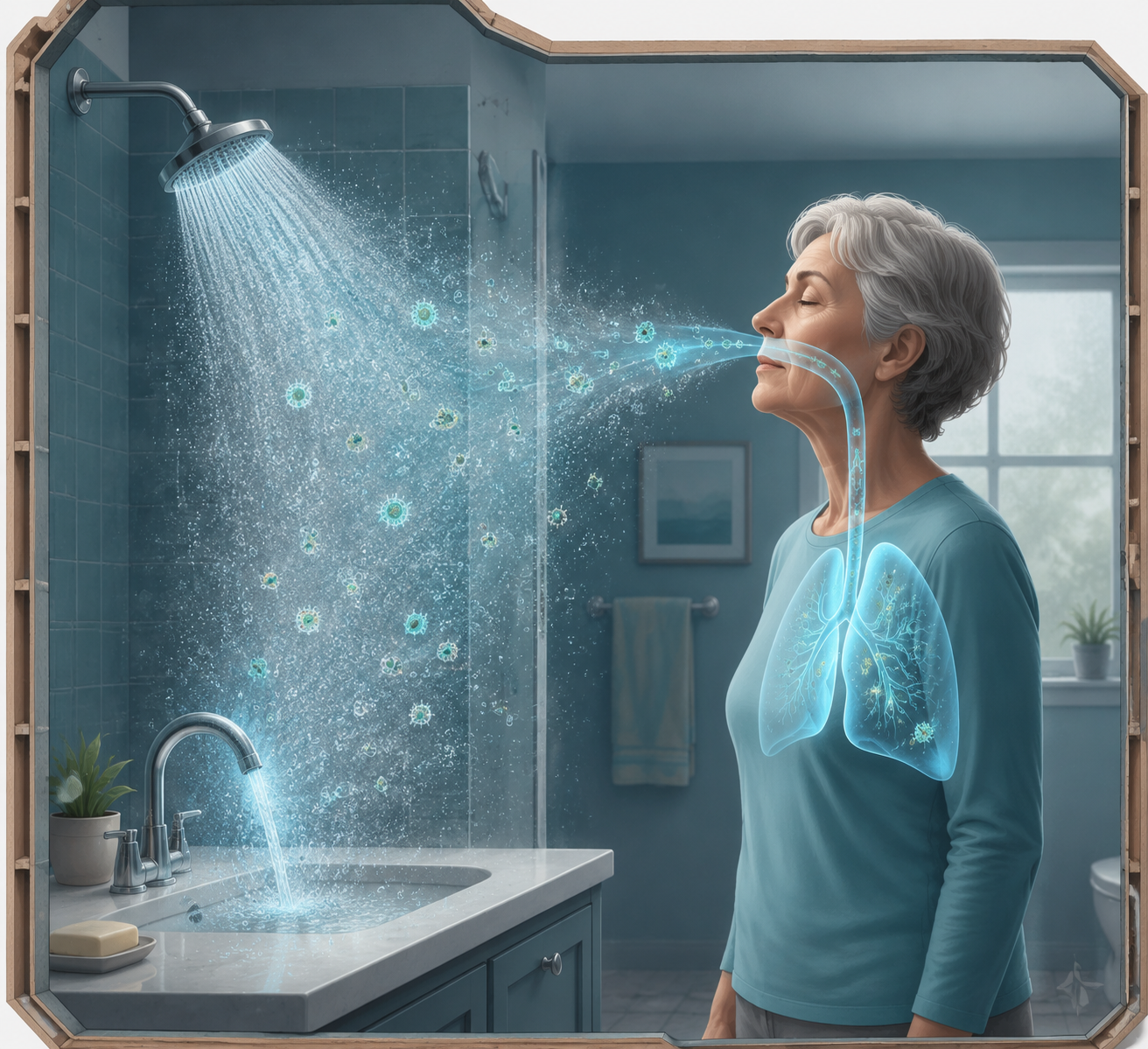
The risk is not evenly spread across all older adults. Age itself matters, but so do chronic lung disease, smoking history, weakened immune system, cancer treatment, transplant medications, and other serious medical problems. A parent who is 82, has COPD, and recently came home from a rehab stay is in a different risk category than a healthy 52-year-old reading the same headline.
The senior warning signs are easy to misread
Here is the part I would not soften for a family caregiver: in an older adult, Legionnaires’ disease may not announce itself in the neat way people expect pneumonia to announce itself. The CDC lists symptoms that can include cough, shortness of breath, muscle aches, headache, and fever; it also notes that fever can be higher than 104°F and that diarrhea, nausea, and confusion can occur. AARP’s health reporting makes the caregiver-relevant point explicit: confusion or mental-status changes and gastrointestinal symptoms can be part of the outbreak picture, not side issues. [6][7]
That symptom mix is exactly why families miss the beginning. A parent says they are “just tired.” They are queasy. They skip lunch. They seem foggy on the phone. They are weaker getting out of a chair. The cough may be mild, late, or not the thing that makes anyone alarmed at first.
For caregivers, the practical red flags are less about memorizing a disease page and more about noticing a cluster:
- New confusion, unusual sleepiness, or a parent who suddenly “isn’t themselves”
- Fever, chills, or feeling intensely ill, especially with weakness
- Shortness of breath, faster breathing, chest discomfort, or worsening cough
- Nausea, vomiting, diarrhea, or loss of appetite alongside respiratory or fever symptoms
- A recent stay in a hospital, rehab center, assisted living facility, hotel, or other building where an outbreak has been reported
The mistake is waiting for the picture to become obvious. In older adults, “obvious” sometimes arrives after the infection has already taken hold. If there has been a known exposure or a local outbreak and your parent develops fever, breathing symptoms, sudden confusion, or severe weakness, that is a medical call, not a wait-and-see project.
At home, reduce the water situations that help Legionella grow
No home routine can create a zero-risk bubble. The useful goal is narrower: reduce stagnant warm water, reduce unsafe mist exposure, and stop accidentally turning devices into tiny aerosol machines.
Check hot water temperature, but do not create a scalding hazard
New York State health guidance for home Legionella control says water heaters may be kept at 130°F to 140°F, with anti-scald or mixing valves to reduce burn risk. The same guidance also warns that higher water temperatures increase the risk of serious scalding, especially for children, older adults, and people with disabilities. [8]
That second sentence is not a footnote. If your parent has neuropathy, slower reaction time, dementia, limited mobility, or needs help bathing, do not just crank up the water heater and walk away. Ask a plumber or facility maintenance person about mixing valves, anti-scald devices, and whether the actual tap temperature is safe where your parent bathes.
The reason temperature matters is that Legionella grows best in warm water. CDC water management guidance identifies 77°F to 113°F as the range where Legionella grows well. [9]
Flush taps after the house has been quiet
Standing water is one of the ordinary household details that becomes less ordinary after an outbreak. New York State advises that after water has not been used for 3 or more days, faucets should be run on low for 3 minutes to clear standing water. [8]
That applies after a trip, after a hospital stay, after your parent spends several days at your sibling’s house, or in a rarely used bathroom. Run the water gently to avoid unnecessary splashing or mist. If your parent is frail or immunocompromised, do the flushing yourself before they shower.
Use the right water in CPAP machines and humidifiers
This is one of those small routines that deserves more respect. New York State tells people using respiratory devices such as CPAP machines and humidifiers to follow manufacturer instructions and use sterile or distilled water. [8]
For a parent, that means making the correct water easy to use. Put distilled water where they can reach it. Label it if needed. If they have memory problems, do not assume they will remember that tap water is not the plan. Clean and replace device parts according to the manufacturer’s instructions rather than inventing a “good enough” rinse.
Be more suspicious of hot tubs than of bathtubs
Hot tubs are a particular concern because they combine warm water with bubbling and aerosol. AARP reports that hot tubs in vacation rentals may be linked to about half of Legionnaires’ disease cases associated with those rentals, and it cites maintenance targets of chlorine at 3 parts per million or higher, or bromine at 4 parts per million or higher. [7]
For a healthy younger person, a questionable hot tub may just look unappealing. For an older parent with lung disease or immune compromise, it is reasonable to skip it unless maintenance is clear, current, and verifiable. “It looks clean” is not a water-safety program.
If your parent lives in senior housing, ask specific water questions
A senior living facility should not answer Legionella questions with vague comfort phrases. “We follow all guidelines” is not enough by itself. The basic question is whether the building has a real water management program and whether someone can explain what happens when testing, construction, low occupancy, water disruptions, or illness reports raise concern.
CDC guidance says all healthcare facilities should have a water management program to reduce the risk of Legionella growth and spread, and it points to ASHRAE Standard 188 as the industry standard for building water systems. CDC also notes that the Centers for Medicare & Medicaid Services requires Medicare-certified healthcare facilities to have policies and procedures to reduce the risk of Legionella and other opportunistic pathogens in building water systems. [9]
For a family member, that turns into a short set of questions:
- Do you have a written water management program for Legionella prevention?
- Who is responsible for it, and how often is it reviewed?
- Do you follow CDC guidance and ASHRAE Standard 188?
- Has there been recent Legionella testing, remediation, water disruption, construction, or a reported case?
- If a resident develops pneumonia symptoms, how is possible Legionnaires’ disease considered and communicated?
The tone of the answer matters. A good facility may not hand you engineering diagrams, and you probably do not need them. But it should be able to name the program, the responsible role, and the procedure. If the answer becomes defensive, circular, or purely reassuring, ask again in writing.
For a deeper facility-focused script, use How to Check if Your Parent's Facility Prevents Legionella. That is the place to go line by line. Here, the main point is simpler: if your parent is in long-term care, Legionella prevention is not a courtesy. It is part of responsible building and healthcare safety.
When to seek urgent medical care
Do not try to diagnose Legionnaires’ disease at home. The caregiver job is to recognize when the situation has crossed from “watch closely” into “get medical help now.”
Seek urgent medical care if your parent has possible exposure to an outbreak or high-risk water setting and develops any of the following:
- Shortness of breath, chest pain, blue lips, or struggling to breathe
- New confusion, faintness, severe weakness, or a sudden change in mental status
- High fever, shaking chills, or a rapidly worsening illness
- Cough or pneumonia symptoms after staying in a healthcare facility, senior living facility, hotel, cruise ship, or building connected to a known outbreak
- Vomiting, diarrhea, or dehydration together with fever, breathing symptoms, or unusual confusion
When you call a clinician, urgent care, or emergency department, say the exposure concern plainly: “There has been a Legionnaires’ disease outbreak, and my parent is older and now has fever/confusion/shortness of breath.” Do not bury that detail under a long timeline. It helps the medical team decide what to test for and how seriously to treat the possibility.
The short mental checklist is enough: age risk, unusual symptoms, water exposure, urgent care if breathing, fever, confusion, or sudden weakness appears. Legionnaires’ disease is not something to obsess over every time your parent takes a shower. It is something to take seriously when the risk signs line up—and to act on before the picture becomes unmistakable.
References
- Legionellosis, World Health Organization, https://www.who.int/news-room/fact-sheets/detail/legionellosis
- About Legionnaires’ Disease, CDC, https://www.cdc.gov/legionella/about/index.html
- Legionella pneumonia tied to high death rates, especially in older patients, underlying conditions, CIDRAP/University of Minnesota, https://www.cidrap.umn.edu/legionella/legionella-pneumonia-tied-high-death-rates-especially-older-patients-underlying
- Surveillance for Legionnaires’ Disease, CDC, July 8, 2026, https://www.cdc.gov/legionella/php/surveillance/index.html
- How Legionella Spreads, CDC, https://www.cdc.gov/legionella/causes/index.html
- Clinical Features of Legionnaires’ Disease, CDC, https://www.cdc.gov/legionella/hcp/clinical-signs/index.html
- Legionnaires’ Disease: What to Know About Symptoms and Treatments, AARP, https://www.aarp.org/health/conditions-treatments/legionnaires-disease-outbreak-symptoms-treatments/
- Legionella at Home, New York State Department of Health, https://www.health.ny.gov/diseases/communicable/legionellosis/legionella_at_home.htm
- Overview of Water Management Programs, CDC, https://www.cdc.gov/control-legionella/php/wmp/index.html
Questions to bring to a clinician or OT
This is not medical, legal, or a family's final decision — only a framework. Bring these questions to a clinician, occupational therapist, or your local Area Agency on Aging.
Find Local HelpRelated reading
Noticed something outdated or inaccurate on this page? Flag a correction. We review every report against CDC, NIA, and AARP HomeFit guidance before updating a page.