
Caregiver decision guide
How to Choose a Safe Mobility Scooter for Seniors
This buying guide uses injury data and lab testing to help caregivers identify the safety features that reduce fall and collision risks in a mobility scooter for an older adult.
Last reviewed: July 20, 2026.
If your parent has already fallen, had a near miss, or started avoiding walks because their legs feel unreliable, a mobility scooter can look like the kindest purchase in the world. It may be. But the first question in a mobility scooter buying guide for seniors should not be, “How far does it go on one charge?” It should be, “What new fall, tip, or collision risk could this device bring into my parent’s day?”
That question is not meant to frighten families away from scooters. It is meant to put the decision in the right order. A scooter is a vehicle with a seat, a motor, a braking system, a turning radius, a weight limit, and limits on slopes. If those limits do not match the person and the places they will drive, the device that was bought to prevent one kind of fall can introduce another.
The injury evidence deserves attention early. A UK Trauma Audit and Research Network study of 1,504 mobility scooter trauma patients found 10.6% overall mortality, rising to 15.4% among patients older than 75. Among major trauma cases, mortality was 24.2%, and vehicle collisions accounted for 65.4% of injuries in the study population.[1] This is UK data, not a U.S. national injury estimate, but the practical message travels well: scooters belong in the same safety conversation as curbs, cars, slopes, driveways, dim parking lots, and reaction time.
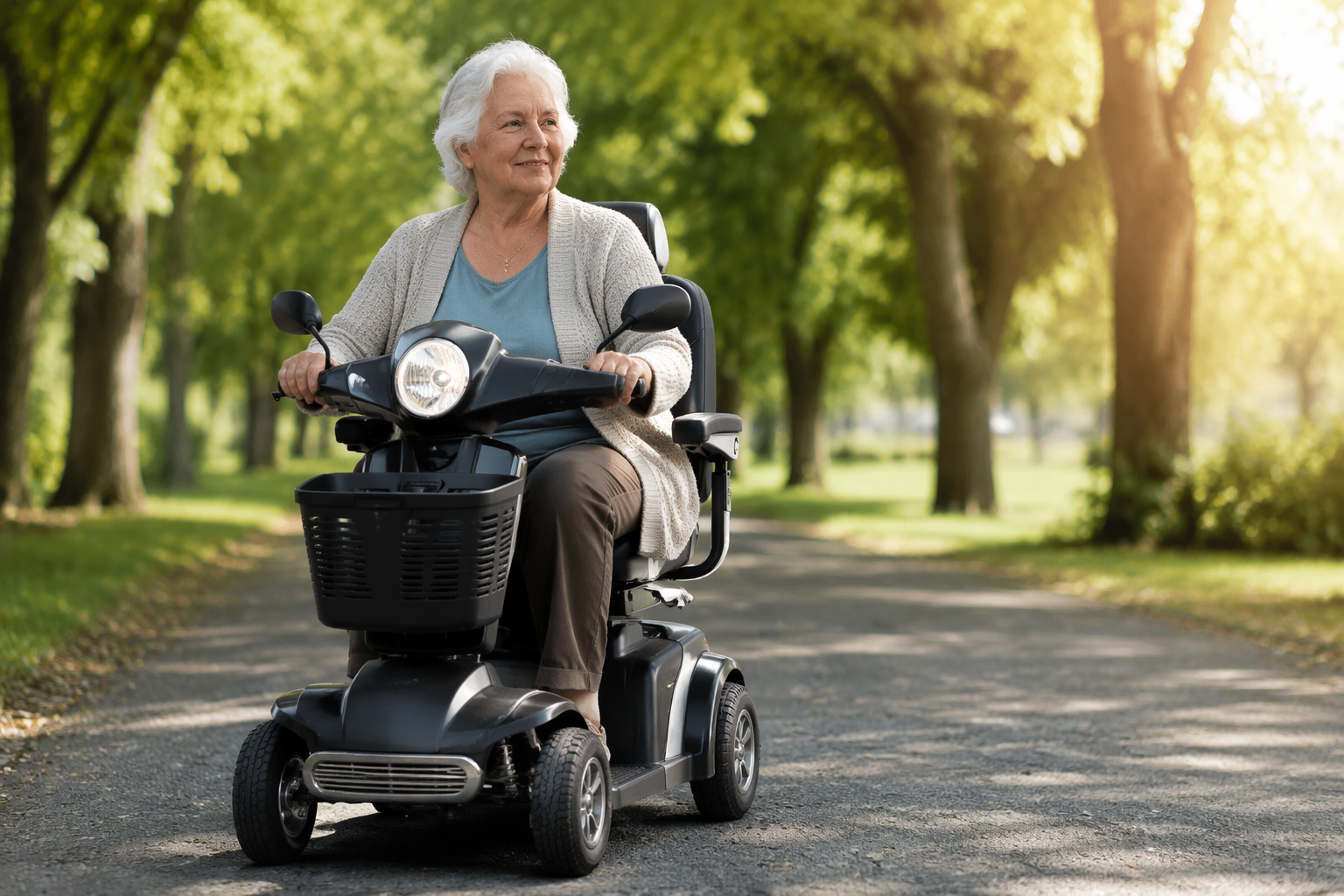
Start With Where the Scooter Will Actually Go
Before comparing brands, write down the real route. Not the ideal route. The real one.
- Inside the home: hallways, bedroom turns, kitchen corners, thresholds, rugs, bathroom doorway, and where the scooter will be parked.
- Outside the home: driveway slope, sidewalk cracks, curb cuts, mailbox route, apartment ramp, garage entry, parking lot crossings, and nighttime lighting.
- Transport: whether anyone must lift the scooter into a trunk, load it onto a vehicle lift, or store it in a small apartment.
- Human factors: whether your parent has slow reaction time, poor vision, hand weakness, tremor, confusion, neuropathy, or fear after a previous fall.
This route decides what matters. A scooter that is pleasant in a showroom can become difficult on a sloped driveway. A model that turns beautifully in a kitchen may feel tippy on uneven pavement. A scooter that folds neatly for a car trunk may not have the frame weight, incline capacity, or stability your parent needs outdoors.
Consumer Reports’ 2026 mobility scooter testing is useful here because it moved beyond brochure promises. Its lab work found meaningful stability differences between three-wheel and four-wheel designs, and one popular three-wheel model was excluded from ratings because of tipping risk and brake failure on downhill sections.[2] That is exactly the kind of finding a caregiver can turn into a shopping rule: do not buy a scooter until you know how it behaves when turning, stopping, and going downhill.
Three Wheels or Four Wheels Is a Safety Trade-Off, Not a Personality Choice
Many buying guides make this too simple. Three-wheel scooters are often described as easier to maneuver, while four-wheel scooters are described as more stable. That is broadly useful, but not enough for a parent with a fall history.
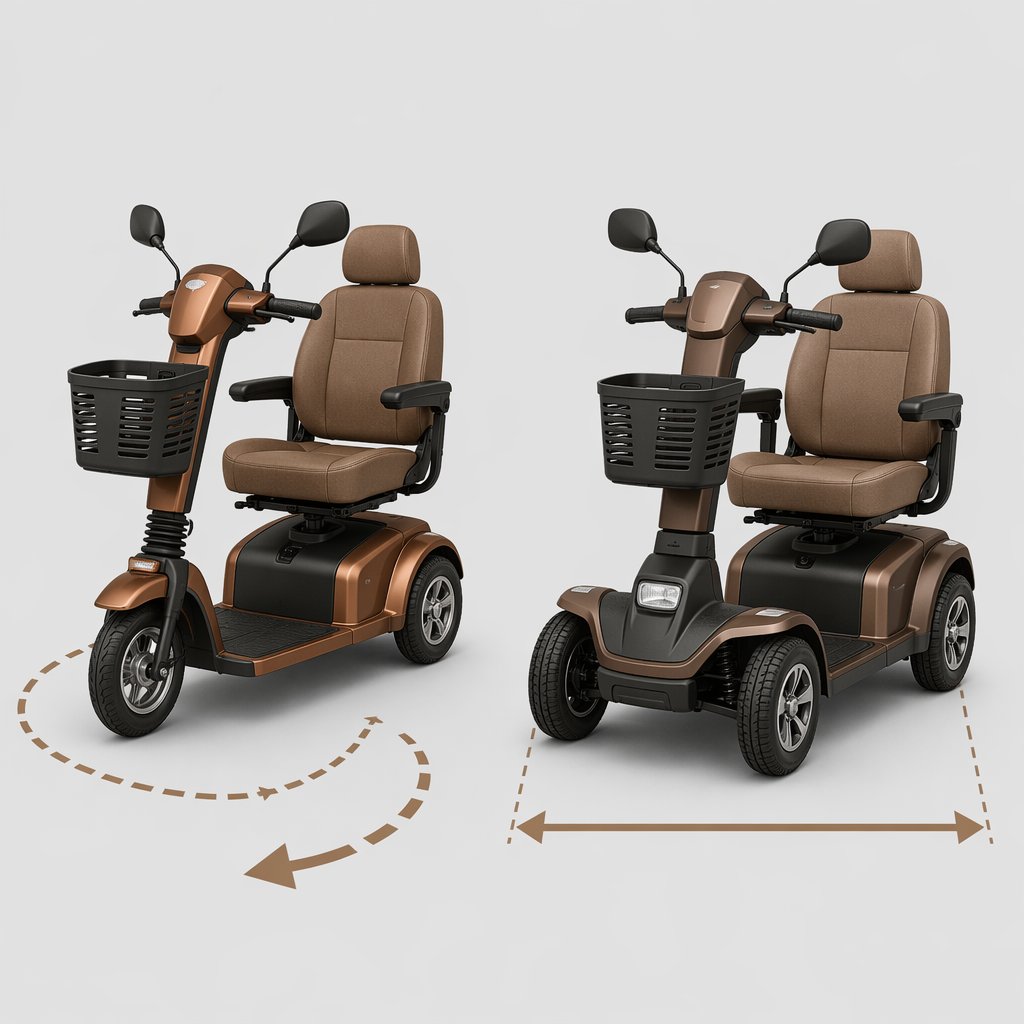
A three-wheel scooter can be safer in a specific indoor situation: tight rooms where the alternative is repeated backing up, awkward repositioning, bumping furniture, or twisting to see behind. If the scooter will mostly be used inside a small apartment or assisted-living unit, turning radius is not a luxury feature. It can reduce risky maneuvers.
Outdoor use changes the balance. If your parent will use the scooter on sidewalks, curb cuts, sloped driveways, parking lots, or uneven paths, four-wheel stability deserves much more weight. Prior falls, poor balance, delayed reaction time, or fear while turning all push the decision toward a wider, more stable base unless a clinician or mobility professional sees a clear reason otherwise.
| Use situation | Safety priority | What to ask before buying |
|---|---|---|
| Mostly indoors in tight spaces | Maneuverability without repeated backing | Can the scooter turn through the actual bedroom, kitchen, and hallway routes? |
| Outdoor sidewalks and curb cuts | Stability while turning and crossing uneven surfaces | Does the model stay stable during turns and transitions, not just on flat showroom floors? |
| Driveways, ramps, or hills | Controlled downhill braking and incline rating | How does it stop on a slope, and what slope is it rated to handle? |
| Parent has fallen, tips easily, or panics with controls | Stability, speed control, and braking response | Can speed be limited, and can the parent stop without squeezing or overcorrecting? |
Braking Matters Most When the Parent Is Already Nervous
A calm rider on level ground is not the only test. Watch what happens when your parent is startled, turns too sharply, approaches a curb cut, or starts downhill and wants the scooter to stop now.
For many older adults, automatic braking is not optional. The scooter should slow and stop predictably when the throttle is released. If the parent must remember a separate braking step during panic, the device is asking for more coordination than some riders can reliably provide. That does not mean every person needs the same control layout, but it does mean braking should be tested as a real-life event, not read as a line in a feature list.
If there is any slope in the daily route, ask specifically about downhill control. A scooter that stops well on flat flooring may behave differently on a ramp or driveway. The Consumer Reports finding about downhill brake failure in a tested three-wheel model is a reminder to treat slope performance as a pass-fail safety issue, especially for outdoor users.[2]
Anti-Tip Wheels, Lights, and Reflectors Are Not Extras
The parts at the back of a scooter rarely get as much attention as the seat cushion or battery range. They should. Rear anti-tip wheels can help limit backward tipping risk when the scooter is on a slope or when weight shifts during acceleration. They do not make a scooter impossible to tip, and they do not excuse using a scooter beyond its rating, but their absence should make a caregiver slow down.
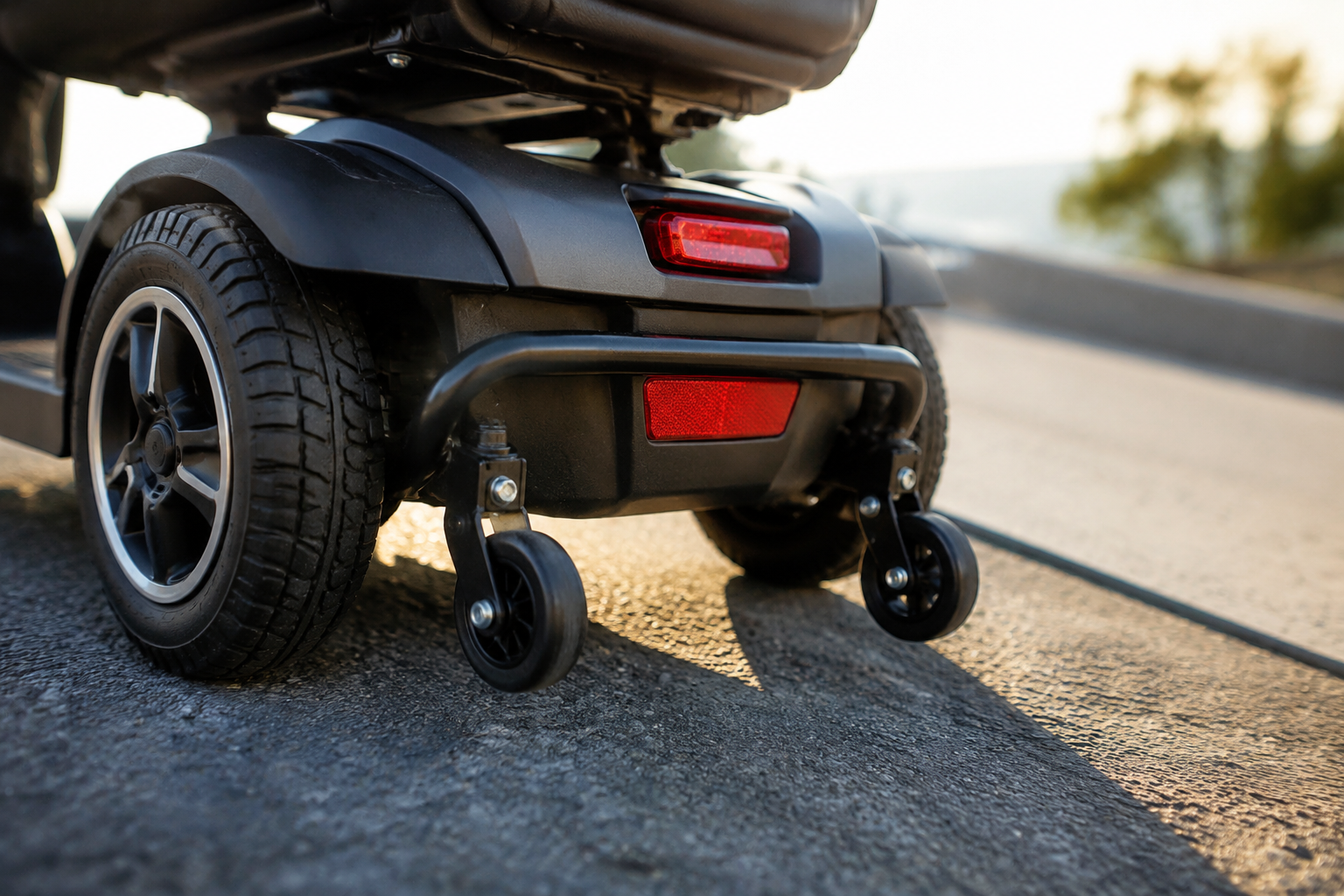
Lighting and reflectors matter for a different reason: other people need to see the scooter. That includes drivers in parking lots, neighbors backing out of driveways, cyclists, and pedestrians. The TARN study’s finding that vehicle collisions were the major injury source in its serious trauma population should make visibility part of the safety screen, not an afterthought.[1]
- Look for front lights if the scooter may be used near dusk, in garages, in parking lots, or in dim hallways.
- Check for rear reflectors and brake lights so others can see when the scooter slows or stops.
- Ask whether anti-tip wheels are standard, optional, or unavailable on the model.
- Do not assume a bright scooter color replaces actual lights and reflectors.
Fit the Scooter to the Person, Not the Other Way Around
A scooter that is too large, too small, too fast, or too awkward at the controls can make a capable older adult look unsafe. Before deciding that a parent “can’t use a scooter,” make sure the scooter being tested actually fits.
Seat height should let the rider sit with stable posture and get on and off without a risky drop or climb. The tiller should come close enough that the parent is not leaning forward to steer. A delta tiller may be easier for some people with limited grip because it allows more hand positions, while a T-style tiller may suit others who prefer a familiar handlebar feel; the safer choice is the one the parent can control without strain.[8]
Controls need special attention after a fall. Some riders tense up and squeeze. Others freeze and forget to release the throttle. If your parent has tremor, neuropathy, arthritis, weakness, or delayed processing, test the slowest speed setting first. The goal is not to prove they can drive it once in a store. The goal is to see whether they can start, stop, turn, and recover from a mistake without panic.
Fall fear also deserves respect. A 2024 University of Illinois survey reported that among 156 wheelchair and scooter users, 96% had fallen in the past year, 74% were injured by a fall, and 94.6% feared falling again.[3] The survey’s median age was 33, so it should not be treated as senior-specific evidence. Still, it points to something families see at home: people who depend on mobility devices may carry repeated fear into every transfer, turn, and threshold.
Check Weight Capacity and Incline Rating Against Real Use
Weight capacity is not just the rider’s body weight. Add the bag on the tiller, the oxygen equipment, groceries, winter clothing, and anything else that will commonly ride along. A scooter used close to its limit may not handle, brake, or climb the way a family expects.
Published specifications vary widely by scooter class. Travel scooters are commonly listed around 35–59 pounds with roughly 8–14 miles of range, while full-size models may weigh up to 366 pounds and may list weight capacities up to 500 pounds.[7] Incline ratings also vary; travel models are commonly listed around 6–8 degrees, while heavier-duty models may list around 6–12 degrees.[7][8] Those numbers are not a promise that every rider will feel safe on every slope. They are a reason to measure the route before buying.
If the home has a sloped driveway, apartment ramp, steep garage entry, or uneven path to the mailbox, ask for the scooter’s incline rating in writing. Then compare it with the steepest regular route. If no one can tell you the rating, or if the rating barely covers the route, keep looking.
Portability Can Solve One Problem and Create Another
Folding and travel scooters are tempting for good reasons. They can fit into smaller cars, help families get to appointments, and reduce the need for a vehicle lift. For a parent who only needs help crossing a large clinic, airport, or senior center, portability may be the feature that makes scooter use possible at all.
The trade-off is that lighter frames often come with limits: shorter range, lower incline ratings, smaller wheels, reduced outdoor comfort, or less stability than a full-size model. The exact trade-off depends on the model, but the decision should be made openly. A scooter that is easy for an adult child to lift is not automatically easy for an older parent to drive safely.
| Feature families often notice first | Safety question to ask instead |
|---|---|
| Longest battery range | Will the scooter stay stable and stop predictably on the actual route? |
| Lightest folding frame | What stability, wheel size, incline, or comfort trade-offs come with the lower weight? |
| Lowest price | Does it fit the rider, meet the weight and slope needs, and include lights, reflectors, and anti-tip protection? |
| Most comfortable seat | Can the rider transfer safely, sit upright, reach the tiller, and control speed without strain? |
Medicare and Price Come After the Safety Screen
Cost matters. So does coverage. But a covered scooter that does not match the rider’s risks is not a bargain.
Medicare Part B may cover power-operated vehicles, including scooters, when they are medically necessary for use in the home. Medicare.gov states that after the Part B deductible, Medicare pays 80% of the approved amount when the doctor and supplier meet Medicare requirements, including use of a supplier that accepts assignment.[4] Solace Health’s 2026 Medicare guidance describes the usual pathway as a face-to-face exam, documentation of in-home medical necessity, a seven-element order, and in some cases prior authorization timelines ranging from 7 to 45 days.[5]
That “in the home” requirement is important. A scooter wanted mainly for shopping malls, outdoor paths, or community outings may not meet the same coverage standard. Families should confirm current Medicare rules, plan details, supplier status, and any prior authorization requirement before assuming reimbursement.
For private purchase, prices vary widely. Forbes Health reported in 2024 that new mobility scooters can range from about $700 to more than $6,000, while used scooters may cost several hundred dollars less.[6] The lower price of a used model can be helpful, but only if the scooter still passes the same safety screen.
Buying Used Requires Extra Caution
A used scooter should be checked for battery age, charger condition, tire wear, loose tiller movement, worn upholstery that affects posture, missing reflectors, damaged lights, weak braking, and any sign that it has been stored outside. Ask for the manual so you can confirm the weight capacity and incline rating rather than relying on a seller’s memory.
Battery replacement can change the real price. Forbes Health reported typical battery lifespan estimates of 18 months to 3 years for lead-acid batteries and up to 5 years for lithium batteries, with replacement batteries costing $55 to more than $100 each and often sold in pairs.[6] If the batteries are near the end of life, the used scooter may not be as inexpensive as it first appears.
A Pre-Purchase Safety Check for Caregivers
Use this check before the deposit, the delivery appointment, or the used-scooter pickup. If the answer is unclear, pause the purchase.
- Confirm the real use environment: indoors, outdoors, sidewalks, curb cuts, parking lots, ramps, driveways, and storage space.
- Match wheel configuration to risk: consider three wheels only when tight indoor maneuverability is the dominant safety need; lean toward four wheels for outdoor use, uneven surfaces, slopes, or prior falls.
- Test braking and speed control: watch whether the scooter stops predictably when the throttle is released and whether the parent can drive comfortably at the lowest speed.
- Inspect safety hardware: lights, reflectors, brake lights, horn, anti-tip wheels, and any speed-limiting controls.
- Verify fit: seat height, transfer safety, tiller reach, hand control comfort, posture, leg position, and ability to look around while turning.
- Check capacity and terrain limits: rider weight plus carried items, incline rating, wheel size, and whether the scooter is meant for the surfaces your parent will actually use.
- Bring in a clinician or mobility professional if your parent has significant balance problems, cognitive changes, low vision, poor reaction time, uncontrolled dizziness, or repeated falls.
A scooter can protect independence. It can let an older adult get to the dining room, the mailbox, the clinic entrance, or the park path with less pain and less exhaustion. But for a senior who has already fallen, the safest purchase is the one that treats the scooter as fall-prevention equipment first and transportation convenience second.
References
- Mobility scooter-related injuries - a national trauma database analysis, Injury, 2022.
- Best Mobility Scooters, Consumer Reports, 2026.
- Falls a common hazard for wheelchair and scooter users: study, Safety+Health Magazine, 2024.
- Wheelchairs & scooters, Medicare.gov.
- Does Medicare Cover Mobility Scooters?, Solace Health, June 2026.
- How Much Do Mobility Scooters Cost?, Forbes Health, 2024.
- Best Mobility Scooters, Reviewed.com, 2025; WHILL mobility scooter specifications, WHILL, 2026.
- Mobility Scooter Buying Guide, Silver Cross.
Questions to bring to a clinician or OT
This is not medical, legal, or a family's final decision — only a framework. Bring these questions to a clinician, occupational therapist, or your local Area Agency on Aging.
Find Local HelpRelated reading
Noticed something outdated or inaccurate on this page? Flag a correction. We review every report against CDC, NIA, and AARP HomeFit guidance before updating a page.