
Caregiver decision guide
How to Prevent Falls During Prostate Cancer Hormone Therapy
Prostate cancer hormone therapy accelerates bone loss and frailty in elderly men, raising fall and fracture risk. This guide empowers caregivers with evidence-based steps to prevent injuries and maintain safety.
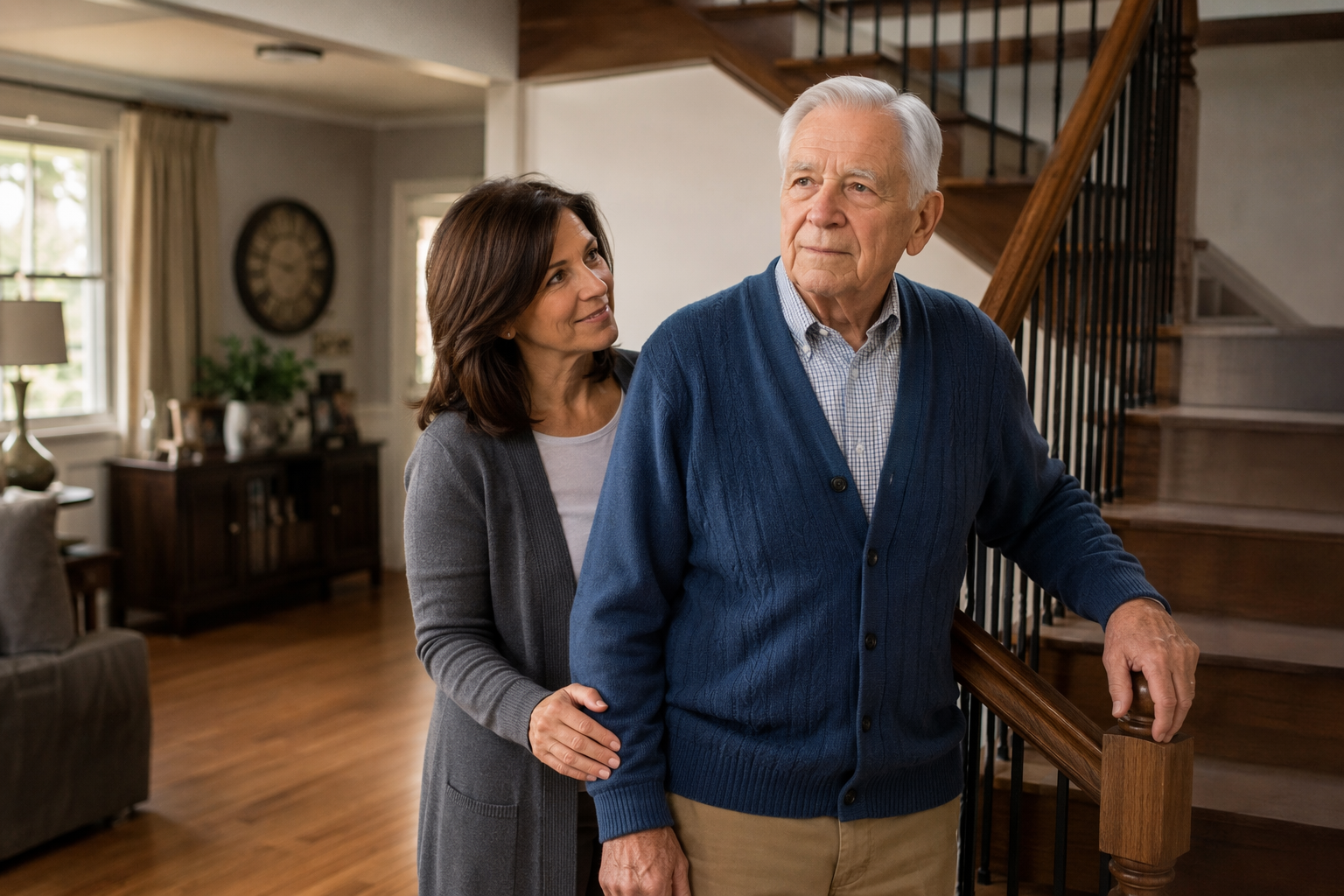
When an older father starts androgen deprivation therapy for prostate cancer, the first practical question at home is not only whether the treatment will control the cancer. It is what changes before he gets weak enough, dizzy enough, or unsteady enough to fall.
Falls and fractures are sometimes treated as background noise among prostate cancer treatment side effects in elderly men. They should not be. ADT can be necessary, and for some men it is part of life-extending treatment. But the body cost is real: published oncology guidance describes bone mineral density loss of about 2–3% per year during ADT, with a 10–20% fracture risk within five years.[1]
For an 80-year-old man, a fracture is rarely just a fracture. It can mean surgery, rehab, a walker that never goes away, a bedroom moved downstairs, or an adult child suddenly trying to decide whether the house is still safe. Prevention has to start at or before treatment initiation, not after the first stumble proves the risk was there.
Why ADT Can Turn a Barely Safe Home Into a Risky One
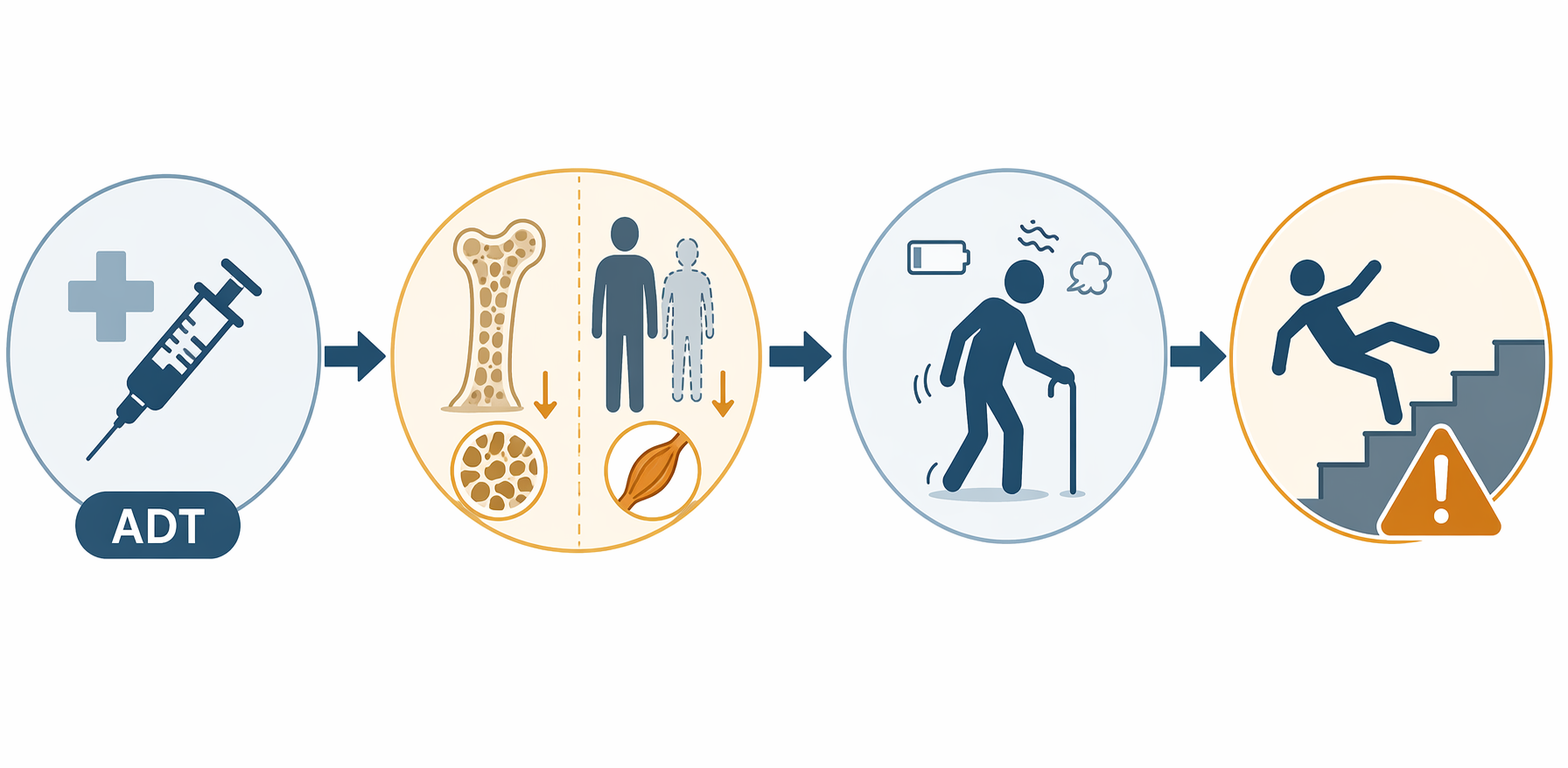
Androgen deprivation therapy lowers testosterone activity because prostate cancer often depends on androgen signaling. That is the cancer reason. The home reason is that testosterone also helps maintain bone, muscle, energy, and physical reserve. When those reserves decline in an older man, the change may not look dramatic at first. He may still say he is fine. He may still take the stairs. He may still refuse the shower chair.
The cascade is easy to miss because each piece looks small by itself: bone thins, lean muscle declines, fatigue makes walking slower, balance reactions dull, and the hallway rug or dim bathroom light that was tolerable last year becomes a fall hazard. ADT exposure has also been associated with substantially higher prefrail or frail status: 40–43% of ADT-exposed men were prefrail or frail compared with 15% of men never exposed to ADT in the geriatric oncology data summarized in ASCO Educational Book.[1]
This is why the missed screening opportunity matters so much. Despite guideline attention to bone health, only 8% of Medicare patients starting ADT received a baseline DXA scan in the data highlighted by ASCO Educational Book.[1] A DXA scan is not a luxury test in this setting. It is the measurement that tells the care team whether bone protection needs to be part of the cancer plan from the beginning.
The risk also does not vanish the day ADT stops. Lost lean muscle mass can be difficult to rebuild, especially when treatment coincides with age, diabetes, cardiovascular disease, neuropathy, prior inactivity, or a winter spent mostly indoors. A father may complete a course of therapy and still carry the balance and strength consequences into ordinary life.
The First Appointment Questions Should Include Bone and Fall Risk
The oncology visit will naturally focus on cancer control: stage, PSA pattern, imaging, drug selection, and treatment duration. A caregiver does not need to redirect the visit away from that. The goal is to make sure the treatment plan includes the older body that has to live through it.
Before ADT starts, or as soon as possible after it has started, ask direct questions that are hard to lose in the shuffle:
- Should he have a baseline DXA scan now, and when should it be repeated?
- Does his current bone density, age, prior fracture history, steroid use, or fall history change the plan?
- What calcium and vitamin D intake do you want for him, including diet and supplements?
- Should primary care, cardiology, physical therapy, or geriatrics be involved before weakness appears?
- Do any of his medications raise dizziness, blood pressure drop, sleepiness, or fall risk?
The National Cancer Institute lists calcium intake of 1,000–1,200 mg daily and vitamin D intake of 400–1,000 IU daily in this bone-health context.[2] Those numbers are not a reason to start pills blindly, especially if he has kidney disease, kidney stones, high calcium levels, or a long medication list. They are a reason to ask the clinician to turn “take calcium and vitamin D” into a specific plan that fits his labs and diet.
A frailty assessment is not an insult. It is a way of making risk visible. In an older man starting ADT, gait speed, recent falls, weight loss, exhaustion, grip strength, medication burden, cognition, and ability to manage daily tasks can be as relevant to safety as the scan report. A man who is already slow on stairs needs a different support plan than one who is still walking several miles a week.
Drug Choice Is a Clinician Decision, But Frailty and Heart History Belong in the Conversation
Families should not rank prostate cancer drugs from an article. The right medication depends on cancer status, prior treatment, kidney and liver issues, access, interactions, side effects, and the oncologist’s judgment. Still, an older man’s heart history and fall risk should not sit outside the treatment conversation.
In the HERO trial, relugolix was associated with a lower rate of major adverse cardiovascular events than leuprolide, 2.9% versus 6.2%.[3] That does not mean every man with prostate cancer should receive relugolix. It does mean that if a father has coronary artery disease, prior stroke, heart failure, diabetes, or multiple cardiovascular risk factors, the caregiver can reasonably ask: “Does his heart history affect which ADT option is safest for him?”
A similar caution applies when additional androgen receptor pathway drugs are being considered. Apalutamide and enzalutamide cross the blood-brain barrier and have raised more concern for falls and fractures than abiraterone or darolutamide in the geriatric oncology discussion.[1] That is not a home-based treatment rule. It is a reason to ask at the visit: “Given his frailty, balance, and fall history, does this drug add fall or fracture risk, and are there alternatives that fit his cancer situation?”
What to Change at Home Before the First Fall
The home work is not about treating a father like a fragile object. It is about preserving the parts of independence that matter: getting to the bathroom at night, using the stairs safely, showering without fear, walking outside, and staying strong enough that one bad step does not become a permanent change.
Start where ADT risk meets ordinary movement. Nighttime bathroom trips deserve special attention because fatigue, urgency, low light, and stiff legs often arrive together. Add bright, motion-activated lighting from bed to bathroom. Remove loose rugs or secure them properly. Keep shoes or nonslip slippers by the bed, not across the room. If he wakes up slowly or uses blood pressure medication, ask him to sit at the bedside before standing.
Bathrooms need more than a bathmat. Install grab bars where hands naturally reach: near the toilet and inside the shower or tub. A shower chair can be a temporary tool during the early fatigue phase, not a surrender. Use nonslip surfaces, check water temperature controls, and keep towels within reach so he is not stepping out wet and twisting for one.
Stairs deserve the same seriousness as medication side effects. Make sure there is a sturdy railing, preferably one he can use on the side where he naturally reaches. Improve lighting at the top and bottom. Clear laundry baskets, shoes, tools, and extension cords from the path. If he already carries items with one hand while using the rail with the other, set up a basket, shelf, or family routine so he is not transporting heavy loads on steps.
For a fuller home-safety framework, use the four pillars of fall prevention as a way to look beyond clutter and include vision, medication, strength, and environmental risk. If you need something printable for a family meeting or fridge door, this fall prevention handout for seniors and caregivers can help turn good intentions into a shared checklist.
A Short Home Walk-Through for ADT
| Place | What to Look For | Practical Change |
|---|---|---|
| Bedroom to bathroom | Dim light, loose rugs, rushed nighttime walking | Add motion lights, clear the path, place stable footwear by the bed |
| Bathroom | Wet surfaces, low toilet, no secure handhold | Install grab bars, use nonslip surfaces, consider a shower chair |
| Stairs | Weak railing, shadows, carrying items | Improve lighting, repair rails, reduce loads on stairs |
| Kitchen and living room | Cords, low stools, unstable chairs, cluttered walkways | Create wide paths and keep frequently used items at waist height |
| Entryway | Thresholds, poor outdoor lighting, wet steps | Add lighting, use nonslip mats, repair uneven surfaces |
If monitoring devices, grab bars, lighting, shower equipment, or mobility aids become part of the plan, focus on the need rather than the brand. A device is useful only if he will actually use it and if it solves the hazard in front of him. For equipment categories and selection questions, this guide to elderly home safety products is a practical place to compare options without turning the house into a showroom.
Exercise Has to Start While He Still Feels Capable
Resistance and weight-bearing activity are not decorative wellness advice during ADT. They are part of fall prevention because they push against the muscle and bone losses that make ordinary movements unsafe. The best time to begin is before treatment fatigue narrows the day.
For some men, that may mean supervised physical therapy, especially if there is neuropathy, a prior fall, spinal disease, severe arthritis, or uncertainty about safe form. For others, it may mean a simple routine: sit-to-stands from a firm chair, heel raises at the counter, step-ups on a low step, light resistance bands, short outdoor walks, and balance work near a stable support. The exact plan should match his current ability, not the person he was at 60.
The point is not to turn every older man on ADT into an athlete. It is to keep the muscles that catch a trip, steady a turn, and rise from a toilet from disappearing quietly. If he enjoys social movement, lower-impact group activity can help with consistency. For a broader look at movement, balance, and aging, the discussion of pickleball and senior exercise benefits may be useful, though men with cancer-related fatigue, bone metastases, severe osteoporosis, or balance problems should clear activity choices with the clinical team.
What a Fall Can Trigger
Families often underestimate the administrative and emotional aftershock of a fall. The injury is only one part. Someone has to decide whether he can sleep upstairs, whether he can shower alone, whether he can drive to treatment, whether the next oncology appointment needs a wheelchair, and whether the house still fits his body.
That is why fall prevention should be discussed before the emergency room visit, not during discharge. If a fall has already happened, use an aging-in-place review rather than assuming the house can stay the same. This post-fall aging-in-place checklist can help sort immediate safety decisions from longer-term home changes.
Bone health also deserves its own attention, especially when a father is already thin, has lost height, has taken steroids, drinks heavily, smokes, has low vitamin D, or has had a prior fracture. For more context on why older adults often discover bone risk too late, see this caregiver-focused bone health guide. The ADT difference is that bone loss is not just an age-related possibility; it is a known treatment-associated risk that can be monitored.
A Caregiver Plan for the First Weeks of ADT
The first weeks are the best time to build a prevention routine because everyone is already paying attention. The oncology calendar is active. Lab work is happening. Medication lists are being updated. That is when bone density, supplements, home safety, and strength can be folded into the plan instead of added later as damage control.
- Ask for baseline bone assessment. If no DXA scan has been ordered, ask whether one is indicated now and how the result would change management.
- Review calcium and vitamin D with the clinician. Include diet, supplements, kidney history, lab values, and other medications.
- Put frailty on the agenda. Mention recent falls, slower walking, weight loss, fatigue, memory changes, neuropathy, or trouble rising from a chair.
- Ask about heart history and drug selection. This is especially important if he has cardiovascular disease, diabetes, prior stroke, or multiple risk factors.
- Walk the house before symptoms build. Prioritize bedroom-to-bathroom lighting, bathroom grab bars, stairs, footwear, and clutter-free paths.
- Start strength and balance work early. Ask whether physical therapy is appropriate, especially if he is already unsteady or deconditioned.
None of this asks the family to manage cancer treatment alone. It asks the family to bring the daily-life consequences into the treatment plan while the oncology team is still steering the medical decisions.
Do not wait for weakness, a stumble, or a fracture to prove that risk exists. Build screening, supplementation discussions, home safety, and resistance exercise into the care plan from the start, and keep each decision anchored to the clinicians who know his cancer, heart history, frailty, and goals.
References
- ASCO Educational Book 2023, ASCO Educational Book, 2023.
- Nutrition in Cancer Care (PDQ®), National Cancer Institute.
- Oral Relugolix for Androgen-Deprivation Therapy in Advanced Prostate Cancer, HERO trial / PMC review.
Questions to bring to a clinician or OT
This is not medical, legal, or a family's final decision — only a framework. Bring these questions to a clinician, occupational therapist, or your local Area Agency on Aging.
Find Local HelpRelated reading
Noticed something outdated or inaccurate on this page? Flag a correction. We review every report against CDC, NIA, and AARP HomeFit guidance before updating a page.