
Caregiver decision guide
Senior Health Care Services: A Family Guide to the Full Continuum of Care
This guide helps family caregivers understand the full spectrum of senior care options — from in-home companionship to skilled nursing — so they can plan proactively, avoid crisis-driven decisions, and match care to changing needs over time.
Why Understanding the Full Continuum Matters Before a Crisis
Most family caregivers first encounter the senior care system the same way: in a hurry, under stress, and with incomplete information. A parent falls and breaks a hip. A dementia diagnosis arrives. A spouse can no longer manage the stairs. In that moment, the instinct is to find a solution — fast — and the options that surface first are often the most expensive or the most institutional, simply because they are the most visible.
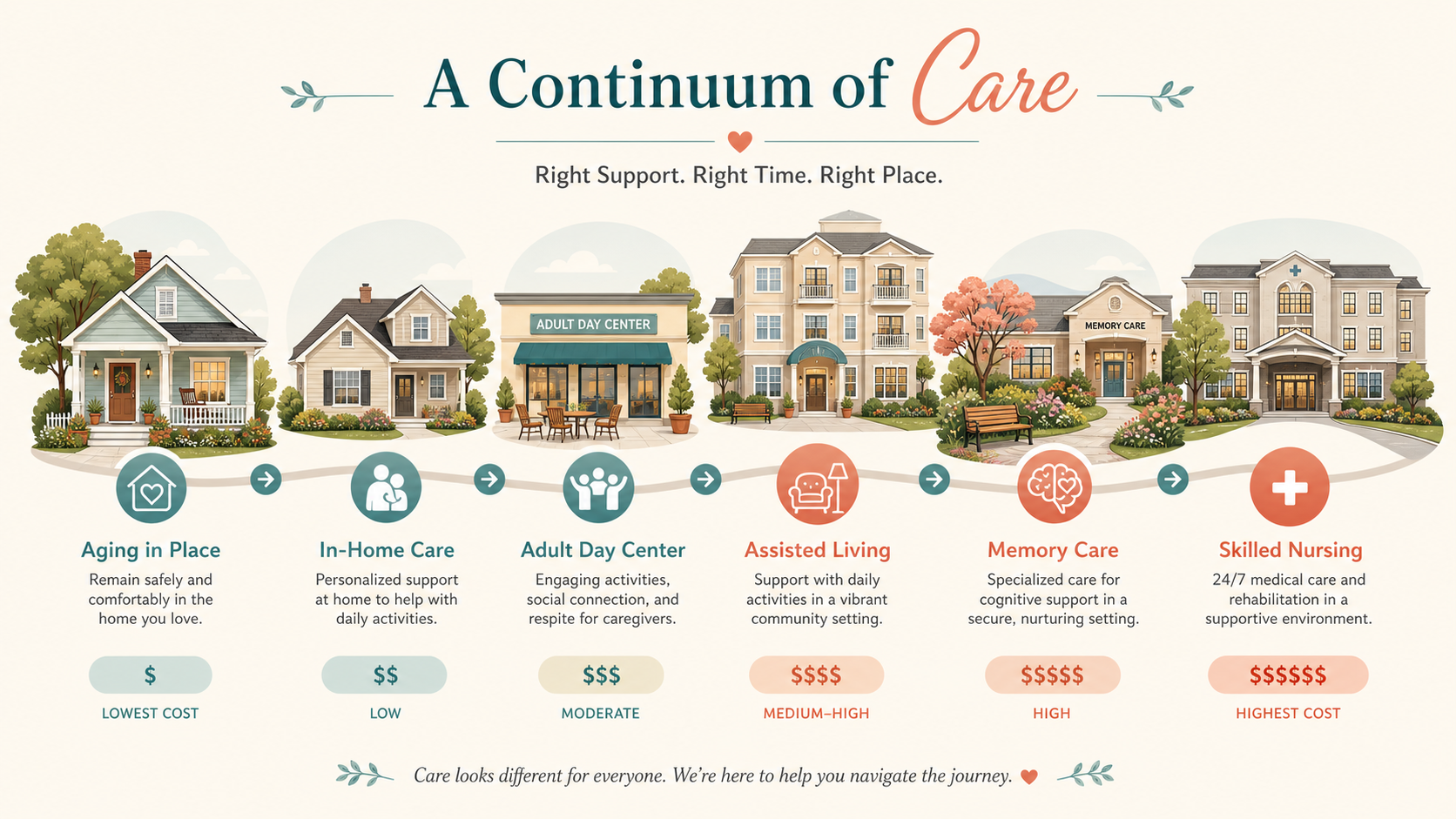
This guide takes a different approach. It is written for the early-stage caregiver — the person who senses that care needs are emerging but has not yet hit a crisis point. The core argument is straightforward: the senior health care services system is not a collection of unrelated options. It is a continuum that runs from light-touch, low-cost services like volunteer companionship all the way to round-the-clock skilled nursing. Families who understand this continuum before they need it make decisions that are less expensive, less emotionally costly, and better matched to the actual needs of the person they care for.
The Senior Care Continuum: A Framework for Matching Care to Changing Needs
The continuum of care is a simple but powerful idea: as a person's functional abilities change, the type and intensity of support they need changes too. At one end, a healthy older adult may need nothing more than a weekly phone check-in and a ride to the grocery store. At the other end, a person with advanced dementia or multiple chronic conditions may need 24-hour nursing supervision. Between those two poles lies a wide range of services — many of which families never learn about until they are already past the point where those options would have been most useful.
Questions to bring to a clinician or OT
This is not medical, legal, or a family's final decision — only a framework. Bring these questions to a clinician, occupational therapist, or your local Area Agency on Aging.
Find Local HelpRelated reading
Noticed something outdated or inaccurate on this page? Flag a correction. We review every report against CDC, NIA, and AARP HomeFit guidance before updating a page.