
Caregiver decision guide
Senior-Friendly Northern Lights Viewing Requires a Different Safety Plan
Older adults face unique cold-related risks during aurora viewing that standard advice ignores. This guide explains how aging physiology changes the rules and provides a senior-specific preparation framework for safe northern lights travel.
Most northern lights advice gets to the cold in one cheerful line: bundle up. For an older adult standing still in the dark, that is not a safety plan. It leaves out the part that matters most: older bodies can lose heat faster, and they may not shiver even when body temperature is dropping. Confusion, slowed breathing, pale skin, or a person becoming unusually quiet can matter more than whether they say, “I’m not that cold.”[1]
That changes how senior-friendly northern lights viewing tips should be judged. A good plan is not the one that proves someone can tolerate Arctic weather. It is the one that makes it easy to get warm before judgment, balance, speech, or heart strain become the problem.
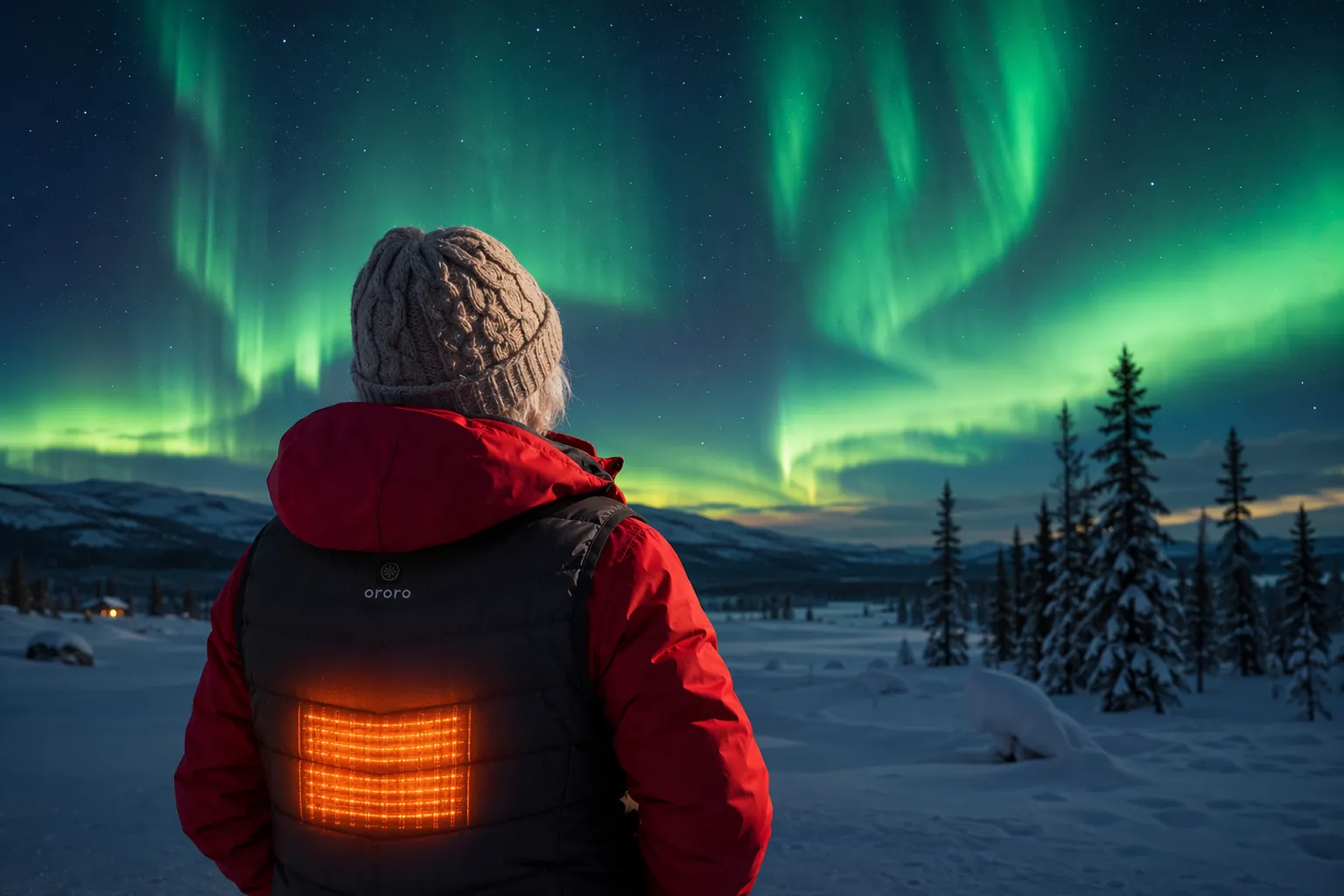
Why Aurora Viewing Is Different After 65
Northern lights viewing asks the body to do a very specific thing: stand or sit nearly motionless at night, often in wind, on snow or ice, while attention is fixed on the sky. Walking briskly to a viewpoint may feel manageable. Waiting there is the harder test.
The usual early warning sign for cold exposure is shivering. In older adults, that warning sign may be weaker or absent. HealthInAging, from the American Geriatrics Society, notes that older adults lose body heat faster than younger people and may not shiver when their temperature drops. Its warning signs include confusion, slowed breathing, and pale skin.[1]
That is why a spouse, travel companion, or adult child needs permission to interrupt the outing before the traveler agrees there is a problem. The person getting cold may be the least reliable judge in that moment. A companion who notices slower answers, clumsier movement, a blank look, or sudden irritability should not wait for dramatic symptoms.
Cold also asks more of the cardiovascular system. AARP reported in December 2025 that sustained cold can raise blood pressure and increase heart attack and stroke risk in older adults.[2] That does not mean a northern lights trip is off-limits. It does mean the plan should reduce prolonged exposure, not simply make the traveler look properly dressed in photos.
The Senior-Specific Plan Starts Before Destination Shopping
There is a place for comparing Alaska, Iceland, Norway, Finland, or northern U.S. viewing spots. It just should not be the first decision. For older travelers, the first question is whether the night can be built with heat close by, short outdoor intervals, safe footing, and a companion who knows what cold trouble can look like.
Readers choosing within the United States can use this guide to senior-friendly northern lights destinations after the cold-safety plan is clear. Families leaning toward Iceland can pair the health planning here with practical trip budgeting in planning an affordable Reykjavik trip for an aging parent.
| Decision | Senior-friendly standard |
|---|---|
| Viewing setup | Warm indoor space is nearby and easy to re-enter, not a distant bus or lodge. |
| Outdoor timing | Use a planned 20-minutes-out, 10-minutes-in rhythm before symptoms appear. |
| Clothing | Dress for standing still in wind and damp cold, not for a scenic winter walk. |
| Medical preparation | Discuss heart conditions, medications, circulation, and individual cold tolerance before travel. |
| Companion role | Watch behavior and breathing, not just complaints of feeling cold. |
Dress for Immobility, Wind, and Moisture
Layering is useful advice only when the layers have jobs. For aurora viewing, the problem is not a few minutes of cold air on the way to dinner. It is stillness. Muscles are not generating much heat. Hands are busy with a phone, cane, camera, or railing. Feet are planted on cold ground. Wind steals warmth at cuffs, necklines, and jacket openings.
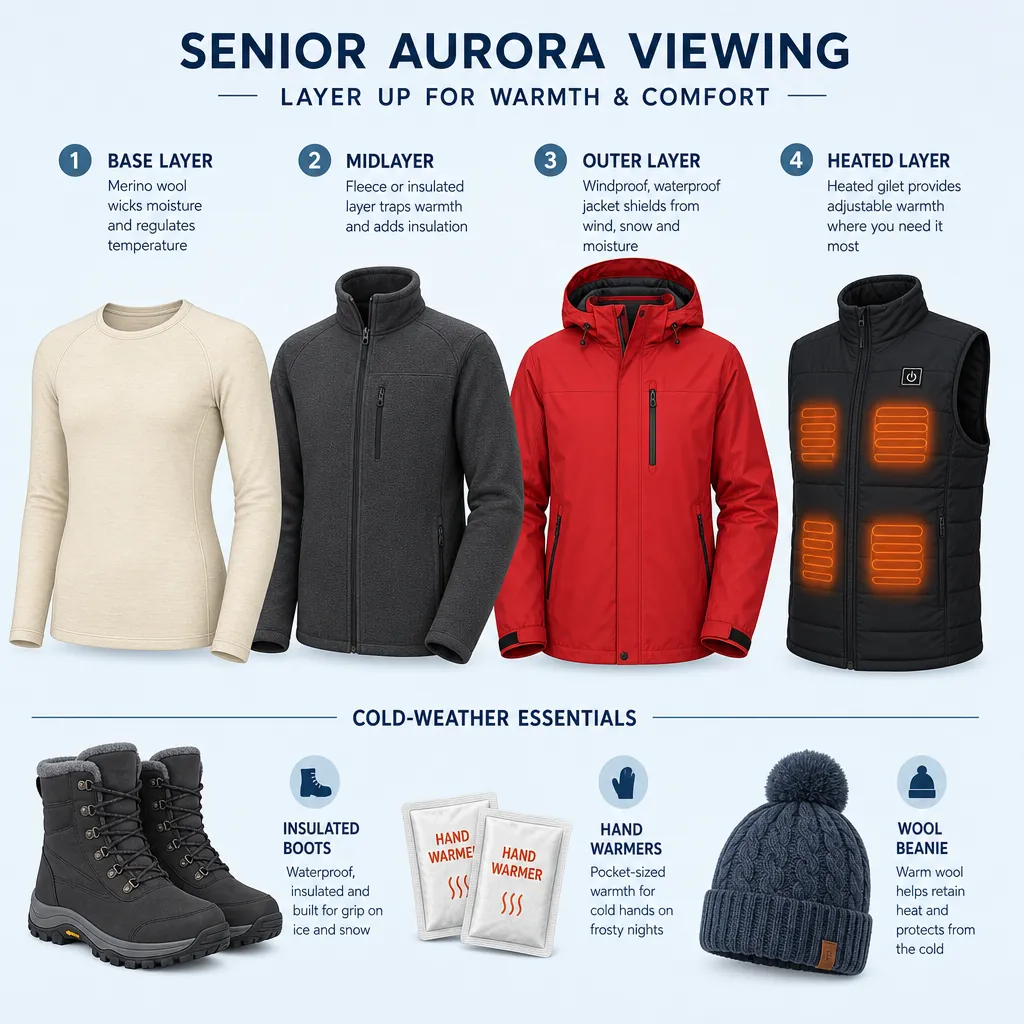
A senior-friendly clothing system should work from skin outward. A merino wool base layer helps manage moisture better than cotton. An insulated midlayer traps warmth. A windproof outer layer protects that warmth from being stripped away. Waterproof boots with grip soles matter because wet feet and insecure footing shorten the safe window outside. Approach Tours’ senior travel guidance for Iceland emphasizes three insulated layers, waterproof grip-soled boots, and hand and toe warmers as essentials rather than extras.[3]
Hand and toe warmers deserve a place in the plan, not the bottom of the suitcase. Fingers and toes are often where a traveler first loses useful function. Once hands are stiff, opening a door, adjusting a zipper, handling medication, or gripping a walking aid becomes harder. That is not just discomfort; it changes what the person can safely do next.
A heated gilet can be especially useful because it warms the torso without adding bulky sleeves. Aurora photographer Wil Cheung, described by the BBC as having more than 400 aurora sightings, called a heated gilet the single most effective comfort upgrade for aurora chasing.[4] For an older traveler, the value is not only comfort. Keeping the trunk warm helps the whole outing feel less like a test of endurance.
- Choose merino or another moisture-managing base layer; avoid cotton next to the skin.
- Add an insulated midlayer that does not restrict shoulder movement or breathing.
- Use a windproof outer shell with a hood, secure cuffs, and enough room for layers underneath.
- Wear waterproof boots with grip soles, plus warm socks that do not squeeze circulation.
- Pack hand and toe warmers where they can be reached before going outside.
- Test any heated gilet or battery-powered garment at home before relying on it during travel.
Make 20 Minutes Outside and 10 Minutes Inside the Rule
The safest cold-weather rhythm is the one decided while everyone is still warm. For aurora viewing with an older adult, use 20 minutes outside followed by 10 minutes inside as an operating rule, not a suggestion to remember after someone gets chilled.
The point is not that every older adult has the same exact cold tolerance. They do not. The point is that aging can make cold stress harder to detect from the inside. Scheduled indoor breaks remove the argument. No one has to admit defeat. The group simply follows the plan.
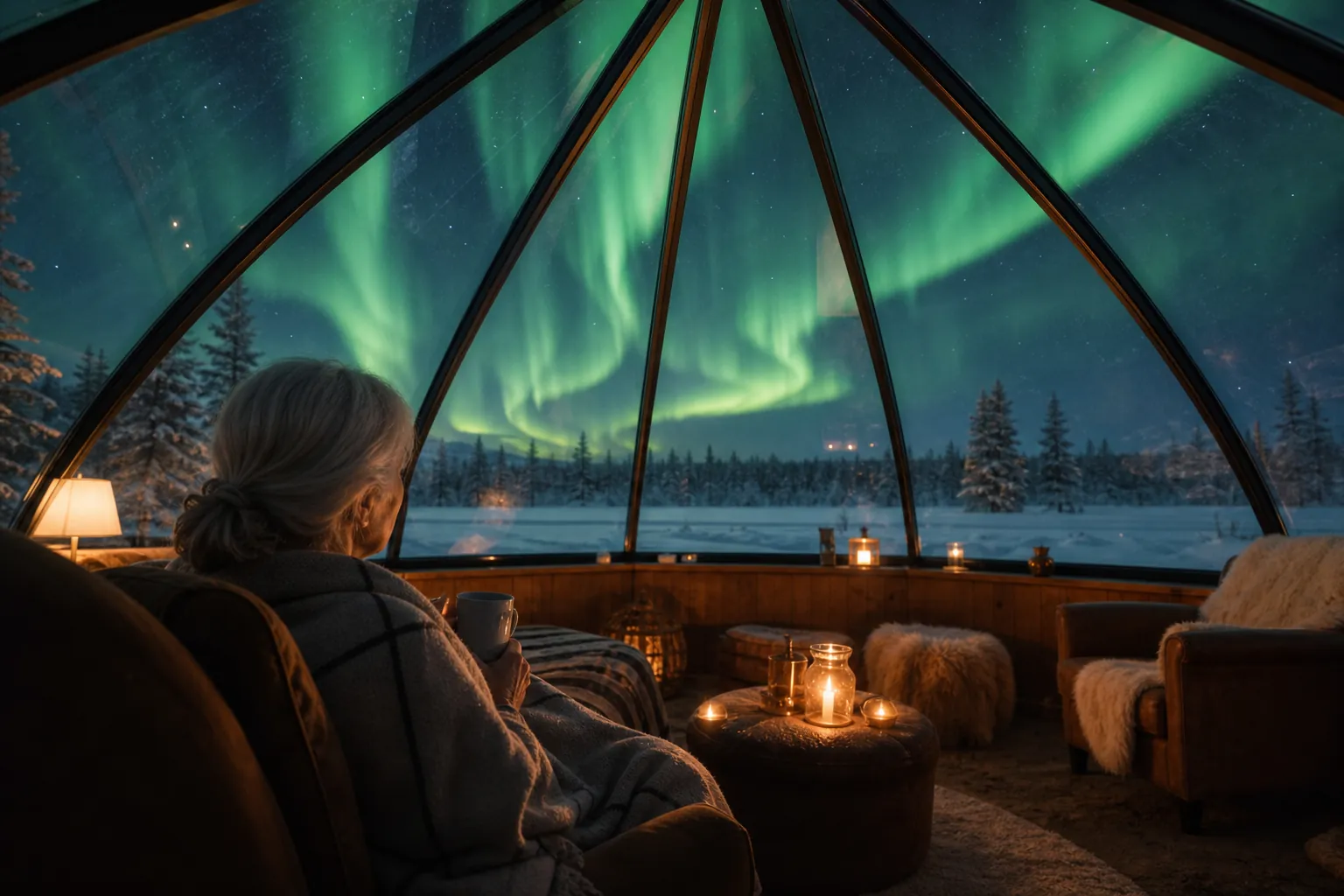
This is where heated viewing domes, indoor lounges, warm cruise cabins, and glass-roofed accommodations become safety infrastructure. AARP’s northern lights guide points to heated indoor-viewing options such as Borealis Basecamp dome suites, Aurora Igloo, and Hurtigruten cruises with a Northern Lights Promise.[2] Those features are often marketed as special experiences. For older travelers, they also reduce the dangerous gap between “I’m fine” and actually getting warm.
The indoor break should be real rewarming time. Sit down. Remove damp gloves if needed. Drink something warm if it agrees with the traveler. Check whether speech, color, breathing, and attention look normal. Then decide whether to go back out for another interval.
What a Companion Should Watch For
A companion does not need to diagnose hypothermia to act responsibly. The job is to notice change and end the exposure early. The warning signs HealthInAging highlights for older adults include confusion, slowed breathing, and pale skin.[1] On a trip, those may show up as delayed answers, unusual stubbornness, fumbling with zippers, drifting away from the group, or insisting on staying outside after the planned break.
That is a time to go in, not to negotiate under the sky. If symptoms do not improve promptly with warmth, or if breathing, alertness, chest discomfort, weakness, or coordination raise concern, seek medical help according to local emergency guidance.
Talk With a Physician Before the Trip, Especially About Heart Risk and Medications
A pre-travel medical conversation is not a formality for this kind of trip. It is where an older traveler can ask how their heart history, circulation, diabetes, mobility limits, blood pressure pattern, and medications might affect cold tolerance. Because sustained cold can raise blood pressure and increase heart attack and stroke risk in older adults, the clinician should know the trip involves nighttime outdoor waiting, not just ordinary winter sightseeing.[2]
Medication questions belong with a clinician or pharmacist. Some travelers take beta-blockers, blood pressure medications, sedatives, sleep aids, or other drugs that may affect cold response, balance, alertness, or how symptoms are noticed. This article cannot turn that into a self-checklist. The safe question is simple: “Given my conditions and medications, how long should I be outdoors in cold weather, and what symptoms should my companion treat as a stop sign?”
It is also worth asking what to do if the planned aurora night follows a poor sleep night, a respiratory illness, dehydration, alcohol, or a long travel day. The body that was cleared for a trip in general may still need a shorter outing on a rough day.
Choose Timing That Fits an Older Body, Not Just the Sky
Aurora timing in 2026 has an encouraging planning context, but it is not a guarantee. Space.com reported that 2026–2027 remains within an elevated northern lights window after solar maximum.[5] That makes timing worth considering, while still leaving room for the usual uncertainties of weather, cloud cover, solar activity, and local forecasts.
Equinox months deserve special attention for older travelers. September–October and February–March can offer a useful compromise: good aurora odds, less severe cold than deep winter, and darkness that may begin earlier in the evening rather than forcing the best effort into the 10 p.m.–2 a.m. stretch. 50° North, citing solar physicist Pål Brekke, identifies the equinox periods as especially favorable for northern lights activity.[6]
There is a trade-off. Around the equinox, there are fewer total dark hours than in deep winter. For a younger photographer chasing every possible hour outside, that may feel like a loss. For an older adult who needs sleep, safer footing, milder cold, and a workable recovery day, the compromise may be the better plan.
Do not book only around a calendar promise. Check current aurora forecasts, local weather, daylight hours, and tour conditions before departure. Mid-2026 timing guidance is useful for planning, but the actual night still belongs to the weather.
A Workable Plan for One Night of Viewing
For one aurora night, the plan should be plain enough that nobody has to improvise in the cold. Eat before going out. Use the restroom before bundling. Put warmers in place early. Confirm how to get back indoors. Agree that the 20-minute outdoor interval will end even if the sky is active.
- Start from a warm indoor base: dome, lodge, cruise cabin, vehicle, or lounge close enough to reach quickly.
- Dress fully before the first step outside, including hat, gloves, warm footwear, and wind protection.
- Set a timer for 20 minutes outside and return inside for 10 minutes of real rewarming.
- During each indoor break, check alertness, breathing, skin color, hand function, and steadiness.
- Stop for the night if confusion, unusual fatigue, chest symptoms, unsafe footing, or poor recovery appears.
Photography should stay secondary. A traveler who is trying to manage gloves, glasses, a phone screen, a tripod, and icy footing may miss the body signals a companion is trying to catch. If photos matter, simplify: let one person handle the camera, use a tour guide’s help, or accept fewer images in exchange for a safer night.
The same goes for pride. Needing indoor breaks, a heated gilet, a glass viewing room, or an earlier viewing month is not a failure of spirit. It is the design that lets an older traveler stand under the aurora without making cold exposure the price of wonder.
Northern lights viewing can be senior-friendly, but only when the safety plan is built around aging physiology rather than standard cold-weather travel advice.
References
- Tip Sheet: Winter Safety for Older Adults, HealthInAging.org, American Geriatrics Society
- Northern Lights Guide, AARP, December 2025
- Iceland Northern Lights Guide for Senior Travellers, Approach Tours
- An aurora chaser's guide to the northern lights, BBC, January 2026
- Northern Lights 2026: Where and when to see the aurora, Space.com
- Best month to see the Northern Lights, 50° North
Questions to bring to a clinician or OT
This is not medical, legal, or a family's final decision — only a framework. Bring these questions to a clinician, occupational therapist, or your local Area Agency on Aging.
Find Local HelpRelated reading
Noticed something outdated or inaccurate on this page? Flag a correction. We review every report against CDC, NIA, and AARP HomeFit guidance before updating a page.