
Caregiver decision guide
How to Spark Creative Aging in a Reluctant Parent
Learn how to introduce creative activities to a reluctant aging parent with practical, evidence-based techniques that boost their health and strengthen your caregiving relationship.
The first attempt often goes badly because it sounds too much like an assignment. You suggest watercolor, a playlist, a simple collage, or recording a few family stories, and your parent hears, “I have a project for you.” If they say, “I’m not good at that,” “What’s the point?” or “I’m too tired,” the problem may not be the activity. It may be the way the invitation lands.
That is why the most useful creative aging tips for seniors are not really about buying better supplies. They are about lowering embarrassment, making the first step small enough to try, and protecting your parent from feeling graded. A caregiver can act as a creativity coach, but only in the modest sense: remove friction, offer a choice, sit beside them, and stop before the whole thing becomes another caregiving task everyone quietly resents.
Why It Is Worth Trying, Even If Nobody Becomes an Artist
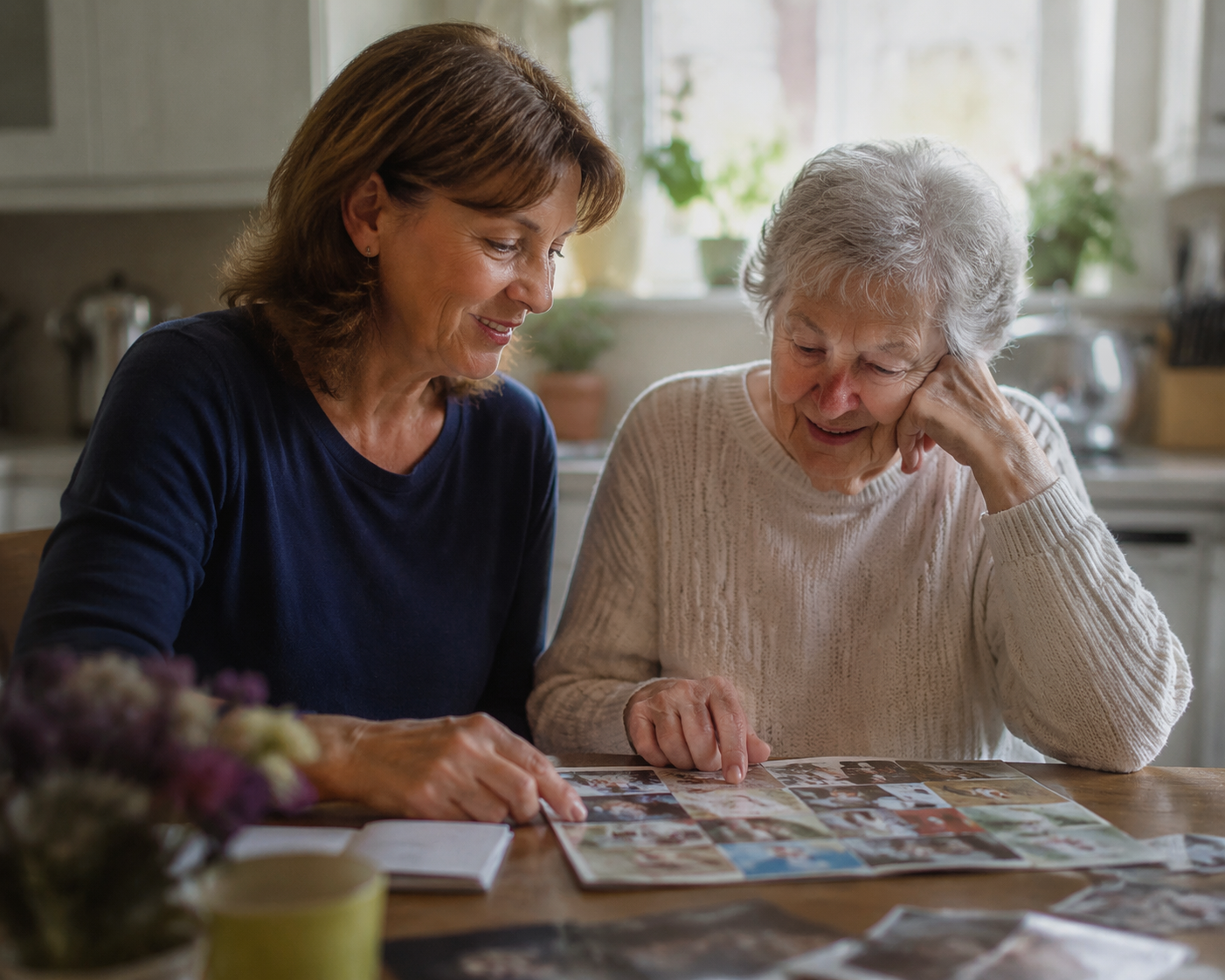
Creative aging does not need to mean art class, talent, or a new identity. It can be singing along to familiar songs, arranging old photos, making a card, choosing fabric scraps, shaping clay, telling a story into a phone recorder, or listening to live music. The point is not the finished object. The point is engagement: attention, memory, choice, hand movement when possible, language, rhythm, and a reason to stay with something pleasant for a little while.
The evidence is strong enough to take seriously, and also limited enough that it should not be oversold. In a Health and Retirement Study analysis of 19,134 adults age 50 and older from 2008 to 2016, older adults who engaged in creative activities were 20% less likely to experience depression, both immediately and two years later.[1] That does not mean a collage prevents depression by itself. It does mean creative activity belongs on the short list of practical ways to keep mood from shrinking along with the day.
The time commitment can also be smaller than caregivers fear. A 2023 EpiArts Lab cognition study followed 4,344 U.S. adults from their early 60s into their late 70s and found that both participatory arts, such as making or performing, and receptive arts, such as attending or listening, for 1–3 hours per week were associated with better executive function, language abilities, and memory seven years later.[2] Association is not a promise. Still, 1–3 hours a week is a reachable target: two half-hour sessions and one longer one, or a few short moments that add up.
Other EpiArts findings widen the picture. In a 2024 study of 8,771 adults age 50 and older, creative activities showed more consistent benefits across daily functioning, fitness, sleep, and overall feelings of health than other leisure categories.[3] Another 2023 study of 12,412 adults age 50 and older linked creative and social engagement with fewer hospital stays and nursing home admissions.[4] Those results do not turn painting, music, or storytelling into medicine. They do suggest that a more engaged life is not decorative. It is part of how older adults keep using what they still have.
Start With the Resistance, Not the Supplies
A reluctant parent is usually protecting something. Dignity, privacy, energy, competence, control. If they used to be the person who hosted holidays, fixed the sink, balanced the checkbook, or managed everyone else’s schedule, being handed a craft kit can feel insulting. Even a thoughtful idea can sound childish if it arrives with too much cheer.
So the first job is not persuasion. It is translation. Instead of saying, “Let’s do an art activity,” make the invitation sound like an ordinary shared moment.
| If this sounds too managed | Try this instead |
|---|---|
| I bought you a painting kit. | I found these colors and wondered which one you like best. |
| You should work on your memory. | Can you help me remember who is in this photo? |
| Let’s do something creative today. | Do you want music while we fold laundry, or should we look through a few old pictures? |
| This will be good for you. | I’d like to sit with you for ten minutes. We can stop after that. |
The difference is small but important. The second version gives the parent a role. It does not announce improvement work. It also gives an exit, which makes saying yes safer.
The First Invitation Should Be Almost Too Easy
For a first attempt, choose something with almost no setup and no visible standard of success. A blank canvas can intimidate anyone. A half-finished family photo album, a familiar song, a basket of greeting cards, or a few magazine pictures on the table gives the parent something to respond to instead of something to produce.
Offer two choices, not an open-ended menu. “Would you rather listen to Ella Fitzgerald or the church choir recording?” is easier than “What do you want to do?” “Should we sort beach photos or holiday photos?” is easier than “Tell me about your life.” Choice preserves control; too much choice creates work.
- Use materials already connected to your parent’s life: recipes, photos, music, fabric, garden catalogs, old letters, postcards, tools, buttons, or newspaper clippings.
- Keep the first session short enough that stopping feels natural, not like failure.
- Begin with looking, listening, sorting, choosing, or remembering before asking them to make anything.
- Do the activity beside them rather than standing over them.
- Praise the decision, memory, effort, or company, not the quality of the result.
The caregiver guide from Hovi Care uses the same practical direction: start small, focus on process rather than product, join alongside rather than instructing, and adapt creative activities to the person’s cognitive stage.[5] That advice sounds simple until you are tired and trying not to sound like a camp counselor. It helps to plan the wording ahead of time.
A first-session script
Try something this plain: “I brought a few photos. I don’t want to organize the whole box. Can we just pick three you like?” Then sit down. Put the photos between you, not in your lap. Let silence do some work. If your parent points, laughs, corrects a name, or pushes one photo aside, that counts as participation.
If they say, “I’m no good at this,” answer the fear, not the sentence. “Good. Then we don’t have to make anything impressive.” Or: “I’m not asking for art. I just want your opinion.” The less you argue, the less they have to defend the refusal.
Sit Beside, Not Across
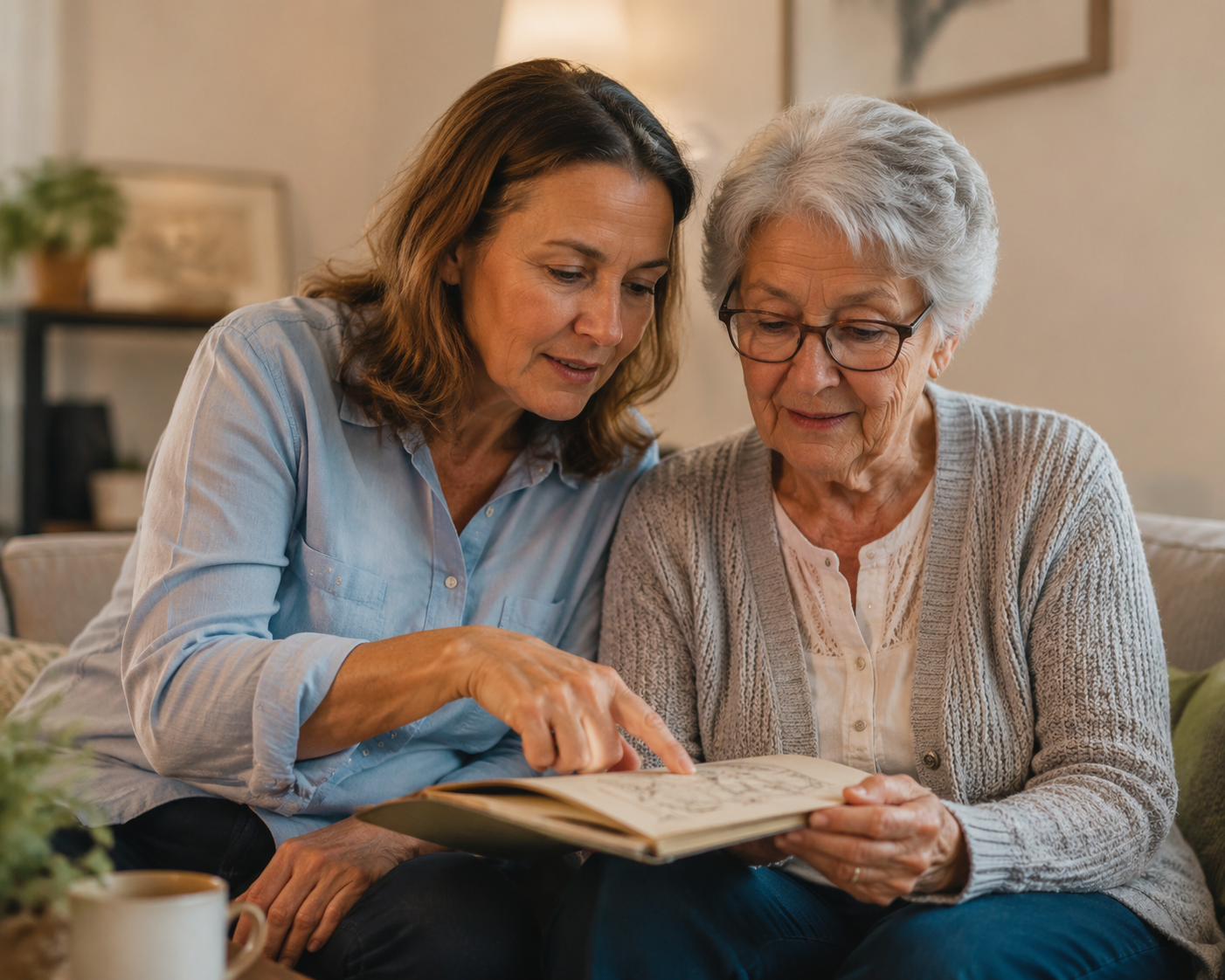
The physical setup matters more than it seems. Sitting across the table can feel like being tested. Standing nearby can feel like supervision. Sitting shoulder-to-shoulder changes the mood. You are looking at the same object together: a photograph, a recipe card, a sketchbook, a song list, a lump of clay, a few flowers in a vase.
This also protects the caregiver from performing too hard. You do not have to be the entertainment director. You can cut out the magazine picture while your parent chooses where it goes. You can hum along badly. You can write down the sentence they dictate. You can be the hands if their hands are stiff, while they remain the person making decisions.
That distinction matters for dignity. If arthritis makes scissors difficult, your parent can still select, arrange, approve, reject, remember, and laugh. If vision is limited, they can still choose music, textures, scents, or spoken stories. If speech is harder than it used to be, they may still respond through tapping, pointing, facial expression, or a repeated phrase. The activity should bend around the person, not the other way around.
Choose Activities by Friction Level
Long lists of senior activities can be oddly unhelpful because they treat all ideas as equal. They are not. A project that requires shopping, setup, cleanup, fine motor control, and a cheerful attitude may be a poor fit for a Wednesday afternoon. Pick by friction first.
| Low-friction option | What the parent can do | Why it works |
|---|---|---|
| Music from a familiar decade | Choose songs, tap, sing, remember, or simply listen | No hand skill required; familiar music can open conversation |
| Photo sorting | Identify people, choose favorites, group by event, dictate captions | Uses memory and identity without demanding a polished product |
| Recipe storytelling | Describe a dish, correct your version, name who liked it | Turns family knowledge into the creative material |
| Simple collage | Select images, arrange pieces, approve placement | Allows shared making even when the caregiver handles cutting or glue |
| Seasonal cards | Pick colors, dictate a message, add stickers or a signature | Creates a small social connection with a clear endpoint |
| Read-aloud poetry or short passages | Listen, choose a line, react, compare it to a memory | Works when energy is low and attention comes in short stretches |
The best choice is usually the one that lets your parent enter through competence. A retired nurse may respond to sorting old medical pins or telling work stories. A former gardener may enjoy seed catalogs more than paint. A parent who always cooked may not want to “make art” but may enjoy designing a family recipe page. Creativity does not have to wear a smock.
Adapt Without Announcing the Adaptation
Adaptations are kinder when they are built into the setup instead of presented as accommodations. Put out thick markers instead of saying, “These will be easier for your hands.” Use large photos instead of explaining vision decline. Offer a short playlist instead of saying attention span is shorter now.
If mobility is limited
Bring the activity to the chair, bed, or kitchen table where your parent is already comfortable. Use a tray, clipboard, lap desk, or shallow box lid so materials do not slide away. Choose activities that can be paused without ruining anything. Music, story prompts, photo selection, clay, textured fabric, and arranging objects are more forgiving than wet paint or complicated tools.
If memory or cognition is changing
Use fewer materials and repeat the same structure. “Pick one,” “tell me about this,” and “should this go here or here?” are better than multi-step instructions. Avoid correcting every mistaken date or name unless the mistake affects safety or causes distress. In a creative moment, accuracy is not always the highest value. Connection may be.
Art therapy research is relevant here, but it should be kept in its lane. A 2022 scoping review in Frontiers in Psychology looked at 12 studies of art therapy interventions for community-dwelling older adults without diagnosed pathology and found improvements in cognitive performance, self-identity, and loneliness.[6] That supports the idea that structured creative engagement can have preventive value. It does not mean every family activity is therapy, and it does not make a caregiver responsible for delivering treatment.
If time is the problem
Do not start with a weekly masterpiece. Attach creative engagement to something that already happens: coffee, a phone call, Sunday dinner, folding laundry, sorting mail, waiting before an appointment. Ten minutes of choosing songs while you make lunch is still a real start. A short phone call where your parent helps name people in one photo can become part of the weekly rhythm.
Build Toward 1–3 Hours a Week Without Making It a Burden
The 1–3 hour finding is useful because it is small enough to plan around.[2] It does not require a personality change. It asks for a rhythm. The safest rhythm is predictable, short, and easy to repeat when nobody slept well.
| Weekly rhythm | What it might look like |
|---|---|
| One anchor session | A 30- to 45-minute visit on Tuesday with music, photos, cards, or a simple project |
| Two tiny add-ons | Ten to twenty minutes during a call, meal, or appointment wait |
| One receptive activity | Listening to a concert recording, watching a performance, or attending a short local program if energy allows |
| One continuation cue | Leaving the photo box, playlist, or card basket visible so next time starts faster |
A weekly rhythm should have an obvious beginning and ending. “After lunch on Tuesdays, we pick three photos and write one caption” is more sustainable than “We should do more creative things.” The routine carries the decision so the caregiver does not have to re-sell the idea every time.
Stopping early is part of the plan. Fatigue can turn a good activity sour in five minutes. If your parent is still engaged, end with something like, “Let’s leave this here for next time.” That preserves anticipation. It also avoids the common caregiving mistake of continuing because something is finally working.
What to Notice Besides the Finished Product
A finished painting or scrapbook page is nice, but it is not the main measurement. Watch for smaller signs: your parent stays at the table a little longer, corrects your memory of a story, chooses a song before you offer one, asks where the cards went, smiles at a photo, sleeps better after a calmer afternoon, or has something new to mention on a phone call.
Also notice what changes for you. A caregiver can spend months in a relationship made of pill boxes, insurance calls, safety reminders, and appointments. Creative time gives you another way to be in the room. You are not only monitoring. You are listening, making, remembering, and sometimes doing nothing more impressive than sharing a song.
If an activity repeatedly causes agitation, shame, argument, or exhaustion, drop it. That is not failure. It is information. Try a more familiar material, a shorter session, a receptive activity, or a different time of day. The standard is not whether your parent becomes creative on command. The standard is whether the practice leaves both of you with a little more ease than you had before.
When a Program Helps More Than Doing It Yourself
Some parents respond better to someone who is not their adult child. A community arts program, senior center workshop, adult day program, assisted living activity, choir, museum session, or professionally led art therapy group can remove the family dynamic from the invitation. That can be a relief, especially when your parent hears every suggestion from you as management.
The NEA’s 2006 Creativity and Aging Study is often cited in support of professionally conducted community arts programs, with reports of better physical health, fewer doctor visits, and improved mental health among participants compared with non-participants. Because the original study is being cited here through secondary evidence summaries and review literature, it should be treated as supportive context rather than the main proof.[7][6]
Even when a program is available, the caregiver role still matters. You may be the person who frames it without pressure, handles transportation, checks whether the room is accessible, asks whether supplies are adapted, and gives your parent permission to attend once without committing forever.
A Realistic Version of Success
Success may look unimpressive from the outside. Your mother lets you play three songs while she folds napkins. Your father tells the same fishing story while you label one photo. A parent who refused “art” agrees to choose colors for a birthday card. A person with limited speech taps along to a hymn. The day is not transformed, but it has a shape.
That is enough to build on. Creative aging works best at home when it respects the older person’s pride and the caregiver’s limits. Keep it small, familiar, optional, and repeatable. Let the activity carry less weight than the time together.
References
- Engagement in Leisure Activities and Depression in Older Adults, PMC
- Participatory and Receptive Arts Engagement in Older Adults: Associations With Cognition Over a Seven-Year Period, Lifetime Arts Resource Center, 2023
- Leisure Engagement in Later Life Is Related to Objective and Subjective Experiences of Aging, Lifetime Arts Resource Center, 2024
- Associations of Social, Cultural, and Community Engagement With Health Care Utilization in the US Health and Retirement Study, Lifetime Arts Resource Center, 2023
- The Caregiver's Guide to Encouraging Creative Activities in Seniors, Hovi Care
- Art Therapy for Older Adults With Dementia: A Scoping Review, Frontiers in Psychology, 2022
- Evidence, Lifetime Arts
Questions to bring to a clinician or OT
This is not medical, legal, or a family's final decision — only a framework. Bring these questions to a clinician, occupational therapist, or your local Area Agency on Aging.
Find Local HelpRelated reading
Noticed something outdated or inaccurate on this page? Flag a correction. We review every report against CDC, NIA, and AARP HomeFit guidance before updating a page.