
Caregiver decision guide
SSDI payment delayed for your elderly parent? Here's what to check
When an elderly parent's Social Security disability payment doesn't arrive, caregivers need to quickly diagnose why. This guide explains the four main categories of SSDI delays — from SSA backlogs to simple reporting errors — and the specific corrective action each requires.
The first thing to sort out is what kind of “late” you are dealing with. An SSDI application that has not been approved yet is a different problem from a monthly SSDI payment that usually arrives and did not show up today. One is a claims-processing delay. The other is a payment-delivery problem. They use some of the same Social Security offices and phone numbers, but they do not have the same fix.
Also make sure the benefit is actually SSDI. SSDI is Social Security Disability Insurance, generally tied to a worker’s Social Security-covered work history. SSI is Supplemental Security Income, a needs-based program for people with limited income and resources, including some elderly recipients. Families often use the acronyms loosely when they are stressed. This guide focuses on SSDI, but if the letter, bank deposit, or online account says SSI, the payment schedule and some rules may be different.

Start with the payment date, not the panic
For monthly SSDI, the “missing payment” question starts with the calendar. Many Social Security payments arrive on the second, third, or fourth Wednesday of the month, depending on the beneficiary’s birth date. That can make the gap between deposits feel uneven: a normal scheduled gap can run from 28 to 35 days. Newsweek’s May 2026 example described seniors waiting longer between benefit payments because of the way Wednesdays fell on the calendar, not because SSA had stopped the payment [1].
Before calling anyone, check the expected date against the parent’s birth date and the current month’s calendar. If the expected Wednesday has not arrived, the payment is not late yet. If the expected date has passed, SSA’s standard triage advice is still to wait 3 business days before reporting a missing payment, then call 1-800-772-1213 or contact the local Social Security field office [2][3].
| If your parent was born | Usual SSDI payment timing |
|---|---|
| 1st through 10th of the month | Second Wednesday |
| 11th through 20th of the month | Third Wednesday |
| 21st through 31st of the month | Fourth Wednesday |
Business days matter. A weekend or federal holiday can make a “three-day” wait feel longer in a household that is already counting grocery money. If the payment was due Wednesday, do not count Saturday or Sunday as business days when deciding whether SSA will treat it as missing.
The four buckets to check
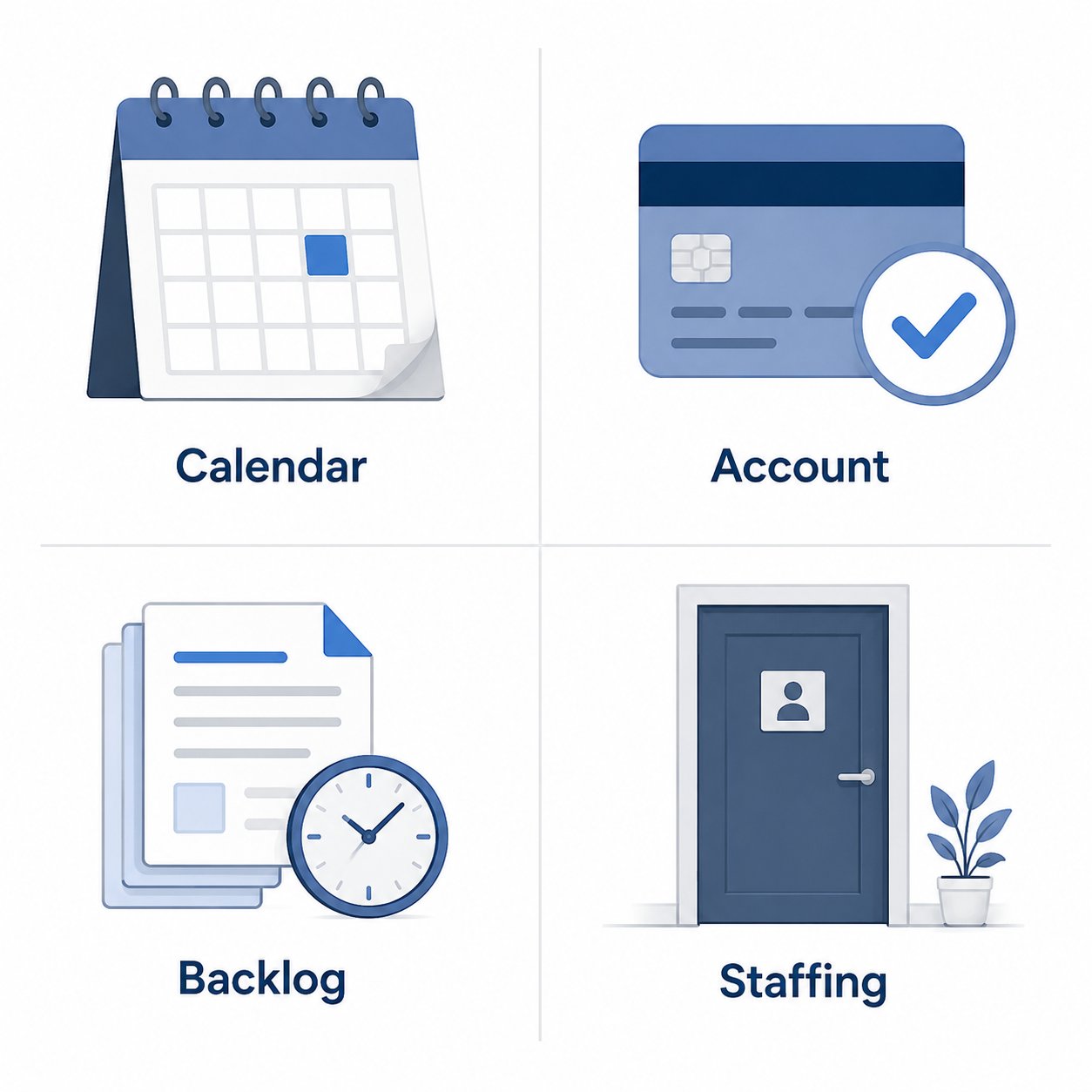
| Bucket | What it usually looks like | Best next action |
|---|---|---|
| Calendar schedule | Payment feels late, but the scheduled Wednesday has not passed or 3 business days have not elapsed | Confirm the payment date and wait until SSA’s missing-payment window has passed |
| Bank, address, or reporting issue | Payment was expected, but there was a recent direct deposit change, move, mail problem, or unreported status change | Check the bank and SSA account details; call SSA if the payment is still missing |
| Application or approval timing | Parent is waiting for an initial SSDI decision, appeal, or first payment after approval | Separate claim status from monthly payment status; watch for the 5-month waiting period |
| SSA staffing or field-office constraint | You cannot get through, appointments are delayed, or the claim seems stuck despite correct paperwork | Document every contact attempt and use the correct SSA channel, but recognize another call may not speed the file |
If the monthly payment really is missing, look for account and reporting changes
Once the scheduled date and 3-business-day window have passed, the fastest useful question is not “Why is Social Security doing this?” It is “What changed since the last successful deposit?”
- Was the direct deposit account changed, closed, frozen, or merged into another account?
- Did your parent move, start forwarding mail, or miss a letter from SSA?
- Did the bank reject the deposit because the name or account information did not match?
- Was there an out-of-country stay, work change, or other status change that SSA may have needed reported?
- Is there a representative payee, and did that person receive a notice or payment information the rest of the family has not seen?
Consumer finance and disability-benefit guidance repeatedly point to bank account changes, address changes, and reportable status changes as common avoidable reasons Social Security payments are delayed or suspended [2][3][4]. That does not mean your parent did anything wrong. It means the payment system may be waiting on a correction that no one in the family realized mattered.
Before calling SSA, gather the boring proof that turns a vague complaint into a fixable problem: your parent’s full name, Social Security number, date of birth, current address, bank routing and account information, last successful deposit date, expected payment date, and any SSA letter received in the last few months. If you are not the representative payee or authorized contact, expect limits on what SSA can discuss with you.
Then call SSA at 1-800-772-1213 or contact the local field office. If the bank says it did not receive or rejected the payment, write down the bank’s explanation, the date, and the person or department you spoke with. If SSA says the payment was issued, ask what date it was sent and whether it was direct deposit, paper check, or another method. Those details matter if the issue has to be traced.
Approval does not always mean a payment is coming this month
A different kind of scare happens when an elderly parent finally receives an SSDI approval, everyone exhales, and then no deposit appears. SSDI has a mandatory 5-month waiting period before benefits begin [5]. The family may be reading “approved” as “paid now,” while SSA is applying the waiting-period rule.
Pull the approval notice and look for three separate dates: the disability onset date, the entitlement date, and the payment date. If the letter is hard to decode, do not try to solve it from memory while sitting on hold. Mark the dates on paper. The issue may be that the first payment has not legally become payable yet, not that a monthly check disappeared.
If the notice says payment should already have started, then treat it like a missing monthly payment: confirm the account, confirm the address, wait the 3-business-day missing-payment window if the scheduled date just passed, and call with the notice in front of you.
If there has never been a payment, you may be looking at the claims backlog
When a parent is still waiting for an initial SSDI decision, the word “delayed” means something else entirely. SSA performance data cited in 2026 reporting showed initial disability decisions averaging about 227 to 231 days in fiscal year 2024, roughly 7.5 to 8 months, up about 81% from around 121 days in 2019 [6]. That is an average, not a promise. Some files move faster; some sit longer because of medical-record collection, state Disability Determination Services workloads, consultative exams, or appeal posture.
The painful part is that a long wait can be normal processing and still be financially disastrous. It can also hide a correctable problem: SSA may be waiting for medical records, a form, an exam response, or an appeal filing. A caregiver’s job here is to find out whether the file is simply pending or whether something specific is missing.
- Check the claim status through your parent’s my Social Security account if they have one.
- Look for recent SSA or DDS letters asking for medical releases, work history, daily activity information, or exam attendance.
- Call the number on the most recent claim notice, not just the general SSA line, if the notice identifies a disability examiner or office.
- Keep a call log with dates, phone numbers, names if given, and what each office said was still needed.
Denial is also common at the initial level. AARP’s June 2024 coverage and SSDI wait-time analyses put initial SSDI denials at roughly 67%, which can push applicants into a much longer appeals process [7]. A parent who says “Social Security hasn’t paid me” may actually have been denied months ago, missed the appeal window, or filed an appeal that is now waiting in another queue.
That distinction changes the next step. A pending claim needs status tracking and missing-document follow-up. A denied claim needs attention to appeal deadlines. An approved claim with no payment needs the waiting-period and payment-delivery checks. Lumping all three together wastes the family’s limited energy.
Sometimes the delay is the system, not the file
There is a point where families have checked the calendar, the bank, the address, the approval notice, the appeal status, and the paperwork trail—and the answer is still slow processing. That is not comforting, but it is different from being at fault.
The broader SSA operating picture helps explain why. The agency cut more than 7,100 jobs in 2025, described in 2026 reporting and Urban Institute analysis as its largest staffing reduction ever, and closed 6 of 10 regional offices [6][8]. Fewer staff and fewer regional offices do not prove the reason for any one parent’s delayed payment, but they make long hold times, slower responses, and backlog pressure less surprising.
Field-office access has also become less reliable in some places. As of May 2026, reporting from Gordon, Wolf & Carney described 10 Social Security field offices in 9 states as appointment-only or fully closed, with phone wait times remaining a barrier [9]. If your local office cannot take walk-ins, showing up with a folder may not solve anything. Call first, confirm appointment rules, and write down what the office tells you.
This is where documentation matters even when it feels useless. Keep copies of notices, fax confirmations, uploaded documents, bank statements showing the missing deposit, and a dated call log. If the problem escalates—to a field office, a claims representative, a representative payee issue, or eventually a congressional constituent-services office—the family that can show the paper trail is in a better position than the family trying to reconstruct six months from memory.
A clean next-action map
- Confirm the program: SSDI, SSI, retirement, survivor, or another Social Security payment. Do not assume the acronym is right.
- If it is a recurring SSDI payment, confirm the scheduled Wednesday based on birth date and the current month’s calendar.
- If the scheduled date has passed, wait 3 business days before reporting it missing unless SSA or the bank has already identified a specific error.
- Check for recent bank account, address, mail, representative payee, travel, or status changes.
- If the parent was just approved, read the notice for the disability onset date, entitlement date, payment date, and the 5-month SSDI waiting period.
- If the parent is still applying or appealing, check whether the claim is pending, denied, awaiting records, awaiting an exam, or past an appeal deadline.
- Call 1-800-772-1213 or the local field office with records ready: dates, notices, bank information, claim status, and a call log.
- If the office cannot act immediately, document the contact and ask what exact event should trigger the next follow-up.
References
- Social Security Update: Seniors Will Wait Longer for Benefits Next Month, Newsweek
- Reasons Your Social Security Payment Is Delayed and What to Do About It, U.S. News
- Social Security Payment Delayed? Reasons Why, Kiplinger
- Late Social Security Disability Payments, Leventhal Sutton & Gornstein
- Social Security Disability Benefits, Social Security Administration
- Social Security SSA disability claims drop Trump performance dispute, Fortune, June 2, 2026
- SSD Wait Times: Case Study, Hiller Comerford
- Downsizing Staff Will Make It Harder to Receive Social Security Payments, Urban Institute
- SSA Backlogs and Delays: What Recent Changes Mean for Your Disability Claim Timeline, Gordon, Wolf & Carney
Questions to bring to a clinician or OT
This is not medical, legal, or a family's final decision — only a framework. Bring these questions to a clinician, occupational therapist, or your local Area Agency on Aging.
Find Local HelpRelated reading
Noticed something outdated or inaccurate on this page? Flag a correction. We review every report against CDC, NIA, and AARP HomeFit guidance before updating a page.