
Caregiver decision guide
SSI Payment Schedule July 2026 Explained for Seniors
SSI recipients will receive two payments in July 2026 — July 1 and July 31 — because August 1 falls on a Saturday. This guide explains the exact schedule, why this happens, and how to budget when no SSI deposit arrives in August.
For July 2026, the SSI payment schedule is simple but easy to misread: SSI pays on Wednesday, July 1, and again on Friday, July 31. The July 1 deposit is the regular July SSI benefit. The July 31 deposit is August’s SSI benefit arriving early because August 1, 2026 falls on a Saturday. There is no separate SSI deposit in August.[1][2]
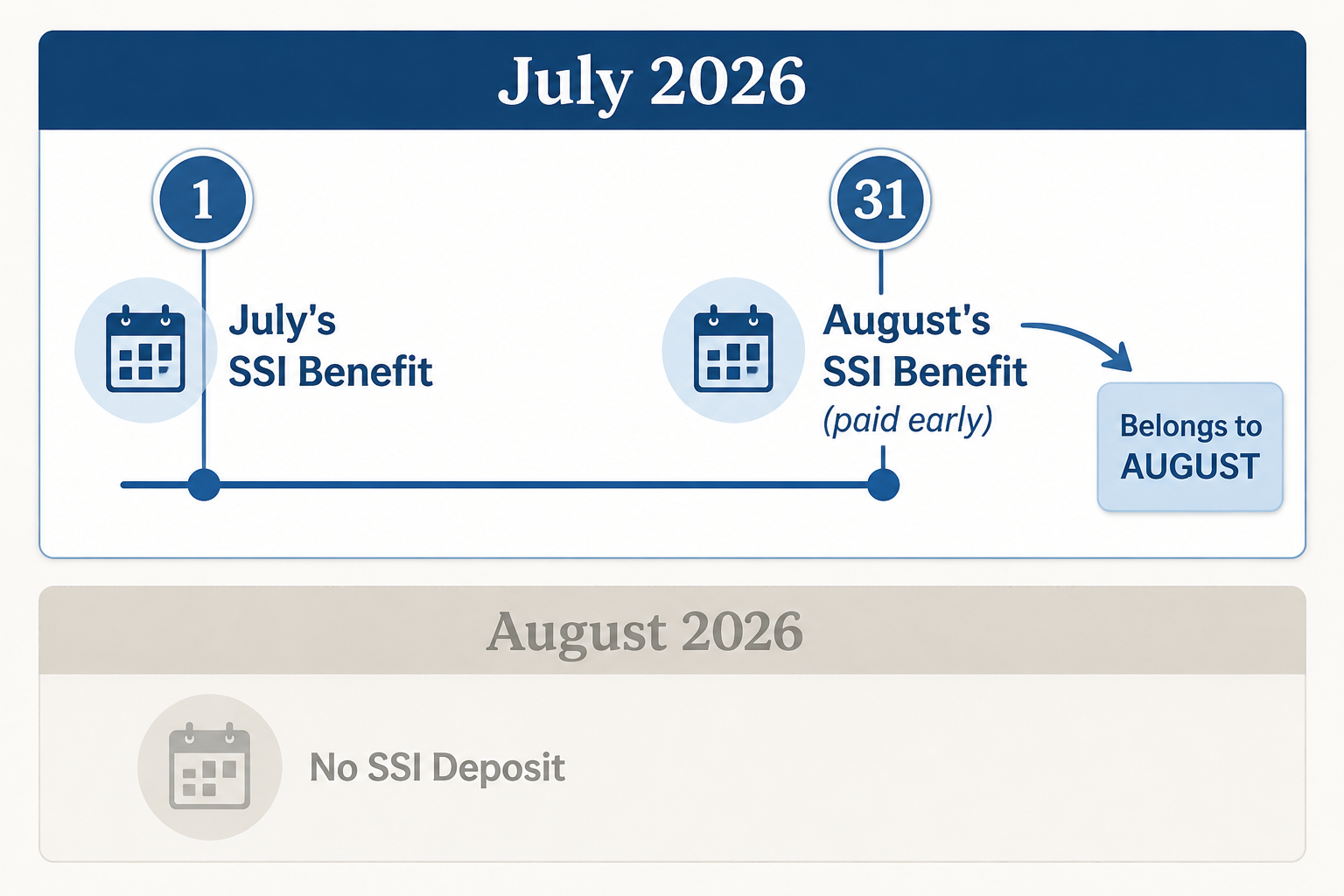
That second July deposit is not extra money, not a bonus, and not a correction payment. It is August money showing up one business day before August begins. If rent, groceries, utilities, medication costs, or an in-home aide are paid from SSI, the safest label for the July 31 deposit is “August SSI.”
| Date | What It Is | How To Treat It |
|---|---|---|
| July 1, 2026 | Regular July SSI benefit | Use for July expenses |
| July 31, 2026 | August SSI benefit paid early | Set aside for August expenses |
| August 2026 | No separate SSI deposit | Do not expect another SSI payment until September 1 |
Why SSI pays twice in July 2026
SSI normally pays on the first day of the month. When the first lands on a weekend or federal holiday, the Social Security Administration moves the payment to the preceding business day. Since August 1, 2026 is a Saturday, the August SSI benefit moves back to Friday, July 31.[1]
This is the whole mechanism. The calendar moved the payment date; it did not change the benefit month. A bank statement may show two SSI deposits in July, but the household budget still has one July benefit and one August benefit.
The distinction matters because a payment date is not always the same thing as the month the money is meant to cover. July 31 is physically in July, but for SSI budgeting it belongs to August. Spending it as if it were surplus July income creates the gap: bills keep arriving in August, but no new SSI deposit does.
What seniors and caregivers should do with the July 31 deposit
The practical step is to separate the two July deposits as soon as they appear. If the account holder uses one checking account for everything, put a note in the register, budgeting app, shared spreadsheet, or paper calendar: “July 31 SSI = August benefit.” If another family member helps review bills from out of state, send that note before anyone assumes the account has extra cash.
A cleaner method is to map August’s fixed expenses against the July 31 deposit before touching it. Start with rent or housing charges, utilities, phone, insurance, prescription refills, transportation, groceries, and any regular caregiving payments. If a bill is usually paid after the first of the month, the money for it still needs to come from the July 31 SSI deposit.
- Rename or tag the July 31 deposit as “August SSI” in the household budget.
- Do not treat the second July deposit as extra spending money.
- Tell anyone helping with bills that no SSI payment arrives in August.
- Check automatic payments scheduled for early August so they do not create an overdraft.
Financial planners quoted by Newsweek made the same point in plain budget language: the second July SSI payment is not a bonus or windfall; it is the August benefit paid early.[3] That warning is useful because the mistake is not theoretical. A second deposit can make the account balance look comfortable for a few days, especially if the rent has not cleared yet.
How much the July SSI payment may be
For 2026, the maximum federal SSI amounts are $994 per month for an eligible individual, $1,491 per month for an eligible couple, and $498 per month for an essential person.[4] Those are federal maximums, not a promise that every recipient will receive that amount.
Actual SSI payments can be lower because of countable income, living arrangements, or other eligibility factors. Some states also add state supplements, which can change the amount a person receives. That is why the date rule can be explained nationally, while the exact deposit amount may still need to be checked against the recipient’s SSA notice, my Social Security account, bank record, or state supplement information.
The July 2026 two-payment pattern does not double the monthly benefit. A recipient whose regular federal SSI amount is the same from month to month is seeing timing compressed into July, not a new entitlement added to July.
SSI and Social Security are not on the same schedule
Many seniors receive more than one kind of benefit, so it is easy for household calendars to get messy. The two-payment issue in July 2026 is about SSI specifically. Social Security retirement, survivor, and disability benefits usually follow a different payment schedule tied to birth dates or other program rules, depending on the person’s situation.
If a parent or spouse receives both SSI and Social Security, track the deposits separately. The July 31 SSI deposit should still be marked as August SSI, even if another Social Security payment arrives on a different date. Mixing the labels can make it harder to tell whether a payment is missing, early, or simply from another program.
Other 2026 SSI dates to mark now
After the July 31 early payment, the next regular SSI payment date is Tuesday, September 1, 2026. The remaining 2026 SSI calendar has two more early-payment dates worth circling: Friday, October 30, for the November benefit, and Thursday, December 31, for the January 2027 benefit.[5]
| Payment Date | Benefit Month | Why It Matters |
|---|---|---|
| September 1, 2026 | September 2026 | Regular first-of-month SSI payment |
| October 1, 2026 | October 2026 | Regular first-of-month SSI payment |
| October 30, 2026 | November 2026 | November 1 falls on a Sunday, so SSI pays early |
| December 1, 2026 | December 2026 | Regular first-of-month SSI payment |
| December 31, 2026 | January 2027 | January 1 is a federal holiday, so SSI pays early |
Those dates are not separate bonus months either. They are the same weekend-and-holiday rule showing up again. Marking them now prevents the same confusion from repeating in the fall and at year-end.
When the early deposit may affect other paperwork
The July 31 deposit is August’s SSI benefit for payment-schedule purposes, but other programs may have their own reporting instructions. SNAP, housing assistance, Medicaid-related programs, and other income-based benefits can use monthly income information in ways that vary by program and state. If a form asks about deposits received in July, do not guess. Ask the caseworker or program office how to report an SSI benefit paid early for August.
Resource limits are another reason not to rely on assumptions. SSA says SSI resource limits are $2,000 for an individual and $3,000 for a couple.[6] SSA also explains that resources generally include things a person owns, such as cash, bank accounts, stocks, U.S. savings bonds, land, vehicles, personal property, life insurance, and anything else that can be converted to cash for food or shelter, though exclusions can apply.[7]
That does not mean every early SSI payment automatically creates a resource problem. It means caregivers should be careful when balances look higher at the end of July than usual. If the early payment raises a reporting question, use SSA or the relevant benefits office rather than a social media explanation or a bank teller’s guess.
What to check if the amount or date looks wrong
If the July 31 deposit arrives, the first check is the label: treat it as August SSI. If it does not arrive when expected, or the amount is different from the usual payment, compare the bank record with the recipient’s SSA notice or online account. A state supplement, change in living arrangement, income change, or administrative adjustment may affect the amount, but the July 31 date itself is explained by the calendar rule.
Keep the verification chain short: SSA schedule, SSA notices, the bank record, and any state benefit office involved. General news coverage can help identify the pattern, but the household decision is straightforward: July 1 is July’s SSI, July 31 is August’s SSI, and August has no separate SSI deposit.
References
- Social Security Payment Schedule, AARP
- SSI check July 2026: See when your payment will arrive, USA Today via Yahoo Finance
- Social Security Update: Some Recipients Will Get Paid Twice in July, Newsweek
- 2026 Social Security Changes, Social Security Administration
- July 2026 Social Security and SSI payment dates, Democrat and Chronicle
- Supplemental Security Income (SSI) Eligibility Requirements, Social Security Administration
- Understanding Supplemental Security Income SSI Resources, Social Security Administration
Questions to bring to a clinician or OT
This is not medical, legal, or a family's final decision — only a framework. Bring these questions to a clinician, occupational therapist, or your local Area Agency on Aging.
Find Local HelpRelated reading
Noticed something outdated or inaccurate on this page? Flag a correction. We review every report against CDC, NIA, and AARP HomeFit guidance before updating a page.