
How to Get Your Aging Parent to a Cooling Center During a Heat Wave
Learn how to locate a cooling center for an older loved one who lacks air conditioning, overcome common barriers like transportation and reluctance, and plan the visit so it actually protects their health.
If your parent’s home is too hot today and they do not have reliable air conditioning, treat the cooling center trip as a same-day safety plan, not a casual suggestion. Start with the fastest locator options: call 2-1-1, check your county or city emergency management page, search your state or local health department’s heat emergency page, look at local news alerts, call the nearest senior center or Area Agency on Aging, and use the National Center for Healthy Housing’s state-by-state cooling center list as a backup directory.[1]
Then call before you go. A cooling center that is technically “open” may still be wrong for your parent if it closes before the hottest part of their apartment cools down, has stairs they cannot manage, does not allow pets, has no quiet seating, or is too far from a bathroom. The phone call is not fussy; it is the difference between a workable plan and a failed outing.
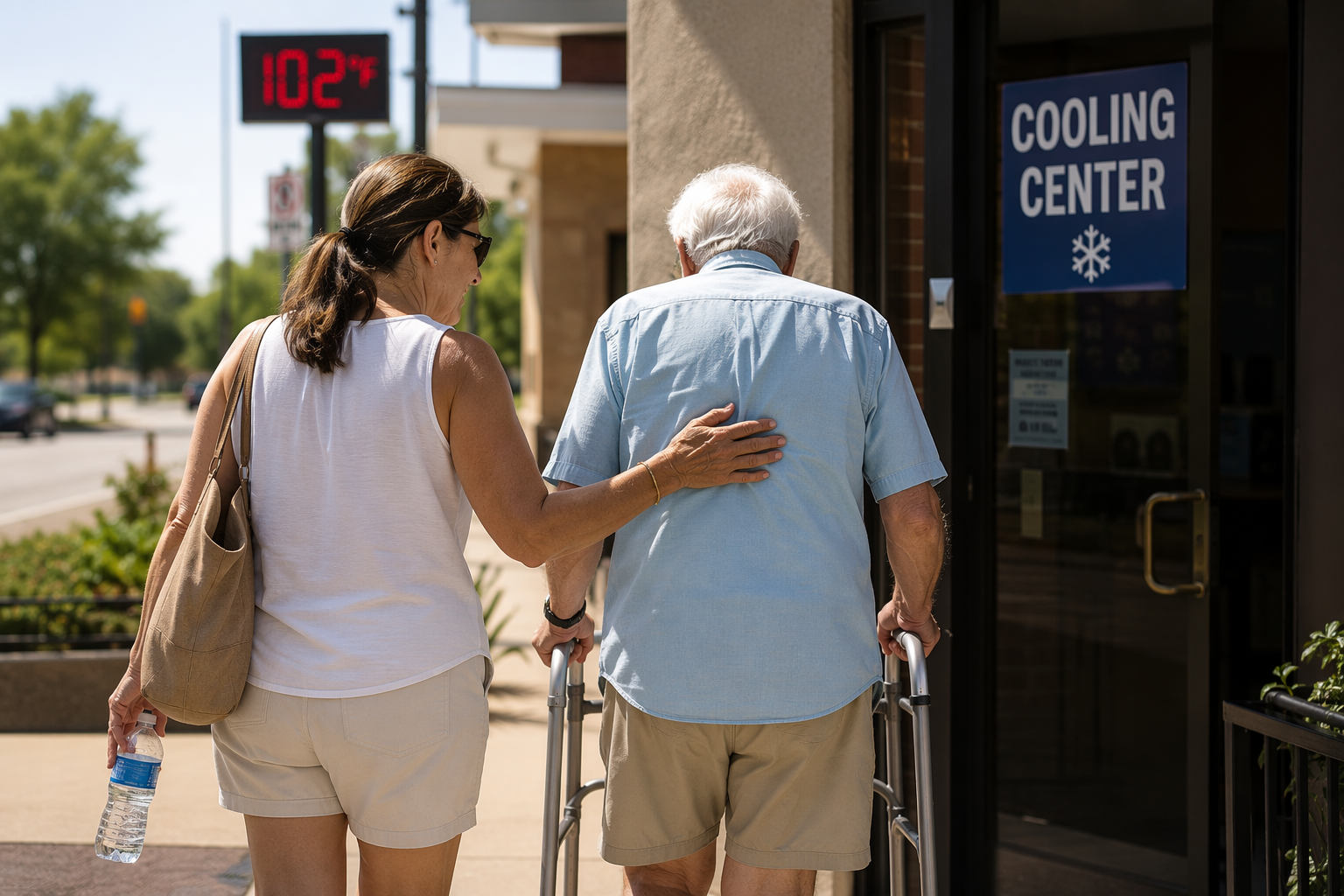
First, Decide Whether This Is a Cooling Center Day
Aging parents do not always say, “I am unsafe.” They say the fan is fine, the bill is too high, they have lived through hotter summers, or they do not want to be a bother. Meanwhile, older adults carry a disproportionate share of heat danger: adults age 60 and older account for 81% of U.S. heat fatalities, and nearly 1 in 3 older adults—14.8 million people—are energy insecure, meaning heat protection may compete with utility costs and other household expenses.[2]
Use a practical threshold. If the home is hot enough that your parent is limiting movement, drinking less, sleeping poorly, feeling dizzy, confused, unusually tired, nauseated, or flushed, do not spend the afternoon debating whether they “qualify” for help. If they have serious symptoms such as confusion, fainting, chest pain, trouble breathing, or a very high body temperature, call emergency services. A cooling center is for preventing heat illness or easing early heat strain; it is not a substitute for urgent medical care.
The Centers for Disease Control and Prevention identifies adults 65 and older as a higher-risk group during heat because aging can make it harder for the body to cool itself, and chronic medical conditions or medications can add to that vulnerability.[3] That does not mean every older adult is fragile. It means the margin for delay is smaller than many families realize.
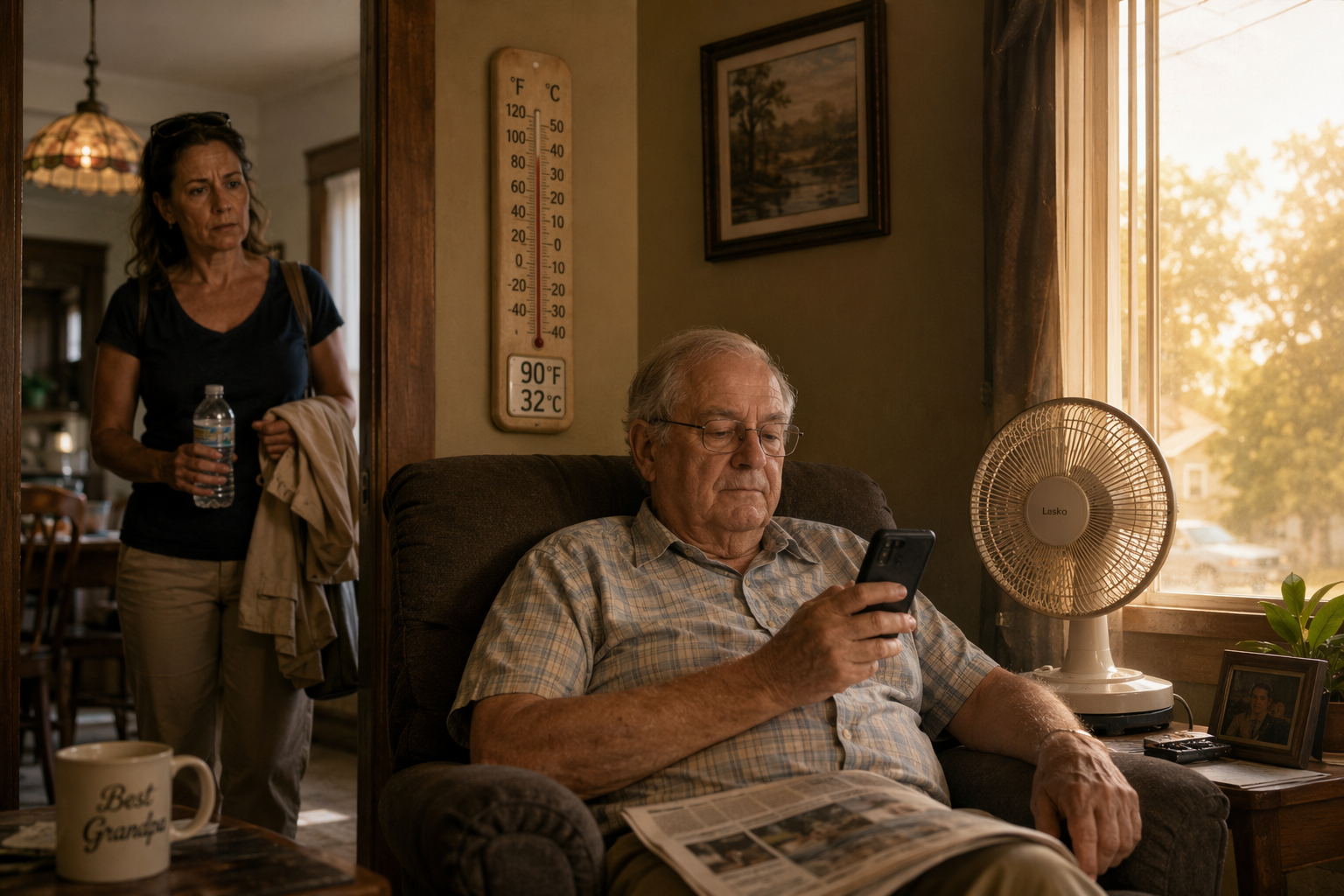
Find the Center, Then Verify the Details That Usually Break the Plan
Do the search in two passes. First, find every possible cooling location near your parent. Second, narrow that list to the one they can actually use.
- Call 2-1-1 and ask for cooling centers near your parent’s address, not just in their city.
- Search the county emergency management, public health, or aging services website for “cooling center,” “heat emergency,” or “extreme heat.”
- Check local news stations, which often publish heat-wave lists faster than static agency pages.
- Call a nearby senior center, library, recreation center, faith community, or Area Agency on Aging if online listings are unclear.
- Use the NCHH state cooling center directory to locate the right state or local starting point if you are searching from another town.[1]
Once you have a candidate, call the site directly if a phone number is available. If you cannot reach the site, call the city or county number that posted the listing. Ask plain questions, because vague reassurance does not help when you are trying to move an 83-year-old with a walker in 96-degree heat.
| Question to Ask | Why It Matters |
|---|---|
| What are today’s exact hours? | Some centers are open only during daytime hours, while apartments can stay hot into the evening. |
| Is this the correct entrance and address? | Large campuses, schools, and government buildings can be confusing from the parking lot. |
| Is it accessible for a walker, wheelchair, cane, or oxygen equipment? | A “public building” is not automatically manageable for a parent with limited mobility. |
| Is there seating, water, and access to restrooms? | Your parent may need several hours there, not a 20-minute stop. |
| Can a caregiver stay with them? | Many reluctant parents will go only if someone familiar stays at least long enough to settle them. |
| Are pets allowed, and if not, what local pet sheltering option exists? | Some centers allow pets, but many do not; a parent may refuse to leave if a pet is unresolved.[4] |
| Is there transportation, shuttle service, paratransit, or a pickup option? | The trip fails if the only real plan is “someone should drive them.” |
Transportation deserves early attention, not whatever is left after you find the building. Eighteen percent of adults 65 and older do not drive, and research cited in cooling-center preparedness work has found that more than half of cooling center visitors walk or use transit.[5] That may be manageable for a younger person carrying a backpack. It is a different calculation for an older adult who tires easily, uses a mobility aid, or has to wait at an uncovered bus stop.
If You Are Coordinating From Across Town
Assign one person to the location call and one person to transportation if possible. If it is only you, book the ride before you start persuading your parent. A confirmed pickup time changes the conversation from “Maybe you should go somewhere” to “I found the place, I checked the entrance, and the ride can be there at 11:30.”
- Try family, neighbors, building staff, church members, or a senior center volunteer ride program.
- Ask 2-1-1 or the local aging office whether heat-emergency rides are available.
- If your parent already uses paratransit, call early; same-day service may be limited.
- For rideshare or taxi use, plan door-to-door help, not just curb-to-curb arrival.
Why the Trip Is Worth the Trouble
A cooling center is not just a symbolic public service. In a 2023 study of healthy older adults ages 64 to 79, two hours in air conditioning lowered core temperature by about 0.8°C and heart rate by about 10 beats per minute during simulated heat exposure.[6] That is the kind of result that matters when you are trying to decide whether it is worth the argument, the ride, the packed bag, and the awkward conversation at the front door.
The same study also keeps expectations honest. The participants were healthier than many real-world aging parents: they had no chronic conditions and were not taking medications that impaired heat regulation. The cooling benefit also faded within two hours after participants returned to an unairconditioned hot environment.[6] So yes, the visit can help. No, it does not make the home safe for the rest of the night.
Getting a Reluctant Parent Out the Door
Many older adults do not see themselves as the person the warning is about. Research on heat risk perception has found that older people may be among the least likely to perceive themselves as vulnerable to heat even though they are physiologically more vulnerable.[7] That gap explains a lot of family frustration. You can bring facts; your parent may hear an accusation that they are weak, careless, or no longer in charge.
Lead with logistics and respect, not a lecture. “The county opened the senior center because the heat index is dangerous” is usually easier to accept than “You are not safe alone.” Offer a limited visit: lunch, cards, the newspaper, phone charging, or two hours in the cool while the apartment heat peaks. If they are proud, let them do something useful: bring a neighbor, remind you to pack the medications, choose the sweater they want for the air conditioning.
Do not ignore the pet issue. For some parents, a cat, dog, or bird is not a side detail; it is the reason they will stay in a dangerous apartment. New York State’s cooling center guidance notes that pet policies vary, and local rules may differ by site.[4] If the first center says no pets, ask whether there is an emergency pet sheltering location, a pet-friendly cooling center, or a neighbor who can check in while your parent is out.
What to Say When They Refuse
Keep the ask concrete and time-limited. Try: “I am not asking you to move anywhere. I am asking you to spend the hottest part of today somewhere air-conditioned, and then we will reassess tonight.” If they object to being watched, say: “You can sit and read. I just want your body to get a break from this apartment.” If they worry about cost, say clearly that public cooling centers are generally offered as community heat-safety resources, then confirm any transportation cost before the ride.
If your parent has cognitive impairment, severe mobility limitations, or symptoms that make you uneasy, involve their clinician, local aging services, or emergency services sooner. Persuasion is not the right tool when judgment, heat illness, or medical instability is already in question.
Pack for a Stay, Not an Errand
The trip goes better when your parent is comfortable enough to remain there. Think in terms of several hours: a cool room, a chair, a bathroom, and enough familiar items that they do not feel stranded.
- Water or another allowed drink, unless their clinician has restricted fluids.
- Medications due during the outing, plus a current medication list.
- Hearing aids, glasses, dentures, phone, charger, and emergency contacts.
- Walker, cane, wheelchair cushion, oxygen supplies, or other mobility and medical equipment.
- A light sweater or wrap; some older adults dislike strong air conditioning and will use that discomfort as a reason to leave.
- A snack, book, puzzle, newspaper, or other quiet activity if the site allows it.
- Pet supplies if the center is pet-friendly, or written instructions for the person checking on the pet.
Hot-weather safety guidance for older adults commonly emphasizes drinking fluids, staying in air-conditioned places when possible, and paying attention to medications and health conditions that can increase heat risk.[8] For a caregiver, that translates into a bag by the door and a medication check before leaving—not a frantic search for pill bottles after the ride arrives.
Make the Visit Protective Once They Arrive
When you get to the center, help your parent settle before you leave. Find the restroom. Check whether water is available. Make sure their phone has service and volume they can hear. Point out staff or volunteers. If they use a walker or wheelchair, choose a seat that does not trap them behind other chairs.
Agree on the pickup plan while everyone is calm. Write it down if needed: who is coming, what time, which entrance, and what number to call if plans change. If the center closes at a fixed hour, set an alarm for yourself well before closing, not at closing. The most dangerous part of the day is often when everyone is tired and the next step is vague.
If you cannot stay, call or text during the visit. A short check-in can catch problems early: they are too cold, embarrassed, hungry, bored, worried about the pet, or thinking of leaving. The solution may be as simple as asking staff for a different seat or dropping off a sweater.
Do Not Let the Return Home Undo the Benefit
This is the part too many heat-safety instructions rush past. The cooling center may lower your parent’s heat strain for a while, but if they return to a sealed, unairconditioned apartment at 6 p.m., the problem may come right back. In the physiological study, the benefit of two hours of air conditioning faded within two hours of returning to a hot environment.[6]
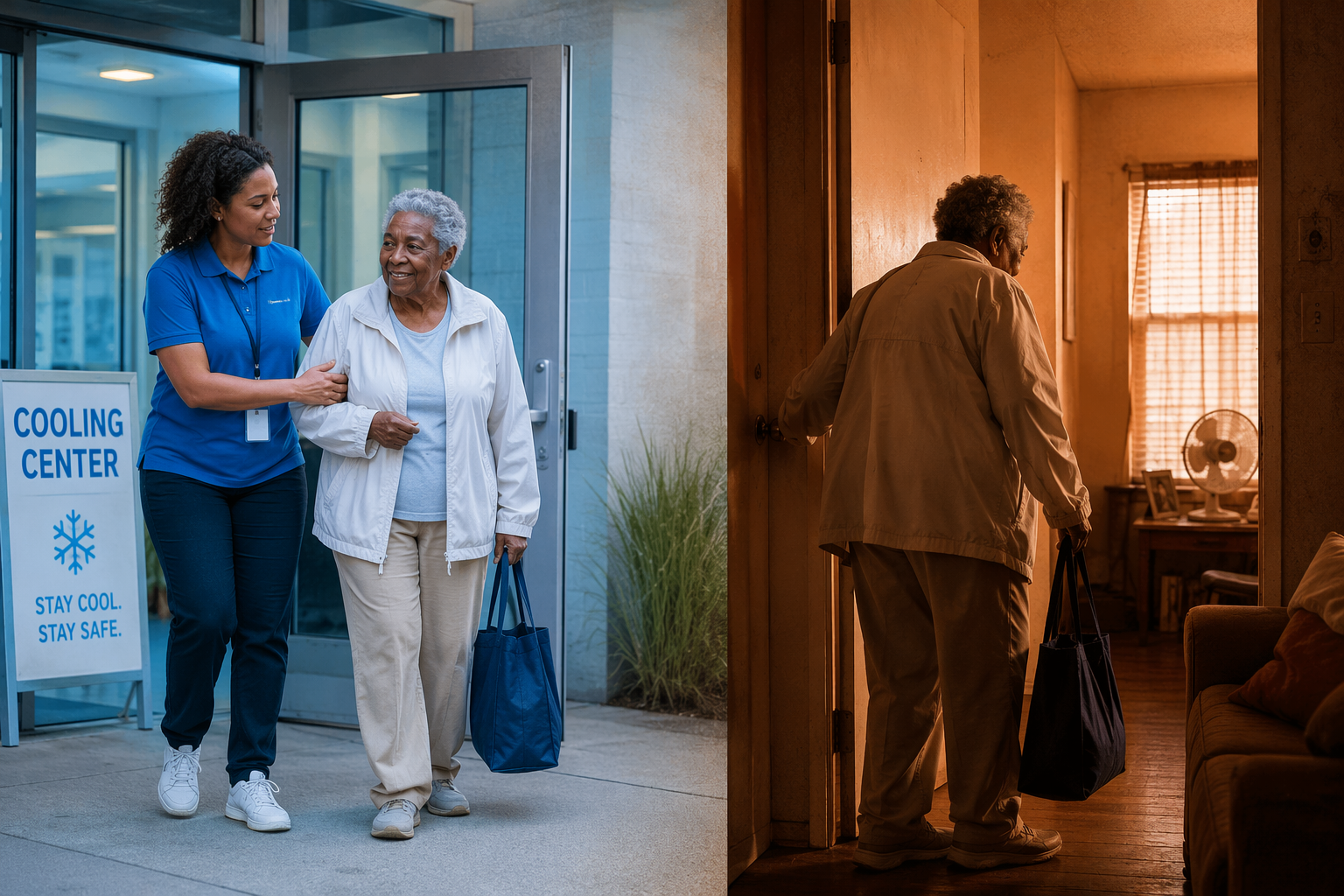
Before they leave the center, decide what kind of home they are returning to. Has the indoor temperature dropped? Is there any working air conditioning? Will they use it, or are they afraid of the bill? Are they going to sleep in the hottest room? Is anyone checking on them later?
- If the home is still dangerously hot, consider a second cooling location, an overnight stay with family, a hotel if affordable, or local emergency shelter guidance.
- If they have AC but will not run it, discuss a specific setting and hours rather than arguing about the entire utility bill.
- If they live alone, schedule an evening and morning check-in by phone or in person.
- If medications, confusion, dizziness, or weakness are part of the picture, call their clinician or urgent care line for guidance.
- If the apartment repeatedly overheats, treat this as an aging-at-home safety issue, not a one-off inconvenience.
Fans can make a room feel less stagnant, but they do not solve severe indoor heat by themselves. Council on Aging heat-safety guidance for seniors emphasizes moving to air-conditioned places during extreme heat and checking on older adults who may be at risk.[9] If your parent’s only plan is a fan in a 90-degree room, keep looking for actual cooling.
After the Heat Wave: Fix What Today Revealed
A cooling center can get your parent through today. It cannot repair a broken air conditioner, pay a utility bill, change a lease, or build a transportation network. If this heat wave exposed a bigger problem, write it down while the details are fresh: no reliable ride, no working AC, fear of utility costs, refusal to leave a pet, poor medication organization, or a home that stays hot after sunset.
Ask the local aging office, utility company, health department, or 2-1-1 about cooling assistance, weatherization, utility support, and emergency repair programs. LIHEAP or state HEAP cooling assistance may be available in some places, but eligibility and benefits vary by state, and it will not usually solve the immediate ride to a cooling center during today’s heat emergency.[2]
For today, the job is concrete: find the open site, verify it, solve the ride, pack the essentials, get your parent there, and plan the return. Tonight, check whether the home is still hot and whether they are acting like themselves. Tomorrow, if the same risks are still sitting there, start turning this incident into a longer-term care plan.
References
- Cooling Centers by State, National Center for Healthy Housing, https://nchh.org/information-and-evidence/learn-about-healthy-housing/emergencies/extreme-heat/cooling-centers-by-state/
- Protecting Older Adults From Extreme Heat, Center for American Progress, https://www.americanprogress.org/article/protecting-older-adults-from-the-growing-threats-of-extreme-heat/
- Heat and Older Adults (Aged 65+), CDC, https://www.cdc.gov/heat-health/risk-factors/heat-and-older-adults-aged-65.html
- NY State Cooling Centers, New York State Department of Health, https://www.health.ny.gov/environmental/weather/cooling/
- Cooling Center Preparedness across 25 U.S. Cities, IJERPH, 2021, https://pubmed.ncbi.nlm.nih.gov/33946281/
- Efficacy of Cooling Centers for Mitigating Physiological Strain in Older Adults, Environmental Health Perspectives, 2023, https://pmc.ncbi.nlm.nih.gov/articles/PMC10234508/
- Risk Perception and Heat Vulnerability in Older Adults, PMC, 2022, https://pmc.ncbi.nlm.nih.gov/articles/PMC9378433/
- Hot Weather Safety Tips for Older Adults, HealthInAging.org, American Geriatrics Society, https://www.healthinaging.org/tools-and-tips/tip-sheet-hot-weather-safety-tips-older-adults
- Heat Safety Tips for Seniors, Council on Aging, https://www.help4seniors.org/news/tips-to-help-older-adults-stay-safe-during-extreme-heat/
Where this decision comes from
Suggest a correction
We keep this content strictly product-neutral and reviewed against CDC STEADI, NIA, and AARP HomeFit guidance. If something here looks outdated, unclear, or inaccurate, tell us — this page does not carry open public comments, because it touches medical urgency, cost, or capacity-adjacent decisions where a discussion thread is a trust liability rather than a trust asset.
See the correction process on our editorial standards page →