
Why death hoaxes about elderly public figures keep happening
Understand why death hoaxes about elderly celebrities keep appearing online and how to help your aging parent navigate them without embarrassment or confusion.
The moment usually arrives sideways. A parent forwards a Facebook post late at night: “Is Jackie Chan dead?” or “Did Willie Nelson pass away?” The headline looks grief-soaked and urgent. The photo is familiar. The comments are already filling with broken-heart emojis. For the adult child on the receiving end, the first feeling may be irritation: not at the parent, exactly, but at the fact that someone designed this little trap well enough to make a decent person stop and worry.
A death hoax about an elderly public figure is not proof that your parent is naive, careless, or suddenly unable to understand the internet. It is a patterned online event. The same ingredients appear again and again: an older celebrity whose death would be believable, a headline that borrows the language of mourning, repeated exposure across feeds, and a link that may be earning ad money, redirecting to a scam, or trying to hijack an account.
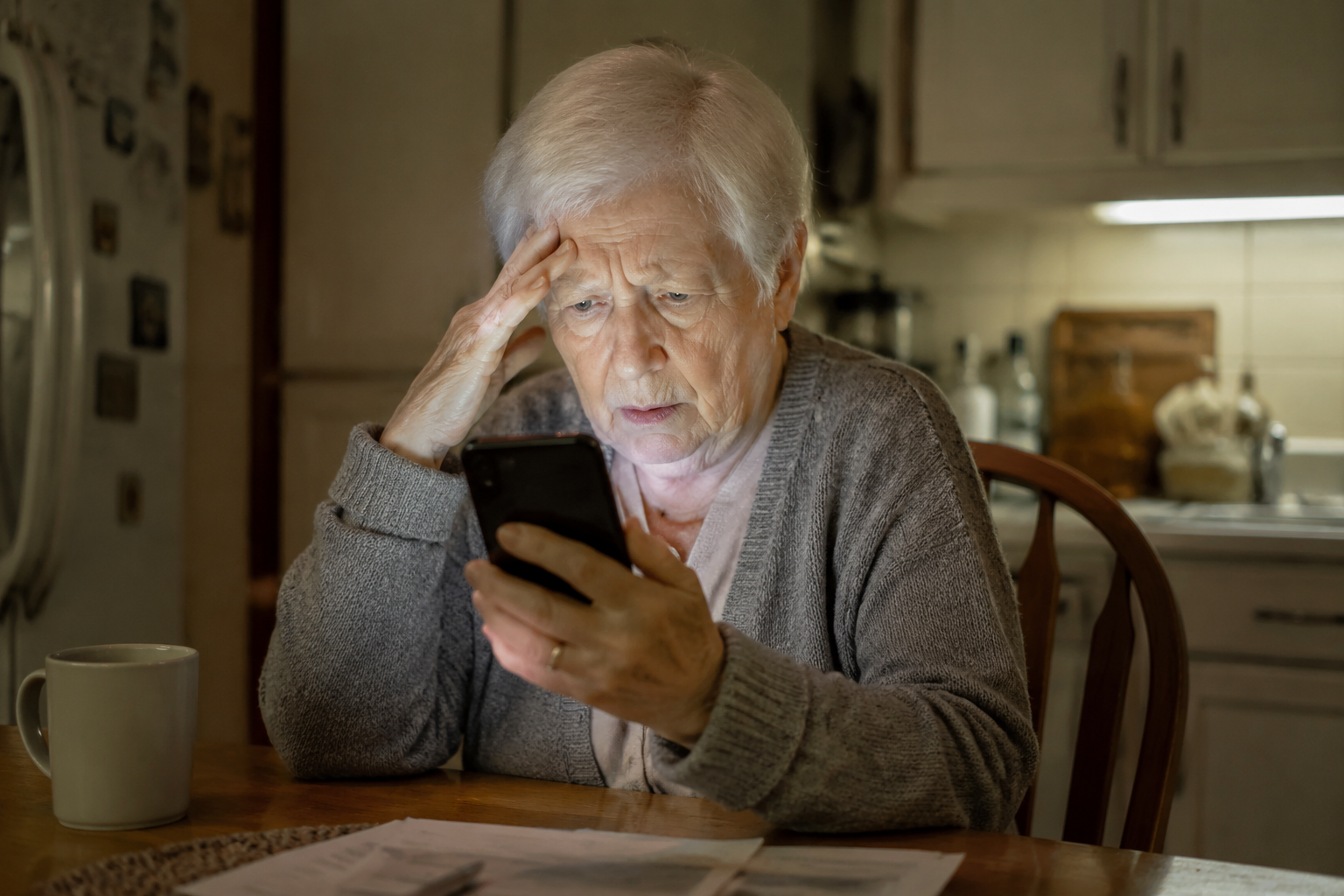
The rumor works because it starts with something plausible
Death hoaxes are older than social media. Mark Twain was the subject of false death reports, and Paul McCartney became the center of one of the most famous pop-culture death rumors of the 20th century.[1] The internet did not invent the impulse to pass along shocking news before it is confirmed. It made the impulse faster, easier to monetize, and easier to repeat.
The reason older public figures are such reliable targets is painfully simple: age makes the claim feel possible before anyone has checked it. Walter Scheirer of the University of Notre Dame put it bluntly when discussing Jackie Chan rumors: “Jackie Chan is not the youngest guy.” Newsday’s reporting also notes how recurring health updates about aging stars can prime audiences to believe a death claim, while public affection gives the rumor emotional fuel.[2]
That is why the same kind of hoax clusters around names people already know and care about. A beloved actor, singer, athlete, or television personality has been in the household for decades. Your parent may remember the person from movies, late-night reruns, records, or interviews. The fake headline does not have to persuade from zero. It borrows from a long relationship that already exists in memory.
This is also why the hoax can feel different from ordinary celebrity gossip. The subject is not just famous; the subject is familiar. When the person is elderly, has recently been in the news for illness, or has already survived earlier rumors, the fake post lands in a gray area where worry can outrun verification.
The death-hoax cycle
Most of these stories do not need to be handled as brand-new mysteries. They tend to move through the same cycle.
| Stage | What is happening |
|---|---|
| Plausibility | An elderly or recently discussed public figure is chosen because the claim does not feel impossible. |
| Packaging | The post uses mourning language, dramatic images, vague sourcing, or a familiar social-media format. |
| Repetition | The same claim appears in feeds, groups, comments, or search results until it starts to feel familiar. |
| Sharing | People forward it to warn, inform, grieve, or ask whether it is true. |
| Profit or theft | The click may generate ad revenue, redirect to product scams, or lead to phishing. |
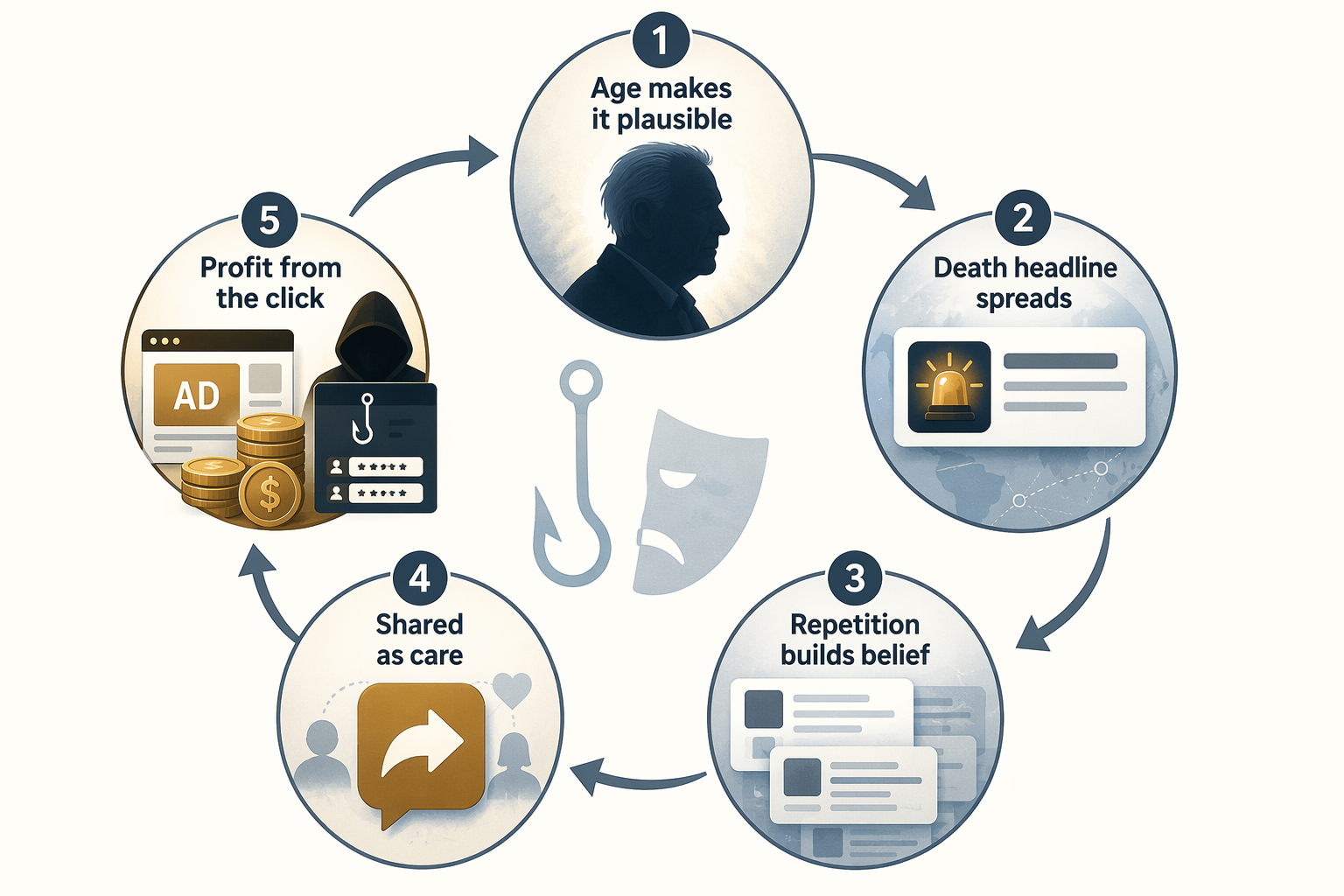
The packaging matters. A fake death post often imitates the look of ordinary news without doing the work of news. It may use phrases like “sad news,” “family confirms,” or “last moments,” while avoiding a clear, reputable source. It may include a video thumbnail that requires a click, or a headline written just vaguely enough to make the reader open the link before learning anything.
Snopes has documented celebrity death-hoax pages that appear to exist for clickbait ad revenue and for redirects into product schemes, including CBD and keto offers.[3] ABC7 San Francisco reported on a related “look who died” Facebook scam in which a message about someone’s death led users toward phishing pages that could compromise their accounts.[4] Those examples are useful because they move the story out of the category of “internet misunderstanding.” Some of these posts are business models.
The user who clicks may think she is reading an obituary. The operator behind the page may be counting impressions, selling low-quality products, or harvesting credentials. The emotional labor belongs to the family; the financial upside belongs to someone else.
Why older adults may see and share more of it
It is tempting, especially when tired, to treat the forwarded link as a character flaw. That is usually the least useful interpretation. The better question is: what made this post feel worth checking?
There is evidence that older adults share more false news online than younger adults. In a 2019 Science Advances study, Andrew Guess, Jonathan Nagler, and Joshua Tucker found that Facebook users over 65 shared nearly seven times as many articles from fake-news domains as the youngest age group in their sample during the 2016 U.S. election period.[5] That finding is often repeated too crudely, as if it proves older adults are simply more gullible. It does not. It measured sharing behavior in a particular political and platform context, not every kind of belief or every older person.
Still, it gives caregivers a clue. If an older parent is more likely to encounter questionable links through Facebook, group messages, or forwarded posts, the death hoax is not arriving in a vacuum. It is arriving through a daily environment where personal updates, neighborhood warnings, church news, celebrity memories, ads, and manipulative posts may all look uncomfortably similar.
Cognitive science adds another piece. Nadia Brashier and Daniel Schacter describe the illusory truth effect: repeated exposure can make information feel truer, partly because familiar statements are easier for the mind to process. They also discuss how source memory can decline with age, meaning a person may remember seeing a claim without remembering whether it came from a trustworthy outlet, a random page, or a friend’s repost.[6]
That pathway is not exclusive to seniors. Anyone can mistake familiarity for credibility, especially when distracted, grieving, lonely, or scrolling quickly. Older adults may face extra friction, though: smaller screens, more confusing interfaces, less practice spotting cloned pages, and a social feed that has quietly learned which emotional topics hold their attention.
Forwarding can be a form of care
The message from a parent often comes with no context except “Is this true?” or “So sad.” It is easy to hear that as carelessness. Sometimes it is closer to caretaking.
Research on generativity helps explain this. In a 2017 study in The Journals of Gerontology: Series B, Tamara Sims, Andrew Reed, and Deborah Carr examined how older adults use news sharing as a way to connect with and benefit others.[7] In ordinary family life, that can look like sending a storm warning, a recall notice, a health article, or a celebrity death report because the sender thinks someone else would want to know.
That does not make the false link harmless. It does change the correction. A parent who forwards a death hoax may not be trying to be first, dramatic, or political. She may be trying to participate in the family’s information flow. If the response is “How could you fall for this?” the lesson she learns may not be “verify better.” It may be “do not ask my daughter next time.”
AI makes the old pattern faster and sharper
Artificial intelligence did not create celebrity death hoaxes. It does make them cheaper to produce and easier to dress up. Newsday reported in 2025 that AI tools, including realistic fake images, voice cloning, and auto-generated obituary-style content, have accelerated creation and reach since 2023.[2] The National Council on Aging has also warned that deepfake scams can target older adults by imitating trusted faces or voices.[8]
For a caregiver, the practical point is not that every fake post now involves AI. The point is that visual confidence is worth less than it used to be. A polished image, a solemn voiceover, or a long obituary-style paragraph does not prove that a public figure has died. It may only prove that the producer had better tools than the old clickbait farms did.
A calm verification routine you can share
The goal is not to turn your parent into a professional fact-checker. The goal is to make the next hoax feel less urgent. A shared routine works better than a lecture because it gives both of you something to do before embarrassment takes over.

- Pause before clicking the dramatic link. If the post is designed around shock, grief, or urgency, treat that as a reason to slow down.
- Check a reliable source directly. Search a major news outlet, the public figure’s official website, verified social account, management page, or family statement.
- Search the person’s name with “official,” “death hoax,” or “Snopes.” A real death of a globally known figure usually appears in multiple reputable places quickly.
- Do not enter a password after clicking a death message. A post that asks you to log in again, install something, or verify your account should be treated as suspicious.
- Answer the person, not just the claim. “I checked, and I’m not seeing confirmation from any reliable source” preserves more dignity than “That’s fake.”
A useful response can be very short: “I checked a couple of reliable sources, and there’s no confirmed report. This looks like one of those fake death posts that gets shared around.” That gives your parent the answer, names the pattern, and avoids making the mistake the center of the conversation.
If your parent already clicked, the next step depends on what happened. If they only opened a page, close it and avoid further links. If they entered a password, help them change it and turn on account protections. If the post was sent from their account without permission, warn close contacts not to click it. The point is to move from shame to containment.
These conversations sit beside many other caregiving moments where accuracy and dignity have to travel together. If the pattern is becoming part of a broader set of worries, it may help to think of it alongside other difficult family conversations about aging, memory, money, driving, and independence; our guide to having hard conversations with aging parents can help frame those talks without turning every correction into a fight.
The next time a headline says a beloved elderly public figure has died, the first question does not have to be “How did my parent believe this?” A better first question is “Where is the confirmation?” That small shift protects the person you love from both the hoax and the humiliation the hoax was never worth.
References
- Death hoax, Wikipedia.
- Why Jackie Chan keeps being killed off by the internet, Newsday, November 2025.
- Celebrity Death Hoaxes, Snopes, September 2022.
- 'Look who died' Facebook phishing scam, ABC7 San Francisco, May 2023.
- Less than you think: Prevalence and predictors of fake news dissemination on Facebook, Science Advances, 2019.
- Aging in an Era of Fake News, Current Directions in Psychological Science, 2020.
- Information and Communication Technology Use Is Related to Higher Well-Being Among the Oldest-Old, The Journals of Gerontology: Series B, 2017.
- What Are Deepfakes? How to Spot a Deepfake Scam, National Council on Aging.
Where this decision comes from
Suggest a correction
We keep this content strictly product-neutral and reviewed against CDC STEADI, NIA, and AARP HomeFit guidance. If something here looks outdated, unclear, or inaccurate, tell us — this page does not carry open public comments, because it touches medical urgency, cost, or capacity-adjacent decisions where a discussion thread is a trust liability rather than a trust asset.
See the correction process on our editorial standards page →