
Garmin Cirqa vs Whoop for senior fitness tracking
Compare Garmin Cirqa and Whoop side by side for an older adult's health monitoring needs. Learn why neither replaces a fall detection system and which device's cost and features fit your parent or partner best.
The practical question in Garmin Cirqa vs Whoop for senior fitness tracking is not which band has the most wellness data. It is whether the device can stay on an older adult, keep producing useful information without becoming another family admin job, and avoid pretending to be safety equipment when it is not.
The split is clear. Garmin Cirqa is a $199 one-time purchase with no required subscription, 50-meter water resistance, basic health tracking, abnormal high and low heart rate alerts, and LiveTrack location sharing during outdoor activity.[1][2] Whoop is a membership device, with published tiers at $199, $239, and $359 per year; the top Whoop Life tier adds ECG readings and irregular heart rhythm notifications through Whoop MG hardware.[3][4] Neither one provides 24/7 automatic fall detection, so neither should be treated as a replacement for a medical alert system.[2][5]
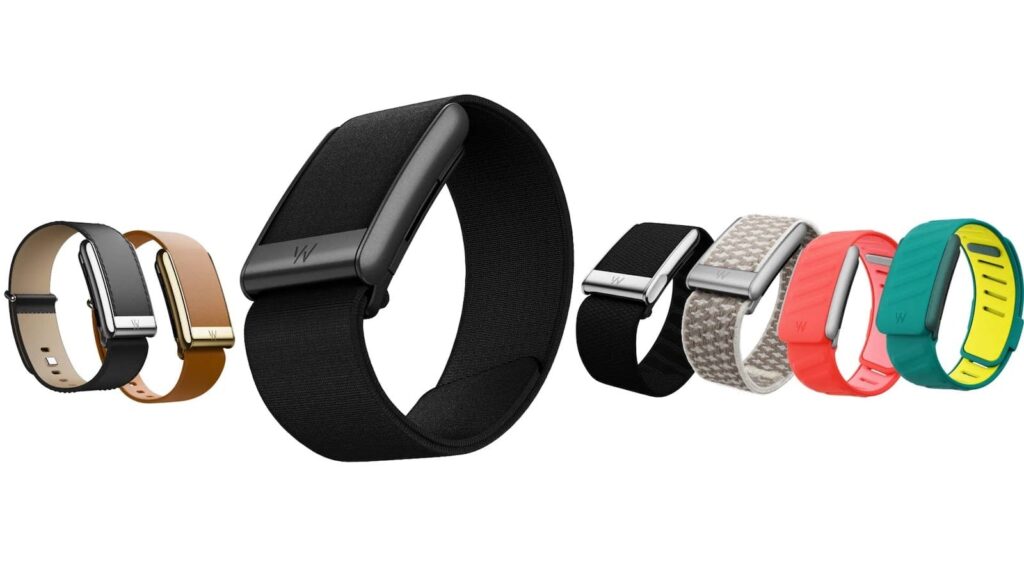
| Caregiver question | Garmin Cirqa | Whoop |
|---|---|---|
| What does it cost? | $199 one-time purchase | $199-$359 per year |
| Three-year cost | $199 | $597-$1,077 |
| Does it have a screen? | No | No |
| ECG or irregular rhythm alerts? | No ECG; abnormal high/low heart rate alerts | Yes, on Whoop Life |
| Water resistance | 50m | 10m for Whoop 5.0 |
| Location sharing | LiveTrack during outdoor walks via Garmin Explore | Not the same caregiver location feature |
| Automatic fall detection | No 24/7 automatic fall detection | No 24/7 automatic fall detection |
| If the subscription lapses | No required subscription to lapse | Hardware becomes inactive without membership |
The Cost Difference Is Also a Maintenance Difference
A $199 device and a $199 annual membership look similar for the first week. They do not look similar after a family has used the device through holidays, appointments, credit-card replacements, and one forgotten renewal email.
Using the published prices, Garmin Cirqa costs $199 over three years. Whoop costs $597 at the $199-per-year tier and $1,077 at the $359-per-year Whoop Life tier over the same period.[1][3] That is a $398 to $878 gap before counting replacement bands, accessories, or the caregiver time spent deciding whether a renewal still makes sense.
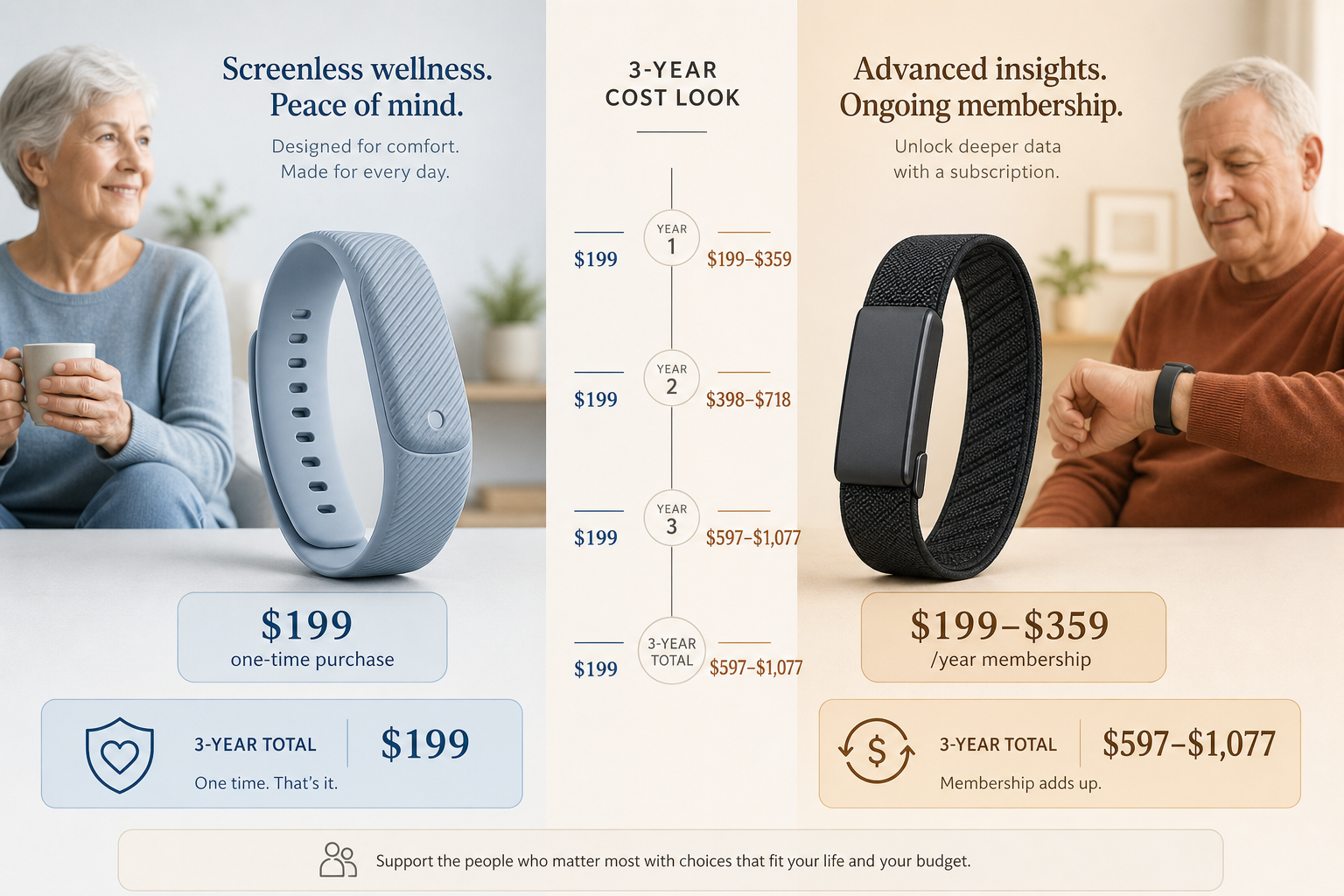
For an older adult, subscription risk is not just financial. If the person wearing the device never opens the app, the adult child or spouse becomes the subscription manager by default. Whoop’s hardware depends on an active membership, while Cirqa’s core function does not require one.[2][6] Garmin does have an optional Connect+ subscription, but DC Rainmaker wrote of using Garmin without it: “not a single moment I missed it.”[2]
That makes Cirqa administratively cleaner for basic tracking. Buy it, set it up, attach it, and the family is not forced to revisit an annual payment just to keep the band useful. This matters most when the goal is low-friction wellness visibility rather than advanced athletic recovery analysis.
Whoop’s recurring fee is easier to justify when the family has a specific reason to want the premium heart features. Paying every year for recovery scores may feel beside the point for a parent who is mainly walking, sleeping, and trying not to forget the device on the bathroom counter. Paying for ECG and irregular rhythm notifications is a different conversation.
Daily Wear: The Device Has to Survive Ordinary Life
Screenless design is the main reason either device belongs in this conversation. A band without a tiny watch face does not ask an older adult to swipe through menus, dismiss notifications, or interpret charts from the wrist. The trade-off is that the phone app becomes the real interface.
That trade-off can work if one person in the family is willing to check the app. It works less well if the older adult lives alone, dislikes smartphones, and no caregiver will consistently review the data. A screenless tracker can reduce friction at the wrist while moving friction into the phone.
Water resistance is one of the less glamorous specifications that matters more with age. Cirqa is rated to 50 meters, while CNET reported Whoop 5.0 at 10 meters.[1][7] A band that can stay on in the shower is less likely to be removed, misplaced, or left charging for three days because nobody noticed it was gone.
That gives Cirqa a practical daily-wear advantage for a parent who does not want a morning routine built around a wearable. It is not that Whoop cannot be worn consistently; many people do. It is that the margin for forgetfulness is smaller when a device has to be treated more carefully around water.
Heart Features: Whoop Life Goes Further, but It Is Still Not a Cardiologist
This is the area where Whoop has the stronger senior-specific argument, but only at the right tier. Whoop Life includes on-demand ECG readings and irregular heart rhythm notifications through Whoop MG hardware.[4] For a family already watching cardiac concerns, those features are not a decorative upgrade.
Garmin Cirqa does not offer ECG. It uses Garmin’s Elevate Gen4 optical sensor and supports abnormal high and low heart rate alerts, but that is not the same as an ECG reading or an irregular rhythm notification system.[1][2] For a generally active older adult, high and low heart rate alerts may be enough. For someone with known rhythm concerns, the gap matters.
The boundary has to stay visible. Wirecutter’s 2026 fitness tracker guide notes that Whoop received an FDA warning letter in July 2025 related to blood pressure claims.[5] That does not erase the usefulness of ECG or rhythm alerts, but it is a reminder to separate a supported heart feature from broader wellness language that can start sounding more clinical than it is.
Neither device should be used to diagnose a heart condition, rule out an emergency, or replace professional cardiac monitoring. A wearable alert can be a prompt to seek care. It is not care itself.
Caregiver Visibility: Location May Matter More Than Another Score
For many families, the useful question is not “What was the recovery score?” It is “Did Dad go for his usual walk, and can someone see where he is if he is late coming back?”
Cirqa’s LiveTrack feature can share the wearer’s real-time location during outdoor walks through the Garmin Explore app.[1][2] That is narrower than all-day location monitoring, but it maps to a common caregiving situation: an older adult who still walks independently, while a spouse or adult child wants visibility during that outing.
Whoop’s strength is not this kind of caregiver-facing location visibility. Its platform is built more around physiology, strain, sleep, recovery, and health metrics. Those can be useful, but they do not answer the same question as LiveTrack.
If location during walks is part of the family’s concern, Cirqa fits more naturally. If the family mainly wants heart-related signals and is willing to pay for Whoop Life, Whoop becomes more compelling. If the family wants continuous location tracking, geofencing, emergency dispatch, or wandering support, both bands are the wrong category and a broader elderly monitoring system is a better place to look.
Battery Life Is Worth Checking, but It Should Not Decide the Whole Purchase
Battery life matters because every charging session is a chance for the device to disappear into a drawer. The available figures are not perfectly aligned across sources. DC Rainmaker reported roughly seven days for Cirqa.[2] CNET reported about 14 days for Whoop 5.0, while other reviewers have reported shorter ranges for Whoop.[7]
In practice, either device still needs a charging habit. For a caregiver, the better question is whether the older adult can tolerate that habit. A weekly charge tied to Sunday breakfast may work. A device that comes off unpredictably and waits for someone else to notice is more fragile, no matter what the advertised battery life says.
The Fall-Detection Gap Is the Place Not to Compromise
This comparison can only go so far because Garmin Cirqa and Whoop are both screenless wellness trackers, not medical alert systems. Neither provides 24/7 automatic fall detection.[2][5] That is not a small missing feature if the person has a fall history, lives alone, gets dizzy, uses a walker, or has already had a “found on the floor” scare.
A family that needs fall detection should start with a dedicated medical alert system with fall detection or a smartwatch category known for emergency features, not with either of these bands. A screenless tracker may still be useful for wellness trends, but it should not be the device everyone is counting on after a fall.
This is also where false reassurance creeps in. A band can show sleep, heart rate, strain, or walking activity and still fail to call for help when the person is on the floor. If emergency response is the real need, the search should move to medical alert systems with fall detection, not stay inside fitness trackers.
There is one more timing caveat for Cirqa. Garmin launched Cirqa on July 21, 2026, so early coverage is still based on initial information and hands-on impressions rather than long-term senior-use testing.[1][2] That does not make the device uninteresting. It just means families should treat the early spec sheet as a starting point, not proof that it will behave perfectly on an older adult’s wrist for the next year.
Which One Fits Which Senior?
Garmin Cirqa is the simpler long-term fit when the family wants a screenless band for basic wellness tracking, abnormal high and low heart rate alerts, stronger water resistance, and location sharing during outdoor walks. Its one-time price also makes it easier to keep using without turning the caregiver into a subscription clerk.
Whoop is the better fit when the family has a clear reason to pay for Whoop Life’s ECG and irregular rhythm notifications, and when someone will actually use the app enough to make the membership worthwhile. For a senior with cardiac concerns, that may be a reasonable trade. For someone who only needs gentle activity and sleep visibility, the recurring fee is harder to defend.
- Choose Cirqa if low maintenance, no required subscription, shower-friendly daily wear, and walk-time location sharing are the priorities.
- Choose Whoop Life if ECG and irregular rhythm notifications match a known heart-monitoring concern and the annual fee is acceptable.
- Do not choose either as the primary answer if the real need is fall detection, emergency response, or professional cardiac monitoring.
References
Where this decision comes from
Suggest a correction
We keep this content strictly product-neutral and reviewed against CDC STEADI, NIA, and AARP HomeFit guidance. If something here looks outdated, unclear, or inaccurate, tell us — this page does not carry open public comments, because it touches medical urgency, cost, or capacity-adjacent decisions where a discussion thread is a trust liability rather than a trust asset.
See the correction process on our editorial standards page →