
Your Guide to Preventing Foodborne Illness in Seniors
This guide explains why seniors are uniquely vulnerable to severe foodborne illness and provides caregivers with a systematically adapted approach across all four food safety steps, safer food choices, refrigerator management, and emergency recognition thresholds.
Preventing foodborne illness in seniors starts with one uncomfortable shift: food that might only make a younger adult miserable can put an older adult in the hospital. The CDC says nearly half of people age 65 and older with lab-confirmed foodborne illness from Salmonella, Campylobacter, Listeria, or E. coli are hospitalized.[1] That is the number to keep in mind when you are standing at the counter deciding whether the turkey from Tuesday is “probably fine.”
The stricter rules are not about fear. They are about physiology. The FDA notes that the immune system begins to decline between ages 50 and 60, and after age 75 the risk of contracting a foodborne illness increases while the body’s ability to fight infection is lower.[2] Older adults may also have less stomach acid, slower digestion, and reduced liver and kidney function, which can make it harder to clear germs or tolerate fluid loss.[2]
Some diagnoses raise the stakes even further. The CDC identifies people on dialysis as 50 times more likely to get a Listeria infection, and the FDA notes that diabetes can delay the body’s immune response.[1][2] That matters at home because a parent with diabetes, kidney disease, cancer treatment, an organ transplant history, or immune-suppressing medication may need older-adult food safety rules even before the family thinks of them as medically fragile.
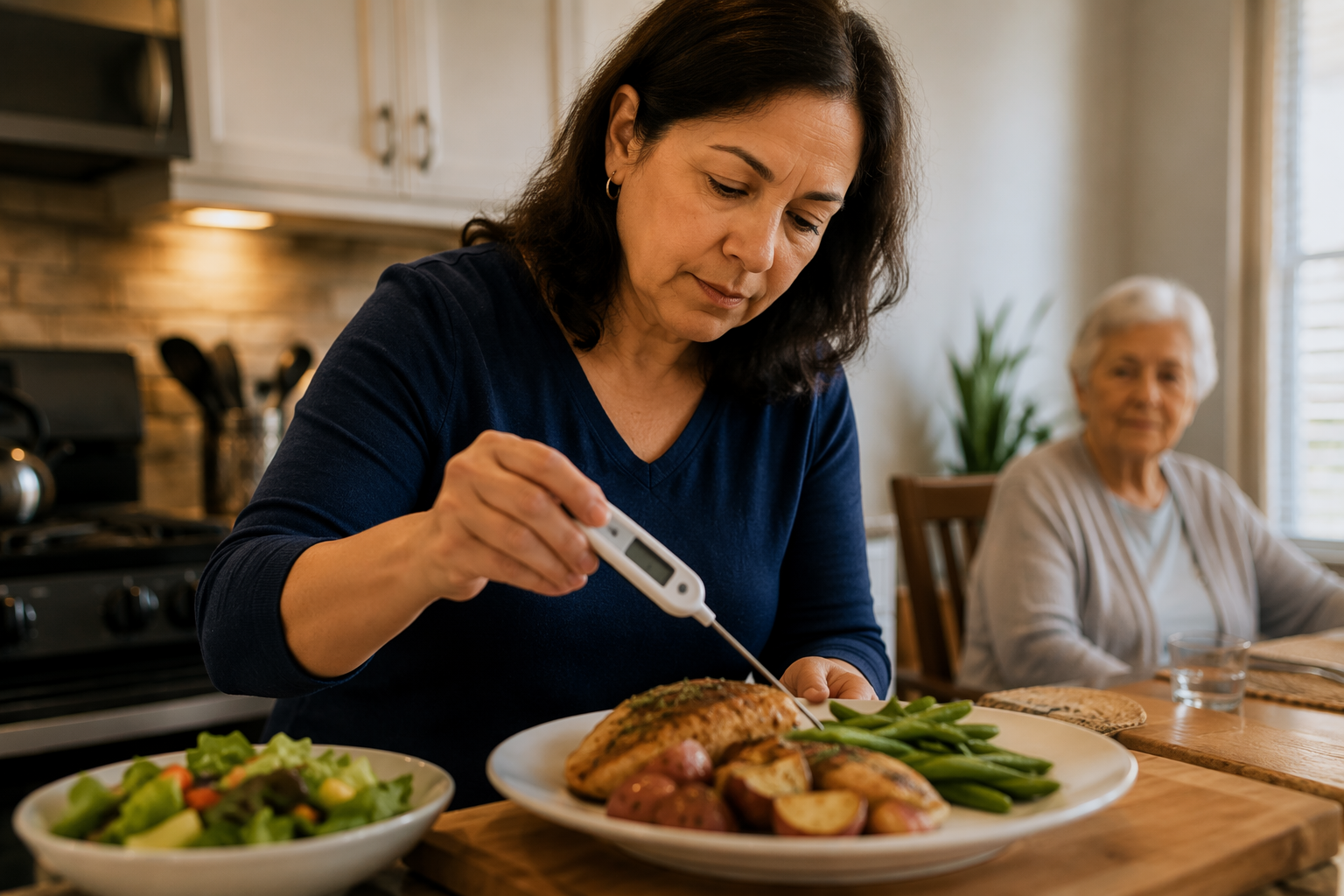
What Changes When You Cook for an Older Adult
The familiar Clean, Separate, Cook, and Chill framework still works. What changes is the margin for error. For an older adult, “looks done,” “smells okay,” “only sat out for a while,” and “we always ate it this way” are not good enough decision rules.
| Home decision | Older-adult-safe default |
|---|---|
| Leftovers | Cool promptly, refrigerate within 2 hours, or within 1 hour if the room or outdoor temperature is above 90°F. |
| Deli meats and hot dogs | Reheat to 165°F or until steaming hot before serving. |
| Poultry | Use a thermometer and cook to 165°F. |
| Ground meat | Use a thermometer and cook to 160°F. |
| Whole cuts of beef, pork, lamb, and veal | Cook to 145°F and allow a 3-minute rest. |
| Fish | Cook to 145°F. |
| Refrigerator | Keep at or below 40°F. |
| Freezer | Keep at 0°F. |
Those numbers are not kitchen trivia. They are the line between a meal and a gamble. The CDC lists 165°F for poultry, 160°F for ground meats, 145°F with a 3-minute rest for whole cuts, and 145°F for fish; it also uses the 2-hour rule, shortened to 1 hour when food is exposed to temperatures above 90°F.[3] The USDA explains why time matters: bacteria can double in as little as 20 minutes in the Danger Zone between 40°F and 140°F.[4]
Clean: Make the First Tray Safe Before Food Touches It
Clean does not mean making the kitchen look tidy. It means keeping germs from moving onto ready-to-eat food. For caregivers, the important surfaces are the ones food actually touches: hands, cutting boards, knives, counters, sink handles, refrigerator handles, dish towels, and the plate that will go in front of the older adult.
- Wash hands before cooking, after handling raw meat, poultry, seafood, or eggs, after using the bathroom, after touching pets, and after helping with toileting or personal care.
- Use clean plates for cooked food. Do not put cooked burgers, chicken, fish, or vegetables back on the plate that held raw food.
- Change or wash dish towels often, especially if they were used while handling raw food.
- Wash cutting boards, knives, and counters with hot, soapy water after raw meat, poultry, seafood, or eggs touch them.
- Rinse fresh fruits and vegetables under running water before cutting, peeling, or serving, unless the package says the item was prewashed.
One small caregiver habit is worth naming: clean the thermometer probe between uses. If you check raw or partly cooked chicken, then use the same probe on finished food without washing it, the thermometer has become a cross-contamination tool instead of a safety tool.
Separate: Keep Raw Food From Becoming Everyone’s Problem
Separation starts at the grocery cart and ends in the refrigerator. Raw chicken leaking onto salad greens is not a storage inconvenience; it is a route from raw food to a ready-to-eat meal that may never be cooked again.
- Bag raw meat, poultry, and seafood separately from produce, bread, deli items, and prepared foods.
- Store raw meat, poultry, and seafood in a container or sealed bag on the lowest refrigerator shelf so juices cannot drip onto other foods.
- Use separate cutting boards when possible: one for raw meat, poultry, and seafood, and another for produce or ready-to-eat foods.
- Keep marinades that touched raw meat out of finished dishes unless the marinade is boiled before serving.
- Do not taste food with a spoon and return that spoon to the pot, especially when cooking for someone with a weakened immune system.
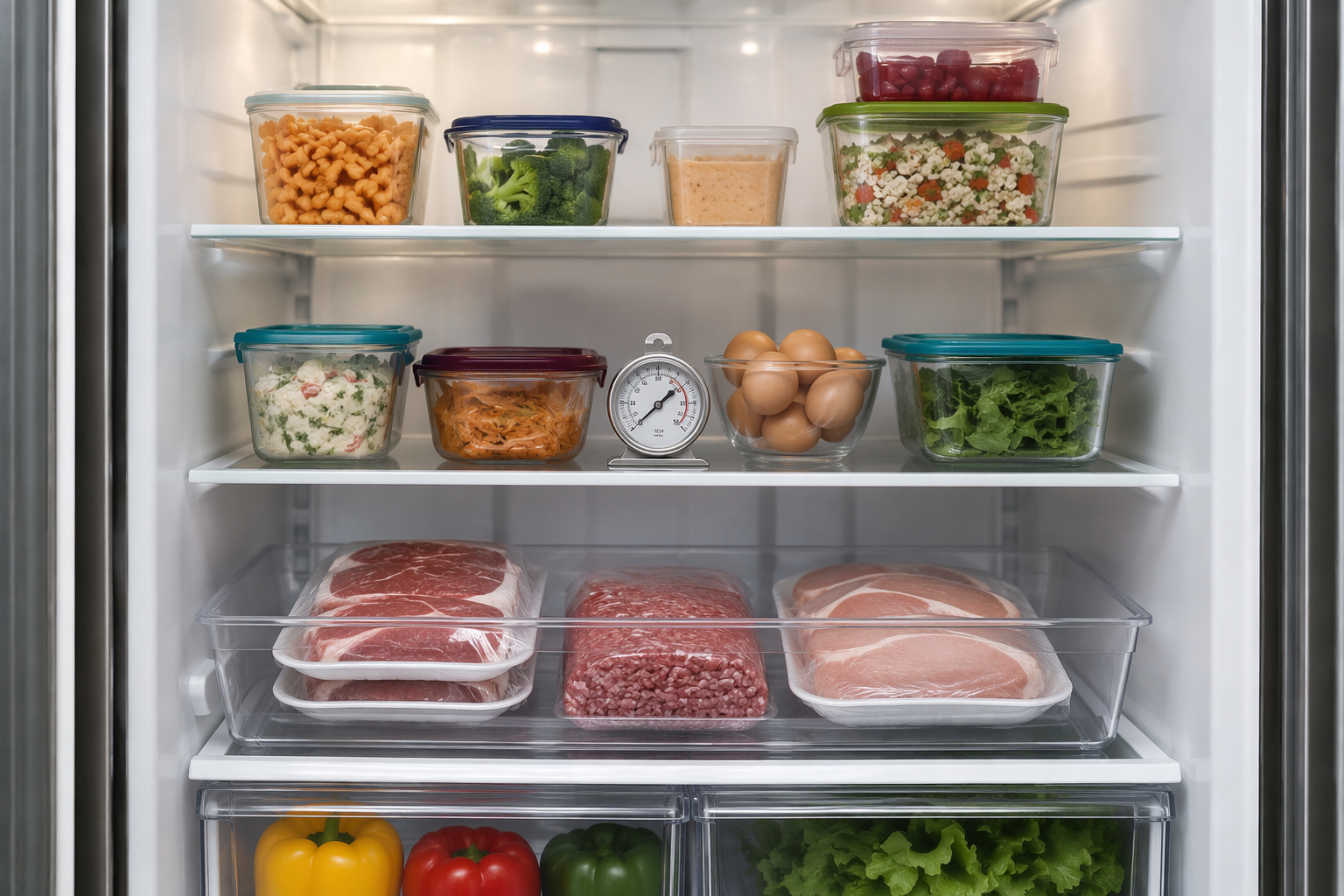
The refrigerator should make the safe choice obvious. Raw foods go low. Ready-to-eat foods go high. Leftovers get labels. The thermometer stays visible. If a tired caregiver has to solve the whole refrigerator every night, the system is too fragile.
Cook: Stop Guessing and Use the Thermometer
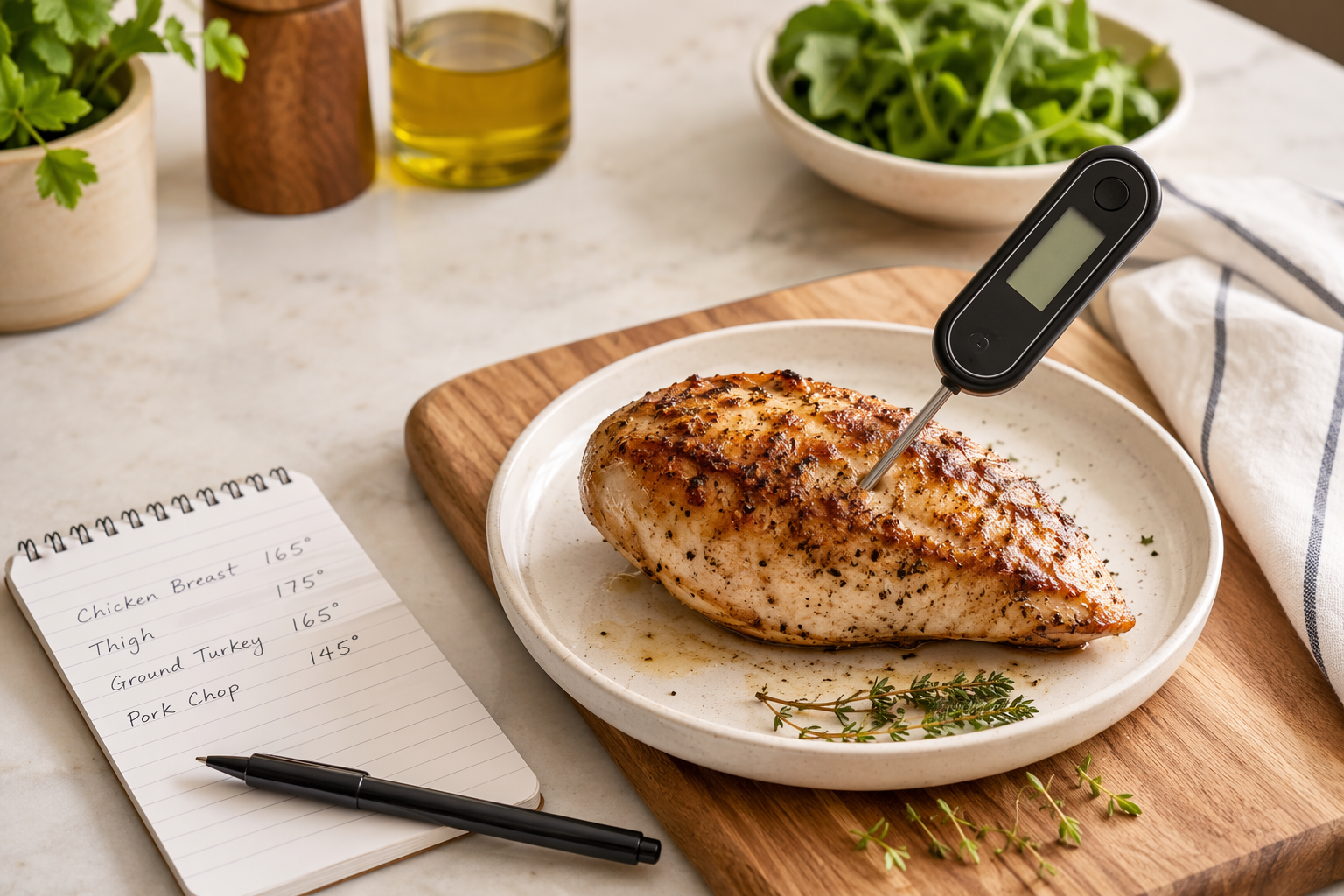
Color is a poor discharge instruction for dinner. Chicken can brown before it is safe, and a casserole can bubble at the edges while the center is still not hot enough. For seniors, a food thermometer should be treated like a basic kitchen tool, not something reserved for holidays.
| Food | Safe minimum internal temperature |
|---|---|
| Chicken, turkey, duck, stuffing, casseroles with poultry | 165°F |
| Ground beef, pork, veal, and lamb | 160°F |
| Whole cuts of beef, pork, veal, and lamb | 145°F plus a 3-minute rest |
| Fish | 145°F |
| Leftovers | Reheat to 165°F |
| Deli meats and hot dogs for older adults | Reheat to 165°F or steaming hot |
The CDC gives the main cooking temperatures for poultry, ground meats, whole cuts, and fish, and Foodsafety.gov advises reheating leftovers to 165°F.[3][5] For deli meats and hot dogs, the older-adult rule is stricter because of Listeria: reheat them to 165°F or until steaming hot before serving.[5][6]
Check the thickest part of the food, away from bone when possible. In a mixed dish, check the center and any dense areas. For microwaved food, stir when you can, rotate if the microwave does not rotate evenly, and let the food stand briefly so heat can distribute before checking the temperature.
Chill: The Refrigerator Is Part of the Care Plan
A refrigerator full of food is not the same as a refrigerator full of safe food. The FDA says refrigerators should be kept at or below 40°F and freezers at 0°F.[7] The USDA’s Danger Zone guidance explains why this cannot be handled by feel: bacteria can multiply quickly between 40°F and 140°F.[4]
- Put an appliance thermometer in the refrigerator and freezer, then check it as part of the normal kitchen routine.
- Refrigerate perishable food within 2 hours, or within 1 hour if it has been above 90°F.
- Divide large pots of soup, stew, chili, or pasta into shallow containers so they cool faster.
- Label leftovers with the date they were cooked or opened.
- Do not leave groceries in the car while running extra errands, especially in warm weather.
The 2-hour rule includes serving time. If the casserole sat on the table during dinner, then stayed out while medications were sorted and dishes were cleared, that clock was already running. When the room is hot, the 1-hour rule applies.[3]
Foods That Need Different Rules After 65
Most older adults do not need a joyless diet. They do need fewer high-risk shortcuts. The CDC’s safer food choices for adults 65 and older recommend avoiding several foods that are more likely to carry germs unless a safer version is chosen or the food is cooked properly.[6]
| Higher-risk choice | Safer older-adult choice |
|---|---|
| Raw or undercooked eggs | Cook eggs until yolks and whites are firm; use pasteurized eggs for recipes that call for raw or lightly cooked eggs. |
| Raw or undercooked meat, poultry, seafood, or sprouts | Cook to the recommended internal temperature; cook sprouts thoroughly. |
| Unpasteurized milk, cheese, or juice | Choose pasteurized products. |
| Cold deli meats, cold cuts, fermented or dry sausage, and hot dogs | Reheat to 165°F or steaming hot before serving. |
| Refrigerated pâté or meat spreads | Choose shelf-stable versions when appropriate, following package directions. |
| Smoked seafood sold refrigerated | Use only if cooked in a dish; shelf-stable versions are lower risk when handled as directed. |
Listeria deserves special attention because it can grow at refrigerator temperatures. USDA FSIS reports that adults 65 and older are 4 times more likely than other age groups to get Listeria infections, and more than half of all Listeria infections occur in people 65 and older.[8] That is why cold deli meat from a clean-looking refrigerator is still not automatically safe for an older adult.
This is where many household habits need to change. A sandwich made straight from a deli package may be routine for a younger adult. For an older adult, the safer default is to heat the meat until steaming hot or to choose another protein that does not carry the same Listeria concern. Refrigeration slows many problems; it does not erase this one.[6]
Leftovers: Label, Reheat, or Let Them Go
Leftovers create the most caregiver decision fatigue because they sit in the gray zone between thrift and risk. A simple system is kinder than repeated judgment calls: label the container, cool it quickly, store it cold, reheat it fully, and discard it when you cannot verify the timeline.
- Use shallow containers for hot leftovers so the center cools faster.
- Write the date on the lid before the container goes into the refrigerator.
- Reheat leftovers to 165°F, including soups, sauces, casseroles, and mixed dishes.
- Throw away food with mold, off odors, leaking packages, or an unknown storage history.
- When family members disagree, use the older adult’s risk level as the deciding standard, not the youngest person’s tolerance.
The hardest containers to throw away are the ones someone lovingly brought over. Still, no casserole comes with a guarantee once it has sat in a car, on a porch, or on a counter too long. If nobody knows when it was cooked, how long it traveled, or whether it stayed cold, it should not become an older adult’s lunch.
Meal Delivery and Takeout Need a Receiving Routine
Meal delivery can be a real support, but it does not remove the caregiver’s food safety role. The risky moment is often not the cooking; it is the handoff. A meal may arrive while the older adult is napping, while the caregiver is at work, or while nobody is sure how long the bag has been at the door.
- Ask delivery programs or restaurants how meals are kept hot or cold during transport.
- Arrange delivery windows when someone can bring food inside promptly.
- Refrigerate cold meals right away if they will not be eaten immediately.
- Reheat delivered meals to safe temperatures when reheating is required.
- Discard meals left at room temperature beyond the 2-hour rule, or beyond 1 hour in heat above 90°F.
For families building a broader care plan, food safety belongs beside medication reminders and fall prevention. If the refrigerator is repeatedly full of spoiled food, expired prepared meals, or unmarked containers, that is not just a housekeeping issue. It may be a sign that meal management has become too much for the current level of support.
When Symptoms Are Not a Wait-and-See Problem
Caregivers do not need to diagnose which germ caused the illness. They do need to recognize when home monitoring is the wrong setting. The CDC lists food poisoning symptoms such as diarrhea, stomach pain or cramps, nausea, vomiting, and fever, and warns that some symptoms call for medical attention.[9]
- Call a health care professional promptly for an older adult with diarrhea and a fever higher than 102°F.
- Seek medical help for bloody diarrhea.
- Seek help if vomiting is frequent enough that liquids cannot be kept down.
- Treat signs of dehydration as urgent, including very little urination, dry mouth and throat, or dizziness when standing.
- Get medical guidance if diarrhea lasts more than 3 days.
The CDC uses these red flags for food poisoning generally, and older adults have less reserve when vomiting or diarrhea causes fluid loss.[9] If the person is frail, lives alone, has kidney disease, diabetes, heart disease, cancer treatment, immune suppression, or is already weak or confused, the threshold for calling should be lower, not higher.
Severity data also argues against casual waiting. In a Canadian study of salmonellosis hospitalizations from 2000 to 2010, seniors had a median hospital stay of 7 days compared with 4 days for other adults, and those age 80 and older had a median stay of 9 days; 60% of hospitalized seniors in the study had at least one chronic disease.[10] The same paper reports a 5.2% death rate among hospitalized seniors compared with 1.1% among other hospitalized adults, while noting patterns that align with U.S. FoodNet surveillance even though the exact figures are Canadian.[10]
A Caregiver’s Safer Default
The safest home kitchens for older adults are not the ones where everyone is anxious. They are the ones where fewer decisions have to be made from scratch. The thermometer is in the drawer where it can be found. The refrigerator has a visible temperature reading. Raw meat has one place to go. Leftovers have dates. Deli meat gets heated. Food with an unknown history leaves the kitchen without a debate.
That is the practical heart of preventing foodborne illness in seniors: replace adult-default habits with older-adult-safe defaults, then act quickly when symptoms cross a red line. The work is ordinary, but the consequences are not.
References
- People at Increased Risk for Food Poisoning, CDC
- Food Safety for Older Adults and People with Cancer, Diabetes, HIV/AIDS, Organ Transplants, and Autoimmune Diseases, FDA
- Preventing Food Poisoning, CDC
- Refrigeration & Food Safety, USDA FSIS
- People at Risk: Older Adults, Foodsafety.gov
- Safer Food Choices for Adults 65 and Older, CDC
- Are You Storing Food Safely?, FDA
- Adults 65 and Older: An At-Risk Population, but Why?, USDA FSIS
- Food Poisoning Symptoms, CDC
- Hospitalizations associated with salmonellosis among seniors in Canada, 2000–2010, Turgeon et al.
Where this decision comes from
Suggest a correction
We keep this content strictly product-neutral and reviewed against CDC STEADI, NIA, and AARP HomeFit guidance. If something here looks outdated, unclear, or inaccurate, tell us — this page does not carry open public comments, because it touches medical urgency, cost, or capacity-adjacent decisions where a discussion thread is a trust liability rather than a trust asset.
See the correction process on our editorial standards page →