
Choosing Safe Anti-Aging Products for Seniors
This guide helps caregivers choose anti-aging products for seniors 70+ that prioritize skin barrier protection and safety over aggressive wrinkle-fighting, with essential guidance on ingredients to use and avoid based on age and medications.
The search for the best anti-aging products for seniors often starts with something ordinary: a sleeve pulled over a forearm and a bruise appearing the next day, shins so dry they itch through the night, or a new cream that leaves a parent’s face red and stinging. After 70, skin care is less about chasing a younger face and more about keeping fragile skin comfortable, protected, and intact.
That does not mean appearance stops mattering. An older adult may still want to look rested, cared for, and like themselves. But for a caregiver choosing products, the first question is not “Will this smooth wrinkles?” It is “Will this reduce dryness, protect from sun damage, and avoid making thin skin easier to irritate, bruise, or tear?”
After 70, “Anti-Aging” Starts With the Skin Barrier
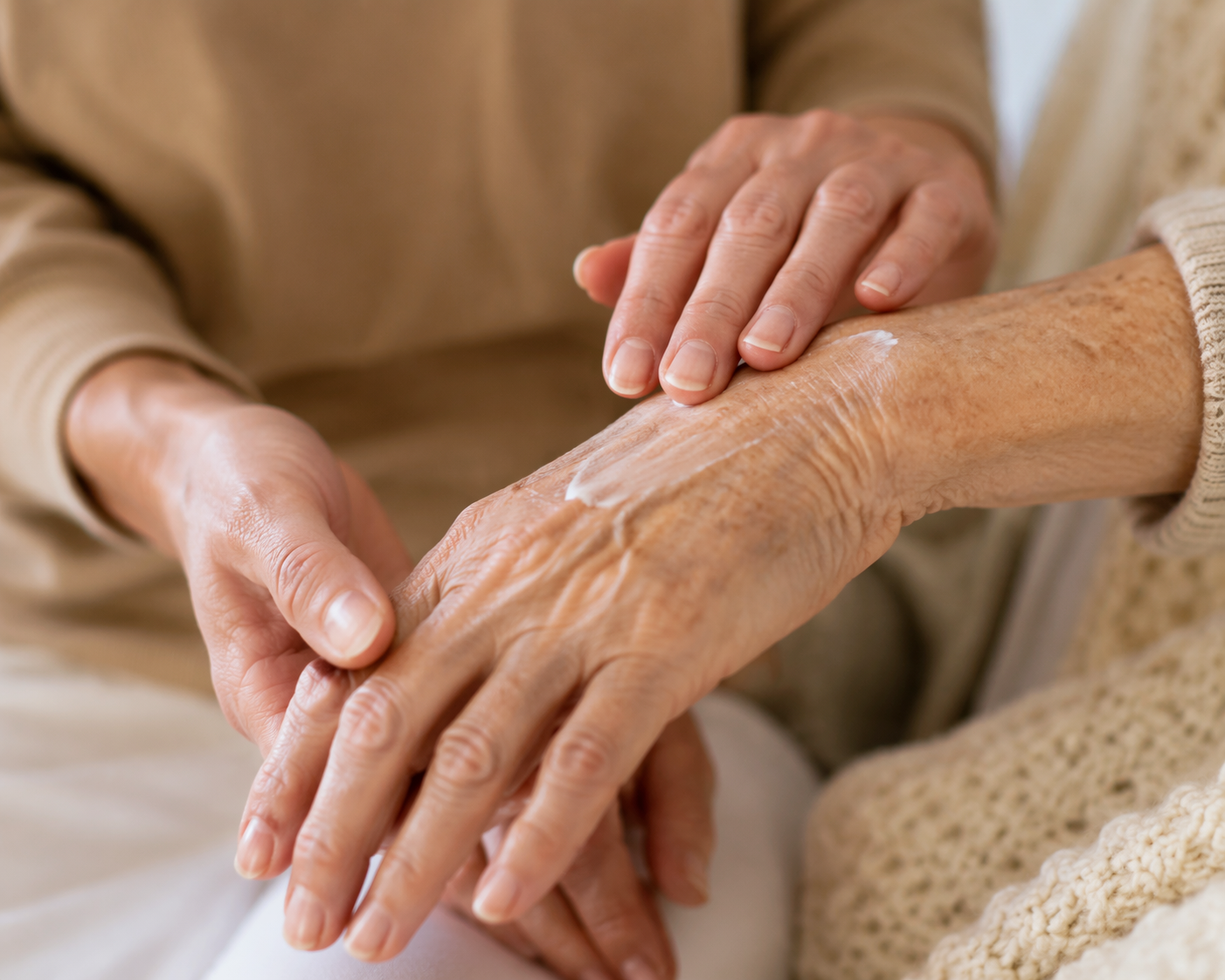
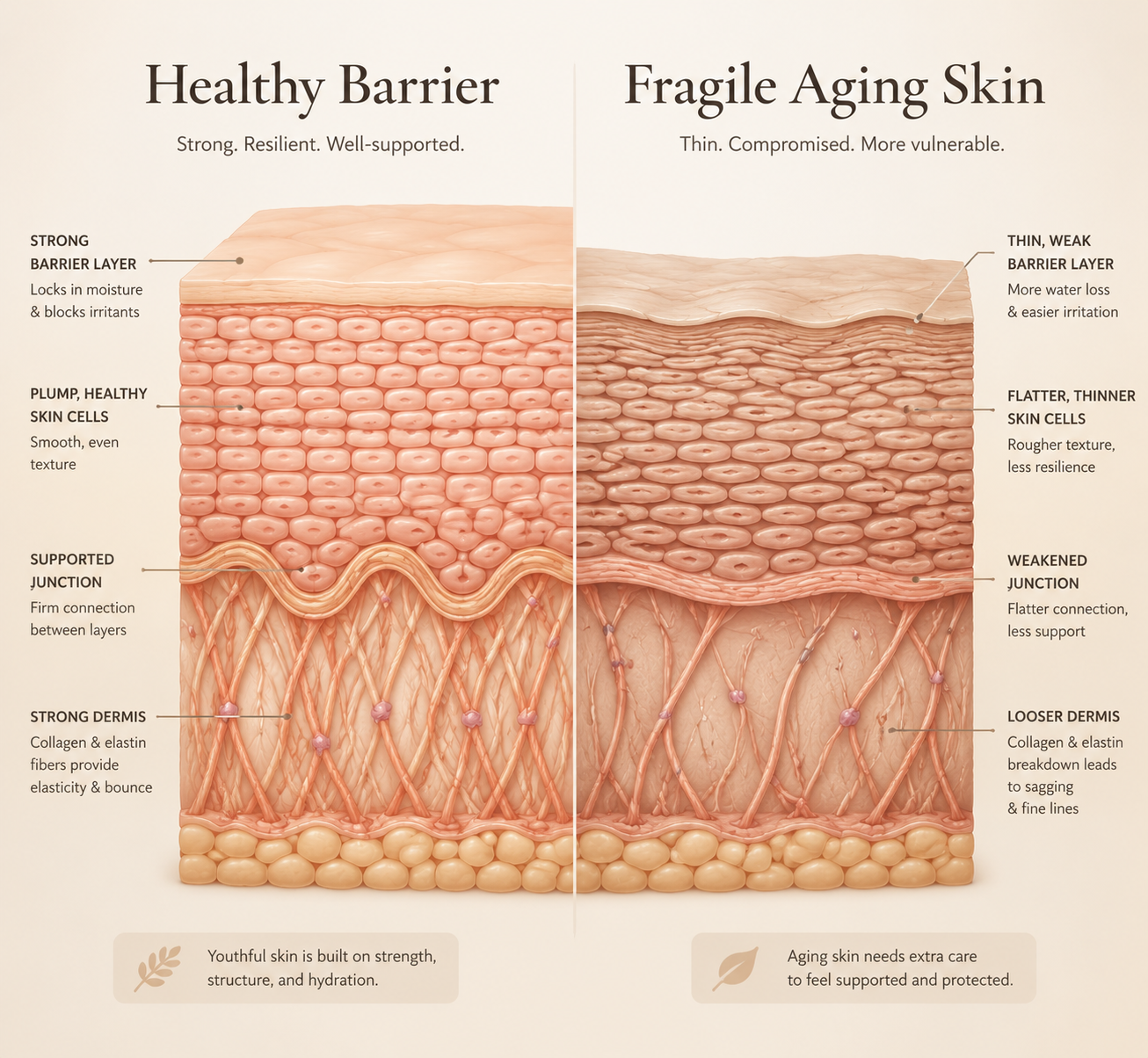
Older skin behaves differently from middle-aged skin. The American Academy of Dermatology says that up to 85% of older adults develop xerosis, or extremely dry skin, and notes that skin in the 60s and 70s is often drier, more easily irritated, and more vulnerable to injury.[1] Mayo Clinic also describes thin skin as more prone to bruising and tearing, with protection becoming more important as skin loses some of its cushioning.[2]
That changes the meaning of a good anti-aging product. A product that makes sense for a 45-year-old with oily, resilient skin may be too aggressive for a 78-year-old whose hands split in winter or whose forearms bruise after a blood draw. The usual beauty language—firming, resurfacing, renewing—can hide the practical problem sitting in front of the caregiver: the skin barrier is already under strain.
If there is active redness, scaling, rash, weeping, pain, or recurring irritation, treat that as a skin problem first, not as a cosmetic shopping problem. For related seasonal irritation and fragile-skin care, see this guide to managing senior skin inflammation.
The Two-Product Baseline to Try First
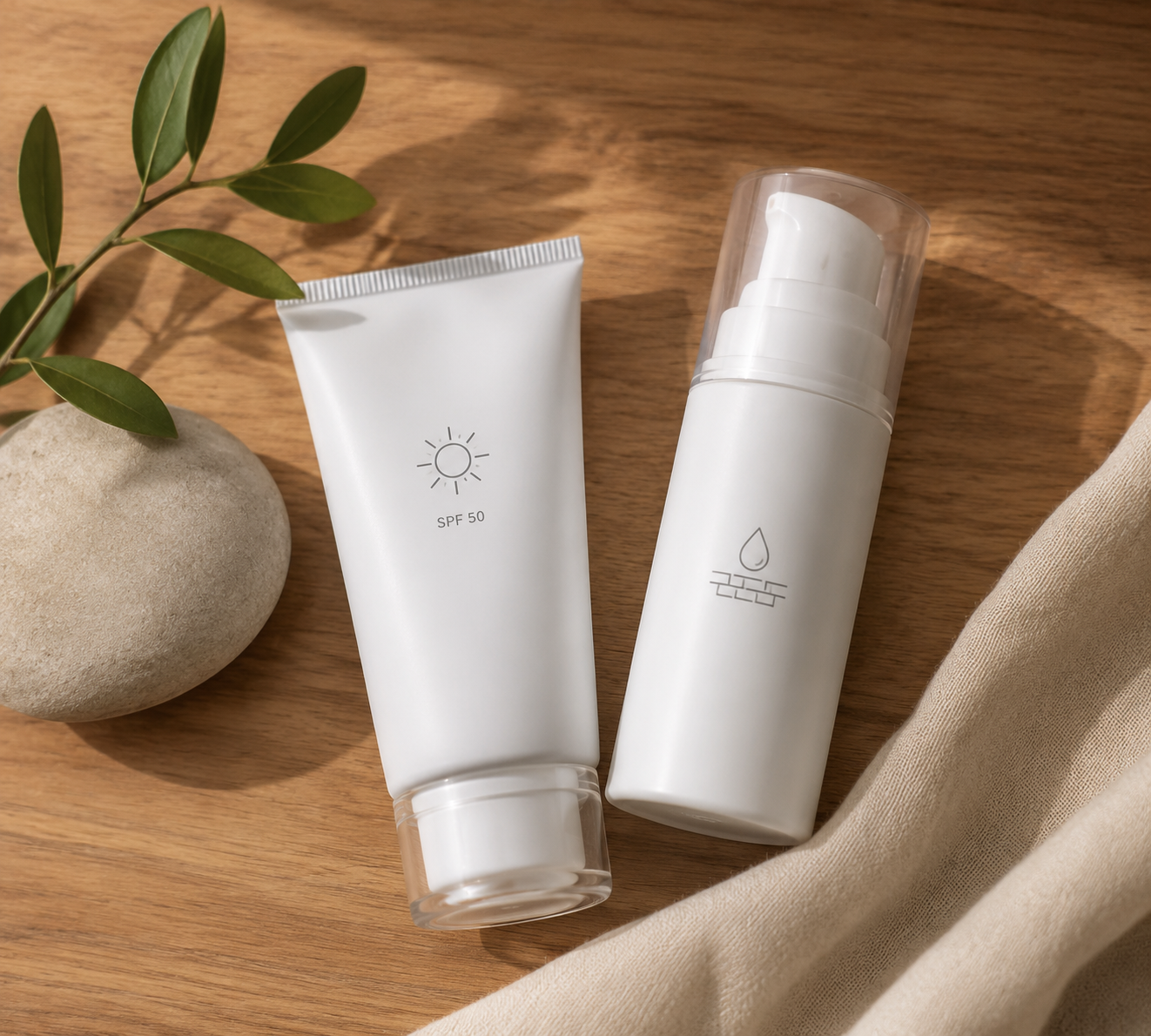
The most useful starting routine is plain: a broad-spectrum mineral sunscreen with SPF 30 or higher in the morning, and a fragrance-free moisturizer with ceramides at least daily. The AAD recommends choosing a sunscreen and moisturizer first, then giving them several weeks to work before adding another anti-aging product.[3]
That advice is easy to underestimate because it sounds too simple. But for a senior whose skin is dry, itchy, or reactive, several quiet weeks with the same gentle products can tell you more than a bathroom shelf full of serums. If the skin calms down, flakes less, and tolerates touch better, the baseline is doing real work.
| Product | What to Look For | Why It Matters for Seniors |
|---|---|---|
| Mineral sunscreen | Broad-spectrum SPF 30+, zinc oxide and/or titanium dioxide | Protects from UV exposure without relying on more irritating anti-aging steps first |
| Ceramide moisturizer | Fragrance-free cream or lotion with barrier-supporting ingredients | Helps reduce dryness and supports skin that is more prone to itching and cracking |
| Gentle cleanser | Fragrance-free, non-scrubbing, non-deodorant cleanser | Cleans without stripping already dry skin |
A cleanser belongs in the routine only if it is gentle enough not to undo the moisturizer’s work. Cleveland Clinic dermatologists include cleanser, vitamin C serum, retinol, moisturizer, and SPF 30+ in an anti-aging routine, but also emphasize that older adults often do better with a simpler approach.[4] For many caregivers, that means cleanser only where needed, moisturizer generously, and sunscreen on exposed skin before daytime exposure.
How to Run the Baseline Without Guessing
- Start one new product at a time when possible, especially if the parent has a history of rashes or stinging.
- Use the moisturizer every day for several weeks before deciding it “doesn’t work,” unless it causes burning, rash, or worsening irritation.
- Apply sunscreen to exposed skin before outdoor time, car rides with sun exposure, gardening, errands, or sitting near strong windows.
- Watch the skin you actually worry about: forearms, hands, shins, cheeks, neck, and any area that already tears or bruises easily.
- Keep the routine easy enough that the older adult or caregiver can repeat it on tired days.
Medication and Fragility Come Before the Ingredient Wish List
Before adding retinol, exfoliating acids, or brightening serums, look at the medication list. The AAD notes that some medications and medical treatments can make skin more fragile, and Mayo Clinic discusses added protection for thin skin that bruises and tears more easily.[1][2] Blood thinners such as warfarin or apixaban can increase bruising risk, while oral or topical corticosteroids may contribute to thinner, more fragile skin.[5]
This is not a reason to stop a prescribed medication or change how it is used. It is a reason to be conservative with skin products and to ask a clinician or pharmacist when bruising, tearing, or new irritation suddenly worsens. The cream in the cart is only one part of the picture.
Caregivers also need to separate product comfort from household safety. The AAD specifically warns older adults not to use bath oil because it can make the tub slippery and increase fall risk.[1] A moisturizing idea that turns the bathtub into a hazard is not a safe skin-care solution.
Ingredients That Usually Make Sense
For a senior parent, ingredients are best judged by purpose and tolerance, not by how many “anti-aging” words appear on the label. A short, calm routine beats a dramatic one that leaves the skin stinging.
| Ingredient or Product Type | Useful Role | Caregiver Note |
|---|---|---|
| Zinc oxide or titanium dioxide sunscreen | UV protection | Often preferred for sensitive older skin; choose broad-spectrum SPF 30+ |
| Ceramides | Barrier support | Good fit for dry, fragile skin when the formula is fragrance-free |
| Niacinamide | Tone and barrier support | Optional; introduce after the basic moisturizer and sunscreen are tolerated |
| Vitamin C | Antioxidant and brightening support | Optional; can be irritating for some and does not stay fresh indefinitely |
| Low-strength retinoid | Fine-line and texture support | Optional, slow, and not appropriate for every senior |
Mineral sunscreen deserves its place at the front of the routine. Consumer Reports notes FDA concern that some chemical sunscreen ingredients can be absorbed into the bloodstream, and identifies mineral ingredients such as zinc oxide and titanium dioxide as generally recognized as safe and effective.[5] For a caregiver choosing for reactive skin, that tilts the decision toward mineral sunscreen unless a clinician has advised otherwise.
Niacinamide and vitamin C can be reasonable later additions, but they should not crowd out the basics. Harvard Health describes evidence that 5% niacinamide used twice daily reduced age spots in four weeks in a randomized controlled trial, and also notes that vitamin C products have a short shelf life of about six months.[6][7] That makes vitamin C a product to buy and use thoughtfully, not a bottle to leave half-open for a year in a warm bathroom.
Retinoids Can Help, But They Are Not the Starting Point
Retinoids are the ingredient family that most anti-aging articles treat as inevitable. They do have evidence behind them. Harvard Health reports that over-the-counter retinoids can significantly improve fine wrinkles by increasing collagen thickness.[6] Wirecutter’s testing of skin-care products for aging skin included testers ages 40 to 84 and found gentle retinoid options, including a 0.1% retinol cream, useful for mature skin without irritation in that testing context.[8]
That does not make retinol automatic for a 75- or 85-year-old. A parent with paper-thin forearm skin, frequent unexplained bruises, eczema-like patches, or a history of product reactions may be better served by never adding it. A parent whose skin has tolerated moisturizer and sunscreen for several weeks may be a candidate for a low-strength retinoid, introduced cautiously.
- Use it at night, not before sun exposure.
- Start one or two nights per week, not every night.
- Apply moisturizer before or after to reduce dryness, depending on tolerance.
- Avoid using it on torn, irritated, recently treated, or actively inflamed skin.
- Stop and reassess if burning, peeling, cracking, or persistent redness appears.
The goal is not to prove that a senior can “handle” retinol. The goal is to notice early if the cost is too high for the likely benefit. Fine-line improvement is not worth a skin tear, a bleeding crack, or a week of itching that keeps someone awake.
What to Avoid or Slow Down
Some products are not “bad” in every setting, but they are easy to misuse on older skin. When the person applying the product is an adult child helping after a shower or before bed, the safest choice is often the boring one.
- Fragrance-heavy creams: fragrance is a common irritant, and “natural” fragrance can still bother sensitive skin.
- Alcohol-heavy formulas: these can feel light but may worsen dryness on already depleted skin.
- High-concentration retinoids or aggressive exfoliating acids: these are especially risky when skin is thin, cracked, or reactive.
- Bath oils: they may sound soothing, but they can create a serious slip hazard in the tub.
- Complicated routines: the more products added at once, the harder it is to identify what caused a reaction.
Label language deserves caution too. The AAD explains that “clinically proven” on a cosmetic label means the product was given to consumers to try; it does not mean the product went through FDA clinical trials the way a drug would.[3] For a caregiver trying to protect fragile skin, that distinction matters. A claim can be legal, polished, and still not strong enough to override visible irritation.
Brand Names Can Help, But They Are Not the Decision
Names like CeraVe, Vanicream, Dove Sensitive, and La Roche-Posay come up often because they make fragrance-free, dermatologist-recommended products that fit the gentle-cleanser, moisturizer, and sunscreen categories discussed here.[8] They can be useful starting points in a drugstore aisle, especially when a caregiver is tired and trying not to buy the wrong thing.
Still, the brand is not the safety check. The ingredient list, fragrance status, texture, SPF rating, and the parent’s actual reaction matter more. Product formulas and availability can change, so a “best” label from any roundup should be treated as temporary, not as permission to ignore fragile skin.
A Conservative Decision Rule for Caregivers
If you are choosing for a senior over 70, start with this rule: no optional anti-aging active gets added until the skin tolerates mineral SPF 30+ and a fragrance-free ceramide moisturizer for several weeks. If the parent is on blood thinners, uses corticosteroids, bruises easily, scratches at night, or has skin that tears, be slower still.
The Health in Aging Foundation’s caregiver guide to skin problems encourages caregivers to pay attention to skin changes and seek medical guidance for concerning symptoms, which is the right frame here.[9] A new dark lesion, a wound that does not heal, sudden widespread rash, infection signs, unexplained bruising, or severe itching belongs with a clinician, not in a product comparison.
The safest anti-aging products for seniors are often the least dramatic ones: sunscreen that gets used, moisturizer that stops the itching, cleanser that does not strip, and optional actives that earn their place slowly. That routine may not promise a transformed face. It can give a parent skin that is less dry, better protected from UV exposure, less likely to react, and handled with the dignity fragile skin deserves.
References
- Skin care in your 60s and 70s, American Academy of Dermatology
- Thin skin? Added protection helps, Mayo Clinic
- How to select anti-aging skin care products, American Academy of Dermatology
- Anti-Aging Skin Care: Ingredients and Routine, Cleveland Clinic
- Best Anti-Aging Skin Care, Consumer Reports
- Skin care for aging skin, Harvard Health
- Drugstore skincare: Science-backed anti-aging ingredients that don’t break the bank, Harvard Health
- The Best Skin Care Products for Aging Skin, NYT Wirecutter
- Caregiver Guide: Skin Problems, Health in Aging Foundation
Where this decision comes from
Suggest a correction
We keep this content strictly product-neutral and reviewed against CDC STEADI, NIA, and AARP HomeFit guidance. If something here looks outdated, unclear, or inaccurate, tell us — this page does not carry open public comments, because it touches medical urgency, cost, or capacity-adjacent decisions where a discussion thread is a trust liability rather than a trust asset.
See the correction process on our editorial standards page →