
Caregiver decision guide
Passive Home Monitoring Sensors for Aging Parents: A Guide to Motion, Door, and Stove Safety
This product-neutral guide explains how three layers of passive sensors — motion detectors, door contact sensors, and stove safety devices — work together to monitor an aging parent's safety at home without cameras or wearables, helping family caregivers understand their options before making purchasing decisions.
Why Passive Monitoring Matters for Aging Parents
When an aging parent lives alone, the question of how to keep them safe without eroding their independence or dignity is a delicate one. Cameras feel invasive. Wearable pendants get left in drawers. Smartphones go uncharged. Passive monitoring offers a third path: sensors that observe the home environment — not the person — and alert caregivers only when something is wrong.
The core idea is simple. Instead of asking your parent to wear a device or remember to press a button, you place small sensors around the house that detect motion, door openings, and stove activity. These sensors learn daily routines — when your parent typically gets up, when they move through the kitchen, when the front door opens — and flag deviations that could signal a fall, wandering, or a forgotten stove burner.
The evidence base for this approach is growing. A 2022 scoping review by Kim et al., covering 30 studies on in-home monitoring for older adults, found that passive infrared (PIR) motion sensors were used in 21 of the 30 studies, and contact sensors (for doors, windows, and cabinets) appeared in 19 of 30. These are not experimental technologies — they are the most studied and most validated tools for aging-in-place monitoring.
The stakes are high. According to the CDC, over 14 million older adults — roughly 1 in 4 — report falling each year, and the age-adjusted fall death rate rose 21% between 2018 and 2024. For families managing dementia, the Alzheimer's Association estimates that 60% of people with Alzheimer's will wander at some point. And in the kitchen, adults 65 and older face a 2.5 times greater risk of dying in a cooking fire than the general population, a figure that climbs to 4 times by age 85, according to FEMA.
A well-designed passive monitoring system addresses all three risks — falls, wandering, and cooking fires — through three distinct sensor layers. Each layer serves a different purpose, and together they create a safety net that respects your parent's autonomy while giving you the information you need to respond.
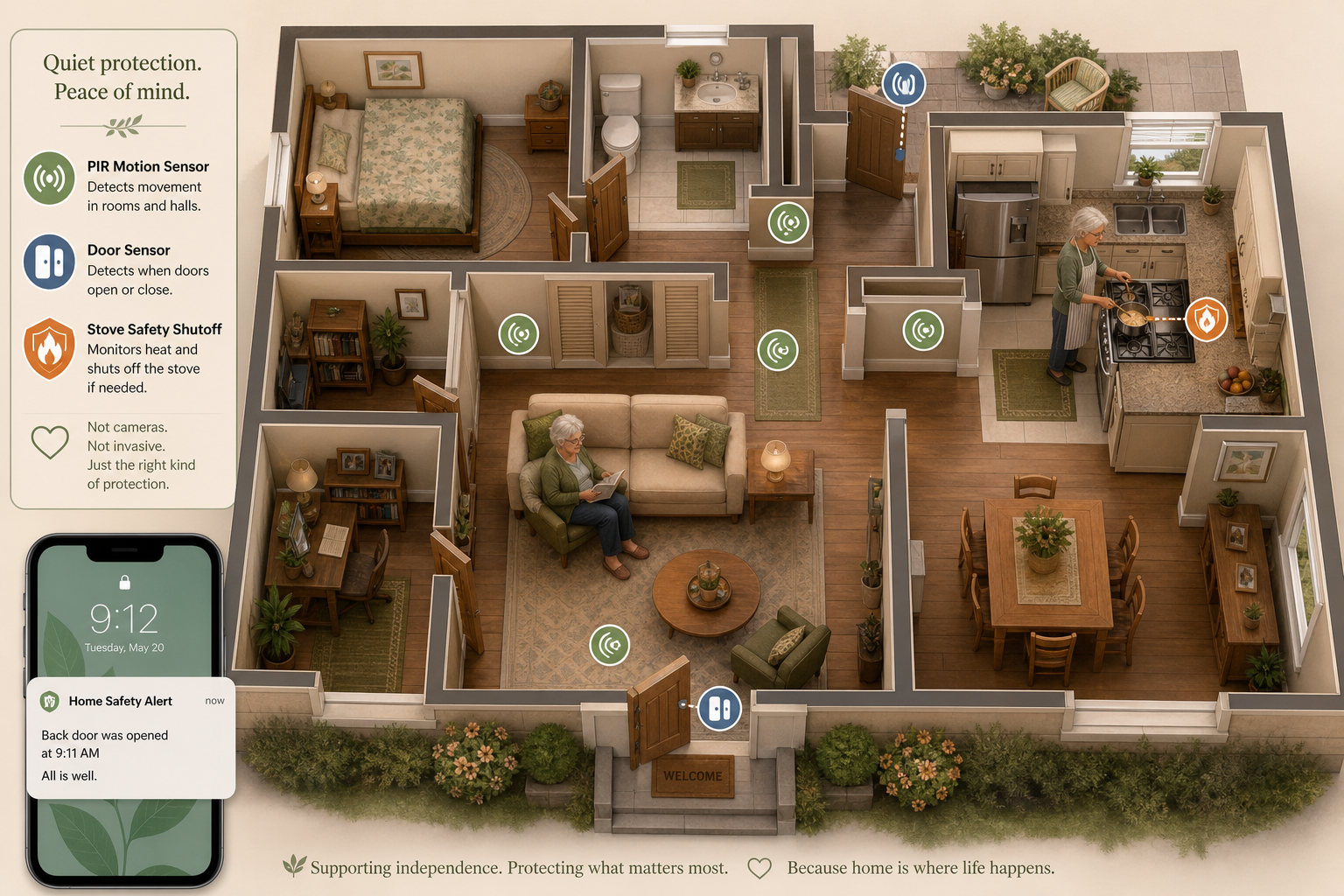
Layer 1: Motion Sensors for Routine and Fall Detection
Passive infrared (PIR) motion sensors are the workhorses of home monitoring. They detect body heat and movement within a defined area — typically a hallway, living room, or bedroom — and report when motion is present or absent. They do not record video or audio. They simply register that someone is (or is not) moving through that space.
The Kim et al. review found that PIR sensors were the most common technology across the 30 studies, used in 21 of them. Researchers have deployed them to track daily activities, detect abnormal behaviors, assess cognitive decline, and identify falls. In many studies, four sensors placed roughly 2 feet apart were sufficient to monitor mobility patterns in a single room.
For a family caregiver, the practical value lies in pattern recognition. After a few days of installation, a motion sensor system learns when your parent typically wakes up, how often they move between rooms, and when they settle in for the night. When the system detects an anomaly — no motion detected by mid-morning, an unusual number of bathroom trips at night, or a sudden drop in overall activity — it can send an alert.
- Prolonged inactivity: If no motion is detected for several hours during a time when your parent is normally active, it could indicate a fall or medical event.
- Increased nighttime activity: Two or more bathroom trips at night (nocturia) are associated with higher fall risk, sleep disturbance, and cognitive decline.
- Reduced mobility: A gradual decline in daily movement patterns can signal worsening arthritis, fatigue, or early-stage cognitive changes.
Placement matters. A single sensor in the hallway gives you only hallway data. A well-designed system places sensors in the bedroom (to detect wake time), the bathroom (to flag nighttime trips), the kitchen (to confirm meal activity), and the main living area (to track daytime routines). The more sensors, the richer the pattern — but even two or three strategically placed sensors can provide meaningful insight.
Layer 2: Door Contact Sensors for Wandering and Exit Awareness
Magnetic contact sensors — the same technology used in many home security systems — attach to doors and window frames. When the door opens, the magnetic connection breaks, and the sensor sends a signal. For aging parents, these sensors serve two primary functions: alerting caregivers when an exterior door is opened (especially at unusual hours) and monitoring access to hazardous areas like basements, garages, or medicine cabinets.
For families managing dementia, door sensors are arguably the most critical layer. The Alzheimer's Association estimates that 60% of people with Alzheimer's disease will wander at some point. Wandering can happen at any stage, but it is most common in the middle stages of the disease, when the person may become disoriented even in familiar surroundings. A door sensor that sends an alert the moment an exterior door is opened — especially between midnight and dawn — can be the difference between a quick return and a dangerous situation.
Door sensors come in two broad categories: simple chime systems and connected smart sensors.
- Simple chime systems: A battery-powered sensor on the door and a receiver that plays a chime when the door opens. Some models include a pager that the caregiver carries. These are inexpensive (often under $50), easy to install, and require no WiFi or smartphone. The trade-off is that the caregiver must be within range of the receiver or pager.
- Connected smart sensors: These link to a central hub or smartphone app and can send push notifications, text messages, or email alerts regardless of the caregiver's location. They also allow for more sophisticated rules — for example, alert only if the door opens between 10 p.m. and 6 a.m., or only if the door is left open for more than 30 seconds.
Door sensors can also be used on interior doors — the medicine cabinet, the basement door, the garage entry — to monitor access to areas that may be unsafe for a person with cognitive decline. The Kim et al. review noted that contact sensors were used in 19 of the 30 studies, often on cabinets and drawers to track medication adherence or on exterior doors to monitor exit behavior.
Layer 3: Stove Safety Devices for Cooking Fire Prevention
Cooking fires are the leading cause of home fires and fire-related injuries in the United States. For older adults, the risk is disproportionately high. According to FEMA, adults 65 and older face a 2.5 times greater risk of dying in a kitchen fire than the general population. That risk rises to 3 times at age 75 and 4 times at age 85. The USFA and NFPA estimate that 37% of cooking fires are caused by unattended or forgotten cooking.
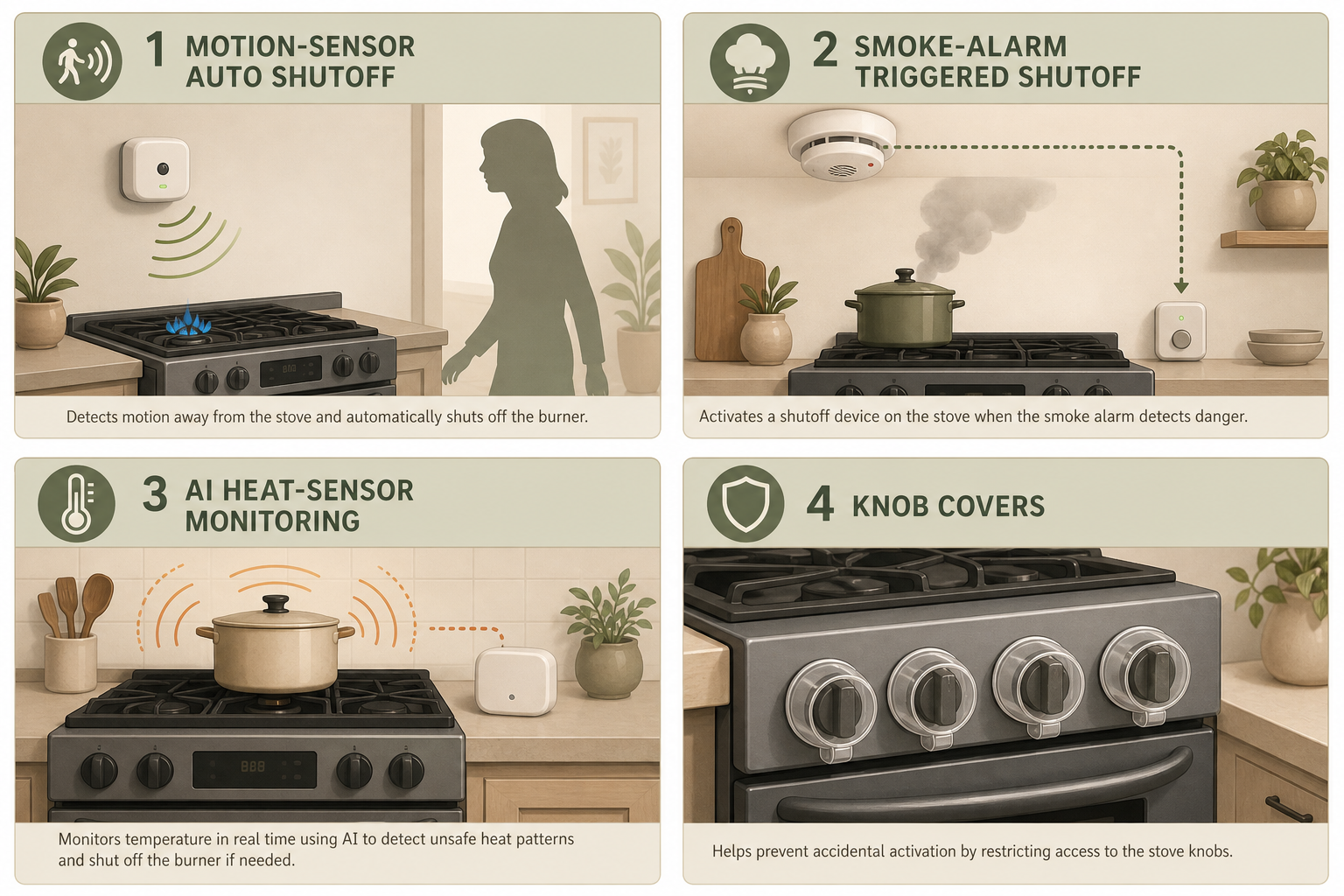
Stove safety devices address this risk by automatically shutting off the stove when a dangerous condition is detected. There are four main types, each with a different operating principle and price point.
| Device Type | How It Works | Typical Price Range | Best For |
|---|---|---|---|
| Motion-sensor auto shutoff | Detects absence in the kitchen and shuts off power to stove heating elements after a set time | $200–$299 | Electric stoves; caregivers who want a fully automatic solution with no user action required |
| Smoke-alarm-triggered shutoff | Plugs into the stove outlet and listens for the sound of a smoke alarm; shuts off power when alarm is detected | ~$250 | Homes with existing smoke alarms; renters (no hardwiring needed) |
| AI heat-sensor monitoring | Monitors stove surface temperature and detects abnormal heat patterns; shuts off gas or electric supply | Varies by model | Gas stoves; homes with induction or ceramic cooktops |
| Knob covers | Physical covers that prevent the stove knobs from being turned on | $20–$35 | Mild cognitive impairment; renters; lowest-cost option; no installation required |
Motion-sensor devices like iGuardStove (which claims to have prevented over 1 million potential forgotten cooking fires with zero reported incidents as of 2026) are the most common automatic option. They work by detecting the absence of body heat in the kitchen. If no motion is detected for a preset period — typically 30 seconds to a few minutes — the device cuts power to the stove's heating elements. The newer iGuard model (2026) adds radar-based detection, remote access via a mobile app, and a gas sensor for gas stove models.
Smoke-alarm-triggered devices like FireAvert take a different approach. They plug into the stove's power outlet and listen for the specific sound pattern of a smoke alarm. When the alarm sounds, the device shuts off power to the stove. This approach has the advantage of not requiring any change in the older adult's behavior — the stove works normally until a smoke alarm is triggered.
The right choice depends on your parent's stove type, cognitive status, and living situation. For a parent with mild cognitive impairment who lives alone and uses an electric stove, a motion-sensor shutoff is a strong first step. For a parent with more advanced dementia who lives with a spouse, a simple knob cover may be sufficient to prevent accidental activation. For a gas stove, an AI heat-sensor or gas-detection device is necessary, since motion-sensor and smoke-alarm devices typically only work with electric models.
How These Three Layers Work Together as a Unified System
Each sensor layer addresses a specific risk, but the real value emerges when they are deployed together. A motion sensor in the hallway tells you your parent is moving normally. A door sensor on the front door tells you they have not left the house. A stove sensor tells you the burners are off. Individually, each data point is useful. Together, they create a coherent picture of safety.
Consider a typical scenario. Your parent wakes up at 7:30 a.m. — the bedroom motion sensor registers activity. They move to the kitchen — the hallway sensor picks them up. They open the refrigerator — a cabinet sensor (if installed) notes the activity. They turn on the stove — the stove sensor begins monitoring. At 9:00 a.m., they leave the kitchen. The stove sensor detects no motion for 60 seconds and shuts off the burner. The front door sensor remains silent. At 11:00 a.m., the living room sensor shows no movement — but this is normal for their routine. At 2:00 p.m., the front door opens. You receive a notification on your phone. You call your parent. They answer — they are just checking the mail.
Now consider the same scenario with a problem. Your parent wakes at 7:30 a.m. The hallway sensor picks them up heading toward the kitchen. The stove sensor detects heat. Then — nothing. No motion in the kitchen for 45 minutes. The stove is still on. The front door has not opened. The system sends you an alert: "Possible fall in the kitchen area. No motion detected for 45 minutes. Stove is active." You call. No answer. You call a neighbor or emergency services.
This is the power of a layered system. No single sensor could have told you that a fall might have occurred while the stove was still on. But the combination of motion absence and stove activity creates a signal that is far more informative than either sensor alone.
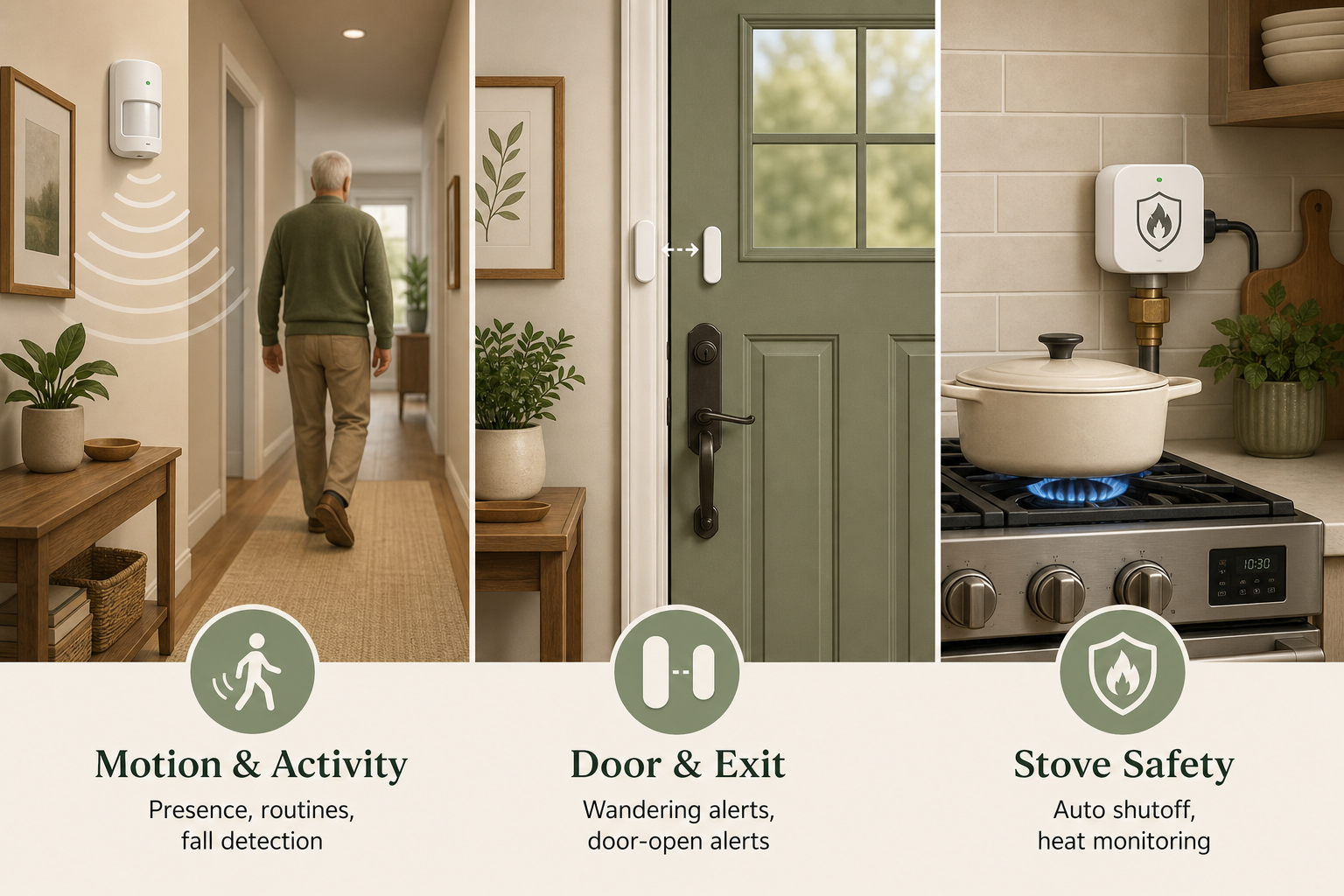
Most modern passive monitoring systems integrate all three sensor types into a single platform with a central hub and a smartphone app. The hub collects data from all sensors, applies rules and thresholds, and sends alerts to the caregiver's phone. Some systems, like envoyatHome, offer a fully managed service with professional monitoring ($99/month after a $399 equipment fee). Others allow you to mix and match sensors from different manufacturers using a smart home hub like Alexa, Google Home, or Apple HomeKit.
Smart vs. Simple: When Connectivity Earns Its Keep
One of the most common questions family caregivers face is whether to buy simple standalone devices or invest in a connected smart system. The answer depends on who you are trying to serve.
| Factor | Simple Standalone Devices | Connected Smart System |
|---|---|---|
| Setup | Battery-powered, no wiring, no WiFi needed | Requires hub, WiFi, and app setup; may need professional installation |
| Reliability | Works even during power or internet outages | Depends on WiFi and cloud service; some hubs have cellular backup |
| Cost | Low upfront ($20–$80 per device); no monthly fees | Higher upfront ($200–$500+); often $10–$100/month subscription |
| Alerts | Audible chime or pager; range-limited | Smartphone push, text, email; works from anywhere |
| Best for | The older adult who needs an immediate local alert | The long-distance caregiver who needs remote awareness |
For the older adult living at home, simpler is often better. A door chime that plays a pleasant tone when the front door opens requires no smartphone, no app, and no learning curve. A stove knob cover costs $25 and installs in seconds. These devices work regardless of WiFi outages, power failures, or whether the caregiver remembers to check their phone.
For the caregiver — especially a long-distance caregiver — connectivity earns its keep. A smartphone alert that a door opened at 3 a.m. provides peace of mind that a local chime cannot. A motion sensor that sends a daily summary of activity levels helps you spot trends before they become emergencies. The AARP reports that 75% of Americans ages 50 and older plan to age in place, and for the adult children managing that process from another city, a connected system is often the only practical option.
Battery life is another important consideration. Simple devices often run for a year or more on a single set of batteries. Connected sensors, especially those that communicate via WiFi, may need battery changes every 3–6 months. If your parent is not able to change batteries, you will need to plan for regular visits or choose a system with long battery life and low-battery alerts.
Avoiding Alert Fatigue: A Monitoring Philosophy of Restraint
The most common failure of home monitoring is not technology failure — it is alert fatigue. When a system sends too many notifications, caregivers stop paying attention. A chime that goes off every time the front door opens stops being a warning and becomes background noise. A smartphone that buzzes with every bathroom trip gets silenced.
The solution is restraint. Start with the highest-risk sensor for your parent's specific situation. If your parent has mild cognitive impairment and lives alone, start with a stove safety device — cooking fires are the most immediate lethal risk. If your parent has a dementia diagnosis and a history of wandering, start with a door sensor. If your parent is generally healthy but has had a recent fall, start with a motion sensor in the bedroom and bathroom.
- Set thresholds, not triggers. Instead of alerting on every motion event, set the system to alert only when no motion is detected for an unusually long period — for example, 4 hours during the day or 12 hours overnight.
- Use time-based rules. A door opening at 2 p.m. is probably normal. A door opening at 2 a.m. is worth an alert. Most connected systems allow you to set different rules for different times of day.
- Add layers gradually. Install one sensor, live with it for a week, and then decide whether the next layer is necessary. This prevents the system from becoming overwhelming for both you and your parent.
- Review and adjust. After a month, review the alerts you received. How many were actionable? How many were noise? Adjust thresholds accordingly.
It is also worth discussing the monitoring philosophy with your parent. Even though passive sensors do not use cameras, the presence of sensors can feel like surveillance. Explain what each sensor does and why it is there. Emphasize that the goal is to help them stay at home longer, not to watch them. For many older adults, knowing that a stove shutoff device will prevent a fire is a source of reassurance, not resentment.
Sources and Further Reading
The information in this guide is drawn from the following sources. Readers are encouraged to consult these directly for deeper context and to verify current data, as statistics and product categories evolve.
- Kim et al. (2022) — "In-Home Monitoring Technology for Aging in Place: Scoping Review" (PMC). Covers 30 studies on sensor-based monitoring, with PIR motion sensors in 21 studies and contact sensors in 19. Foundational reference for sensor prevalence and evidence base.
- CDC — Older Adult Falls Data. Reports over 14 million older adults fall each year (1 in 4), with a 21% increase in the age-adjusted fall death rate from 2018 to 2024.
- FEMA/USFA — Kitchen Fire Risk Statistics. Adults 65+ have a 2.5x greater risk of dying in a kitchen fire; 3x at 75; 4x at 85. Cooking is the leading cause of home fires.
- Alzheimer's Association — Wandering Statistics. Approximately 60% of people with Alzheimer's disease will wander at some point. Door sensors and wandering prevention strategies are recommended as first-line interventions.
- iGuardFire — iGuardStove product data. Company reports over 1 million prevented cooking fires with zero reported incidents as of 2026. Pricing and feature information for motion-sensor stove shutoff devices.
- ElderGuardHome — Automatic Stove Shutoff Devices Guide. Comprehensive overview of four stove safety device types with pricing and use-case recommendations.
- SafeWise — Dementia Caregiver Safety Guide. Recommendations for door chimes, motion sensors, and wandering prevention tools, including product examples and pricing ranges.
- AgingCare — Products and Strategies for Managing Dementia Wandering. Overview of wandering prevention strategies including door alarms, GPS trackers, and environmental modifications.
Questions to bring to a clinician or OT
This is not medical, legal, or a family's final decision — only a framework. Bring these questions to a clinician, occupational therapist, or your local Area Agency on Aging.
Find Local HelpRelated reading
- Why Wearable Help Buttons Fail and What Actually Works: A Caregiver's Guide to Passive Monitoring
- Wearable vs. Passive Senior Monitoring: What Each Approach Misses — and How to Cover Both
- The Privacy Trade-Off in Elderly Monitoring: Camera-Free Systems, Data Security, and Gaining Your Parent's Acceptance
Noticed something outdated or inaccurate on this page? Flag a correction. We review every report against CDC, NIA, and AARP HomeFit guidance before updating a page.