
Caregiver decision guide
8 Medication Classes That Raise Heat Risk in Older Adults
Standard heat safety tips miss how common medications affect body temperature regulation. This guide explains which drug classes increase heat risk and what caregivers should do differently.
The awkward part of heat safety for an older parent is not usually the advice itself. Shade, air conditioning, lighter clothing, fluids, and checking in all make sense. The problem starts when the person you are watching over takes a diuretic in the morning, a blood pressure pill at night, an allergy tablet during pollen season, or diabetes medication that already requires attention to meals and hydration. Suddenly “drink more water” is not a complete plan.
Heat safety for older adults has to include the medication list. Common prescriptions and over-the-counter drugs can affect sweating, thirst, blood flow to the skin, fluid balance, blood pressure response, alertness, or glucose control. The CDC’s clinician guidance names several medication classes that can increase heat-related risk through these different mechanisms, including diuretics, beta blockers, ACE inhibitors and ARBs, antipsychotics, SSRIs and SNRIs, anticholinergics, antihistamines, and certain diabetes medications.[1]
That does not mean an older adult should stop a medication because the forecast is ugly. Do not skip, hold, split, or change doses for heat without the prescribing clinician’s guidance. The safer move is to use the list below to prepare better questions before hot weather arrives, and to recognize when ordinary summer advice needs to be individualized.

Why Heat And Medication Risk Overlap In Older Adults
An older body does not handle heat the same way a younger one does. The CDC notes that adults aged 65 and older are at higher risk during heat because aging can make it harder to adjust to sudden temperature changes, and because chronic medical conditions and some medications can affect temperature regulation.[3] Harvard Medicine describes the same basic problem from the body’s side: older adults may have a reduced ability to sweat, move blood toward the skin, and sense or respond to overheating, and medications can compound those changes.[4]
Chronic illness is also part of the picture. A Center for American Progress report states that 95% of adults over 60 have at least one chronic condition, which means many older adults are not facing heat as a single isolated exposure; they are facing it with heart disease, diabetes, kidney disease, lung disease, cognitive impairment, or several conditions at once.[5] The same report notes that Alzheimer’s disease was linked to 6% higher mortality on hot days, a reminder that heat safety depends not only on what the thermometer says but also on whether the person can notice danger, explain symptoms, and act quickly.[5]
For caregivers, the practical issue is translation. A weather alert says “stay hydrated.” A cardiologist may have said “watch fluids.” A primary care doctor may have added a new blood pressure medication in spring. A pharmacist may warn that a medication can cause dizziness. None of those statements are wrong, but they do not automatically add up to a workable heat plan.
The Medication Classes Caregivers Should Flag Before Hot Weather
The point of flagging these medications is not to diagnose heat illness from a pill bottle. It is to know which bottles deserve a heat-specific review. AARP’s caregiver-facing overview makes the same broad point in plain language: several common medication types can make it harder for older adults to handle heat, and families should ask clinicians how to manage risk rather than making changes on their own.[2]
| Medication class | Why heat precautions may need to change | Caregiver question to ask |
|---|---|---|
| Diuretics | Can increase fluid loss and contribute to dehydration or electrolyte problems. | What should hydration look like on hot days, especially if fluids or salt are restricted? |
| Beta blockers | May blunt heart-rate response and reduce the body’s ability to move heat through circulation. | Could heat illness warning signs look different because pulse response is muted? |
| ACE inhibitors and ARBs | Can affect blood pressure and kidney-related fluid balance, especially when dehydration develops. | When should low blood pressure, dizziness, poor intake, vomiting, or diarrhea trigger a call? |
| Antipsychotics | Can interfere with thermoregulation and may also affect alertness or symptom reporting. | What heat symptoms should caregivers watch for if the person may not recognize or explain distress? |
| SSRIs and SNRIs | Can affect sweating and temperature regulation in some patients. | Should sweating changes, confusion, weakness, or unusual fatigue prompt earlier assessment? |
| Anticholinergics | Can reduce sweating and cause dry mouth, constipation, urinary retention, or confusion. | Which of this person’s medications have anticholinergic effects, including bladder or sleep medicines? |
| Antihistamines | Some can have anticholinergic effects and may cause sedation or reduced sweating. | Is this allergy or sleep medication safe to use during heat, or is there a better option? |
| Certain diabetes medications | Heat, dehydration, appetite changes, and activity changes can complicate glucose management. | How often should glucose be checked during heat, and what intake or symptom changes require a call? |
Diuretics: The Hardest Place To Interpret “Drink More Fluids”
Diuretics are often the first class caregivers think of, because the mismatch is obvious. These medications help the body get rid of fluid, and the CDC identifies volume depletion as one way they can increase heat-related risk.[1] On a normal day, that may be exactly what the medication is supposed to do. On a very hot day, fluid loss from sweating, poor intake, diarrhea, or extra urination can stack up quickly.
The caregiver problem is that the usual advice can collide with heart failure, kidney disease, swelling, or a prior instruction to limit fluids. “Drink more” may be unsafe for one person, while “keep fluids low” may be unsafe for another if it is followed rigidly during extreme heat. This is why diuretics deserve a specific question before the heat wave, not a rushed phone call after dizziness starts.
- Ask what the daily fluid target should be during hot weather, and whether it changes if the person is sweating, eating less, or spending time without air conditioning.
- Ask whether the clinician wants the family to monitor weight, blood pressure, swelling, urine output, or symptoms more closely during heat.
- Ask which symptoms should trigger same-day advice, such as dizziness, fainting, confusion, very low intake, vomiting, diarrhea, or a sudden change in urination.
- Ask whether any lab monitoring is relevant for this person if heat exposure, dehydration, or poor intake occurs.
Beta Blockers, ACE Inhibitors, And ARBs: When The Body’s Usual Signals May Be Less Helpful
Cardiovascular medications are another place where heat advice needs more precision. The body normally responds to heat partly by increasing blood flow to the skin and adjusting heart rate and blood pressure. The CDC guidance notes that beta blockers can reduce blood flow to the skin and decrease the body’s ability to dissipate heat, while ACE inhibitors and ARBs can contribute to heat risk through effects involving blood pressure, kidney function, thirst, and fluid balance.[1]
This matters because a caregiver may be waiting for the wrong signal. If an older adult on a beta blocker does not show the racing pulse someone expects during overheating, that does not prove they are fine. If someone on blood pressure medication becomes lightheaded after sitting in a warm room, standing up, or skipping lunch, the issue may not be “just tired.” Heat can make ordinary vulnerabilities show up faster.
A useful heat-season question for the prescriber is not “Should we stop this blood pressure medicine when it’s hot?” It is more specific: “If he is not eating or drinking normally, has diarrhea, seems weak, or has low blood pressure during a heat wave, what should we do and who should we call?” That gives the clinician something concrete to answer, and it gives the caregiver a plan that does not depend on improvising around the pill organizer.
Anticholinergics And Antihistamines: Dry Mouth Is Not The Same As Safe Hydration
Anticholinergic medications are easy to miss because they are not one neat category on the kitchen counter. They may include some bladder medications, medications used for dizziness or nausea, certain sleep aids, and other drugs with anticholinergic effects. The CDC lists anticholinergics among medications that can increase heat-related risk by reducing sweating.[1]
That mechanism deserves attention. Sweating is one of the body’s main cooling tools. If a medication reduces sweating, an older adult may not look as sweaty as the room feels. Dry mouth can also be misleading: it may make the person feel thirsty or uncomfortable, but it does not tell a caregiver whether the fluid plan is adequate or whether the body is cooling effectively.
Antihistamines can overlap with this concern. The CDC includes antihistamines in its medication guidance, and AARP’s plain-language version highlights that some allergy medicines can make heat harder to tolerate, especially when they cause sedation or anticholinergic effects.[1][2] For a caregiver, the small seasonal change matters: a parent who did reasonably well on winter medications may add an over-the-counter allergy or sleep product in July and unknowingly increase heat vulnerability.
- Before heat season, ask the pharmacist to identify which prescription and over-the-counter products have anticholinergic effects.
- Do not assume an over-the-counter allergy or sleep medication is harmless just because it is familiar.
- Watch for reduced sweating, unusual sleepiness, confusion, constipation, urinary retention, dizziness, or a sudden decline in functioning during hot days.
Antipsychotics, SSRIs, And SNRIs: Heat Risk Can Show Up As Behavior Or Confusion
Psychiatric medications can affect heat risk in ways that are especially hard for families to interpret. The CDC guidance includes antipsychotics, SSRIs, and SNRIs among medication classes that may interfere with thermoregulation, sweating, or heat tolerance.[1] These are not interchangeable drugs, and the risk is not identical for every person taking them. The practical point is that they should prompt a heat-specific review.
With antipsychotics, the concern may include impaired thermoregulation and changes in alertness or communication. With antidepressants such as SSRIs and SNRIs, the issue may involve sweating or temperature regulation. In real caregiving life, the warning sign may not arrive as a neat complaint of “I feel overheated.” It may look like new confusion, unusual agitation, sleepiness, weakness, poor coordination, or a parent who insists the room is comfortable even as the thermostat and the weather alert say otherwise.
This is where families need permission to treat a behavior change as a physical warning sign. If the person has dementia, depression, psychosis, or a history of delirium, heat planning should include who checks the room temperature, who confirms meals and fluids, and who decides that “he says he’s fine” is not enough evidence.
Certain Diabetes Medications: Heat, Food, Fluids, And Glucose Do Not Stay In Separate Lanes
Diabetes adds a different layer because heat days often disrupt the very routines glucose management depends on. Appetite may fall. Fluids may change. Activity may drop or shift indoors. Illness, dehydration, or missed meals can complicate blood sugar control. The CDC includes certain diabetes medications in its heat-and-medications guidance and notes that heat can interact with glucose management and medication safety.[1]
For caregivers, the question is not only whether a medication increases heat risk. It is whether the heat plan tells you what to do when lunch is half-eaten, the person is drowsy, the air conditioning fails, or the glucose reading is outside the usual range. The answer belongs with the diabetes prescriber or care team, because it depends on the person’s medication regimen, glucose targets, kidney function, diet, and history of lows or highs.
- Ask whether glucose should be checked more often during heat waves, illness, poor intake, or dehydration.
- Ask what to do if the person eats less than usual after taking diabetes medication.
- Ask which symptoms should be treated as urgent, especially confusion, weakness, fainting, vomiting, or signs of very high or very low glucose.
- Ask how insulin or other temperature-sensitive supplies should be stored during travel, outages, or appointments.
Turn The Medication List Into A Heat Plan
The most useful heat preparation is not a perfect spreadsheet. It is a complete enough medication list that a clinician or pharmacist can see the whole picture: prescription drugs, over-the-counter medications, supplements, eye drops, patches, inhalers, injections, and “only when needed” medicines that appear during allergy season, insomnia, pain flares, dizziness, or nausea.
Once the list is current, mark any medication that falls into the heat-sensitive classes above. If the older adult sees multiple specialists, do not assume each office knows what the others have prescribed. The cardiology portal, the primary care refill list, and the pharmacy profile may not match perfectly. Heat is one of those moments when the mismatch matters.
- Make one medication list that includes dose, timing, prescriber, reason for use, and whether the medication is daily or as needed.
- Ask the pharmacist to flag diuretics, cardiovascular drugs, anticholinergic medications, antihistamines, psychiatric medications, and diabetes medications that may affect heat tolerance.
- Send the list to the primary prescriber or relevant specialist before extreme heat, with specific questions about hydration, blood pressure, glucose checks, and warning signs.
- Write down who to call during heat if the person has dizziness, fainting, confusion, very poor intake, vomiting, diarrhea, abnormal glucose readings, or a major change in urination.
- Keep the plan where the medication routine actually happens: near the pill organizer, on the refrigerator, or in the shared caregiving folder.
If organizing the list is already the hard part, a broader medication management guide for older adults can help turn scattered bottles, portal messages, and refill dates into something a clinician can review. The heat-specific layer comes after that foundation: which medications change sweating, fluid balance, blood pressure response, alertness, or glucose control?
Clarify Hydration Before The Heat Wave, Not During It
Hydration is the instruction most likely to sound simple and become complicated. Some older adults avoid drinking because they do not want extra bathroom trips, especially overnight or when mobility is poor. Some have been told to limit fluids. Some take diuretics. Some have diabetes or kidney disease. Some simply do not feel thirsty until they are already behind.
A medication-aware heat plan should answer three questions in advance: how much fluid is appropriate for this person, what counts as a warning sign that intake is too low or too high, and what to do when heat combines with poor appetite, diarrhea, vomiting, or missed meals. The answer may be different for a parent with heart failure than for a parent whose main issue is forgetting to drink.
This is also where caregivers should ask about electrolytes and salt only if the clinician says it is relevant. Sports drinks, salt tablets, and electrolyte products are not automatically safe for every older adult, especially when heart, kidney, or blood pressure issues are involved. The useful question is, “If she is sweating more or eating less during heat, do you want us to change anything about fluids, salt, or monitoring?”
Watch For Masked Or Unusual Heat Symptoms
Medication-related heat risk is not only about whether heat illness happens. It is also about whether families recognize it early. A beta blocker may make pulse less helpful. An anticholinergic drug may reduce sweating. A psychiatric medication or dementia may make self-report less reliable. Diabetes can make weakness, confusion, sweating, or dizziness harder to interpret without checking glucose.
So the monitoring plan should not depend on one cue. Look at the room temperature, access to cooling, fluid and food intake, urination changes, balance, alertness, speech, skin temperature, and whether the person is acting like themselves. If an older adult is suddenly confused, faint, very weak, unable to keep fluids down, or not improving after cooling measures, treat that as more than ordinary summer discomfort.
Caregivers who are also planning for outages, evacuation, oxygen, mobility equipment, or refrigerated medications may need a broader severe weather medical-needs plan. Heat is not separate from those logistics when the person depends on devices, cold storage, transportation, or another adult to notice decline.
Do Not Forget The Medications Themselves
Heat can also damage medications and delivery devices. The CDC clinician guidance notes that heat can degrade medication delivery devices: inhalers can burst, insulin can lose potency, and EpiPens may malfunction when exposed to high temperatures.[1] That is not an abstract storage warning. It is the car dashboard during a pharmacy stop, the tote bag left in sun at an outdoor event, the mail-order package sitting outside, or the backup supplies stored near a window.
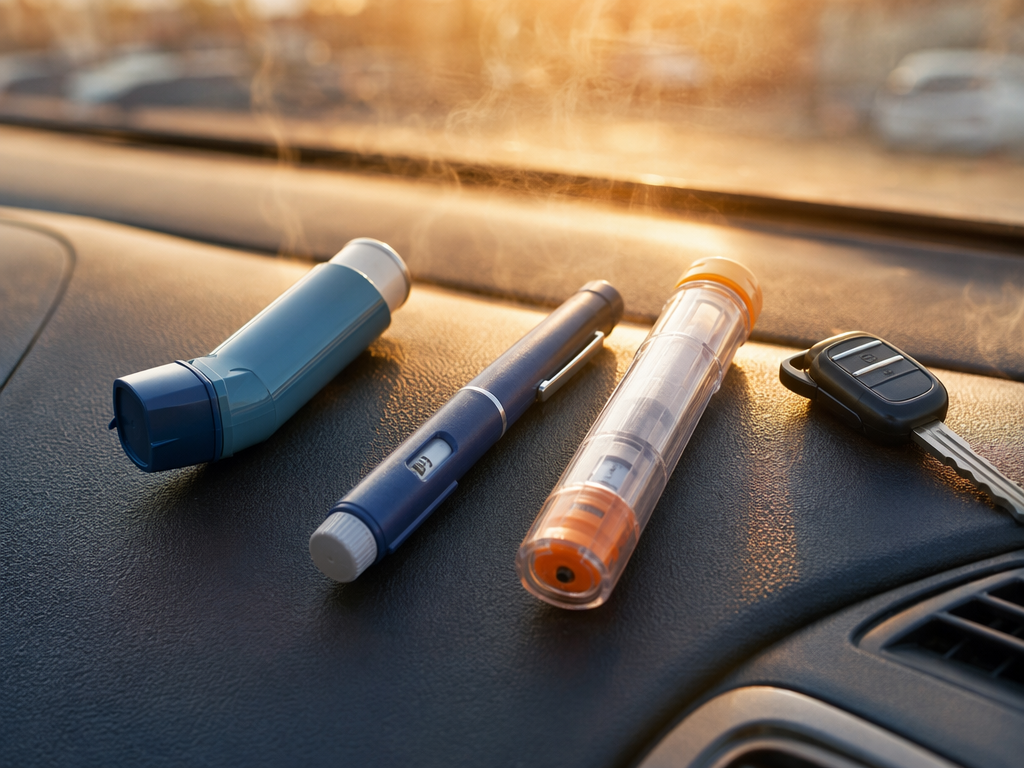
- Do not leave inhalers, insulin, EpiPens, patches, test strips, or other supplies in a hot car.
- Keep medications out of direct window light and away from hot bathrooms, garages, porches, or bags left in the sun.
- Ask the pharmacist what to do if a medication or device may have been overheated; do not guess based on appearance alone.
- For refrigerated medications, ask in advance how long they can safely be out, what temperature range is acceptable, and how to handle power outages or travel.
When Polypharmacy Makes Heat Planning More Fragile
Many older adults are not taking one medication from one category. A parent may take a diuretic, a beta blocker, an antidepressant, a bladder medication, an allergy pill, and diabetes medication at the same time. Each may have a reasonable purpose. Together, they can make heat planning harder because fluid balance, sweating, alertness, blood pressure, and glucose are all being influenced at once.
That is one reason heat is a good prompt for a medication review, especially when prescriptions have accumulated across specialists. Polypharmacy is not just a pill-count problem; it is a situation where the effect of the whole regimen may be harder to predict than the effect of any single drug. Families dealing with falls, confusion, frailty, incontinence, or multiple chronic conditions may also find it useful to understand how geriatric syndromes and polypharmacy overlap with seasonal risks like extreme heat.
A Medication-Aware Standard For Hot Days
Generic heat advice still matters. Cooling the home, avoiding outdoor exertion during the hottest part of the day, checking in, using air-conditioned spaces, and watching for emergency symptoms are still basic protections. They are just incomplete when an older adult’s medications may change how the body senses heat, loses fluid, sweats, circulates blood, regulates glucose, or displays warning signs.
Before and during hot weather, treat the medication list as part of the heat-safety plan. Review the classes that may raise risk, ask the prescriber or pharmacist specific questions, clarify fluid instructions, watch for symptoms that may be masked or atypical, and protect the medications and devices from heat exposure. That is the difference between telling an older parent to “drink more water” and building a plan that fits the body, the prescriptions, and the day’s actual conditions.
References
- Heat and Medications – Guidance for Clinicians, Centers for Disease Control and Prevention, September 18, 2025.
- 8 Types of Medications That Can Make It Harder to Handle the Heat, AARP.
- Heat and Older Adults (Aged 65+), Centers for Disease Control and Prevention.
- The Effects of Heat on Older Adults, Harvard Medicine.
- Protecting Older Adults From the Growing Threats of Extreme Heat, Center for American Progress.
Questions to bring to a clinician or OT
This is not medical, legal, or a family's final decision — only a framework. Bring these questions to a clinician, occupational therapist, or your local Area Agency on Aging.
Find Local HelpRelated reading
Noticed something outdated or inaccurate on this page? Flag a correction. We review every report against CDC, NIA, and AARP HomeFit guidance before updating a page.