
Caregiver decision guide
When More Medications Means More Risk: A Caregiver's Guide to Polypharmacy in Older Adults
For family caregivers whose parent takes five or more medications, this guide explains why aging bodies process drugs differently, how prescribing cascades silently multiply harm, what the Beers Criteria means for caregiver advocacy, and how to initiate a deprescribing conversation with a physician.

The Symptom You're Blaming on Aging May Be a Drug Side Effect
Your parent has been more confused lately. They're sleeping through the afternoon. They've had two falls in the past three months. Their appetite has dropped, and they seem withdrawn in a way that feels different from before.
The easy explanation — the one that tends to go unquestioned — is that this is what getting older looks like. Decline happens. Bodies slow down. Minds fog.
But there is another explanation that deserves equal weight, and it is one that most family caregivers have never been given the tools to consider: the medications themselves may be the cause.
When an older adult takes five, eight, or twelve medications simultaneously — a situation that is far more common than most families realize — the risks compound in ways that are specific to aging physiology, often invisible to any single prescriber, and frequently misread as the diseases they are supposed to treat. The result can be a slow accumulation of harm that looks exactly like aging.
This guide is for caregivers who want to understand why that happens — the biological mechanisms, the clinical patterns, and the tools available to advocate for a safer medication regimen. If you are looking for practical guidance on organizing medications, building a master list, or managing a hospital discharge transition, that territory is covered in the companion guide to medication management for older adults. This article addresses the layer underneath: why multiple medications are uniquely dangerous for aging bodies, and how to have a more informed conversation with your parent's healthcare team about reducing that risk.
What Polypharmacy Is — and How Common It Is
Polypharmacy is defined clinically as the regular use of five or more medications. That threshold is not arbitrary — research consistently shows that adverse drug events, harmful interactions, and fall risk begin rising meaningfully at that point and continue to climb with each additional drug.
The prevalence is striking. More than 40 percent of adults 65 and older take five or more medications simultaneously. Roughly 20 percent take ten or more. When you factor in over-the-counter drugs, vitamins, and supplements — which most people do not think to mention to their doctors — the true number is often higher than the prescription record reflects.
It is important to understand that polypharmacy is usually not the result of poor medical care. Older adults commonly live with multiple chronic conditions — hypertension, diabetes, heart disease, osteoporosis, arthritis, depression — each of which has its own evidence-based treatment guidelines. When a physician follows those guidelines for each condition independently, a patient can end up on a regimen that is individually defensible but collectively burdensome.
The structural problem is that no single guideline accounts for what happens when all those medications interact inside one aging body. That gap is where caregivers can play a meaningful role — not by second-guessing prescribers, but by ensuring the full picture is visible.
- Polypharmacy is defined as 5 or more medications taken regularly — prescription, over-the-counter, and supplements combined.
- Over 40% of adults 65+ meet this threshold; approximately 20% take 10 or more.
- Risk of adverse drug events, falls, and disability increases with each additional medication, regardless of drug type.
- Polypharmacy often results from following individual disease guidelines rather than from clinical error — it is a structural feature of how chronic disease is managed in older adults.
Why Aging Changes the Way Drugs Work in the Body
A medication dose that is safe and effective for a healthy 45-year-old can behave very differently inside a 78-year-old's body. This is not a matter of frailty in a general sense — it is the result of specific, well-documented physiological changes that alter how drugs are absorbed, distributed, broken down, and eliminated.
Understanding these changes helps explain why standard doses can function as overdoses for older patients — and why symptoms that look like disease progression are sometimes the drugs themselves.
| Physiological Change | What It Means for Medications | Practical Effect |
|---|---|---|
| Reduced liver size and hepatic blood flow | The liver processes many drugs more slowly; clearance of some medications may decline by up to 30% | Drugs stay active in the body longer than intended; standard doses can accumulate to toxic levels |
| Declining glomerular filtration rate (kidney function) | Kidneys filter drugs and their byproducts from the blood less efficiently with age — even when creatinine levels appear normal | Renally cleared drugs build up; standard creatinine tests can mask true kidney impairment in older adults |
| Decreased lean body mass and reduced body water | Water-soluble (hydrophilic) drugs are distributed into a smaller volume, leading to higher concentrations | Drugs like alcohol, lithium, and some antibiotics reach higher blood levels than expected |
| Increased body fat stores | Fat-soluble (lipophilic) drugs — including many sedatives and pain medications — are stored in fat tissue and released slowly | Drugs like diazepam accumulate over time and produce prolonged sedation |
| Lower albumin levels | Many drugs bind to albumin in the blood; lower albumin means more unbound, pharmacologically active drug circulates | Drugs like warfarin and phenytoin become more potent at standard doses; bleeding and toxicity risk rises |
Medications that act on the central nervous system — sedatives, sleep aids, anxiety medications, antidepressants, and antipsychotics — are particularly affected by these changes. Older adults are especially sensitive to their cognitive and motor side effects, and those effects can appear gradually rather than all at once, making them easy to misread as natural aging.
The Prescribing Cascade: When One Drug Leads to Another
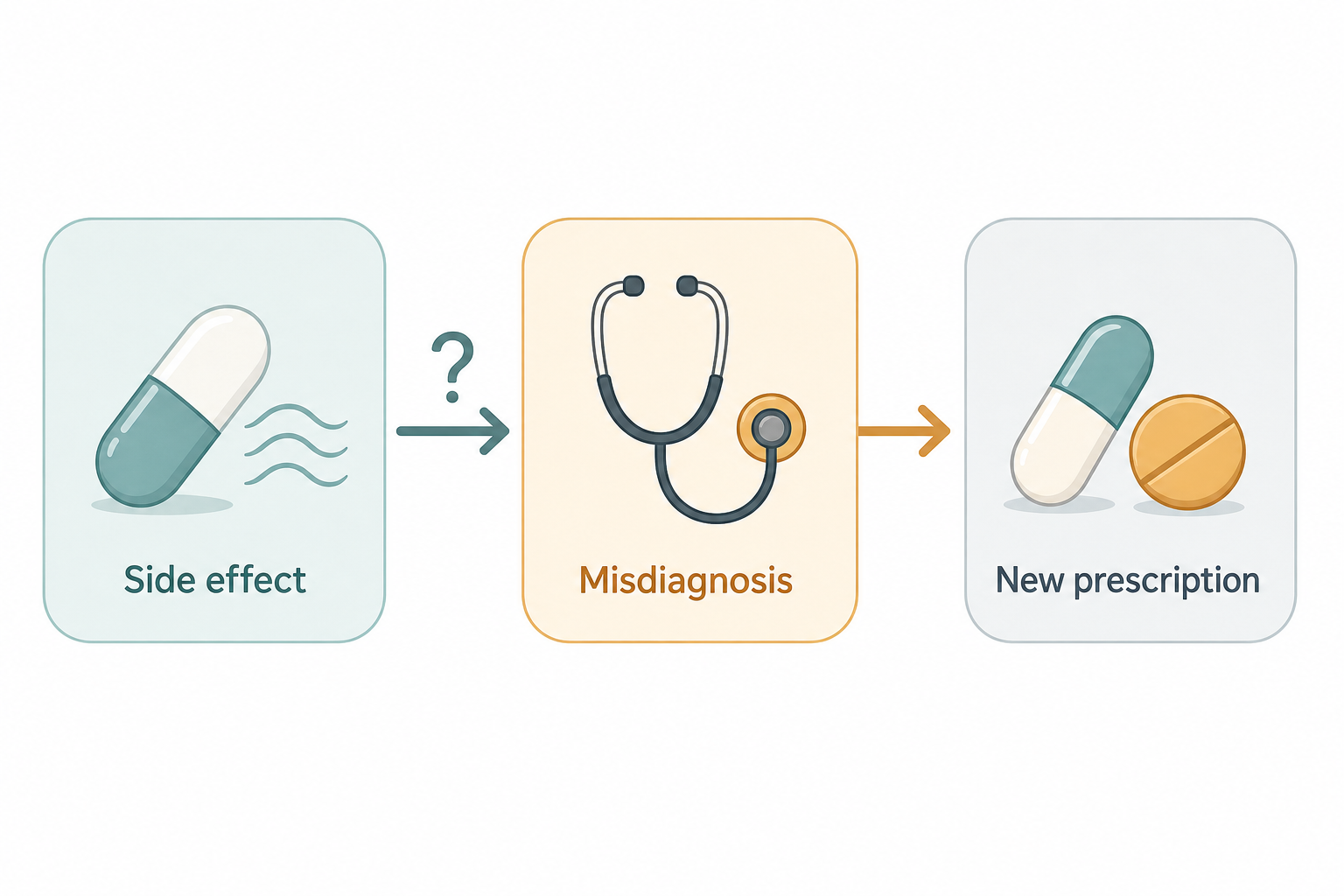
The prescribing cascade is one of the most consequential — and least visible — patterns in older adult medication management. It occurs when a drug's side effect is misidentified as a new medical condition, which is then treated with an additional drug. That second drug may produce its own side effects, which trigger a third prescription, and so on.
The cascade is not a sign of negligent prescribing. It is a predictable consequence of how symptoms are evaluated: a new complaint arrives, it looks like a new condition, and the clinical response is to treat it. The problem is that the new complaint was never a new condition — it was a medication side effect that went unrecognized.
A common example: an older adult takes a nonsteroidal anti-inflammatory drug (NSAID) for arthritis pain. NSAIDs can raise blood pressure as a side effect. At the next appointment, the elevated blood pressure is noted, and an antihypertensive is prescribed. The antihypertensive causes ankle swelling. A diuretic is added for the swelling. The diuretic increases urination frequency, which contributes to urgency incontinence. A bladder medication with anticholinergic properties is prescribed for the incontinence. That anticholinergic causes cognitive fogging and constipation — which may prompt still more prescriptions.
At the end of this chain, the patient is on five or six drugs where one might have been sufficient — or where the original NSAID could have been replaced with a safer alternative.
Warning Signs of Medication Overload Caregivers Should Flag
The symptoms of medication overload in older adults are not exotic or dramatic. They are ordinary-seeming changes that blend seamlessly into the expected picture of aging — which is precisely why they go unrecognized for so long.
The following symptoms are well-documented as common medication side effects in older adults, particularly when polypharmacy or a prescribing cascade is present. Each can also have non-medication causes, which is why the goal here is not self-diagnosis but rather ensuring that medication review is explicitly considered when these symptoms appear.
- Confusion or cognitive fogging — particularly sudden or step-wise changes, which may indicate anticholinergic drug burden, benzodiazepine accumulation, or sedative-hypnotic effects
- Excessive drowsiness or decreased alertness — often linked to central nervous system-active drugs that accumulate due to reduced hepatic or renal clearance
- Falls or new unsteadiness — strongly associated with polypharmacy; patients on more than four medications have measurably increased fall risk, and that risk rises with each additional drug
- Urinary incontinence — can result from diuretics, anticholinergic rebound, or alpha-blockers; frequently triggers a new prescription rather than a medication review
- Depression or emotional withdrawal — some blood pressure medications, corticosteroids, and sedatives are associated with depressive symptoms in older adults
- Loss of appetite or unexplained weight loss — nausea and appetite suppression are side effects of multiple drug classes including digoxin, metformin, and some antidepressants
- Constipation — a well-documented effect of opioids, anticholinergic drugs, calcium channel blockers, and iron supplements; often treated with laxatives rather than addressing the underlying drug
- Parkinson's-like symptoms — tremor, rigidity, and slowed movement can be caused by antipsychotics and some antiemetics, and may be mistaken for new neurological disease
The Beers Criteria: A Tool for Caregiver Advocacy
The American Geriatrics Society (AGS) Beers Criteria is a peer-reviewed, evidence-based list of medications that are potentially inappropriate for adults 65 and older. It is one of the most widely referenced clinical tools in geriatric medicine and is updated approximately every three years.
The 2023 update identifies nearly 100 medication classes organized into five categories, each addressing a different type of risk.
| Beers Criteria Section | What It Covers |
|---|---|
| Medications to avoid regardless of condition | Drug classes with evidence of harm in older adults that outweighs benefit in most circumstances |
| Medications to avoid with specific diseases or syndromes | Drugs that are generally acceptable but are harmful for older adults with certain conditions (e.g., NSAIDs in chronic kidney disease) |
| Medications to use with caution | Drugs that carry elevated risk in older adults but may be appropriate with monitoring and dose adjustment |
| Drug–drug interactions to avoid | Specific medication combinations that are particularly dangerous in older adults |
| Medications requiring renal dose adjustment | Drugs that must be dosed differently when kidney function is impaired — a common condition in older adults whose standard creatinine levels may appear normal |
Among the drug classes most prominently flagged in the Beers Criteria are:
- Benzodiazepines (e.g., diazepam, lorazepam, alprazolam) — associated with increased risk of cognitive impairment, delirium, falls, and fractures in older adults
- Anticholinergic drugs (including first-generation antihistamines like diphenhydramine, found in many over-the-counter sleep aids and allergy medications) — cumulative anticholinergic burden is associated with falls, delirium, and dementia risk
- Oral NSAIDs (e.g., ibuprofen, naproxen) — increased risk of gastrointestinal bleeding, kidney injury, and elevated blood pressure, particularly with chronic use
- Z-drug sleep aids (e.g., zolpidem, eszopiclone) — adverse effects similar to benzodiazepines with limited evidence of meaningful sleep benefit in older adults
- Antipsychotics — increased risk of stroke, cognitive decline, and falls; particularly concerning when used for behavioral symptoms in dementia
- Sulfonylureas as first-line diabetes therapy (e.g., glipizide, glimepiride) — risk of prolonged hypoglycemia, which in older adults can cause confusion, falls, and hospitalization
For caregivers, the practical value of the Beers Criteria is as a conversation-starter. If you recognize a drug class on your parent's medication list that appears prominently in the criteria, that is a legitimate reason to ask the prescriber: "Has this medication been reviewed in light of current guidelines for older adults?" That question is not an accusation — it is informed advocacy.
Because the AGS updates the criteria approximately every three years, the most recent version at time of reading may differ from the 2023 edition. Verify the current version at the AGS Beers Criteria publication before citing it in a clinical conversation.
How to Request a Comprehensive Medication Review
A comprehensive medication review is a structured clinical process in which a pharmacist or physician systematically evaluates every medication a patient is taking — including prescription drugs, over-the-counter medications, vitamins, and supplements — to identify interactions, duplications, inappropriate doses, and drugs that may no longer be necessary.
Requesting one is straightforward, and caregivers are well-positioned to initiate it. Here is how to approach the process:
- Identify who to ask. The primary care physician or geriatrician is the appropriate starting point. A clinical pharmacist — either embedded in the practice or through a Medication Therapy Management program — is often the most thorough resource for this review.
- Compile a complete medication list before the appointment. Include every prescription drug, over-the-counter product, vitamin, herbal supplement, and topical medication. Bring the actual bottles if possible — labels contain dose, frequency, and prescribing physician information that may not appear in the electronic record.
- Frame the request specifically. Rather than a general concern, ask directly: "Given the number of medications my parent is taking and the symptoms we've been seeing, can we schedule a comprehensive medication review to look for interactions or drugs that may no longer be appropriate?"
- Ask about Medication Therapy Management (MTM) coverage. Medicare Part B covers annual comprehensive medication reviews through MTM programs for qualifying beneficiaries. Ask the prescriber or pharmacist whether your parent is eligible and how to access this benefit. Coverage rules are subject to CMS policy changes — verify current eligibility at time of appointment.
- Note the symptoms you have observed. Bring a brief written summary of the changes you have noticed — confusion, falls, fatigue, incontinence, appetite changes — with approximate onset dates. This gives the reviewing clinician a symptom timeline to map against the medication history.
Deprescribing: What It Means and How to Raise It
Deprescribing is not simply stopping medications. It is defined clinically as a systematic, evidence-based process to identify and discontinue medications where existing or potential harms outweigh benefits — considered within the context of a patient's care goals, functional level, life expectancy, values, and preferences.
That distinction matters. Stopping a medication abruptly without clinical guidance can cause withdrawal effects, rebound conditions, or destabilize a carefully managed chronic disease. Deprescribing, by contrast, is a deliberate therapeutic intervention — often involving gradual dose reduction, monitoring, and coordination among multiple prescribers.
Research consistently supports deprescribing as a meaningful clinical strategy for older adults. Reducing inappropriate medications has been associated with decreased fall risk, and in some studies with modest improvements in cognitive function. Physicians who have reviewed the evidence view it as a legitimate therapeutic option — not a concession or a sign of giving up on treatment.
Many caregivers hesitate to raise deprescribing because they worry it will seem like they are questioning the physician's judgment or suggesting that their parent should receive less care. The opposite framing is more accurate: asking whether any medications could be safely reduced or discontinued is asking for a more thorough and individualized clinical assessment.
A constructive way to open the conversation: "We've noticed some changes that we're not sure are disease-related or medication-related. Are there any medications in the current regimen that might be candidates for review or gradual reduction given where things are now?" That framing invites clinical judgment rather than demanding a specific outcome.
It is also worth knowing that patients are more likely to consider deprescribing when their physician recommends it — which means that raising the topic with the physician first, rather than waiting for the physician to raise it, may be the most effective path forward. Physicians who are aware of a caregiver's concerns and observations are better positioned to initiate that recommendation.
Questions to Bring to the Next Medical Appointment
The following questions are designed to open a substantive clinical conversation about polypharmacy, prescribing cascades, and deprescribing. They are not a script — adapt them to the specific situation and the relationship with the healthcare provider. The goal is to ensure that medication burden is explicitly on the agenda, not assumed to be already managed.
- "Can we schedule a comprehensive medication review to look at everything my parent is taking — including over-the-counter drugs and supplements — for interactions or duplications?"
- "Is my parent eligible for a Medication Therapy Management review through Medicare?"
- "Could any of the symptoms we've been seeing — [list specific symptoms: confusion, falls, fatigue, etc.] — be related to one of the current medications rather than to the underlying condition?"
- "Are there any medications on the current list that fall into drug classes identified by the Beers Criteria as potentially inappropriate for older adults? If so, has the risk-benefit balance been reviewed recently?"
- "Is there any medication that was added to treat a symptom that might itself have been a side effect of another drug — what's sometimes called a prescribing cascade?"
- "Given where my parent is now in terms of health goals and functional level, are there any medications that might be candidates for gradual reduction or discontinuation?"
- "Who is responsible for reviewing the full medication list across all the specialists involved? Is that being coordinated, or should we be asking each specialist to communicate with the primary care physician?"
- "Are any of the current medications dosed for a standard adult rather than adjusted for age-related changes in kidney or liver function?"
Questions to bring to a clinician or OT
This is not medical, legal, or a family's final decision — only a framework. Bring these questions to a clinician, occupational therapist, or your local Area Agency on Aging.
Find Local HelpRelated reading
Noticed something outdated or inaccurate on this page? Flag a correction. We review every report against CDC, NIA, and AARP HomeFit guidance before updating a page.