
Caregiver decision guide
What Cartilage Transplant Recovery Means for Older Adults
Determine if cartilage transplant is a realistic option for an older adult with a knee cartilage defect and learn what the 6-12 month recovery truly requires—from extended non-weight-bearing periods to fall prevention and caregiver preparation.
Cartilage transplant recovery for older adults starts with a blunt fit question: is the knee problem small and specific enough, and is the household sturdy enough, to make a long protected recovery realistic? For a carefully selected active adult with a focal cartilage defect and little arthritis, cartilage restoration may be worth discussing. For an older adult with widespread arthritis, multiple cartilage injuries, poor balance, or no safe way to manage weeks off the surgical leg, it can become the kind of “less invasive” plan that is only less invasive in the operating room.
That distinction matters because cartilage transplant is not a softer version of knee replacement. The American Academy of Orthopaedic Surgeons says older patients and patients with multiple cartilage lesions are less likely to benefit from cartilage restoration procedures.[1] MACI, one cartilage repair option, also carries an important age caveat: its safety and effectiveness in patients over 55 have not been established.[2] That does not mean no one over 55 can ever have a cartilage procedure. It means the surgeon’s confidence needs to come from the individual knee, the person’s health, and the recovery plan—not from optimistic language about “restoring cartilage.”
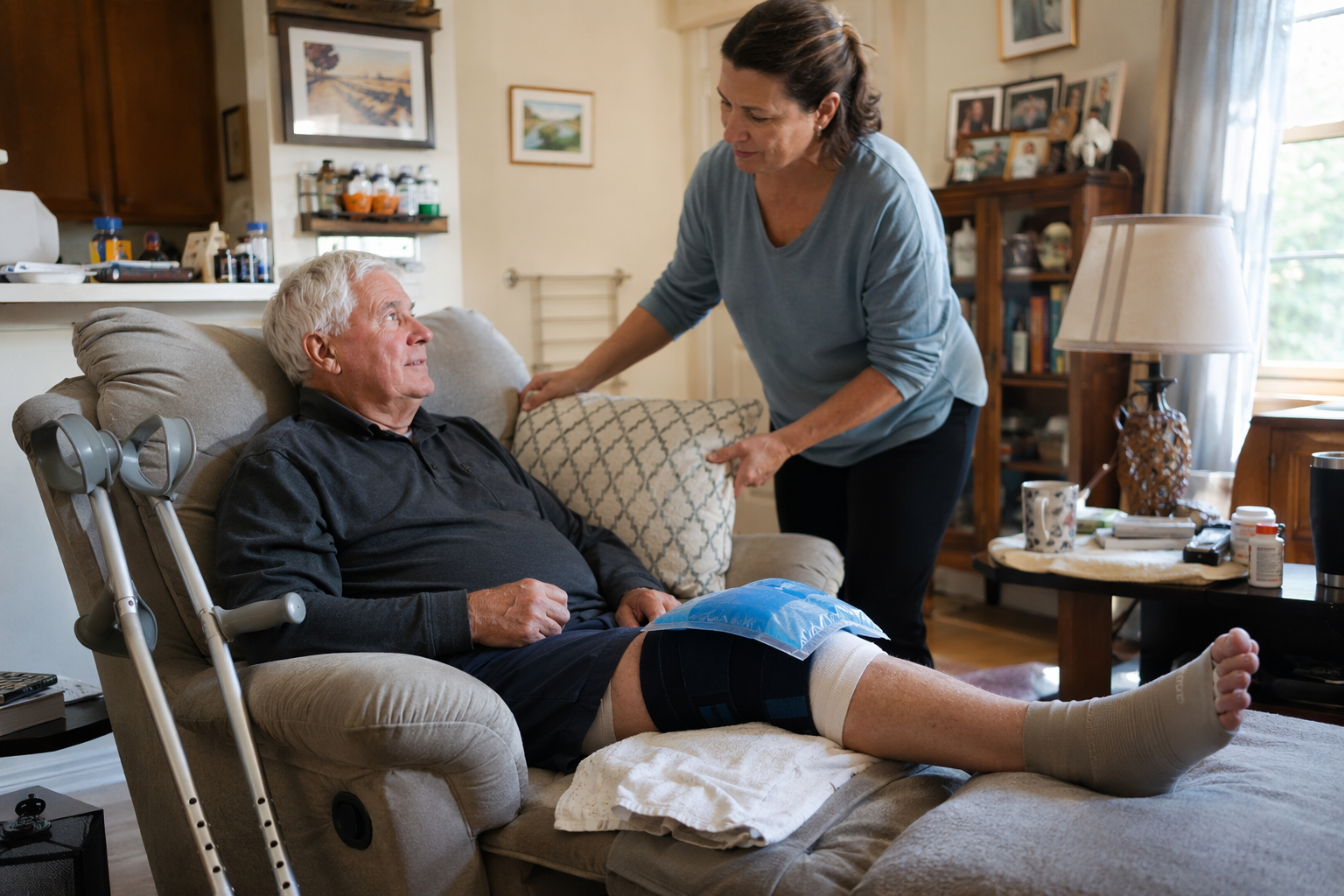
The right candidate is narrower than many families hope
Age alone is not the clean cutoff people sometimes expect. A standardized outcomes study found that patients over 40 benefited from cartilage surgery at rates that were not significantly different from younger patients when age-adjusted expectations were used.[3] HSS-reported studies described cartilage restoration as a viable treatment in patients over 40, with a mean age of 51.5 in the studied group.[4] Those findings are encouraging for the 50-something or early-60s patient who is active, has a well-defined defect, and is not yet in the knee-replacement lane.
They are not a blanket endorsement for every parent in their 60s. Much of the cartilage-restoration world still leans younger and athletic, and evidence for people 65 and older is thinner. A surgeon who does these procedures may reasonably consider selected active patients up to about 65, but the same source notes that a patient who needs a quicker return to weight-bearing may be better suited to partial knee replacement.[5] That is not a small practical detail. It may be the deciding fact.
A realistic candidate usually has a focal cartilage defect, stable alignment or a plan to correct alignment, enough strength and balance to use assistive devices, and a home team that can manage the early restrictions. A less realistic candidate has diffuse arthritis, several lesions, major unaddressed instability, high fall risk, or a recovery setup that depends on a frail spouse doing all transfers, meals, laundry, shower help, and transportation.
Recovery is measured in months, not in the incision size
The early recovery burden is the part families should hear before anyone gets attached to the idea of preserving the native knee. MACI patient materials describe a three-phase rehabilitation arc: “Achieve Routine” from 0 to 3 months, “Build Strength” from 3 to 6 months, and “Be Active” from 6 to 9 months or more.[2] Kerlan Jobe’s cartilage-surgery guidance uses a four-phase model: protection from 0 to 6 weeks, controlled loading from 6 to 12 weeks, functional training from 3 to 6 months, and return to activity from 6 to 12 months or more.[6]
In plain home terms, many patients should expect a protected period often discussed as roughly 4 to 8 weeks of little or no weight-bearing, followed by a gradual loading progression and months of physical therapy.[2][6] The exact restriction depends on the graft, defect location, additional procedures, and surgeon protocol. But the family question is the same: can this person get through the house safely when the operated leg is not available for normal walking?
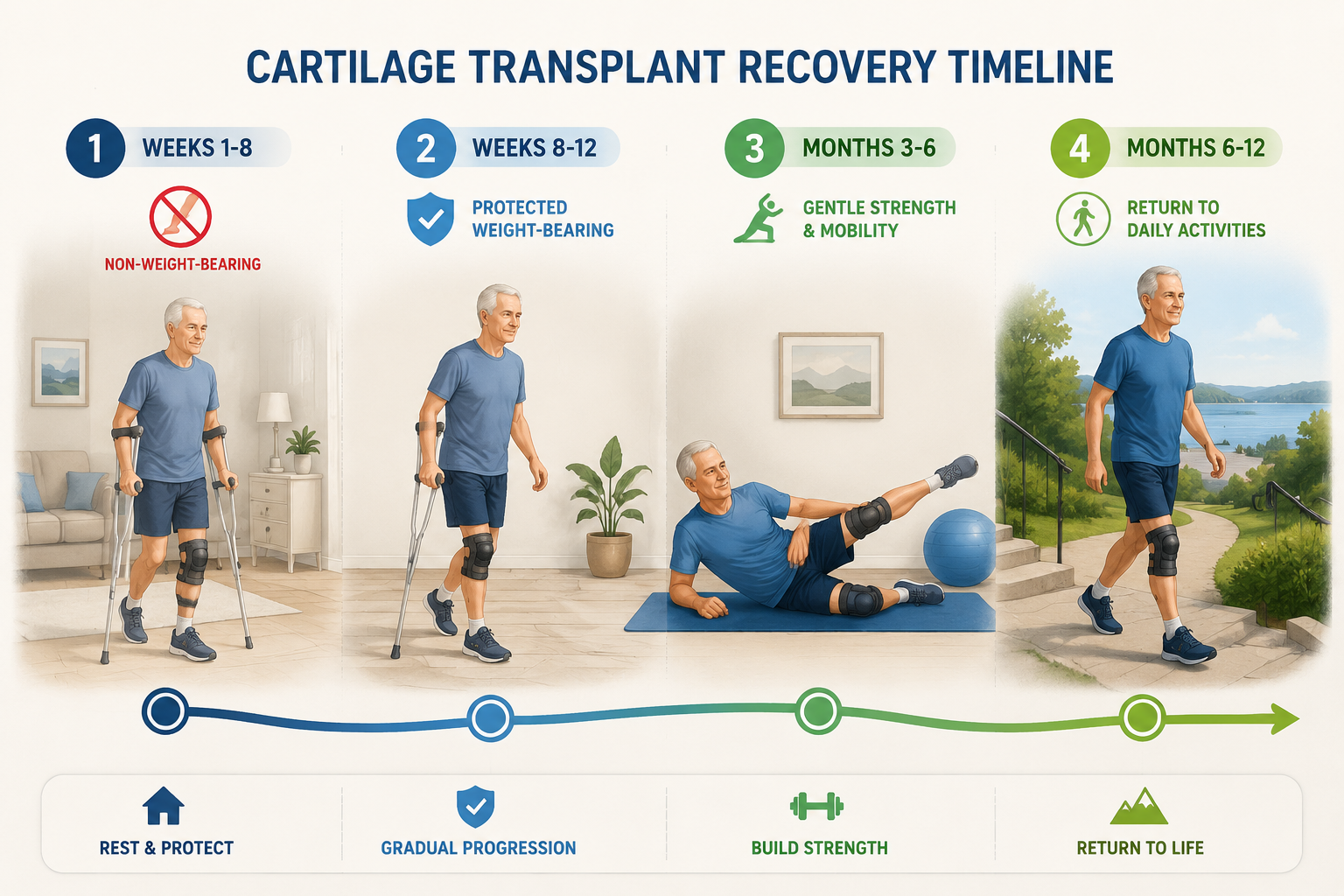
Weeks 0–6: protection changes the whole house
The protection phase is where the surgery leaves the hospital and becomes a household project. The operated knee may be braced. Crutches, a walker, or another assistive device become part of every bathroom trip. Ice, elevation, wound care, medication timing, and sleep disruption sit on top of the ordinary needs of eating, bathing, dressing, and getting to appointments.
Non-weight-bearing is not just “using crutches.” It means the patient cannot casually carry a cup of coffee, pivot quickly at the sink, stand in the shower without planning, or take one tired step on the surgical leg because the phone rang. For an older adult, every transfer matters: bed to chair, chair to toilet, toilet to walker, walker to car. A strong 28-year-old athlete and a 67-year-old who has been limping for a year may be following the same printed protocol, but they are not living the same recovery.
This is also when caregiver coverage has to be honest. If the only available helper is an older spouse with back pain, the plan is fragile. If the bedroom is upstairs and the only bathroom with a shower is also upstairs, the plan is fragile. If the patient has urgency, neuropathy, dizziness, low vision, or a history of falls, the plan needs more than encouragement.
Weeks 6–12: more permission does not mean normal walking
The controlled-loading phase can feel psychologically easier because restrictions may begin to loosen. That does not mean the household is finished caregiving. Partial weight-bearing, gait retraining, brace changes, and physical therapy appointments often add complexity. The patient may be allowed to do more, but not enough to move through the day without supervision, reminders, or transportation.
This is the period when boredom and impatience start making medical instructions negotiable. A parent who tolerated the first few weeks may want to test the knee, skip the walker for a short trip, or stand longer than advised. The caregiver’s job is not to police every step forever, but the home still has to make the safe choice the easy choice: clear paths, stable chairs, reachable meals, and a bathroom setup that does not require improvisation.
Months 3–6: strength becomes the main work
By the functional-training phase, the surgical drama is usually over, but the recovery is not. Months of limping before surgery, early protected movement after surgery, and normal aging can all leave the leg weaker than the patient expected. Physical therapy is not decorative here. It is the bridge between a technically protected graft and a person who can climb steps, get out of a car, shop, cook, and walk outdoors without turning every errand into a fall-risk calculation.
Caregivers often underestimate this middle stretch because the emergency feeling is gone. The patient may no longer need hands-on help every hour, but they may still need rides, coaching, meal support on therapy days, and help noticing whether pain, swelling, or fatigue is changing the way they move. A recovery plan that assumes the family can disappear after the first two weeks is not a plan for many older adults.
Months 6–12 and beyond: “active” has to be re-earned
The later return-to-activity phase is where expectations need careful wording. Some people do very well. Some improve enough to delay joint replacement. Some never return to the activity level they pictured, and some cartilage procedures fail and lead to knee replacement later. Kerlan Jobe’s model places return to activity in the 6-to-12-month-plus window, which is a useful antidote to the idea that cartilage transplant is a quick tune-up.[6]
For an older adult, “return to activity” may mean golf, hiking, pickleball, gardening, long walks, or simply being able to run errands without planning the whole day around the knee. The surgeon and physical therapist should define the target in those real-life terms. A parent who says “I just want to stay active” and a surgeon who hears “sports-level recovery” may be having two different conversations.
Cartilage transplant versus knee replacement is a fit decision
The comparison is not simply “natural knee” versus “artificial knee.” Cartilage procedures try to address a cartilage defect while preserving the joint. Knee replacement addresses broader joint damage by replacing worn joint surfaces. Johns Hopkins makes the basic distinction clearly: cartilage replacement and knee replacement are different operations aimed at different knee problems.[7]
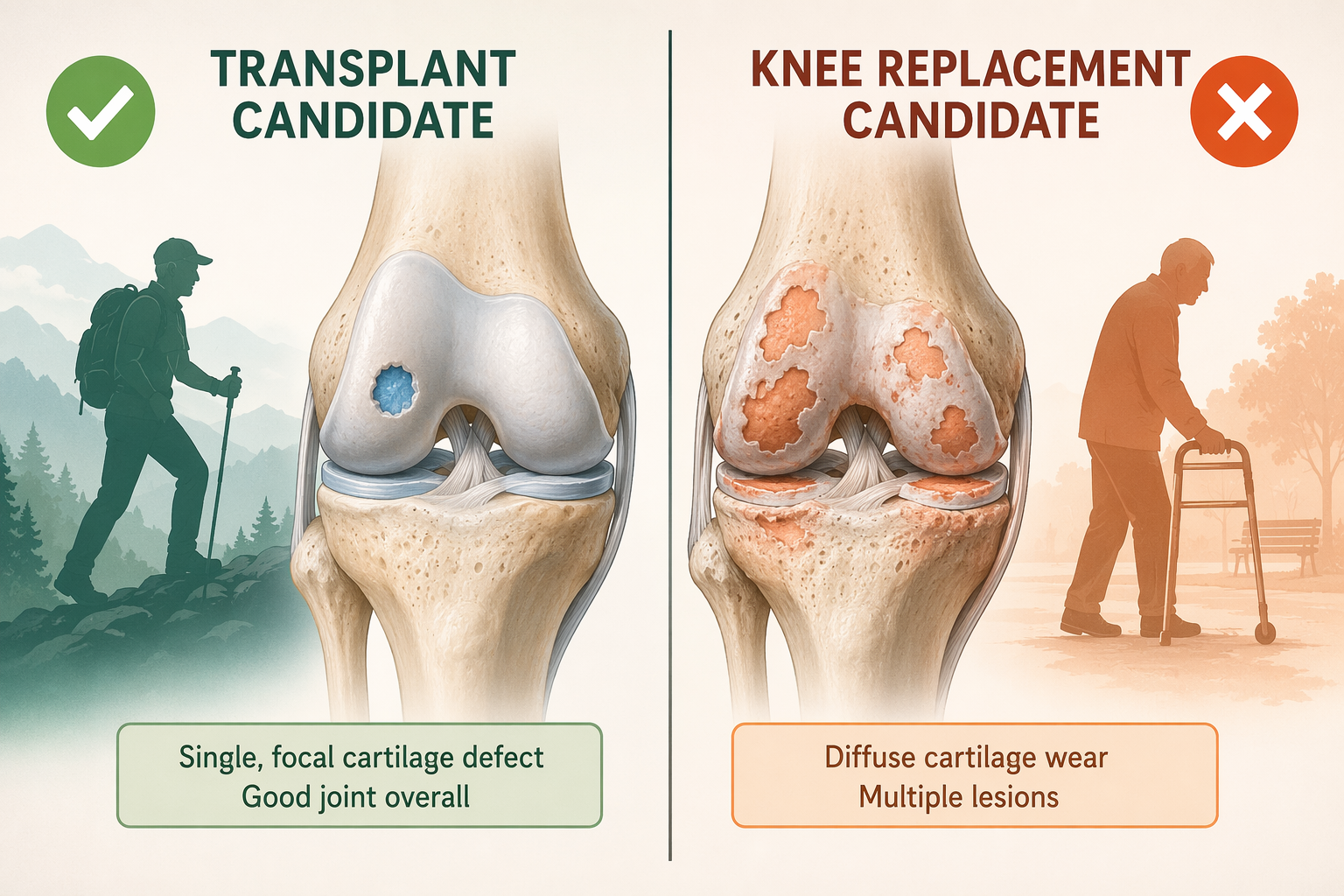
Cartilage transplant tends to make more sense when the pain source is a focal defect in an otherwise salvageable knee and the patient is healthy and motivated enough for a long, protected rehabilitation. Knee replacement tends to move forward in the conversation when arthritis is diffuse, cartilage loss is widespread, deformity is advanced, lesions are multiple, or the person needs a more predictable path back to weight-bearing than a cartilage graft protocol can offer.
There is also an age-related trade-off. Cartilage transplantation may delay knee replacement, but it does not promise to avoid it forever. Knee replacement, especially in older adults, has a long durability record; AAOS patient guidance reports that more than 90% of modern total knee replacements are still functioning well 15 years after surgery.[1] For a 45-year-old, delaying replacement can be a major goal. For a 70-year-old with diffuse arthritis, the durability equation may point in the other direction.
| If this describes the knee and household | The discussion usually leans |
|---|---|
| Single focal cartilage defect, minimal arthritis, active patient, strong home support, can tolerate protected weight-bearing | Cartilage transplant may be worth discussing |
| Multiple lesions, diffuse arthritis, significant joint-space loss, or broader degenerative disease | Knee replacement or another arthritis-focused plan may fit better |
| Needs a faster return to weight-bearing because of frailty, unsafe stairs, limited caregiver help, or high fall risk | A replacement-type option may be safer to consider than a long non-weight-bearing recovery |
| Over 55 and considering MACI specifically | Ask directly about the age caveat and how the surgeon applies evidence to this patient |
The home plan should be built before the surgery date
Caregiver preparation for cartilage transplant borrows some useful principles from knee replacement recovery, but the timeline is different. AARP’s knee replacement caregiver guidance emphasizes home preparation, medication management, appointment support, and fall prevention.[8] Those principles transfer well, even though cartilage transplant often asks more of the household during the non-weight-bearing period. Endeavor Health’s orthopedic-surgery caregiver advice similarly centers practical support: preparing the home, helping with instructions, encouraging movement as allowed, and watching for problems.[9]
Before surgery, the family should walk the actual route from bed to bathroom, bathroom to chair, chair to kitchen, and door to car. Not in theory. With the walker or crutches if possible. Look for thresholds, loose rugs, narrow turns, pets, cords, low toilet height, slippery tile, and chairs that are too soft to stand from without pushing through the surgical leg.
- Sleeping: decide whether the patient can safely stay on one level during the early recovery.
- Bathroom: arrange a raised toilet seat, stable grab points, a shower chair if cleared, and a non-slip plan.
- Transfers: practice chair, bed, toilet, and car transfers with the device the surgeon or therapist recommends.
- Food and fluids: place meals, water, medications, ice supplies, and phone chargers within safe reach.
- Transportation: schedule rides for surgery follow-up and physical therapy before the first week gets chaotic.
- Backup help: name who comes if the main caregiver gets sick, has to work, or cannot safely assist a transfer.
At-home cartilage transplant guidance commonly emphasizes following weight-bearing restrictions, using ice and elevation, taking medications as prescribed, monitoring the incision, and keeping follow-up and therapy appointments.[10] Those are familiar instructions, but in an older adult’s home they need owners. Someone has to refill the ice machine, notice the swelling, track the pain medicine, drive to therapy, and intervene before a tired patient decides the bathroom is only a few steps away.
If home modifications are needed, it is better to price them before the surgery date, not after the first unsafe shower. Families weighing grab bars, ramps, stair changes, or temporary first-floor living arrangements may also need broader cost context from resources on funding sources for home modifications when Medicare will not pay, aging-in-place remodel costs, or senior care assistance at home.
Questions to take back to the orthopedic team
The most useful consult is not the one where everyone agrees the MRI looks interesting. It is the one where the surgeon explains why this specific knee, this specific age, and this specific recovery setup make sense together. Families should ask questions that force the plan out of brochure language and into daily life.
- Is the cartilage problem focal, or is there diffuse arthritis that makes restoration less likely to help?
- Are there multiple lesions, alignment problems, meniscus loss, or instability that change the prognosis?
- For this exact procedure, how many weeks will be non-weight-bearing or partial weight-bearing?
- What assistive device will be used, and should a physical therapist train the patient before surgery?
- When can the patient shower, use stairs, ride in a car, drive, and be alone safely?
- What signs mean swelling, pain, wound changes, or calf symptoms need urgent medical attention?
- If the graft fails or pain persists, what is the next option?
The answer may still be yes. A healthy, active older adult with a focal defect, minimal arthritis, good balance, enough support, and realistic expectations may reasonably choose to pursue cartilage transplant. The answer may also be no, and that should not feel like giving up. If the arthritis is diffuse, lesions are multiple, the evidence is thin for the patient’s age group, or the home cannot safely support prolonged protected weight-bearing, knee replacement or another plan is not the lesser choice. It is the plan that better matches the knee and the life around it.
References
- Articular Cartilage Restoration, AAOS OrthoInfo.
- Undergoing MACI Knee Cartilage Repair? Here’s What You May Expect in the Early Days of Rehab, MACI.
- Age-Dependent Improvements in Clinical Outcomes After Cartilage Repair Surgery, PubMed.
- HSS studies find cartilage restoration procedures as viable treatment for patients over 40 years old, News Medical, March 7, 2016.
- Knee Cartilage Transplant: Which Patients Are Suitable?, Joint-surgeon.com.
- Recovery Guidelines After Cartilage Surgery, Kerlan Jobe Institute.
- Cartilage replacement vs. knee replacement surgery, Johns Hopkins Arthritis Center.
- How to Care for Someone After Knee Replacement Surgery, AARP, December 2024.
- Caregiving Tips for Orthopaedic Surgery Recovery, Endeavor Health.
- What to Expect at Home After Cartilage Transplant Surgery, Dr. Ronak Patel.
Questions to bring to a clinician or OT
This is not medical, legal, or a family's final decision — only a framework. Bring these questions to a clinician, occupational therapist, or your local Area Agency on Aging.
Find Local HelpRelated reading
Noticed something outdated or inaccurate on this page? Flag a correction. We review every report against CDC, NIA, and AARP HomeFit guidance before updating a page.